
1. Introduction
Polymeric foams are fundamental structural elements in high-performance sandwich composites used across wind turbine blades, aerospace components, marine hulls, automotive body panels, and civil infrastructure. Their primary engineering function is to dramatically increase bending stiffness and buckling resistance without introducing substantial additional mass. Among all the mechanical loading modes that sandwich structures experience, shear and compression dominate the performance envelope of foam cores due to the intrinsic load-sharing mechanisms within sandwich laminates.
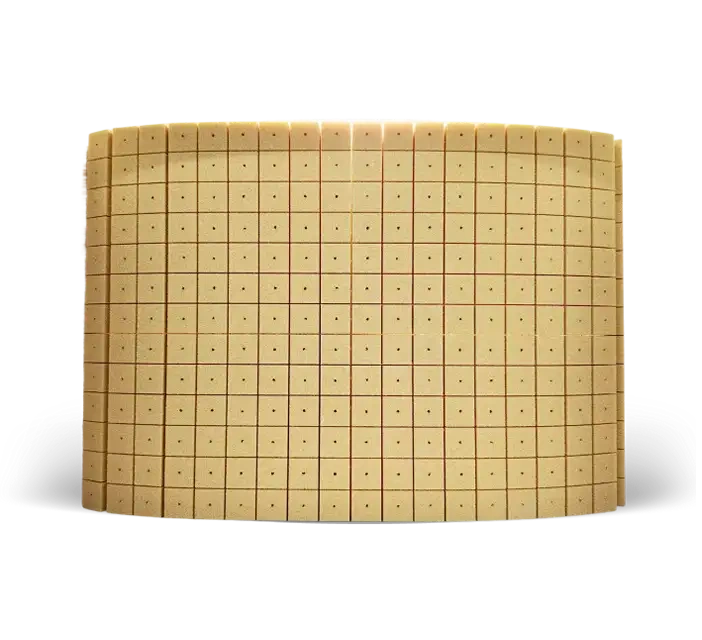
Understanding the mechanical behavior of foam cores under shear and compression is therefore essential for rational design, failure prediction, fatigue life estimation, and material selection. Due to the complex cellular architecture of polymer foams—characterized by heterogeneous, anisotropic, and nonlinear microstructures—their mechanical response is fundamentally different from solid polymers. Properties are governed not only by polymer chemistry, but also by density, cell wall morphology, degree of cross-linking, and processing-induced defects.
This technical review offers a deep analysis of the mechanical properties of structural foams under shear and compression. It highlights microstructural mechanisms, constitutive behavior, failure modes, strain-rate effects, fatigue behavior, and the influence of manufacturing parameters. The focus is on rigid foams commonly used in structural sandwich panels, including PVC, PET, SAN, PMI, and polyurethane-based systems. The article also situates shear and compression behavior within the broader context of composite structural performance and presents emerging trends in modeling and testing technologies.
2. Microstructure and Structure–Property Relationships
Foam cores derive their mechanical behavior primarily from their cellular architecture, which may be:
- Closed-cell (e.g., PVC, PET, SAN foams)
- Open-cell (some polyurethane or reticulated foams)
- Hybrid microcellular structures
Key microstructural parameters influencing shear and compression properties include:
- Density (ρ) – The most significant predictor of strength and stiffness.
- Cell size and shape – Fine, uniform cells improve modulus and reduce stress concentrations.
- Cell wall thickness – Controls elastic stiffness and plastic flow behaviour.
- Degree of cross-linking – Strongly affects compression plateau behavior and creep.
- Orientation / anisotropy – Often introduced during foaming, extrusion, or panel machining.
- Voids and defects – Reduce strength disproportionately relative to density reductions.
The effective mechanical properties E,G,σc,τsE, G, \sigma_c, \tau_sE,G,σc,τs typically scale with foam density following power-law relationships such as:

These empirical scaling laws reflect the architecture of bending-dominated cellular materials.
3. Compression Behavior of Foam Cores
3.1 Constitutive Response
The uniaxial compression behavior of rigid polymeric foams is classically divided into three distinct regimes:
- Linear Elastic Region
Occurs at small strains (<5–10%). Cell walls deform elastically under bending or stretching. Modulus depends heavily on density. - Plastic or Plateau Region
Characterized by long, nearly flat stress–strain behavior. Cells begin to collapse through:- Buckling of cell walls (bending-dominated collapse)
- Plastic hinging in cross-linked foams
- Brittle cracking in thermoset-based foams
- Densification Region
At high strains (typically 60–80%), collapsed cells compact and behave like a solid polymer. Stress rises steeply.
The compressive stress–strain curve is fundamental to structural sizing of sandwich panels.
3.2 Compressive Strength and Modulus
The compressive strength σc\sigma_cσc depends on:
- Foam density
- Degree of cross-linking
- Polymer backbone stiffness
- Cell morphology
- Temperature and strain rate
Typical ranges:
- PVC foam: 0.8–3.0 MPa
- PET foam: 0.7–3.0 MPa
- SAN / PMI foams: 2.0–6.0+ MPa
Highly cross-linked PMI foams exhibit the highest compressive strengths due to a stiff polymer matrix and fine cell sizes.
3.3 Failure Modes in Compression
Common compression failure modes include:
- Cell wall buckling (dominant in flexible thermoplastics)
- Cell crushing / plastic collapse
- Brittle cracking of cell ribs
- Shear-assisted collapse (interaction with imperfections)
- Delamination at skin–core interface (for sandwich panels)
Failure mode transitions depend on temperature and loading rate.
3.4 Environmental and Temperature Effects
Compression properties are highly temperature-dependent because foams soften near their glass transition temperature (Tg):
- PVC: Tg ~70–80°C
- PET: Tg ~70–80°C
- SAN: Tg ~100–110°C
- PMI: Tg 180–220°C
As temperature approaches Tg:
- Compressive modulus decreases significantly
- Plateau strength reduces
- Strain to densification increases
- Viscoelastic behavior becomes dominant
Humidity also influences long-term creep in polyester- or polyurethane-based foams.
4. Shear Behavior of Foam Cores
4.1 Importance in Sandwich Structures
Shear properties of core materials directly control:
- Web performance in wind turbine blades
- Shear stiffness of spar caps
- Debond resistance
- Torsional rigidity of marine and aerospace structures
Shear stress in sandwich beams typically governs mid-span deflection according to:
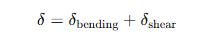
Foam cores must therefore provide adequate shear modulus (G) and shear strength (τ_s).
4.2 Shear Stress–Strain Behavior
The shear stress–strain curve also exhibits:
- Linear elastic region
- Nonlinear softening or plateau depending on foaming chemistry
- Failure due to shear cracking or cell wall torsion
Rigid foams tend to show brittle shear failure, while semi-flexible thermoplastics exhibit ductile shear behaviour.
4.3 Shear Modulus (G)
The shear modulus reflects cell wall bending stiffness. Typical ranges:
- Low-density PVC: 20–50 MPa
- Medium-density PET: 25–60 MPa
- SAN/PUR hybrids: 40–100+ MPa
- PMI: 100–150+ MPa
Higher-density foams generally exhibit higher shear modulus with approximate scaling G∝ρ2G \propto \rho^2G∝ρ2.
4.4 Shear Strength (τ_s)
Shear strength varies significantly by polymer chemistry:
- PVC: 0.6–1.8 MPa
- PET: 0.5–1.6 MPa
- SAN: 1.5–3.0 MPa
- PMI: 2.5–4.5+ MPa
SAN and PMI foams outperform others due to high Tg and fine cell morphology.
4.5 Shear Failure Modes
Foams fail in shear through:
- Diagonal shear cracking
Brittle fracture pathway along planes of maximum shear. - Cell wall torsion and collapse
Common in ductile thermoplastic foams. - Interface-driven failure
Occurs when foam is weakly bonded to laminate skins. - Cohesive shear yielding
Observed in lower-density or lower-crosslink foams.
Failure morphology can be highly anisotropic depending on foaming direction.
5. Interaction Between Shear and Compression in Structural Applications
In real sandwich structures, shear and compression interact significantly.
5.1 Shear–Compression Coupling in Webs and Panels
In wind turbine blades:
- Spar webs experience high shear from flapwise bending
- Trailing-edge panels experience combined compression and shear
- Root sections experience through-thickness compression from bolt forces
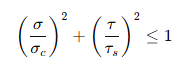
Foams must satisfy multi-axial load conditions, often governed by interaction criteria such as:
5.2 Buckling and Wrinkling Interaction
Foam compression strength contributes to:
- Skin wrinkling resistance
- Local buckling resistance
- Overall laminate stability
The classical wrinkling stress equation:
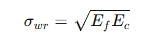
shows that compressive modulus EcE_cEc is as important as skin stiffness.
6. Influence of Density, Chemistry, and Void Content
Density plays the most dominant role in mechanical properties. Increasing density:
- Enhances compressive strength and modulus
- Increases shear strength and stiffness
- Reduces cell size and improves structural uniformity
- Increases weight and cost
Polymer chemistry affects:
- Plateau behaviour
- Temperature sensitivity
- Brittleness vs ductility
- Fatigue resistance
Void content and manufacturing defects generate localized stress concentrations that reduce shear strength disproportionately more than compression strength.
7. Strain Rate and Dynamic Effects
Polymeric foams exhibit strong strain-rate sensitivity due to viscoelastic and viscoplastic mechanisms.
7.1 Compression Strain-Rate Effects
At higher strain rates:
- Compressive strength increases (5–50% depending on foam type)
- Modulus increases
- Plateau region shortens
- Failure transitions from ductile to brittle
This is crucial for crashworthiness applications.
7.2 Shear Strain-Rate Effects
Under dynamic shear:
- Shear stress increases nonlinearly
- Material becomes more brittle
- Crack propagation accelerates
These behaviours must be considered when designing structures subjected to impulsive loads, wave impacts, or rapid fatigue cycles.
8. Fatigue Behavior in Compression and Shear
Foam cores experience billions of load cycles during the life of wind turbine blades, aircraft control surfaces, and marine structures.
8.1 Compression Fatigue
Foam compression fatigue typically results in:
- Stiffness reduction
- Progressive microcracking
- Cell-wall buckling accumulation
- Permanent strain accumulation
Generally, high-density and cross-linked foams (SAN, PMI) handle compression fatigue better than low-density thermoplastics.
8.2 Shear Fatigue
Shear fatigue performance is crucial for wind turbine webs.
Failure modes:
- Shear cracking propagation
- Interface delamination
- Cyclic softening
- Microcell crushing
PET foams often outperform PVC in long-term shear fatigue, despite similar static properties.
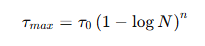
8.3 Fatigue Life Modeling
Foam fatigue is often empirically modeled using:
or S–N curves normalized by static strength.
9. Testing Methodologies for Shear and Compression
Standardized test methods include:
9.1 Compression Tests
- ASTM D1621 – compressive properties of rigid cellular plastics
- ISO 844 – compressive stress–strain behavior characterization
Key parameters measured:
- Compressive modulus
- Compressive yield / plateau stress
- Energy absorption
- Densification strain
9.2 Shear Tests
- ASTM C273 – shear properties of sandwich core materials
- ASTM C394 – shear fatigue testing
- ISO 1922 – shear properties of rigid cellular plastics
Testing considerations:
- Adhesive layer thickness
- Loading configuration
- Core anisotropy
- Boundary-induced constraint effects
9.3 Challenges in Testing Foam Cores
- Nonlinear behavior complicates modulus determination
- Sensitive to specimen preparation
- Size effects due to stochastic microstructure
- Rate and thermal coupling issues
10. Failure Mechanisms in Real Structures
10.1 Sandwich Beams and Panels
Failure modes dependent on core properties include:
- Face wrinkling
- Core shear failure
- Debonding
- Through-thickness crushing
- Kinking instability
10.2 Wind Turbine Webs
Shear failure of foam webs can limit blade life:
- Diagonal web cracking
- Bond-line fatigue
- Cyclic shear softening
10.3 Trailing Edge Panels
Compression and shear interaction leads to:
- Inward buckling
- Core crushing
- Localized delamination
A combination of mechanical property tailoring and improved infusion processes mitigates these modes.
11. Multiscale Modeling of Foam Shear and Compression Behavior
Advances in computational modeling allow high-fidelity prediction of foam performance:
11.1 Microstructural Simulation
Finite element models using:
- Voronoi tessellations
- Beam–shell cell wall elements
- Cohesive failure laws
simulate fundamental cell collapse mechanisms.
11.2 Continuum Constitutive Modeling
Models account for:
- Nonlinear elasticity
- Elasto-plastic plateau behavior
- Densification hardening
- Strain-rate dependence
11.3 Sandwich Panel-Level Simulation
Layered FE models predict:
- Panel shear stiffness
- Core crushing
- Global buckling
- Debond crack propagation
These tools support optimization of foam density distributions along large wind turbine blades.
12. Comparative Assessment of Common Foam Core Materials
| Foam Type | Compression Strength | Shear Strength | Thermal Resistance | Failure Ductility | Fatigue | Cost |
|---|---|---|---|---|---|---|
| PVC | Moderate | Good | Moderate | Moderate | Moderate | Low |
| PET | Moderate | Moderate–Good | High | Good | High | Moderate |
| SAN | High | High | Very High | Moderate-Low (brittle) | Very Good | High |
| PMI | Very High | Very High | Exceptional | Brittle | Excellent | Very High |
Trade-offs drive application-specific selection.
13. Emerging Developments
13.1 Functionally Graded Foam Cores
Density gradients improve:
- Stress distribution
- Weight optimization
- Shear buckling resistance
13.2 3D-Printed Cellular Architectures
Additive manufacturing enables:
- Tunable microcellular geometries
- Optimized shear–compression hybrid behavior
- Superior fatigue performance
13.3 Nano-Modified Foams
Nanofillers improve:
- Cell wall stiffness
- Thermal stability
- Compressive and shear strength
13.4 Recyclable and Bio-Based Foams
Driven by sustainability imperatives:
- rPET foam
- Bio-based polyurethane foams
- Thermoplastic foams suitable for re-melting
14. Conclusion
Foam cores play a decisive role in governing the structural efficiency, stiffness, stability, and fatigue life of sandwich composites. Their mechanical properties under shear and compression are central to designing high-performance structures such as wind turbine blades, aerospace panels, marine hulls, and lightweight automotive components.
Compression behavior is dominated by elastic bending of cell walls, plateau collapse mechanics, and densification phenomena, all strongly dependent on density, polymer chemistry, and microstructural uniformity. Shear behavior reflects torsional deformation of cells, crack propagation mechanisms, and rate-dependent brittle-to-ductile transitions.
The interaction between shear and compression in real sandwich structures introduces complex failure modes such as wrinkling, diagonal shear cracking, debonding, and mid-plane collapse. Accurate prediction requires advanced testing, multiscale modeling, knowledge of fatigue mechanisms, and careful control of manufacturing parameters.
Among commonly used foams, PET and SAN have emerged as leading materials due to their superior fatigue behavior, thermal stability, and predictable mechanical performance, with PMI reserved for ultra-high-end applications. PVC remains prevalent due to cost advantages but is gradually displaced in applications requiring enhanced durability and sustainability.
As structural design requirements intensify—driven by larger wind turbine blades, weight-sensitive aerospace components, and recyclable composite systems—the importance of optimizing foam core shear and compression behavior will only grow. Future innovations in functionally graded foams, additive manufacturing, and sustainable polymer systems promise further improvements in mechanical performance and lifecycle efficiency.
