
1. Introduction
The continued growth of the wind energy industry has accelerated the scale and structural complexity of rotor blades, which are now the largest fiber-reinforced polymer (FRP) structures produced in serial manufacturing. These blades experience billions of load cycles over their operational lifetime—typically 20–30 years—due to stochastic wind fields, gravitational loads, and aerodynamic excitation. Consequently, fatigue performance is a central design driver governing material selection, structural topology, and lifecycle reliability.
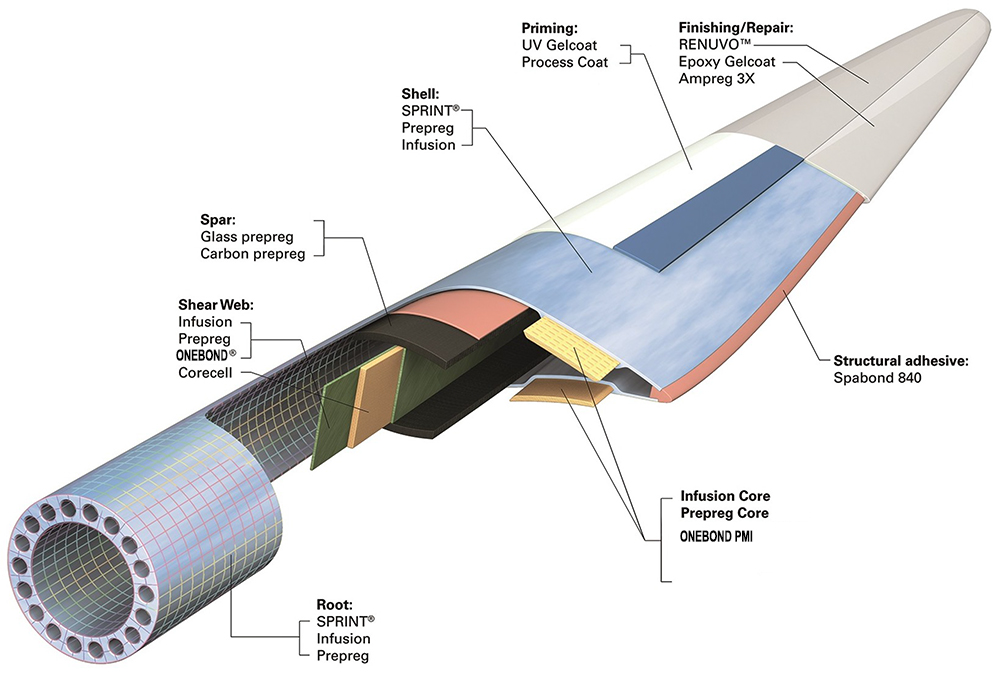
While much attention is given to the fatigue behavior of fiber-reinforced skins, the core materials within sandwich structures play an equally pivotal role. Core properties directly govern shear rigidity, buckling resistance, adhesive bonding behavior, damage tolerance, and long-term dimensional stability. Variation in these properties can dramatically influence localized stress distributions and fatigue crack propagation, making core selection a critical determinant of blade durability.
This article examines in depth the mechanisms through which core materials impact the fatigue life of composite wind turbine blades, emphasizing polymeric foam cores such as PVC, PET, and SAN, as well as high-performance PMI and balsa wood cores. The discussion spans microstructural response, mechanical degradation pathways, interface mechanics, environmental effects, and design implications.
2. Fatigue Loading Mechanisms in Composite Blades
Wind turbine blades experience two principal fatigue load regimes:
- Flapwise (bending) fatigue
- Dominated by aerodynamic lift
- Generates alternating tension/compression cycles in skins
- Imposes high shear stresses in webs and mid-span regions
- Edgewise (gravity) fatigue
- Caused by rotating mass and gravitational loading
- Lower amplitude but higher frequency
- Particularly damaging toward the blade root
In both cases, sandwich structures—typified by face sheets bonded to a foam or balsa core—absorb a significant fraction of shear and through-thickness cyclic stresses. Core material properties therefore govern the strain distribution and fatigue initiation pathways.
3. Role of Core Materials in the Fatigue Resistance of Blades
Core materials influence fatigue life through several structural and material-level mechanisms:
3.1 Shear-Based Fatigue Degradation
Sandwich webs and trailing-edge panels carry large shear loads during bending. Fatigue failure can initiate in the core when:
- Shear modulus decreases due to cyclic microcracking
- Cell wall bending and torsion accumulate damage
- Shear fatigue strength is below the cyclic load envelope
- Localized shear softening accelerates face wrinkling
Foam cores with higher shear fatigue resistance—such as PET and SAN—reduce the risk of:
- Diagonal web cracking
- Progressive shear softening
- Premature delamination at skin–core interfaces
- Instability in trailing-edge panels
3.2 Compressive Fatigue and Skin Wrinkling
The compressive side of the blade, especially under flapwise bending, is susceptible to:
- Core crushing
- Local densification
- Reduction in compressive modulus
- Wrinkling of compressive face sheets
The compressive modulus EcE_cEc of the core has a direct influence on the face-sheet wrinkling stress: σwr=KEfEc\sigma_{wr} = K \sqrt{E_f E_c}σwr=KEfEc
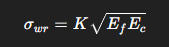
where EfE_fEf is the face-sheet modulus.
Under cyclic loads, if the core loses compressive stiffness, the wrinkling stress drops, dramatically reducing fatigue life. This is particularly an issue with lower-density PVC foams or degraded balsa.
3.3 Interface Fatigue Between Skins and Core
Many fatigue failures in large blades originate not in the core itself but in the bond-line between skins and core. Fatigue debonding can propagate due to:
- Cyclic shear
- Peel stresses from bending curvature
- Resin-starved bond regions
- Weak chemical affinity between resin and foam polymer
- Thermal cycling that causes differential expansion
Core materials with strong interfacial bonding, such as PET and SAN (when surface-treated), significantly slow debond propagation.
4. Material-Specific Fatigue Behavior of Common Core Materials
4.1 PVC Foam Cores
PVC (polyvinyl chloride) has been widely used due to its cost-effectiveness and ease of processing. However, fatigue-relevant characteristics include:
- Moderate shear modulus and shear fatigue strength
- Plasticization under long-term cyclic loading
- Moderate reduction in compressive modulus with cycling
- Local brittle cracking if cross-link content is high
- Elevated microcrack initiation in density gradients
PVC retains serviceability in mid-size blades but is increasingly challenged by newer materials in modern >70 m blade designs.
4.2 PET Foam Cores
PET (polyethylene terephthalate) foams are gaining rapid adoption due to their favorable fatigue performance:
- Excellent shear fatigue resistance
- Good retention of compressive modulus after cyclic loading
- Homogeneous microcellular structure reduces stress concentrations
- High thermal stability mitigates resin exotherm-induced property loss
- Superior environmental durability (humidity, temperature cycles)
PET cores typically exhibit slow stiffness degradation and predictable damage evolution, benefiting lifetime modeling.
4.3 SAN Foam Cores
SAN (styrene–acrylonitrile) foams offer high performance:
- High static shear and compression strength
- Excellent fatigue resistance under both shear and compression
- Higher glass transition temperature (Tg ~ 100–110°C)
- Less susceptible to creep or cyclic softening
Their higher cost restricts SAN foam to performance-critical composite regions such as spar webs.
4.4 PMI Foam Cores
PMI (polymethacrylimide) foam is used in premium aerospace and some advanced turbine blade structures:
- Exceptional compressive and shear stiffness
- Minimal fatigue softening
- Outstanding high-temperature stability (Tg > 180°C)
However, PMI is brittle, meaning local impacts or processing defects can reduce fatigue reliability.
4.5 Balsa Wood Cores
Balsa provides excellent static mechanical properties but exhibits fatigue challenges:
- Highly anisotropic fatigue behavior
- Moisture uptake leading to stiffness degradation
- Microbuckling and cell collapse under cyclic compression
- Debonding risk due to variable density and resin absorption
- Susceptibility to fungal degradation in wet environments
Because of durability concerns, the industry is gradually shifting away from balsa in offshore blades.
5. Mechanisms of Fatigue Damage in Foam Cores
5.1 Microcrack Initiation and Accumulation
Repeated cyclic shear or compression causes:
- Microfissures in cell walls
- Damage accumulation in cross-link bridges
- Shear band formation
- Plastic hinge development in ductile foams
The rate of microdamage accumulation depends strongly on:
- Density
- Polymer chemistry
- Temperature relative to Tg
- Environmental exposure
5.2 Cyclic Softening and Modulus Loss
Foams typically exhibit: GN=G0(1−αlogN)G_N = G_0 (1 – \alpha \log N)GN=G0(1−αlogN)

where GNG_NGN is shear modulus after N cycles.
PVC and balsa show the highest softening rates; SAN and PMI the lowest.
5.3 Progressive Shear Crack Growth
Shear fatigue cracks typically develop at 30–45° angles relative to principal stress directions. Crack propagation accelerates in:
- Coarse-cell foams
- Density-gradient regions
- Foams with low interlaminar fracture toughness
5.4 Interface Failure and Delamination
Bond-line degradation often precedes core cracking. Causes include:
- Differential thermal expansion
- Infusion defects
- Cyclic shear peeling stresses
- Moisture-induced swelling
Interface fatigue resistance is strongly dependent on core surface chemistry.
6. Environmental and Operational Effects on Core Fatigue Life
6.1 Temperature Cycling
Repeated exposure to daily and seasonal temperature cycles accelerates fatigue:
- Foams soften near Tg
- Differential expansion stresses the adhesive
- Thermal oxidation can embrittle cell walls
PET and SAN show high tolerance; PVC and balsa perform less favorably under thermal cycling.
6.2 Moisture and Hydrolytic Degradation
Moisture ingress can:
- Reduce compressive modulus
- Increase creep rates
- Promote delamination
- Trigger balsa rot or fungal attack
PET shows the best hydrolytic resistance among polymeric foams.
6.3 Long-Term Creep–Fatigue Interaction
Combined creep and fatigue loads cause:
- Permanent strain accumulation
- Shear modulus reduction
- Local instability in webs
Higher-density, high-Tg foams resist creep–fatigue coupling more effectively.
7. How Core Properties Influence Structural Fatigue at the Blade Level
7.1 Spar Webs
Fatigue failures in webs often correlate with:
- Insufficient shear modulus in the core
- Fatigue softening that leads to web buckling
- Interface cracking propagating through web–skin joints
Replacing PVC with PET or SAN significantly improves web fatigue margins.
7.2 Trailing Edge Panels
Core material impacts:
- Buckling fatigue
- TE crack initiation due to cyclic peel loads
- Longitudinal delamination from nonuniform core stiffness
Core modulus uniformity is particularly important for TE stability.
7.3 Blade Root and Transition Sections
In these thick composite regions:
- Through-thickness compression fatigue is critical
- Core crushing under bolt preload may initiate fatigue cracks
Higher-density foams or SAN/PMI hybrids are preferred.
8. Design and Manufacturing Considerations
8.1 Density Optimization
Graded-density core architectures can:
- Reduce stress concentrations
- Delay fatigue crack initiation
- Tailor stiffness distribution along the blade span
8.2 Resin Infusion Temperature Effects
High exotherm resin systems can overheat cores:
- Softening PVC
- Degrading adhesive bonding
- Warping cell morphology
PET and SAN provide better thermal margins.
8.3 Bond-Line Quality and Surface Treatment
Interface fatigue life improves substantially with:
- Plasma treatment
- Coupling agents
- Microperforation for better resin keying
- Controlled resin uptake
8.4 Manufacturing Defects
Defects such as voids, resin-starved regions, or misaligned core blocks greatly reduce fatigue life due to localized stress amplifications.
9. Comparative Performance Summary
| Core Material | Shear Fatigue Resistance | Compressive Fatigue | Interface Durability | Environmental Stability | Overall Fatigue Performance |
|---|---|---|---|---|---|
| PVC | Moderate | Moderate | Moderate | Moderate | Moderate |
| PET | High | High | High | High | Very High |
| SAN | Very High | Very High | High | Very High | Excellent |
| PMI | Excellent | Excellent | High | Excellent | Outstanding |
| Balsa | Low–Moderate | Low | Low | Low | Poor |
PET and SAN now provide the best balance of fatigue performance, cost, and manufacturability for modern blades.
10. Conclusion
Core materials exert profound influence on the fatigue life of composite wind turbine blades. Because cores govern shear rigidity, compressive stability, and interface integrity—while undergoing billions of load cycles—their fatigue behavior determines the reliability and lifetime economics of the entire blade system.
Key findings include:
- Shear fatigue is the dominant mechanism in webs and trailing edge sections; PET and SAN outperform PVC and balsa.
- Compressive fatigue plays a major role in face-sheet wrinkling resistance; high-Tg foams such as SAN and PMI show superior stability.
- Interface fatigue often dictates early failure; core surface chemistry and resin compatibility are critical.
- Environmental factors such as moisture and thermal cycles accelerate fatigue degradation, highlighting the advantage of PET and SAN.
- Manufacturability and density uniformity determine damage initiation sites, underlining the importance of quality control.
As blade sizes continue to grow beyond 100 meters and fatigue design margins tighten, the industry is moving decisively toward PET and SAN cores, with advanced hybrid and functionally graded solutions likely to dominate next-generation blade architectures.
