
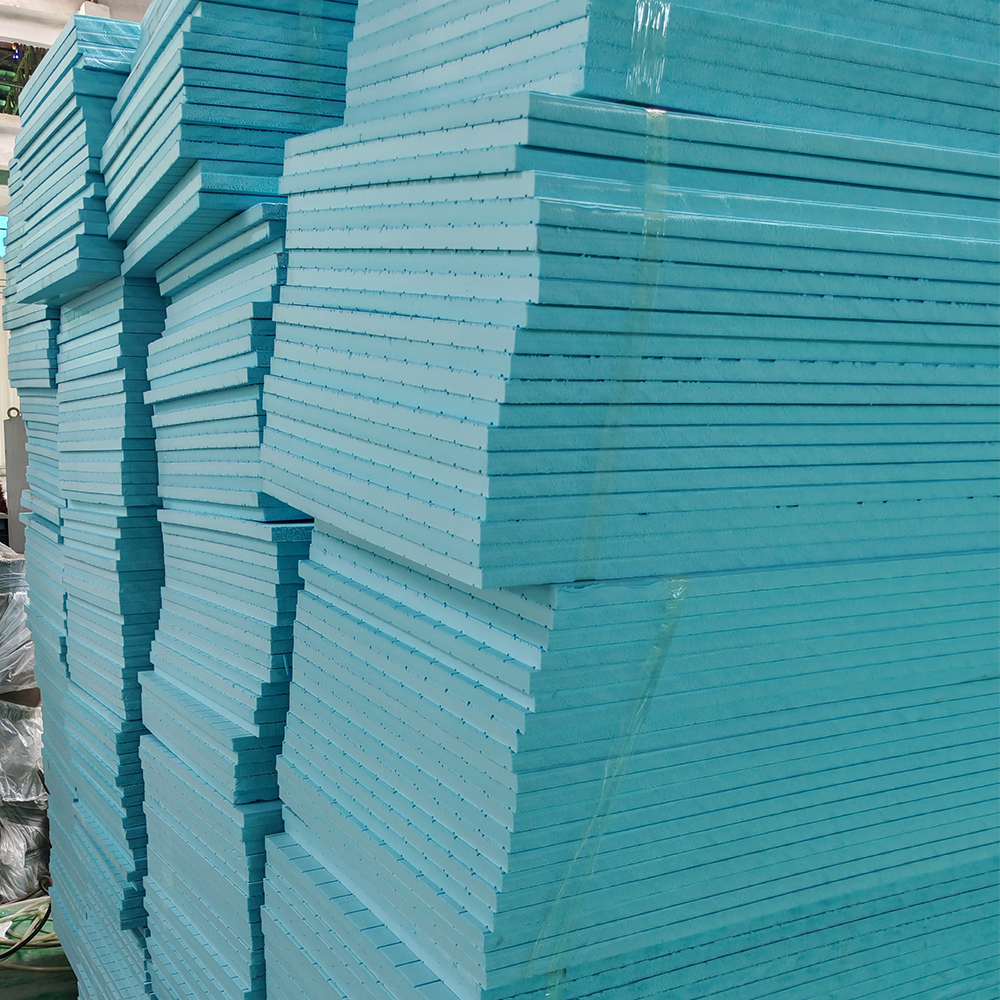
Extruded polystyrene XPS foam is a rigid closed-cell thermal insulation material manufactured through an extrusion foaming process. It is widely used in construction and composite applications because the manufacturing process creates a relatively uniform cellular structure with low moisture absorption and good compressive performance.
The basic manufacturing process begins with polystyrene raw material and a controlled formulation containing processing additives and other components required for foaming and performance. The materials are introduced into an extruder, where they are melted and mixed under controlled temperature and pressure. A blowing system is then used to create the foam structure. When the material exits the die, controlled expansion forms a continuous foam board. The board is subsequently cooled, shaped, trimmed, and cut to the required dimensions.
This manufacturing method is different from EPS, or expanded polystyrene. EPS is generally produced by expanding individual polymer beads and molding them together, while XPS is continuously extruded into a foam structure. The different manufacturing processes result in differences in cell structure, surface characteristics, water absorption, and mechanical behavior.
For Middle Eastern construction projects, extruded polystyrene XPS foam can be useful because buildings may require effective thermal insulation to reduce heat transfer through roofs, walls, floors, and foundations. In hot climates such as Saudi Arabia and the UAE, reducing unwanted heat gain can contribute to improved indoor thermal comfort and potentially lower the cooling load of a building. However, the actual energy-saving performance depends on the complete building envelope, insulation thickness, installation quality, thermal bridges, air leakage, glazing, HVAC efficiency, and local climate.
Another important characteristic is compressive strength. XPS foam is available in different densities and mechanical grades. Higher-density products generally provide higher compressive performance, making them more suitable for applications where insulation boards are exposed to significant loads, such as floor systems, inverted roofs, foundations, and certain industrial structures. The required grade should be selected according to the actual design load rather than assuming that higher density is always necessary.
Moisture resistance is also an important consideration. Because XPS has a predominantly closed-cell structure, it generally has low water absorption compared with many open-cell foam materials. This characteristic can be valuable in areas where insulation may be exposed to ground moisture or intermittent wet conditions. Nevertheless, XPS is not a waterproofing membrane, and proper waterproofing, drainage, joints, and construction detailing remain necessary.
Professional buyers should evaluate XPS foam according to thermal conductivity, density, compressive strength, thickness, water absorption, dimensional stability, fire classification, and applicable standards. Typical thickness options may include 10 mm, 25 mm, 30 mm, 40 mm, 50 mm, and 100 mm, although manufacturers can offer different specifications depending on their extrusion equipment.
For buyers in Saudi Arabia, Qatar, Kuwait, Oman, Bahrain, and the UAE, supplier selection should also include production capacity, quality consistency, export packaging, technical support, and the manufacturer’s ability to produce customized dimensions. A reliable XPS supplier should be able to provide a detailed technical datasheet rather than relying only on general descriptions.
Therefore, extruded polystyrene XPS foam is best understood as an engineered rigid insulation material whose performance depends on both its cellular structure and manufacturing parameters. Proper specification is essential for achieving reliable long-term performance in Middle Eastern construction and composite applications.
