
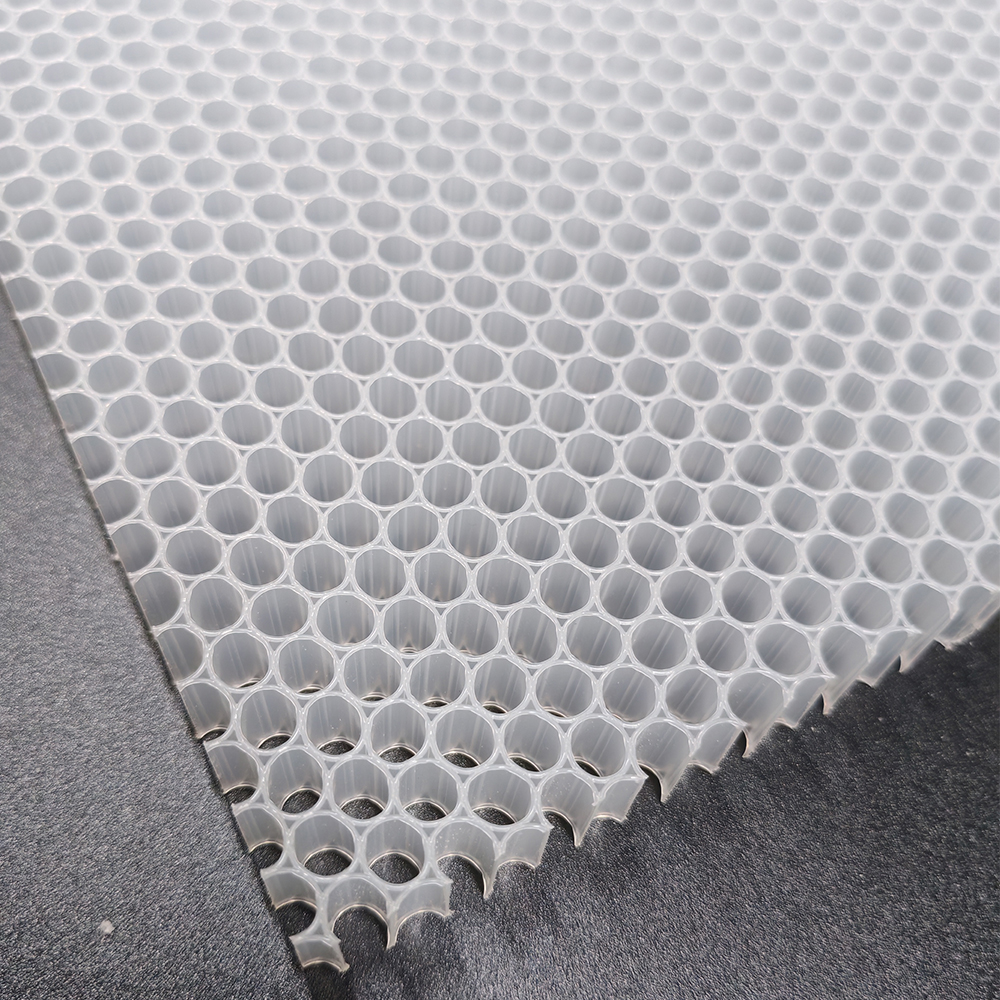
Looking for a reliable PP Honeycomb Core Manufacturer for your composite panel production? ONEBOND welcomes inquiries from FRP panel manufacturers, truck body panel producers, marine composite manufacturers, RV panel manufacturers, and industrial material distributors. Send us your required specifications, drawings, or application details.
ONEBOND is a manufacturer of thermoformed polypropylene (PP) honeycomb core materials, supplying lightweight and customizable core solutions for composite panel manufacturers and industrial applications.
Our product range includes Bare PP Honeycomb Core, Nonwoven Faced PP Honeycomb Core, PP Honeycomb Sheets, and customized polypropylene honeycomb core products. These materials are designed for integration into sandwich panels and lightweight composite structures used in transportation, marine, construction, automotive, packaging, and industrial manufacturing.
With a focus on manufacturing customization, product consistency, and B2B supply, ONEBOND works with international customers to develop PP honeycomb core solutions according to their required thickness, cell size, density, dimensions, surface treatment, and processing requirements.
Whether you are manufacturing FRP composite panels, truck body panels, marine sandwich panels, or other lightweight structural products, ONEBOND can support your material sourcing and customization needs.
1. What Is PP Honeycomb Core?
PP Honeycomb Core, also known as Polypropylene Honeycomb Core, is a lightweight cellular material made from polypropylene thermoplastic. Its internal structure consists of interconnected honeycomb-shaped cells that form a lightweight core for composite sandwich constructions.
The honeycomb structure provides a high proportion of internal void space while maintaining a defined cellular geometry. When combined with suitable face materials, such as FRP, fiberglass, aluminum, or other composite skins, PP honeycomb core can be used to manufacture lightweight sandwich panels.
Compared with solid plastic sheets of similar external dimensions, honeycomb structures use material more efficiently by incorporating a cellular interior.
Key Characteristics of Polypropylene Honeycomb Core
- Lightweight Cellular Structure: Suitable for applications where reducing panel weight is important.
- Thermoplastic Material: Polypropylene offers a combination of low density, chemical resistance, and processability.
- Moisture Resistance: PP itself has low water absorption compared with many open-cell materials, although finished panel performance also depends on its construction.
- Customizable Specifications: Core thickness, cell size, density, sheet dimensions, and surface configurations can be adjusted according to manufacturing requirements.
- Composite Compatibility: Can be incorporated into FRP, fiberglass, and other sandwich panel structures using an appropriate bonding and processing system.
- Multiple Industrial Applications: Used in transportation, marine, automotive, construction, packaging, and industrial composite products.
2. ONEBOND PP Honeycomb Core Product Range
ONEBOND offers several PP honeycomb core configurations to support different composite manufacturing processes and end-use requirements.
2.1 Bare PP Honeycomb Core
Bare PP Honeycomb Core is an uncovered polypropylene cellular core supplied without an additional nonwoven facing layer.
It is suitable for composite manufacturers who prefer to select their own surface treatment, adhesive system, or lamination process.
Typical applications include:
- FRP sandwich panel manufacturing
- Custom composite panel production
- Industrial lightweight structural panels
- Automotive interior components
- Customized sandwich constructions
Bare PP honeycomb core provides flexibility for manufacturers who have their own composite processing equipment and bonding technology.
2.2 Nonwoven Faced PP Honeycomb Core
Nonwoven Faced PP Honeycomb Core features a nonwoven fabric layer attached to one or both sides of the polypropylene honeycomb structure, depending on the product configuration.
The facing layer may provide a more suitable interface for certain lamination and bonding processes. Its effectiveness depends on the nonwoven material, adhesive system, surface treatment, and selected manufacturing process.
Potential applications include:
- FRP composite panels
- Fiberglass sandwich panels
- Truck body panel manufacturing
- RV and caravan panels
- Industrial composite boards
ONEBOND can discuss facing configurations and material compatibility according to the customer’s production requirements.
2.3 PP Honeycomb Sheet
PP Honeycomb Sheet refers to polypropylene honeycomb material supplied in sheet form for further fabrication or composite panel production.
Customers can specify sheet dimensions, thickness, cell size, and other manufacturing parameters according to their equipment and product design.
Potential applications include:
- Lightweight composite sheets
- Interior panel structures
- Industrial partitions
- Packaging structures
- Transportation components
2.4 Customized PP Honeycomb Core
Different industries require different core structures. ONEBOND provides customized PP honeycomb core manufacturing based on customer specifications and intended applications.
Customization may include:
- Core thickness
- Cell size and geometry
- Density or areal weight
- Sheet length and width
- Nonwoven facing configuration
- Color
- Cutting and dimensional requirements
- Special processing requirements
Customers are encouraged to provide drawings, sample specifications, or target panel structures for technical evaluation.
3. PP Honeycomb Core Technical Specifications
The performance and suitability of PP honeycomb core depend on its material formulation, cell geometry, thickness, density, manufacturing process, and final composite construction.
ONEBOND supports specification-based production. The following table provides the main parameters that can be discussed when developing a customized product.
| Parameter | Available Specification |
|---|---|
| Material | Polypropylene (PP) |
| Manufacturing Process | Thermoforming |
| Product Type | Bare PP Honeycomb Core |
| Product Type | Nonwoven Faced PP Honeycomb Core |
| Product Type | PP Honeycomb Sheet |
| Core Thickness | Customized according to requirements |
| Cell Size / Aperture | Customized according to requirements |
| Density | Customized according to product design |
| Sheet Width | Customized |
| Sheet Length | Customized |
| Surface Configuration | Bare / Nonwoven Faced |
| Color | Subject to production requirements |
| Processing | Cutting and customized fabrication |
| Application | FRP Panels, Truck Body Panels, Marine Panels, Industrial Composites |
Note: Actual available specifications, tolerances, density ranges, and production limits should be confirmed with ONEBOND before ordering. Technical values should be based on verified product data rather than assumed standard figures.
How to Select the Right PP Honeycomb Core Specifications
Core Thickness
Core thickness influences the geometry and structural behavior of the finished sandwich panel. The appropriate thickness should be selected according to panel dimensions, loading conditions, skin materials, and manufacturing requirements.
Cell Size
Cell size affects the cellular structure and the interaction between the core and face materials. Different cell sizes may be appropriate for different panel designs and lamination processes.
Density and Areal Weight
Density and areal weight are important parameters for material consumption and panel weight calculations. Buyers should compare products using consistent measurement methods and clearly defined test conditions.
Facing Configuration
Bare and nonwoven faced PP honeycomb cores may behave differently during bonding and lamination. The right configuration should be evaluated using the actual adhesive and face material combination.
4. PP Honeycomb Core Manufacturing Process
ONEBOND focuses on thermoformed PP honeycomb core manufacturing.
A typical manufacturing workflow includes material preparation, heating, forming, structural shaping, cooling, dimensional processing, and quality inspection. The exact process configuration depends on the product design and equipment.
Typical Manufacturing Stages
- Raw Material Preparation: Polypropylene material is prepared according to the target product requirements.
- Thermal Processing: The material is heated under controlled production conditions.
- Thermoforming: The material is formed into the required cellular structure.
- Cooling and Stabilization: The formed structure is cooled and stabilized.
- Dimensional Processing: The core is cut or processed according to the required dimensions.
- Facing and Finishing: Nonwoven facing or other specified configurations are applied where required.
- Quality Inspection: Product dimensions, appearance, and agreed technical parameters are checked.
For composite panel manufacturers, consistent core geometry and dimensional control are important for downstream lamination and panel production.
5. Applications of PP Honeycomb Core
PP honeycomb core is used in a variety of lightweight composite structures. Its suitability depends on the mechanical requirements, bonding system, environmental conditions, and complete panel design.
5.1 FRP Composite Panels
FRP composite panels combine fiberglass-reinforced plastic face materials with a lightweight core to form sandwich structures.
PP honeycomb core can be considered for FRP sandwich panel manufacturing where weight reduction, cellular construction, and customized panel dimensions are required.
Typical applications include:
- FRP wall panels
- Fiberglass sandwich panels
- Industrial composite boards
- Interior and partition panels
- Lightweight equipment enclosures
Related product: FRP Honeycomb Panel with PP Core
5.2 Truck Body Panels
Truck body panels are used in cargo trucks, box trucks, trailers, and other commercial vehicle structures.
Lightweight sandwich panel construction can help manufacturers reduce body weight while designing panels with the required stiffness and structural performance.
PP honeycomb core is a potential core material for customized FRP truck body panels and other transportation composite products.
Typical applications include:
- Truck side wall panels
- Truck roof panels
- Cargo box panels
- Trailer sandwich panels
- Commercial vehicle interior panels
The final panel design should be validated for bending, shear, impact, fastening, environmental exposure, and other service requirements.
5.3 Marine and Boat Applications
Marine composite structures often require lightweight materials with suitable moisture resistance and compatibility with fiberglass manufacturing processes.
PP honeycomb core may be evaluated for selected marine interior panels, partitions, furniture components, and other non-critical composite structures.
The suitability of the core for a specific marine application should be confirmed through bonding tests, environmental testing, and structural validation.
5.4 RV and Caravan Panels
Recreational vehicles and caravans use lightweight panels in walls, roofs, floors, furniture, and interior structures.
PP honeycomb core can be evaluated as a core option for composite panel manufacturers seeking alternative lightweight cellular materials.
5.5 Automotive and Transportation
Lightweight composite structures are increasingly considered for transportation components where weight, design flexibility, and production efficiency matter.
Potential applications include interior panels, partitions, covers, and other components subject to application-specific engineering requirements.
5.6 Packaging and Industrial Applications
PP honeycomb sheets may also be evaluated for reusable packaging, protective structures, industrial partitions, and other lightweight sheet applications.
The appropriate product configuration depends on the required load capacity, surface finish, fabrication method, and service environment.
6. PP Honeycomb Core vs Other Core Materials
Selecting a core material requires evaluating more than its weight or purchase price. Buyers should consider mechanical properties, bonding compatibility, moisture behavior, processing conditions, and total panel cost.
| Comparison | PP Honeycomb Core | PVC Foam Core | Aluminum Honeycomb Core |
|---|---|---|---|
| Material | Polypropylene | PVC Foam | Aluminum |
| Structure | Cellular Honeycomb | Closed-Cell Foam | Metallic Honeycomb |
| Weight | Depends on cell geometry and density | Depends on foam density | Depends on foil thickness and cell geometry |
| Moisture Behavior | PP has low water absorption | Closed-cell foam generally has low water absorption | Metal corrosion protection may be required |
| Processing | Thermoplastic forming and fabrication | Cutting, bonding, and machining | Core expansion, cutting, and bonding |
| Typical Applications | Lightweight composite panels | Marine, wind energy, industrial composites | Transportation, aerospace, architecture |
| Key Selection Factor | Cellular geometry and bonding compatibility | Density and mechanical properties | Strength, stiffness, and corrosion protection |
How to Choose Between PP Honeycomb Core and Foam Core
PP honeycomb core and PVC foam core have different internal structures and processing characteristics.
PP honeycomb core uses a cellular geometry, while PVC foam core uses a closed-cell foam structure. Their mechanical properties, resin and adhesive compatibility, and processing behavior should be compared using application-specific test data.
For manufacturers producing FRP panels, the correct choice depends on panel construction, target weight, mechanical performance, production equipment, and cost requirements.
7. Quality Control and Technical Testing
For industrial composite applications, raw material descriptions are not enough. Buyers need technical data and consistent quality control.
ONEBOND recommends evaluating PP honeycomb core using agreed testing methods and defined specimen conditions.
Important evaluation parameters may include:
- Density: Material mass per unit volume.
- Cell Size: Cellular opening dimensions and structural consistency.
- Thickness: Core thickness and dimensional tolerance.
- Compression Properties: Resistance to compressive loading.
- Shear Properties: Core behavior under shear loading.
- Water Absorption: Water uptake under a defined test method.
- Dimensional Stability: Changes in dimensions under specified environmental conditions.
- Surface and Appearance: Visible defects, deformation, and facing consistency.
For finished FRP sandwich panels, additional testing may be required, including flexural performance, skin-to-core bonding, impact resistance, panel flatness, and environmental durability.
The performance of the complete sandwich panel should not be inferred solely from the test results of the PP honeycomb core.
8. Why Choose ONEBOND as Your PP Honeycomb Core Manufacturer?
Choosing a reliable core material supplier is important for composite panel manufacturers seeking stable production and consistent product specifications.
ONEBOND focuses on PP honeycomb core manufacturing and customized composite material supply.
Manufacturing-Oriented Product Solutions
Our product range covers bare PP honeycomb core, nonwoven faced PP honeycomb core, PP honeycomb sheets, and customized configurations.
Customized Specifications
We support discussions based on customer requirements for thickness, cell size, density, sheet dimensions, and surface configuration.
Multiple Composite Applications
Our PP honeycomb core products can be evaluated for FRP panels, truck body panels, marine composite products, RV panels, and industrial lightweight structures.
Technical Communication
We work with buyers to understand their intended application, existing panel construction, and processing requirements before recommending a suitable material configuration.
B2B Manufacturing Cooperation
ONEBOND aims to support composite manufacturers, panel producers, distributors, and industrial material buyers with product customization and long-term supply cooperation.
9. How to Order Customized PP Honeycomb Core
To help us evaluate your requirements and provide an accurate quotation, please share the following information:
- Required product type: Bare or Nonwoven Faced PP Honeycomb Core.
- Core thickness.
- Cell size or aperture.
- Required density or target areal weight.
- Sheet width and length.
- Intended application.
- Estimated order quantity.
- Any drawings, samples, or technical specifications.
If you are not sure which PP honeycomb core configuration is suitable, you can send us your finished panel structure or application details for an initial technical discussion.
Contact ONEBOND to discuss your PP Honeycomb Core requirements and request a customized quotation.
10. Frequently Asked Questions About PP Honeycomb Core
Q1: What is PP Honeycomb Core?
PP Honeycomb Core is a lightweight cellular core material made from polypropylene and used in composite sandwich panel constructions.
Q2: What is the difference between bare PP honeycomb core and nonwoven faced PP honeycomb core?
Bare PP honeycomb core has no additional facing layer, while nonwoven faced PP honeycomb core includes a nonwoven fabric layer on one or both sides, depending on the configuration.
Q3: Can PP honeycomb core be used in FRP sandwich panels?
Yes, PP honeycomb core can be evaluated for FRP sandwich panel manufacturing when the bonding system, surface configuration, and panel design are properly matched.
Q4: Can PP honeycomb core be used for truck body panels?
Yes, it can be considered as a core material for selected FRP truck body and trailer sandwich panel constructions, subject to structural and bonding validation.
Q5: What specifications can be customized?
Core thickness, cell size, density, sheet dimensions, facing configuration, and other agreed manufacturing parameters can be discussed for customized production.
Q6: Is PP honeycomb core waterproof?
Polypropylene itself has low water absorption, but the water resistance of a finished composite panel also depends on its skins, edges, joints, bonding system, and overall construction.
Q7: How do I select the correct PP honeycomb core?
Selection should consider panel thickness, cell size, density, loading conditions, face materials, adhesive compatibility, and final application requirements.
Q8: Can ONEBOND supply samples?
Sample availability and specifications can be discussed according to your application, technical requirements, and project needs.
Q9: What information is needed for a quotation?
Please provide the required core thickness, cell size, density or areal weight, sheet dimensions, product type, application, and estimated order quantity.
Q10: Does ONEBOND manufacture customized PP honeycomb core?
ONEBOND focuses on thermoformed PP honeycomb core manufacturing and supports customized product discussions based on customer specifications.
