
Introduction
Acoustic honeycomb panels are widely used in modern architecture for wall cladding, ceilings, and interior acoustic optimization. They combine lightweight sandwich structures with perforated acoustic skins and a honeycomb core to achieve both sound control and structural stability.
Among available configurations, two core materials dominate the market: aluminum honeycomb core and paper honeycomb core. Although they may look similar externally, their engineering behavior, durability, fire performance, and acoustic characteristics are fundamentally different.
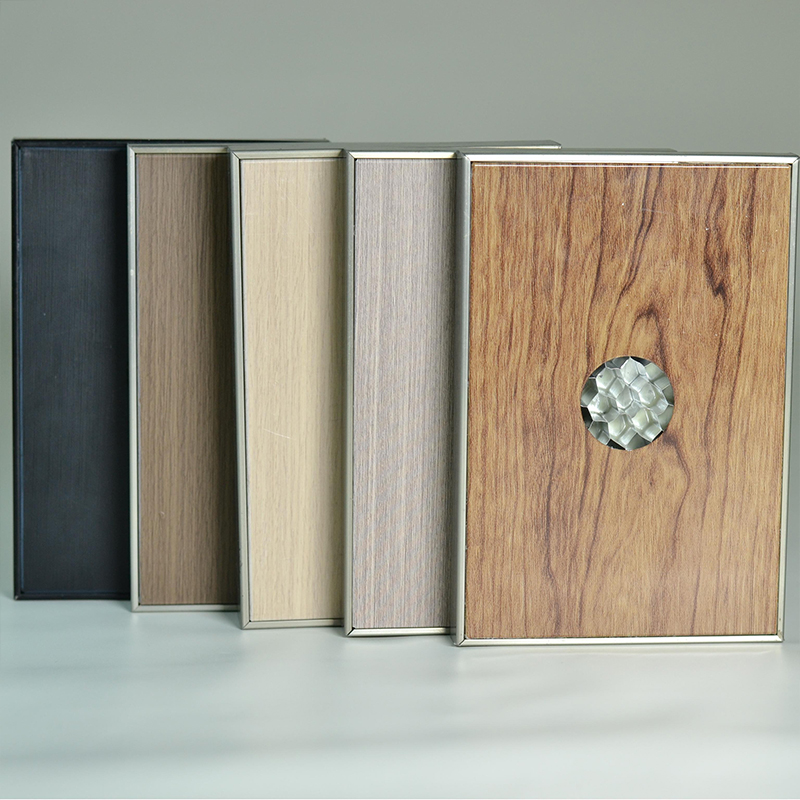
This article provides a comprehensive technical comparison (3000–5000 words level depth) to help architects, engineers, contractors, and procurement teams make informed decisions.
1. What Is an Acoustic Honeycomb Panel?
An acoustic honeycomb panel is a composite sandwich panel system typically composed of:
- Decorative or perforated face sheet (aluminum, steel, HPL, etc.)
- Honeycomb core (aluminum or paper)
- Acoustic backing layer (nonwoven fabric, rock wool, PET felt, etc.)
The core function is not only acoustic performance but also:
- Structural rigidity
- Lightweight support
- Flatness control
- Vibration damping coordination
Key Acoustic Principle
The system works based on:
- Helmholtz resonance effect (perforation + cavity)
- Sound wave dissipation in porous absorbers
- Structural vibration control
Importantly, the honeycomb core itself is not the primary absorber — it is a structural and acoustic system stabilizer.
2. Aluminum Core vs Paper Core: Fundamental Material Difference
The performance gap between aluminum and paper cores originates from material physics:
| Property | Aluminum Honeycomb | Paper Honeycomb |
|---|---|---|
| Material type | Metallic (aluminum alloy) | Cellulose fiber |
| Density | Low–medium | Very low |
| Stiffness | High | Moderate–low |
| Moisture resistance | Excellent | Weak |
| Fire resistance | Non-combustible (A1) | Combustible / treated B class |
| Structural role | Load-bearing core | Light structural filler |
Engineering Interpretation
- Aluminum = structural engineering material
- Paper = lightweight filler material
This fundamental classification explains almost all downstream performance differences.
3. Acoustic Performance Comparison: Which Absorbs Sound Better?
A common misconception is that the honeycomb core directly determines sound absorption. In reality, acoustic performance depends on:
- Perforation ratio of the face sheet
- Air cavity depth
- Backing absorbent material density
- System sealing and installation method
Aluminum Core Acoustic Behavior
Aluminum core panels:
- Have higher structural rigidity
- Reduce unwanted panel vibration
- Improve acoustic consistency across large surfaces
However, aluminum itself does not absorb sound. It must be paired with acoustic backing materials.
Paper Core Acoustic Behavior
Paper honeycomb:
- Naturally dampens vibration due to fiber structure
- Provides slight inherent absorption in mid–low frequencies
- Less effective as a structural isolator
Conclusion
- Aluminum core → better system stability and controlled acoustic performance
- Paper core → slightly more natural damping, but weaker structural acoustic control
👉 In engineered acoustic systems, aluminum core usually performs better overall.
4. Sound Insulation (STC Performance): Why Mass and Structure Matter
Sound insulation is governed by the Mass Law Principle:
R=20log10(mf)−47R = 20 \log_{10}(m f) – 47R=20log10(mf)−47
Where:
- R = sound transmission loss
- m = surface mass
- f = frequency
Aluminum Core Panels
- Higher system stiffness
- Better airborne sound blocking at mid–high frequencies
- More stable STC performance across installations
Paper Core Panels
- Lower mass
- More sensitive to environmental changes
- Slightly weaker in high-performance acoustic partitions
Practical Interpretation
- Aluminum core = predictable insulation system
- Paper core = light-duty acoustic enhancement system
5. Fire Performance: A Critical Engineering Differentiator
Fire performance is one of the most decisive selection factors in building systems.
Aluminum Honeycomb Core
- Non-combustible material
- Melting point ~660°C
- Does not release toxic smoke
- Suitable for A1 fire-rated systems
Paper Honeycomb Core
- Cellulose-based material
- Ignition range: ~230–260°C
- Requires chemical flame retardant treatment
- Typically limited to B/B1 fire rating
Application Impact
Aluminum core is mandatory in:
- Airports
- Metro stations
- Hospitals
- High-rise public corridors
Paper core is limited to:
- Decorative interiors
- Low-risk environments
- Temporary installations
6. Structural Strength and Deformation Resistance
Honeycomb panels rely on cellular geometry for load distribution, but core material still dominates mechanical behavior.
Aluminum Core Advantages
- High compressive strength
- Excellent shear modulus
- Long-span stability
- Minimal deformation over time
Paper Core Limitations
- Moisture-sensitive fiber structure
- Possible creep deformation under load
- Edge swelling in humidity
Engineering Conclusion
For large panel sizes (e.g., 1200×2400mm or larger):
- Aluminum core ensures flatness and durability
- Paper core is suitable for smaller modular systems
7. Environmental Resistance: Humidity, Mold, and Aging
Aluminum Core
- Zero moisture absorption
- Corrosion-resistant (with coating)
- Stable in high humidity (>90%)
Paper Core
- Hygroscopic (absorbs moisture)
- Risk of swelling and weakening
- Potential mold growth in poor ventilation
Engineering Recommendation
- Humid climates → aluminum core
- Dry indoor environments → paper core acceptable
8. Cost Analysis: Initial Price vs Lifecycle Cost
Initial Cost
- Paper core: low
- Aluminum core: higher
Lifecycle Cost Considerations
Paper core may incur:
- Replacement cycles
- Moisture damage repairs
- Higher maintenance frequency
Aluminum core provides:
- Longer service life (10–20 years typical)
- Lower maintenance
- Higher structural reliability
Economic Insight
For long-term commercial projects:
Aluminum core often has lower total cost of ownership (TCO)
9. Acoustic Design Misconception: The Core Is NOT the Absorber
A critical engineering clarification:
The honeycomb core does NOT directly absorb sound.
True acoustic absorption comes from:
- Perforated surface layer
- Backing acoustic material
- Air cavity resonance system
Role of Honeycomb Core
- Maintains panel geometry
- Controls vibration behavior
- Ensures consistent cavity depth
System-Level Conclusion
- Aluminum = structural optimization
- Paper = lightweight support
- Acoustic performance = system engineering
10. Application Scenarios: How to Choose Correctly
Aluminum Core Recommended For:
- Airports
- Metro stations
- Hospitals
- High-end commercial buildings
- Large wall/ceiling systems
Paper Core Recommended For:
- Office interiors
- Exhibition booths
- Residential decoration
- Temporary architectural systems
11. Sustainability Comparison: Which Is Greener?
Paper Core
- Renewable raw material
- Lower manufacturing energy
- Biodegradable potential
Aluminum Core
- Highly recyclable (near 100%)
- Long lifecycle reduces replacement waste
- Energy-intensive production but circular economy compatible
Sustainability Logic
- Paper = low-carbon production
- Aluminum = long-term circular material
In modern green building systems (LEED, BREEAM), aluminum’s recyclability often offsets its initial carbon footprint.
12. Final Engineering Selection Framework
To choose between aluminum and paper honeycomb acoustic panels, evaluate:
1. Fire safety requirements
2. Project lifespan
3. Environmental humidity
4. Structural span requirements
5. Budget constraints
Decision Rule
- High safety + long-term use → aluminum core
- Cost-sensitive + short-term use → paper core
- Humid or public infrastructure → aluminum core
- Decorative interiors → paper core
Conclusion
The comparison between aluminum core and paper core acoustic honeycomb panels is not simply a matter of “better or worse,” but rather a system engineering decision based on structural, acoustic, environmental, and regulatory constraints.
- Aluminum core represents engineering-grade performance systems
- Paper core represents lightweight decorative acoustic solutions
Understanding these distinctions allows architects and engineers to design safer, more efficient, and more cost-optimized acoustic environments.
