
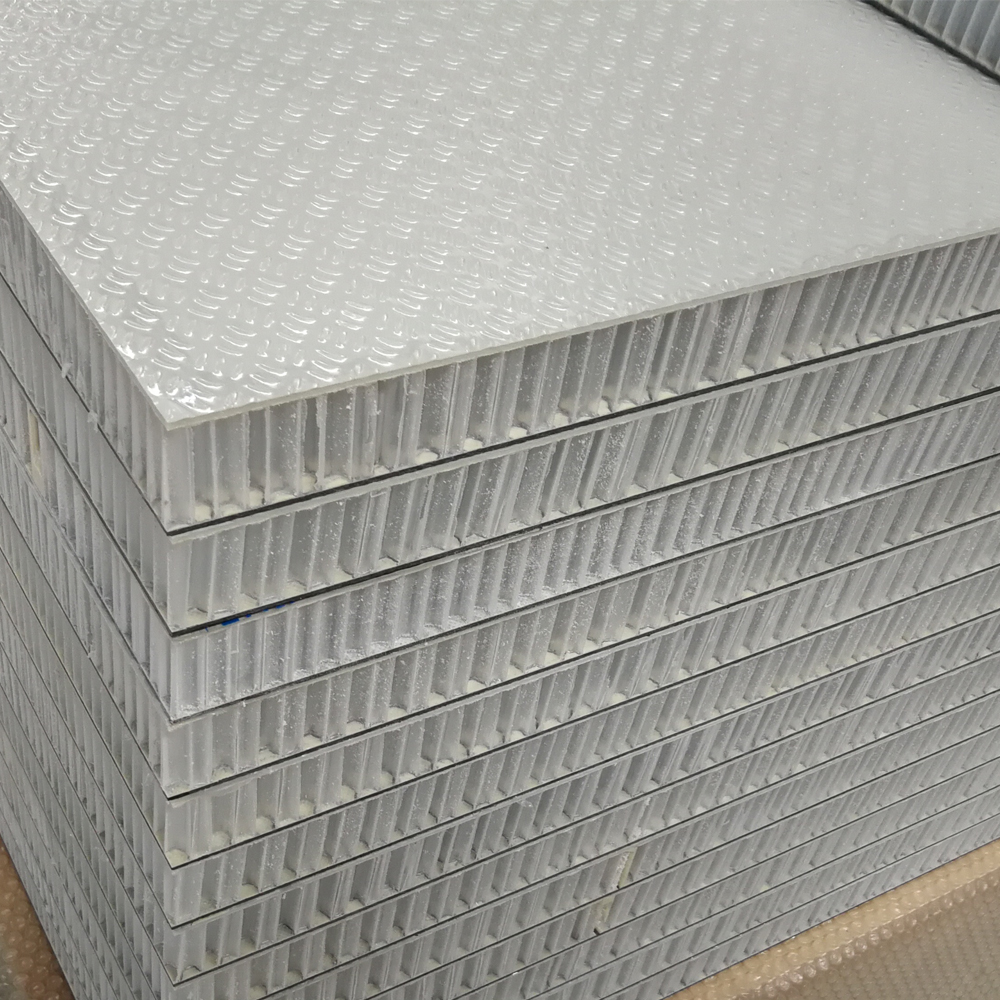
When selecting materials for lightweight composite structures, three factors are consistently important: weight, strength, and durability. A sandwich panel must provide sufficient mechanical performance while keeping the overall structure as light as possible and maintaining reliable performance throughout its service life.
This makes Aluminum Honeycomb versus Foam Sandwich Panels an important comparison for engineers, architects, manufacturers, and procurement teams.
Both aluminum honeycomb and foam cores are designed to separate two face sheets and improve the structural efficiency of a panel. However, their material characteristics are significantly different.
Aluminum honeycomb uses a cellular aluminum structure, while foam sandwich panels use polymeric cores such as PVC, PET, PMI, PU, or XPS.
This article compares these materials using representative engineering data, focusing specifically on weight, mechanical strength, durability, environmental resistance, manufacturing requirements, and application suitability.
Data note: The numerical values in this article are representative industry ranges for preliminary comparison. Actual specifications vary by manufacturer, density, alloy, cell size, thickness, face-sheet construction, adhesive system, and testing standard.
1. Why Weight, Strength and Durability Matter
A lightweight sandwich panel is not necessarily a high-performance panel.
For engineering applications, buyers need to consider several properties simultaneously:
- Panel weight
- Core density
- Compression strength
- Shear strength
- Bending stiffness
- Impact resistance
- Fatigue resistance
- Moisture resistance
- Temperature resistance
- Fire performance
- Bonding durability
- Dimensional stability
A material may perform exceptionally well in one category while being less suitable in another.
For example:
- Aluminum honeycomb generally provides excellent stiffness-to-weight performance.
- PET foam provides good structural performance and impact resistance.
- PVC foam offers a balanced combination of mechanical properties and processability.
- XPS foam provides excellent thermal insulation but is normally used for lower structural loads.
- PMI foam can provide very high mechanical performance at low density.
Therefore, material selection should be based on the complete application requirement, not on one property.
2. Weight Comparison
Weight is often the first parameter considered when designing a sandwich panel.
Typical core density ranges are:
| Core Material | Typical Density |
|---|---|
| Aluminum Honeycomb | 30–160+ kg/m³ |
| PVC Foam | 60–250+ kg/m³ |
| PET Foam | 60–250+ kg/m³ |
| PMI Foam | 50–200+ kg/m³ |
| XPS Foam | 25–50 kg/m³ |
| PU Foam | 30–200+ kg/m³ |
Aluminum honeycomb can achieve extremely low density because the core is composed primarily of thin aluminum cell walls and air-filled cells.
However, XPS and some low-density PU foams can also achieve very low densities.
Therefore, the statement that “aluminum honeycomb is always the lightest” is not technically accurate.
The more important question is:
Which material provides the required structural performance at the lowest finished-panel weight?
3. Core Weight Example
Consider a 1 m² panel with a 20 mm core.
| Core Material | Density | Thickness | Approx. Core Weight |
| Aluminum Honeycomb | 40 kg/m³ | 20 mm | 0.8 kg/m² |
| Aluminum Honeycomb | 60 kg/m³ | 20 mm | 1.2 kg/m² |
| Aluminum Honeycomb | 80 kg/m³ | 20 mm | 1.6 kg/m² |
| PVC Foam | 80 kg/m³ | 20 mm | 1.6 kg/m² |
| PVC Foam | 100 kg/m³ | 20 mm | 2.0 kg/m² |
| PET Foam | 100 kg/m³ | 20 mm | 2.0 kg/m² |
| PET Foam | 150 kg/m³ | 20 mm | 3.0 kg/m² |
| XPS Foam | 35 kg/m³ | 20 mm | 0.7 kg/m² |
These values represent the core only.
A finished sandwich panel will also include face sheets and other components.
For example, the final panel may contain:
- 0.5–2.0 mm aluminum skins
- Fiberglass laminates
- Carbon-fiber laminates
- Adhesive
- Coatings
- Edge profiles
- Inserts
- Local reinforcement
Consequently, finished-panel weight must always be calculated using the complete construction.
4. Compression Strength Comparison
Compression strength is particularly important for panels exposed to:
- Foot traffic
- Equipment loads
- Point loads
- Fasteners
- Furniture mounting
- Transportation loads
- Local impact
- Structural attachments
Representative compression-strength ranges are shown below:
| Core Material | Typical Density | Approx. Compression Strength |
| Aluminum Honeycomb | 40–60 kg/m³ | 0.5–2 MPa |
| Aluminum Honeycomb | 60–100 kg/m³ | 1–4 MPa |
| Aluminum Honeycomb | 100–160+ kg/m³ | 2–8+ MPa |
| PVC Foam | 60–100 kg/m³ | 0.5–3 MPa |
| PVC Foam | 100–200 kg/m³ | 1–6 MPa |
| PVC Foam | 200–250+ kg/m³ | 4–8+ MPa |
| PET Foam | 100–200 kg/m³ | 1–7 MPa |
| PMI Foam | 80–200 kg/m³ | 2–15+ MPa |
| XPS Foam | 25–50 kg/m³ | 0.2–1.0 MPa |
Higher-density cores generally provide higher compression performance, but density alone does not determine the final structural performance.
The face sheets, core thickness, bonding quality and panel dimensions are also critical.
5. Shear Strength and Durability
Shear strength is particularly important for sandwich structures because the core transfers forces between the face sheets.
Typical representative shear-strength ranges are:
| Core Material | Approx. Shear Strength |
| Low-density Aluminum Honeycomb | 0.3–1.5 MPa |
| Medium-density Aluminum Honeycomb | 0.8–3 MPa |
| High-density Aluminum Honeycomb | 2–5+ MPa |
| PVC Foam | 0.5–3 MPa |
| PET Foam | 0.5–4 MPa |
| PMI Foam | 1–6+ MPa |
| XPS Foam | 0.2–0.8 MPa |
A sandwich panel subjected to repeated bending can experience millions of loading cycles during its service life.
Therefore, static shear strength alone is not sufficient.
For long-term structural applications, engineers should also investigate:
- Fatigue strength
- Creep
- Compression fatigue
- Shear fatigue
- Adhesive fatigue
- Skin-core delamination
- Environmental aging
6. Durability Comparison
Durability describes how well a material maintains its performance over time.
| Durability Factor | Aluminum Honeycomb | PVC Foam | PET Foam | PMI Foam | XPS Foam |
| Moisture resistance | Very good | Very good | Very good | Good–very good | Excellent |
| Corrosion resistance | Good with proper protection | Excellent | Excellent | Excellent | Excellent |
| Dimensional stability | Excellent | Very good | Very good | Excellent | Good |
| Long-term structural stability | Excellent | Very good | Very good | Excellent | Moderate |
| Fatigue performance | Excellent | Very good | Very good–excellent | Excellent | Moderate |
| Chemical resistance | Good | Good | Good | Good–excellent | Good |
| Temperature resistance | Excellent | Good | Good | Excellent | Moderate |
The actual ranking can change significantly depending on the specific grade.
7. Moisture Resistance
Moisture is a major consideration for outdoor, marine and transportation applications.
Aluminum itself does not absorb water, but an aluminum honeycomb panel can still suffer problems if water penetrates the panel.
Potential failure locations include:
- Open edges
- Damaged face sheets
- Unsealed holes
- Mechanical fasteners
- Cracks
- Adhesive joints
Water trapped inside a honeycomb structure can contribute to corrosion or degradation of adjacent components.
Foam cores generally provide a different moisture-resistance mechanism.
Closed-cell PVC, PET and XPS foams typically have low water absorption.
| Material | General Water Absorption Behavior |
| Aluminum Honeycomb | Very low material absorption; sealing is important |
| PVC Foam | Low |
| PET Foam | Low |
| PMI Foam | Low–moderate depending on grade |
| XPS Foam | Very low |
For marine structures, the entire panel should be designed to prevent water ingress.
8. Corrosion Considerations
Aluminum honeycomb is a metallic material and can be exposed to corrosion under certain environmental conditions.
Potential concerns include:
- Saltwater exposure
- Galvanic corrosion
- Chemical contamination
- Damaged protective coatings
- Dissimilar-metal contact
This is especially important in marine applications.
Proper material selection may involve:
- Appropriate aluminum alloy
- Protective coating
- Anodizing
- Surface treatment
- Compatible adhesive
- Galvanic isolation
- Sealed edges
Foam cores do not experience metallic corrosion.
This can be a major advantage in composite structures where the surrounding environment is highly corrosive.
9. Fire Performance
Fire performance is another major difference between metallic and polymeric cores.
Aluminum honeycomb is non-combustible as a core material.
Foam cores are polymeric and therefore require formulation-specific fire evaluation.
| Fire Factor | Aluminum Honeycomb | Foam Core |
| Core combustibility | Non-combustible | Material-dependent |
| Flame resistance | Excellent core performance | Formulation-dependent |
| Smoke generation | Depends mainly on other components | Formulation-dependent |
| High-temperature performance | Excellent | Material-dependent |
| Fire certification | System testing required | System testing required |
The finished panel’s fire classification depends on the complete construction.
This includes:
- Core
- Face sheets
- Adhesive
- Coating
- Edge treatment
- Joints
For building, marine and transportation applications, buyers should request test reports for the complete panel system.
10. Thermal Performance
One major advantage of foam cores is thermal insulation.
Typical thermal conductivity ranges include:
| Material | Approx. Thermal Conductivity |
| Aluminum | 160–235 W/m·K |
| PVC Foam | 0.03–0.06 W/m·K |
| PET Foam | 0.035–0.06 W/m·K |
| PMI Foam | ~0.03–0.05 W/m·K |
| XPS Foam | 0.025–0.035 W/m·K |
| PU Foam | 0.020–0.030 W/m·K |
This makes foam sandwich panels attractive for:
- Building insulation
- Refrigerated vehicles
- Cold storage
- HVAC systems
- Marine cabins
- RV walls
- Insulated doors
- Prefabricated buildings
If the panel must perform both structural and thermal functions, foam can eliminate the need for a separate insulation layer.
11. Impact Resistance
Durability also depends on how the panel behaves during impact.
Aluminum honeycomb can absorb impact energy through progressive cell collapse.
Foam cores can absorb energy through compression and cellular deformation.
Different materials behave differently under impact:
| Material | Typical Impact Characteristics |
| Aluminum Honeycomb | Progressive cellular crushing |
| PVC Foam | Progressive compression and deformation |
| PET Foam | Good energy absorption |
| PMI Foam | High-performance structural impact behavior |
| XPS Foam | Moderate impact resistance |
For transportation, marine and protective applications, impact testing should be performed using the actual panel construction.
12. Fatigue and Long-Term Loading
A panel may experience repeated loading during its service life.
Examples include:
- Vehicle vibration
- Ship movement
- Wind loading
- Repeated floor loading
- Aircraft vibration
- Machinery vibration
- Temperature cycling
A material with high static strength may not necessarily have the best fatigue performance.
Procurement teams should therefore request fatigue data when the application involves repeated loading.
Important test parameters can include:
- Compression fatigue
- Shear fatigue
- Flexural fatigue
- Adhesive fatigue
- Skin-core bond durability
- Environmental fatigue
For critical structures, fatigue testing should reflect the expected service environment.
13. Temperature Resistance
Temperature can significantly influence foam performance.
A general comparison is:
| Material | General Temperature Capability |
| Aluminum Honeycomb | High |
| PVC Foam | Moderate |
| PET Foam | Moderate |
| PMI Foam | High |
| XPS Foam | Low–moderate |
| PU Foam | Grade-dependent |
For applications involving elevated temperatures, PMI and aluminum honeycomb can offer advantages over conventional low-temperature structural foams.
The supplier’s maximum continuous service temperature should always be checked.
14. Weight vs Durability
One of the most important procurement decisions is finding the right balance between weight and durability.
A very low-density core can reduce panel weight but may provide lower resistance to:
- Compression
- Impact
- Local loads
- Fasteners
- Repeated loading
A higher-density core can improve mechanical performance but increases weight.
A simplified comparison is:
| Objective | Recommended Direction |
| Minimum panel weight | Low-density honeycomb or foam |
| High compression strength | Medium/high-density structural core |
| High impact resistance | PET/PVC/appropriate structural foam |
| High thermal insulation | XPS/PU/foam systems |
| High-temperature performance | Aluminum honeycomb or PMI |
| High structural stiffness | Aluminum honeycomb/PMI |
| Complex geometry | Foam core |
| Marine composite construction | PVC/PET foam or aluminum honeycomb depending on design |
The best solution is therefore an optimized material system rather than simply the lightest available material.
15. Manufacturing Durability
Manufacturing quality can have as much influence on durability as the core material.
Potential manufacturing defects include:
- Poor adhesive wet-out
- Voids
- Core crushing
- Delamination
- Incomplete bonding
- Uneven pressure
- Incorrect curing
- Poor edge sealing
- Incorrect insert installation
For example, a high-performance aluminum honeycomb core will not produce a durable panel if the skin-to-core bond is defective.
Likewise, an excellent PET foam core cannot compensate for poor laminate quality.
Therefore, buyers should evaluate the manufacturer’s:
- Lamination process
- Adhesive system
- Curing process
- Quality-control procedures
- Dimensional inspection
- Bond-strength testing
- Finished-panel testing
16. Application Comparison
Architectural Applications
Aluminum honeycomb is particularly attractive for:
- Exterior wall panels
- Curtain-wall systems
- Interior wall cladding
- Ceiling panels
- Large decorative panels
- Lightweight partitions
Its combination of low weight, rigidity and dimensional stability makes it suitable for large-format architectural components.
Marine Applications
Both aluminum honeycomb and foam cores are widely applicable.
Foam cores are particularly attractive for:
- Hull structures
- Decks
- Bulkheads
- Composite superstructures
- Curved panels
Aluminum honeycomb can be particularly effective for:
- Interior partitions
- Doors
- Ceilings
- Furniture
- Flooring
Transportation Applications
Both materials can reduce vehicle weight.
Foam cores have an additional advantage in insulated transportation because they can combine structural support and thermal insulation.
Wind Energy
Structural foam is widely used in wind-energy composites because of its low weight, machinability and compatibility with composite manufacturing.
17. Procurement Cost and Lifecycle Value
Purchase price is only one component of the economic evaluation.
A more complete procurement analysis should consider:
| Cost Category | Evaluation Question |
| Core price | What is the price per m² or m³? |
| Finished panel weight | How much does the complete panel weigh? |
| Processing cost | How difficult is machining? |
| Labor | How much fabrication time is required? |
| Edge treatment | Are additional processes required? |
| Installation | Can panel weight reduce installation costs? |
| Maintenance | How resistant is the panel to the service environment? |
| Replacement | What is the expected service life? |
| Certification | Are additional tests required? |
| Logistics | How does panel weight affect transportation? |
A material with a slightly higher purchase price may produce a lower lifecycle cost if it reduces weight, installation time or maintenance requirements.
18. Which Material Is More Durable?
There is no universal answer.
Aluminum Honeycomb can be the better choice when:
- High structural stiffness is required
- Long-term dimensional stability is important
- High-temperature exposure is expected
- Non-combustible core performance is required
- Lightweight structural panels are needed
PVC Foam can be the better choice when:
- Marine applications are involved
- Composite manufacturing is used
- Complex shapes are required
- Good mechanical performance and processability are required
PET Foam can be the better choice when:
- Impact resistance is important
- Large composite structures are required
- Lightweight construction is a priority
- Sustainable material selection is considered
PMI Foam can be the better choice when:
- High mechanical performance is required
- High-temperature resistance is important
- Aerospace or high-performance applications are involved
XPS Foam can be the better choice when:
- Thermal insulation is the primary requirement
- Very low density is required
- Building applications are involved
- Structural loading is relatively moderate
19. Final Weight, Strength and Durability Comparison
| Factor | Aluminum Honeycomb | PVC Foam | PET Foam | PMI Foam | XPS Foam |
| Low weight | ★★★★★ | ★★★★ | ★★★★ | ★★★★★ | ★★★★★ |
| Compression strength | ★★★★–★★★★★ | ★★★–★★★★★ | ★★★–★★★★ | ★★★★★ | ★★ |
| Shear strength | ★★★★–★★★★★ | ★★★–★★★★ | ★★★–★★★★ | ★★★★★ | ★★ |
| Structural stiffness | ★★★★★ | ★★★★ | ★★★★ | ★★★★★ | ★★–★★★ |
| Impact resistance | ★★★★ | ★★★★ | ★★★★★ | ★★★★ | ★★★ |
| Fatigue performance | ★★★★★ | ★★★★ | ★★★★–★★★★★ | ★★★★★ | ★★★ |
| Moisture resistance | ★★★★ | ★★★★★ | ★★★★★ | ★★★★ | ★★★★★ |
| Corrosion resistance | ★★★ | ★★★★★ | ★★★★★ | ★★★★★ | ★★★★★ |
| Fire performance | ★★★★★ | ★★★–★★★★ | ★★★–★★★★ | ★★★–★★★★ | ★★–★★★ |
| Thermal insulation | ★★ | ★★★★ | ★★★★ | ★★★★ | ★★★★★ |
| Machinability | ★★★ | ★★★★★ | ★★★★★ | ★★★★★ | ★★★★★ |
| High-temperature performance | ★★★★★ | ★★★ | ★★★ | ★★★★★ | ★★ |
The ratings are intended for preliminary comparison and should not replace certified technical data.
20. What Should Procurement Teams Request?
Before placing a bulk order, buyers should request a complete technical package.
At minimum, it should include:
| Required Data | Purpose |
| Density | Weight calculation |
| Thickness tolerance | Manufacturing control |
| Compression strength | Load evaluation |
| Shear strength | Structural design |
| Shear modulus | Deflection evaluation |
| Thermal conductivity | Insulation evaluation |
| Water absorption | Moisture assessment |
| Fire classification | Regulatory compliance |
| Operating temperature | Service suitability |
| Fatigue data | Long-term durability |
| Bonding recommendations | Manufacturing quality |
| Test standards | Supplier comparison |
| Quality certificates | Quality assurance |
| Sample availability | Validation before bulk production |
A professional supplier should be able to provide product samples and technical documentation before large-volume procurement.
