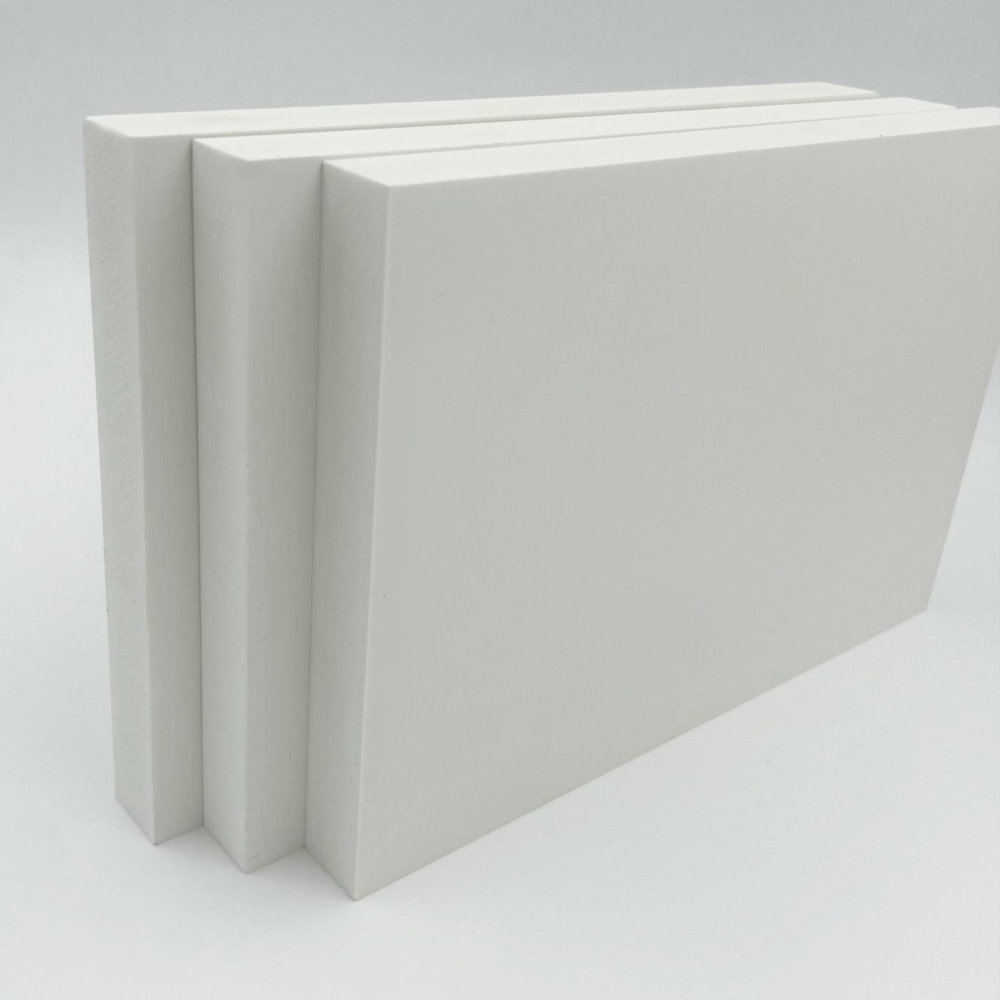
Composite core materials play a fundamental role in improving the strength-to-weight ratio and stiffness-to-weight ratio of sandwich structures. The basic principle is relatively simple: instead of manufacturing a thick solid laminate entirely from relatively heavy structural skins, engineers place a lightweight core between two thin, strong face sheets. This creates a much thicker structural section without adding the same amount of material weight.
In a conventional solid plate, increasing bending stiffness usually requires increasing the thickness of the structural material. However, this can rapidly increase weight and material cost. In a sandwich structure, composite core materials increase the distance between the upper and lower skins. This separation significantly increases the section’s resistance to bending while the lightweight core carries primarily transverse shear loads and stabilizes the skins.
For example, a sandwich panel using fiberglass skins and a lightweight PVC or PET foam core can achieve substantially greater bending stiffness than a solid laminate with a similar mass. Aluminum honeycomb and PP honeycomb cores can provide another approach to achieving very high stiffness at low structural weight.
However, strength-to-weight performance should not be evaluated based only on core density. The final performance depends on the entire sandwich system, including skin thickness, core thickness, core shear modulus, compressive strength, adhesive performance, and manufacturing quality.
The thickness of the core is particularly important. Increasing core thickness generally increases bending stiffness significantly, while the additional weight may remain relatively modest if the core has low density. This is one of the fundamental reasons why sandwich construction is so efficient.
For procurement teams, the important question is therefore not simply, “Which composite core materials have the lowest density?” Instead, buyers should ask, “Which material provides the required structural performance at the lowest total weight and acceptable cost?”
This distinction is particularly important in marine, aerospace, wind energy, transportation, and electric vehicle applications. Reducing structural weight can provide secondary benefits such as lower transportation costs, higher payload capacity, lower energy consumption, and improved operating efficiency.
When comparing suppliers, procurement engineers should request density, compressive strength, shear strength, shear modulus, fatigue data, water absorption, and thermal properties. These parameters should then be evaluated together with the selected skin materials.
Ultimately, composite core materials improve structural efficiency by allowing engineers to place lightweight material where it is most effective. Properly designed sandwich structures can achieve a highly favorable balance between stiffness, strength, weight, durability, and manufacturing cost.