
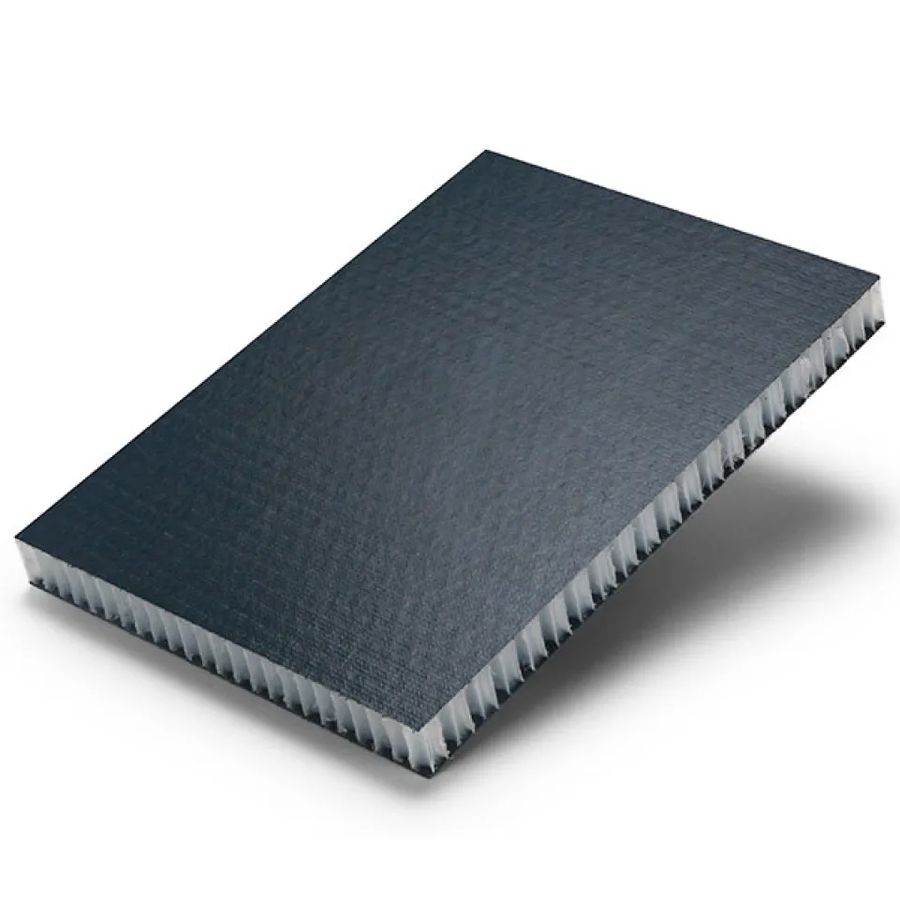
1. Introduction: Which Core Material Is Better for FRP Sandwich Panels?
FRP sandwich panels are widely used in truck bodies, trailers, RVs, marine structures, construction and industrial composite products.
One of the most important decisions during panel development is selecting the core material.
Two common structural options are foam core sandwich panels and honeycomb core sandwich panels.
A foam core panel typically combines FRP skins with materials such as PVC foam, PET foam, PU foam or XPS foam. A honeycomb core panel uses a cellular structure, such as polypropylene honeycomb or aluminum honeycomb, between the FRP skins.
Both structures can provide lightweight panel designs, but their performance characteristics and manufacturing requirements are different.
For composite panel manufacturers, the right choice depends on:
- Finished panel weight
- Bending stiffness
- Core compression and shear properties
- Bonding compatibility
- Thermal insulation
- Water and environmental exposure
- Manufacturing process
- Total production cost
There is no universally better core material. The most suitable option is the one that meets the complete panel’s engineering requirements and manufacturing conditions.
This guide compares FRP foam core and honeycomb core sandwich panels to help manufacturers and buyers make more informed material decisions.
2. Understanding the Two FRP Sandwich Panel Structures
Before comparing performance, it is important to understand the structural differences.
2.1 FRP Panel with Foam Core
An FRP foam core panel typically consists of:
- Outer FRP skin
- Adhesive or bonding interface
- Foam core
- Adhesive or bonding interface
- Inner FRP skin
Common foam core materials include:
- PVC Foam Core
- PET Foam Core
- PU Foam Core
- XPS Foam Core
The foam core has a cellular structure distributed throughout the material. Depending on its formulation and density, it can provide compression resistance, shear performance and thermal insulation.
Foam cores are available in different densities, thicknesses and structural grades.
2.2 FRP Panel with Honeycomb Core
An FRP honeycomb sandwich panel typically consists of:
- Outer FRP skin
- Bonding interface
- Honeycomb core
- Bonding interface
- Inner FRP skin
Common honeycomb core options include:
- PP Honeycomb Core
- Aluminum Honeycomb Core
Honeycomb cores contain interconnected cellular structures with relatively thin cell walls.
Their structural behavior depends on cell size, wall thickness, material properties, core thickness and loading direction.
PP honeycomb core is based on polypropylene, while aluminum honeycomb core uses metallic foil formed into a cellular structure.
The bonding interface is particularly important for PP honeycomb because untreated polypropylene has relatively low surface energy.
3. Foam Core vs Honeycomb Core: Key Differences
The following table provides a general comparison. Actual performance varies according to material grade, density, geometry, skin configuration and manufacturing process.
| Comparison Factor | FRP Foam Core Panel | FRP Honeycomb Core Panel |
|---|---|---|
| Core Structure | Cellular foam material | Cellular honeycomb structure |
| Common Materials | PVC, PET, PU, XPS | PP, Aluminum |
| Weight | Depends on foam density and thickness | Depends on material, cell size, wall thickness and thickness |
| Compression Behavior | Depends on foam formulation and density | Depends on cell geometry, wall thickness and material |
| Shear Behavior | Depends on foam grade and structure | Depends on cell geometry, material and loading direction |
| Bending Performance | Depends on skins, foam properties and panel geometry | Depends on skins, honeycomb properties and panel geometry |
| Thermal Insulation | Often suitable for insulation-focused designs, depending on foam type | Generally requires additional insulation consideration |
| Bonding | Depends on foam surface and adhesive compatibility | Depends on honeycomb material, surface treatment and facing |
| Water Resistance | Varies by foam chemistry and panel design | Varies by core material, joints and panel sealing |
| Processing | Cutting, shaping, grooving and bonding | Cutting, facing, shaping and bonding |
| Typical Applications | Marine, insulated vehicles, wind energy, industrial panels | Transportation, lightweight panels, industrial structures |
The table should be treated as a material-selection overview, not a universal ranking.
A high-density foam may weigh more than a particular honeycomb configuration, while a specific honeycomb core may have lower shear capacity than a suitable structural foam. Actual product data and complete panel tests are necessary.
4. Weight Comparison: Foam Core vs Honeycomb Core
Weight is often one of the first factors considered by FRP panel manufacturers.
However, comparing core density alone can lead to incorrect conclusions.
4.1 Core Density Is Not the Same as Finished Panel Weight
The total panel weight includes:
- Outer FRP skin
- Inner FRP skin
- Core material
- Adhesive or resin
- Surface coatings and additional components
The theoretical core areal weight can be estimated using:
Core Areal Weight = Core Density × Core Thickness
For example, assuming a core density of 80 kg/m³ and a thickness of 20 mm:
80 × 0.020 = 1.6 kg/m²
This is a mathematical example only, not a standard ONEBOND product specification.
To calculate total panel weight, the weight of both skins, adhesive and other components must also be included.
4.2 Why Honeycomb Structures Can Be Lightweight
Honeycomb structures use a cellular geometry with relatively thin cell walls.
This can provide a lightweight core configuration while maintaining the separation between the two face sheets.
For manufacturers seeking to reduce transportation panel weight, PP honeycomb core may be worth evaluating.
4.3 Why Foam Cores Can Still Be Competitive
Foam cores provide a continuous cellular material structure.
Depending on the foam type and density, they can offer useful structural performance and insulation characteristics.
A low-density foam may be competitive in weight, while a higher-density structural foam may be selected where greater mechanical performance is required.
The correct comparison should use actual areal weight and finished panel weight rather than material names alone.
5. Strength and Mechanical Performance Comparison
Mechanical performance is one of the most important considerations in sandwich panel design.
However, strength is not a single property.
Manufacturers should distinguish between compression, shear, bending and tensile performance.
5.1 Compression Performance
Compression performance describes how the core responds to loading through its thickness.
Foam cores resist compression through deformation and collapse of their cellular structure.
Honeycomb cores resist compression through deformation, bending and buckling of their cell walls.
The result depends on:
- Core material
- Density or areal weight
- Cell size
- Cell wall thickness
- Core thickness
- Loading direction
- Test conditions
A higher density does not automatically guarantee better finished-panel performance. Core geometry and material behavior must also be considered.
5.2 Core Shear Performance
Core shear properties are important because the core transfers shear loads between the outer skins.
Foam cores have their own shear strength and shear modulus, which vary by material and grade.
Honeycomb cores may show directional differences because of their cellular geometry.
For PP honeycomb, cell orientation and structural configuration should be considered during testing and panel design.
5.3 Bending Performance
The bending performance of a sandwich panel depends on the interaction between both skins and the core.
During bending:
- One skin carries tensile stress.
- The opposite skin carries compressive stress.
- The core maintains skin separation and transfers shear loads.
The finished panel’s bending stiffness cannot be predicted from core density alone.
Skin thickness, core thickness, core shear modulus, bonding integrity and panel span all influence the result.
5.4 Impact Resistance
Impact performance depends on the complete panel structure.
Important factors include:
- FRP skin reinforcement
- Skin thickness
- Core type and density
- Bonding quality
- Panel support conditions
- Impact location and energy
Neither foam core nor honeycomb core should be assumed superior for every impact scenario.
Representative panel testing is necessary for applications such as truck bodies and trailers.
6. Bonding and Manufacturing Differences
Bonding compatibility is a major practical difference between foam and honeycomb core materials.
6.1 Foam Core Bonding
Foam core bonding depends on the specific foam chemistry and surface condition.
PVC, PET, PU and XPS foam do not necessarily respond to the same adhesive or resin system.
Manufacturers should check:
- Adhesive compatibility
- Surface cleanliness
- Surface preparation
- Adhesive application amount
- Curing temperature
- Pressure during lamination
Some foam materials may be sensitive to certain solvents, resins or processing temperatures.
Compatibility trials should be completed before mass production.
6.2 PP Honeycomb Core Bonding
PP honeycomb requires particular attention because polypropylene has relatively low surface energy.
Direct bonding with conventional adhesives and resins may be difficult without suitable surface preparation or a compatible bonding system.
Possible approaches include:
- Plasma treatment
- Corona treatment
- Flame treatment
- Nonwoven facing
- Qualified adhesive systems
For nonwoven-faced PP honeycomb, two interfaces need to be evaluated:
- PP core-to-facing
- Facing-to-FRP skin
The complete bonding system should be tested rather than assuming that the facing alone guarantees adhesion.
6.3 Aluminum Honeycomb Bonding
Aluminum honeycomb core requires a bonding system compatible with the metallic surface and the selected FRP skin.
Surface cleanliness, corrosion protection, adhesive distribution and curing conditions should be controlled.
The manufacturer should also consider differences in thermal expansion between aluminum and FRP.
6.4 Manufacturing and Processing
Foam cores can often be cut, grooved, shaped and machined using suitable processing equipment.
Honeycomb cores may require cutting, facing, edge preparation and careful handling to avoid damage to the cellular structure.
Production efficiency depends on the panel design, material supply format, cutting process, lamination method and equipment configuration.
7. Thermal Insulation: An Important Difference
Thermal insulation can be a deciding factor when selecting a core material.
7.1 Foam Core for Insulated Panels
Some foam cores are particularly suitable for thermal insulation applications.
For example:
- PU foam is commonly considered for insulated vehicle and building panels.
- XPS foam is widely used in insulation-focused construction applications.
- Certain PET and PVC foam grades can also be evaluated in composite structures where thermal and mechanical performance are both relevant.
The actual thermal conductivity depends on the foam formulation, density, temperature and test conditions.
7.2 Honeycomb Core for Lightweight Structural Panels
PP honeycomb and aluminum honeycomb are primarily evaluated for their cellular structural characteristics.
They should not automatically be treated as direct substitutes for insulation-grade foam.
For refrigerated trucks or cold storage structures, the designer may need an additional insulation layer or a different core configuration.
The panel’s overall thermal performance should be evaluated as a complete system, including joints and thermal bridges.
8. Cost Comparison: Which Core Is More Economical?
The lowest raw material price does not necessarily produce the lowest finished panel cost.
A proper cost comparison should consider:
- Core material price
- Core weight per square meter
- Skin material consumption
- Adhesive consumption
- Cutting and machining costs
- Production cycle time
- Material waste
- Quality control
- Rework and rejection rates
- Long-term service requirements
8.1 Foam Core Cost Factors
Foam core costs vary by material chemistry, density, thickness, grade and manufacturing process.
Structural foam grades may have different costs from insulation-focused foam products.
Processing waste and bonding compatibility should also be included.
8.2 Honeycomb Core Cost Factors
Honeycomb core costs depend on:
- Core material
- Cell size
- Cell wall thickness
- Core thickness
- Density or areal weight
- Facing configuration
- Sheet dimensions
- Customization requirements
For PP honeycomb core, surface treatment and nonwoven facing may add processing or material costs.
8.3 Compare Total Panel Cost, Not Just Core Price
The most useful purchasing comparison is the total cost of the finished panel.
A lower-priced core may require additional adhesive, special surface treatment, more complicated processing or additional reinforcement.
A higher-priced material may reduce total weight or simplify another part of the production process.
The right decision should be based on a complete manufacturing cost calculation.
9. Which Core Material Is Better for Different Applications?
9.1 Truck Body and Trailer Panels
For truck bodies and trailers, manufacturers often prioritize:
- Lightweight construction
- Bending stiffness
- Impact performance
- Moisture protection
- Fastener and joint design
- Production efficiency
PP honeycomb core can be evaluated for lightweight FRP sandwich panel designs.
PVC or PET foam may also be suitable depending on mechanical requirements and bonding conditions.
For floor structures and high-load areas, additional reinforcement or a different core configuration may be required.
9.2 Marine and Boat Building
Marine applications may require:
- Structural performance
- Fatigue resistance
- Water exposure resistance
- Fire compliance
- Long-term bonding durability
PVC foam and other structural foam grades are established options in many marine composite designs.
Honeycomb core may also be evaluated for selected applications, but the core, bonding system and complete structure must meet the relevant marine requirements.
9.3 RV and Caravan Manufacturing
RV manufacturers often seek a balance between weight, insulation, durability and production efficiency.
PP honeycomb can be considered for selected lightweight panel structures.
Foam core may be more appropriate where thermal insulation is a major requirement.
Some designs may also combine structural and insulation materials in a multilayer configuration.
9.4 Refrigerated Truck Bodies
Thermal insulation is a major requirement for refrigerated vehicles.
PU foam and other suitable insulation materials are commonly evaluated for these structures.
A PP honeycomb core should not be selected as a direct replacement for an insulation core without confirming the thermal performance of the complete panel.
9.5 Industrial Composite Panels
Industrial panels can have widely different structural and environmental requirements.
PP honeycomb, PVC foam, PET foam and aluminum honeycomb may all be considered depending on the target application.
The correct material should be selected through engineering evaluation and sample testing.
10. How to Choose Between Foam Core and Honeycomb Core
The following decision framework can help buyers narrow down the options.
| Requirement | Material Direction to Evaluate |
|---|---|
| Lightweight cellular structure | PP Honeycomb Core |
| Thermal insulation priority | PU or XPS Foam Core, depending on application |
| Structural marine composite applications | PVC Foam Core or other qualified structural cores |
| Thermoplastic cellular core | PP Honeycomb Core |
| Metallic high-stiffness cellular structure | Aluminum Honeycomb Core |
| Custom industrial sandwich panels | Compare multiple core configurations |
| Specific FRP bonding process | Select based on validated adhesive and surface compatibility |
This table is a starting point, not a substitute for engineering design.
A manufacturer should confirm the final selection using actual material specifications, prototype production and complete sandwich panel testing.
11. What Should Buyers Include in a Core Material RFQ?
When requesting a quotation for FRP sandwich panel core materials, provide the following information:
| RFQ Parameter | Information Required |
|---|---|
| Application | Truck body, trailer, RV, marine or industrial |
| Core Type | PP honeycomb, PVC foam, PET foam, PU foam, XPS or aluminum honeycomb |
| Thickness | Required core thickness |
| Density | Target density or acceptable range |
| Cell Size | Required cell size for honeycomb core |
| Facing | Bare, nonwoven faced or other surface configuration |
| Sheet Dimensions | Required length and width |
| FRP Skin | Reinforcement, resin and thickness |
| Bonding System | Adhesive or resin type |
| Performance Requirements | Compression, shear, bending, insulation and impact |
| Order Quantity | Sample, trial order and estimated bulk demand |
For a more accurate quotation, buyers should also share technical drawings, existing panel samples or target finished-panel specifications.
12. ONEBOND Foam Core and PP Honeycomb Core Solutions
ONEBOND focuses on composite core materials for manufacturers developing lightweight sandwich panels and industrial composite products.
Our product range includes:
PP Honeycomb Core
- Bare PP Honeycomb Core
- Nonwoven Faced PP Honeycomb Core
- Customized PP Honeycomb Sheets
Foam Core Materials
- PVC Foam Core
- PET Foam Core
- XPS Foam Core
- PU Foam Core
These materials can be evaluated for FRP composite panels, truck body panels, trailer structures, RV components, marine applications and other industrial products.
We understand that different panel manufacturers require different combinations of weight, mechanical properties, bonding compatibility and thermal performance.
Rather than recommending one core material for every application, ONEBOND supports technical discussions based on the customer’s panel structure, production process and target specifications.
Contact ONEBOND to compare PP honeycomb core and foam core options for your FRP sandwich panel project.
13. Frequently Asked Questions
Q1: What is the difference between foam core and honeycomb core FRP panels?
Foam core panels use a cellular foam material, while honeycomb core panels use a cellular structure made from materials such as polypropylene or aluminum.
Q2: Which is lighter, PP honeycomb core or foam core?
The answer depends on the specific material grade, density, thickness and geometry. Compare actual areal weight rather than relying only on material names.
Q3: Is honeycomb core stronger than foam core?
Not universally. Compression, shear and bending performance depend on material properties, cell geometry, core thickness, skins and bonding quality.
Q4: Which core material is better for thermal insulation?
Certain foam materials, particularly suitable PU and XPS grades, are commonly evaluated for insulation-focused panels. The complete panel’s thermal performance should be verified.
Q5: Is PP honeycomb core suitable for FRP panels?
Yes, provided that the bonding interface and complete panel structure are properly designed and validated.
Q6: Why does PP honeycomb core require special bonding consideration?
Polypropylene has relatively low surface energy, which can make direct bonding difficult with many conventional adhesives and resins.
Q7: Can PVC foam core replace PP honeycomb core?
It may be suitable for some applications, but the materials have different structures and performance characteristics. The panel design and manufacturing process may need adjustment.
Q8: Is a honeycomb panel always cheaper than a foam core panel?
No. Total cost depends on material price, areal weight, facing, adhesive, processing, waste and production efficiency.
Q9: Can foam core and honeycomb core be combined in one panel?
Multilayer structures can be engineered for specific applications, but material compatibility, thermal behavior, structural loading and bonding must be evaluated.
Q10: How should manufacturers compare two FRP sandwich panel core materials?
They should compare actual specifications, produce representative samples and test the complete panels under relevant loading and environmental conditions.
Conclusion
Foam core and honeycomb core are both important material options for FRP sandwich panel manufacturing.
Foam cores offer a range of structural and insulation characteristics, while honeycomb cores provide cellular structures that can be useful for lightweight panel designs.
The right choice depends on the complete panel’s weight, mechanical performance, thermal requirements, bonding compatibility, manufacturing process and total cost.
For manufacturers, the most reliable approach is to compare actual core specifications and validate the complete sandwich structure before mass production.
ONEBOND provides PP honeycomb core and multiple foam core materials for industrial manufacturers developing customized FRP composite panels.
