
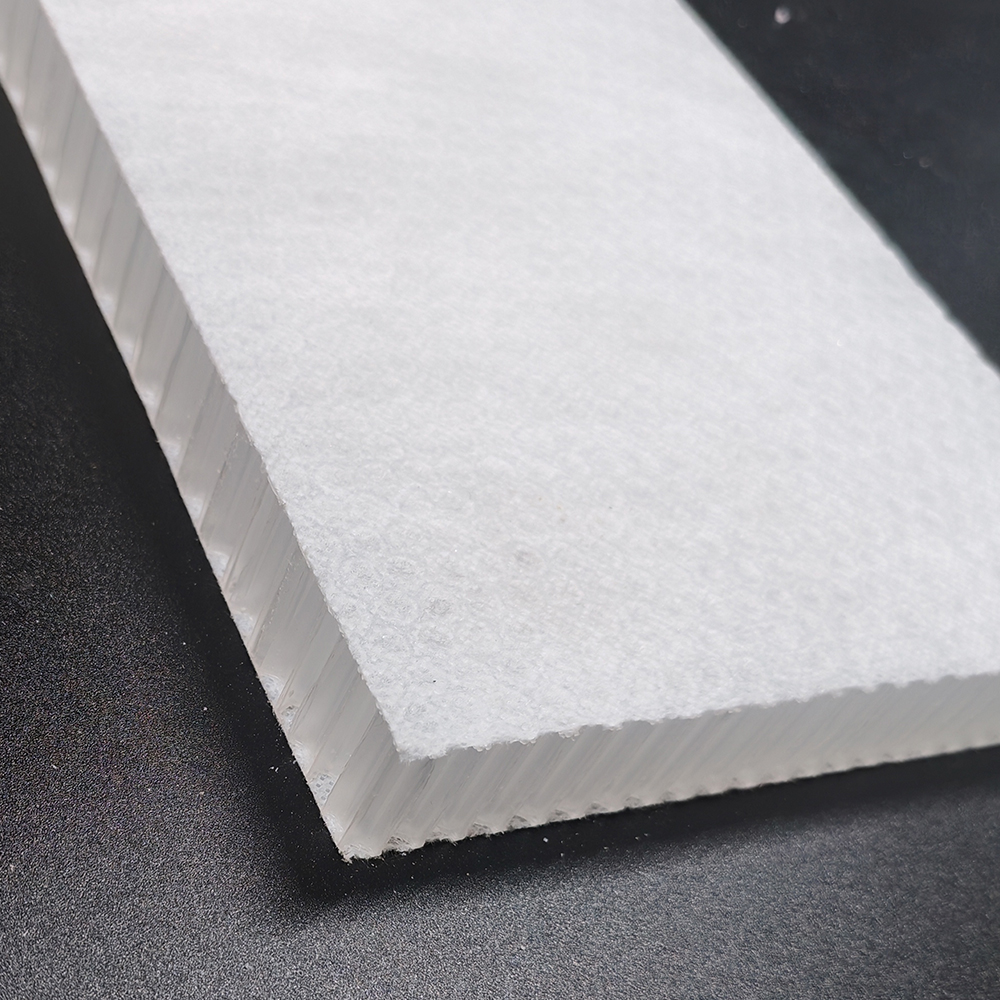
PP Honeycomb Core Compression Strength and Mechanical Properties: A Technical Guide for Composite Manufacturers For composite panel manufacturers, evaluating only the compression strength of the core is not sufficient. A finished sandwich panel also depends on the facing materials, adhesive interface, bonding quality and overall structural design. Mechanical performance is one of the most important…
PP Honeycomb Core Compression Strength and Mechanical Properties: A Technical Guide for Composite Manufacturers
For composite panel manufacturers, evaluating only the compression strength of the core is not sufficient. A finished sandwich panel also depends on the facing materials, adhesive interface, bonding quality and overall structural design.
Mechanical performance is one of the most important considerations when selecting PP honeycomb core for lightweight composite panels. A honeycomb structure may look simple, but its actual load-bearing behavior depends on several interacting factors, including polymer properties, cell geometry, wall thickness, apparent density and manufacturing consistency.
This is particularly important for FRP sandwich panels, truck body panels, RV structures, marine interiors and industrial composite boards, where the core must work together with the outer skins under different loading conditions.
This article examines the mechanical properties of polypropylene honeycomb core, explains how density and cell wall thickness influence structural behavior, and introduces practical testing methods for evaluating complete sandwich panel performance.
1. What Are the Main Mechanical Properties of PP Honeycomb Core?
PP honeycomb core is a cellular thermoplastic material made primarily from polypropylene. Its mechanical properties are determined by both the polymer material and the geometry of the honeycomb structure.
The main mechanical properties include:
| Property | Meaning | Engineering Importance |
|---|---|---|
| Compression Strength | Resistance to compressive loading | Evaluates resistance to crushing and local deformation |
| Compression Modulus | Resistance to elastic compression deformation | Helps assess stiffness under compression |
| Shear Strength | Resistance to forces acting parallel to the core plane | Important for load transfer between sandwich panel skins |
| Shear Modulus | Resistance to elastic shear deformation | Helps evaluate core stiffness |
| Flexural Performance | Structural response of a panel under bending | Evaluates the complete sandwich structure |
| Flatwise Tensile Strength | Resistance to tension perpendicular to the panel surface | Helps assess core-to-skin bonding and internal tensile failure |
| Impact Resistance | Ability to withstand impact loading | Relevant to transportation and industrial panels |
| Creep Resistance | Resistance to deformation under sustained loading | Important for long-term service conditions |
These properties are not interchangeable.
For example, a core with good flatwise compression performance may not necessarily provide high shear strength. Likewise, the flexural performance of a finished panel cannot be predicted from core compression strength alone.
2. PP Honeycomb Core Compression Strength
Compression strength describes the ability of a material to resist compressive loading before reaching a defined failure or deformation criterion.
For PP honeycomb core, flatwise compression means that the compressive force is applied perpendicular to the panel surface, along the core thickness direction.
This is an important loading condition because sandwich panels may experience localized pressure, support reactions, fastening loads or distributed compressive forces during service.
2.1 How Does PP Honeycomb Core Resist Compression?
When a compressive force is applied to a honeycomb core, the cell walls carry and redistribute the load.
Depending on the cell geometry and material configuration, the structure may experience:
- Elastic deformation of cell walls
- Local wall bending
- Cell wall buckling
- Progressive cellular collapse
- Densification at higher deformation levels
The exact failure behavior depends on the polymer grade, cell wall thickness, cell size, apparent density, forming quality and loading conditions.
Unlike a solid polypropylene block, a honeycomb core contains a large proportion of cellular space. Its apparent compression behavior is therefore strongly influenced by structural geometry.
2.2 Compression Strength vs. Compression Modulus
These two parameters describe different aspects of compression behavior.
Compression strength describes the stress associated with a defined failure point or specified deformation criterion.
Compression modulus describes the material’s resistance to elastic deformation within a specified strain range.
A core may have a relatively high compression modulus but still experience localized collapse at a certain stress level.
For engineering selection, both strength and deformation behavior should be considered.
2.3 How Is Compression Strength Calculated?
For a basic flatwise compression test:
Compression Stress = Applied Force / Loaded Area
Where:
- Applied Force is the compressive force measured by the testing machine.
- Loaded Area is the cross-sectional area of the specimen perpendicular to the applied force.
The reported result should also identify specimen dimensions, loading direction, test speed, conditioning and the failure or strain criterion used.
For standardized testing of sandwich core compression properties, ASTM C365/C365M is a relevant reference method. The exact procedure and reporting requirements should be checked against the applicable edition of the standard.
3. PP Honeycomb Core Shear Strength and Shear Modulus
Shear performance is another critical property of honeycomb core materials.
In a sandwich panel, the two facing skins are separated by the core. When the panel bends, the core helps transfer shear forces between the skins and maintain their relative positions.
If the core cannot withstand the required shear loading, the panel may experience core shear failure or other structural damage.
3.1 What Is Core Shear Strength?
Core shear strength describes the maximum shear stress that the core can withstand under a defined test condition.
For a honeycomb structure, shear behavior may vary according to the loading direction and cell orientation.
This is important because honeycomb cores can exhibit anisotropic mechanical properties. In other words, their strength and stiffness may differ depending on the direction in which the load is applied.
3.2 What Is Shear Modulus?
Shear modulus describes the relationship between shear stress and shear strain within the elastic response range.
A higher shear modulus generally indicates greater resistance to shear deformation under comparable conditions.
For composite panel design, shear modulus is useful when evaluating panel deflection and structural stiffness.
3.3 Common Shear Failure Modes
Depending on the core configuration and test setup, possible failure modes include:
- Cell wall bending or rupture
- Localized cellular collapse
- Shear deformation through the core
- Core-to-skin debonding
- Failure within the adhesive layer
It is important to distinguish failure within the core from failure at the bonding interface.
If the adhesive interface fails before the core reaches its shear capacity, the measured panel performance may be controlled by bonding quality rather than the intrinsic shear strength of the core.
ASTM C273/C273M is commonly used to evaluate the shear properties of sandwich core materials. ASTM C393/C393M provides a beam-flexure approach for evaluating core shear properties in sandwich constructions.
4. Flexural Performance: Why the Complete Sandwich Panel Matters
Flexural performance describes how a structure responds when subjected to bending.
For PP honeycomb sandwich panels, bending performance is determined by the combined behavior of the two facing skins, the core and the bonding interfaces.
A typical FRP sandwich panel contains:
- Top FRP skin
- Bonding interface
- PP honeycomb core
- Bonding interface
- Bottom FRP skin
4.1 How Does a Honeycomb Core Improve Panel Bending Performance?
When a sandwich panel bends, the upper and lower skins carry tensile and compressive stresses.
The core separates these skins and helps maintain their distance from the neutral axis.
This structural separation can provide substantial bending stiffness without requiring the entire panel to be made from solid material.
The core also contributes to shear resistance and helps maintain the panel’s structural configuration.
However, the effectiveness of this design depends on the core’s shear properties and the quality of the skin-to-core bond.
4.2 What Determines the Flexural Performance of PP Honeycomb Panels?
The main influencing factors include:
Facing material and thickness
The tensile and compressive properties of the outer skins have a major influence on bending performance.
Core thickness
A thicker core increases the distance between the facing skins. This can increase bending stiffness in a properly designed sandwich structure.
Core shear properties
The core must transfer the shear forces generated during bending.
Bonding quality
Weak skin-to-core adhesion may lead to delamination and reduce the structural efficiency of the panel.
Panel dimensions and support conditions
Span length, loading configuration, specimen geometry and support conditions affect measured flexural behavior.
Therefore, the flexural performance of a PP honeycomb sandwich panel should be measured using a complete panel specimen rather than estimated from core compression data.
5. Relationship Between Cell Wall Thickness, Density and Mechanical Properties
Cell wall thickness and apparent density are closely related to the mechanical behavior of polypropylene honeycomb core.
However, their relationship is more complex than simply assuming that a thicker wall or higher density always produces a stronger material.
5.1 How Does Cell Wall Thickness Affect Mechanical Performance?
Cell wall thickness refers to the thickness of the polymer walls that form the individual honeycomb cells.
It affects the amount of polymer material within the cellular structure and influences the way the cell walls deform under loading.
In general, increasing cell wall thickness, while keeping other structural parameters comparable, may:
- Increase resistance to local wall bending
- Improve resistance to cell wall buckling
- Increase the amount of material available to carry loads
- Change the compression and shear response
- Increase material consumption and product weight
However, the actual improvement depends on cell geometry, wall uniformity, material properties and forming quality.
Uneven wall thickness can create localized weak points even when the average wall thickness appears acceptable.
5.2 How Does Apparent Density Affect Mechanical Properties?
Apparent density describes the mass of the complete cellular structure per unit external volume.
For PP honeycomb core, it is different from the solid density of polypropylene resin.
When the cell geometry and material are comparable, a higher apparent density often indicates more polymer material within the structure.
This may contribute to improved compression or shear resistance.
However, density alone cannot accurately predict mechanical performance.
Two cores with similar apparent density may show different results because of differences in:
- Cell size
- Cell wall thickness
- Cell wall distribution
- Cell orientation
- Forming quality
- Polymer grade
- Manufacturing consistency
5.3 Cell Size, Wall Thickness and Density Must Be Evaluated Together
The three parameters describe different aspects of the cellular structure.
| Parameter | Structural Role | Potential Influence |
|---|---|---|
| Cell Size | Determines individual cell dimensions | Influences cell geometry and deformation behavior |
| Cell Wall Thickness | Determines the thickness of the cellular walls | Influences local wall stability and material distribution |
| Apparent Density | Describes mass per unit external volume | Reflects the overall amount of material in the cellular structure |
For example, two honeycomb cores may have the same thickness and cell size but different wall thicknesses and apparent densities.
Their compression and shear performance may therefore be different.
Likewise, two cores with the same apparent density may distribute their polymer material differently because of variations in cell geometry and wall structure.
For this reason, professional material selection should consider all three parameters together.
6. How to Evaluate PP Honeycomb Core Through Mechanical Testing
Mechanical testing is essential for verifying whether a PP honeycomb core meets the requirements of a particular application.
A useful evaluation program should distinguish between tests performed on the core material itself and tests performed on the complete sandwich panel.
6.1 Core Material Testing
Core-level testing helps characterize the material before it is integrated into a composite panel.
Important tests include:
| Test | Property Evaluated | Reference Standard |
|---|---|---|
| Density Test | Apparent density | ASTM C271/C271M |
| Thickness Measurement | Core thickness | ASTM C366/C366M |
| Flatwise Compression Test | Compression properties | ASTM C365/C365M |
| Core Shear Test | Shear strength and modulus | ASTM C273/C273M |
| Water Absorption Test | Water absorption | ASTM C272/C272M |
These tests help buyers compare core materials and establish basic material specifications.
6.2 Complete Sandwich Panel Testing
Core-level test results cannot fully represent the behavior of a finished sandwich panel.
A complete panel includes multiple components that interact under loading.
For this reason, manufacturers should also evaluate the finished panel.
| Test | Main Evaluation Purpose | Reference Standard |
|---|---|---|
| Sandwich Beam Flexure | Core shear and panel response under bending | ASTM C393/C393M |
| Facesheet Flexure | Facing tensile and compressive properties | ASTM D7249/D7249M |
| Flatwise Tensile Test | Through-thickness tensile and bonding performance | ASTM C297/C297M |
| Edgewise Compression | In-plane compression of sandwich construction | ASTM C364/C364M |
| Sandwich Stiffness Evaluation | Flexural and shear stiffness | ASTM D7250/D7250M |
The exact test method should be selected according to the intended design question, specimen configuration and applicable standard edition.
6.3 Why Should Both Core and Finished Panel Be Tested?
Consider an FRP sandwich panel manufactured with PP honeycomb core.
The core may demonstrate acceptable flatwise compression strength in an independent material test.
However, the finished panel may still fail prematurely because of:
- Insufficient skin-to-core adhesion
- Incompatible adhesive chemistry
- Poor resin distribution
- Uneven bonding pressure
- Localized voids
- Inadequate facing strength
- Manufacturing defects
Testing the core alone would not identify all these potential problems.
A complete sandwich panel test evaluates the interaction between the core, skins and bonding interfaces under a more representative structural condition.
7. How to Interpret Mechanical Test Results Correctly
When comparing PP honeycomb core products from different suppliers, buyers should avoid comparing isolated strength values without understanding how the tests were conducted.
A useful technical report should include the following information.
7.1 Material and Product Configuration
Identify:
- PP material grade or material designation
- Core thickness
- Cell size
- Cell wall thickness, where measured
- Apparent density
- Bare or nonwoven faced configuration
- Facing material and thickness for sandwich specimens
7.2 Test Conditions
The report should identify:
- Test standard and edition
- Specimen dimensions
- Loading direction
- Test speed
- Conditioning temperature and humidity
- Number of test specimens
- Data reporting method
7.3 Failure Mode
The failure mode is as important as the numerical result.
For example:
- Core crushing indicates a compression-related failure.
- Core shear rupture indicates a shear-related failure.
- Skin-to-core separation indicates an interface problem.
- Facing rupture indicates a failure within the outer skin.
A test report should record where and how the specimen failed.
7.4 Compare Equivalent Structures
When comparing two sandwich panel suppliers, the core and facing configurations should be as similar as possible.
Differences in skin material, adhesive thickness, core geometry or specimen dimensions may significantly affect the measured results.
A higher flexural load does not automatically mean the core material is superior if the test panels have different facing structures.
8. Recommended Mechanical Testing for Different PP Honeycomb Core Applications
Different industries place different demands on sandwich panel structures.
The testing program should reflect the actual application.
| Application | Recommended Evaluation Priorities |
|---|---|
| Truck Body Panels | Core shear, panel flexure, impact and skin-to-core bonding |
| RV and Caravan Panels | Panel stiffness, core shear, bonding and dimensional stability |
| Marine Composite Panels | Compression, shear, bonding and environmental durability |
| FRP Industrial Panels | Compression, shear, flexural and adhesion performance |
| Lightweight Interior Panels | Panel stiffness, local compression and surface integrity |
| Transportation Composite Panels | Flexure, impact, fatigue and environmental performance |
These are general engineering recommendations, not universal certification requirements.
Specific test requirements should be established according to the final product design, operating environment and relevant industry regulations.
9. How ONEBOND Approaches PP Honeycomb Core Specification Selection
ONEBOND focuses on composite core materials and lightweight sandwich panel solutions for industrial customers.
For PP honeycomb core, material selection should consider more than apparent density or core thickness.
A suitable configuration needs to match the customer’s panel structure, manufacturing process and expected service conditions.
Important technical considerations include:
Cellular structure
Cell size, cell wall configuration and manufacturing consistency should be evaluated together.
Density and weight
Apparent density and areal weight help manufacturers estimate material consumption and finished panel weight.
Compression and shear requirements
The core should be selected according to the loading conditions expected in the final sandwich panel.
Bonding compatibility
The relationship between PP core surfaces, nonwoven facing, adhesive systems and FRP skins must be evaluated.
Finished panel verification
Where structural performance is important, testing the complete sandwich panel provides more useful application-level information than relying on isolated core properties.
ONEBOND can discuss customized PP honeycomb core configurations according to required dimensions, surface structures and composite manufacturing conditions.
Contact ONEBOND to discuss PP honeycomb core mechanical properties and customized core material solutions for your sandwich panel production.
Frequently Asked Questions
Q1: What determines the compression strength of PP honeycomb core?
Compression strength depends on apparent density, cell wall thickness, cell size, polymer properties, cell geometry and manufacturing consistency.
Q2: Does higher PP honeycomb core density mean higher strength?
Not necessarily. Higher apparent density may improve mechanical resistance when other structural parameters are comparable, but density alone cannot predict compression or shear performance.
Q3: How does cell wall thickness affect PP honeycomb core strength?
Increasing cell wall thickness may improve resistance to local wall deformation and buckling, but the actual result also depends on cell geometry, material properties and wall uniformity.
Q4: What is the difference between compression strength and shear strength?
Compression strength measures resistance to forces applied perpendicular to the core surface, while shear strength measures resistance to forces acting parallel to the core plane.
Q5: Why is complete sandwich panel testing necessary?
Complete panel testing evaluates the combined performance of the core, facing skins and bonding interfaces, which cannot be fully represented by independent core material tests.
Q6: Which ASTM standards are commonly used for PP honeycomb core testing?
ASTM C365/C365M is used for flatwise compression properties, ASTM C273/C273M for core shear properties, and ASTM C393/C393M for core shear properties of sandwich constructions by beam flexure.
Q7: Can PP honeycomb core compression strength represent the strength of an FRP sandwich panel?
No. The mechanical performance of a finished FRP sandwich panel depends on the core, FRP skins, adhesive interfaces, panel dimensions and loading conditions.
Q8: What information should buyers request from a PP honeycomb core manufacturer?
Buyers should request apparent density, core thickness, cell size, wall thickness where available, areal weight, test methods, test conditions and relevant mechanical property data.
