
Honeycomb core materials are widely used in lightweight sandwich panels because they provide structural support while reducing overall panel weight. Among the available options, polypropylene (PP) honeycomb core and aluminum honeycomb core are two commonly considered materials for industrial composite applications.
Although both materials feature a cellular honeycomb structure, they differ significantly in material composition, mechanical behavior, corrosion resistance, bonding requirements, manufacturing processes and application suitability.
For composite panel manufacturers, truck body builders, marine equipment manufacturers and industrial procurement teams, choosing between PP honeycomb core and aluminum honeycomb core requires more than comparing weight or price. The complete sandwich panel structure, including its facings, adhesive system and manufacturing process, must also be considered.
This article compares the two materials from a technical and purchasing perspective to help buyers select the appropriate honeycomb core for their applications.
1. What Is PP Honeycomb Core?
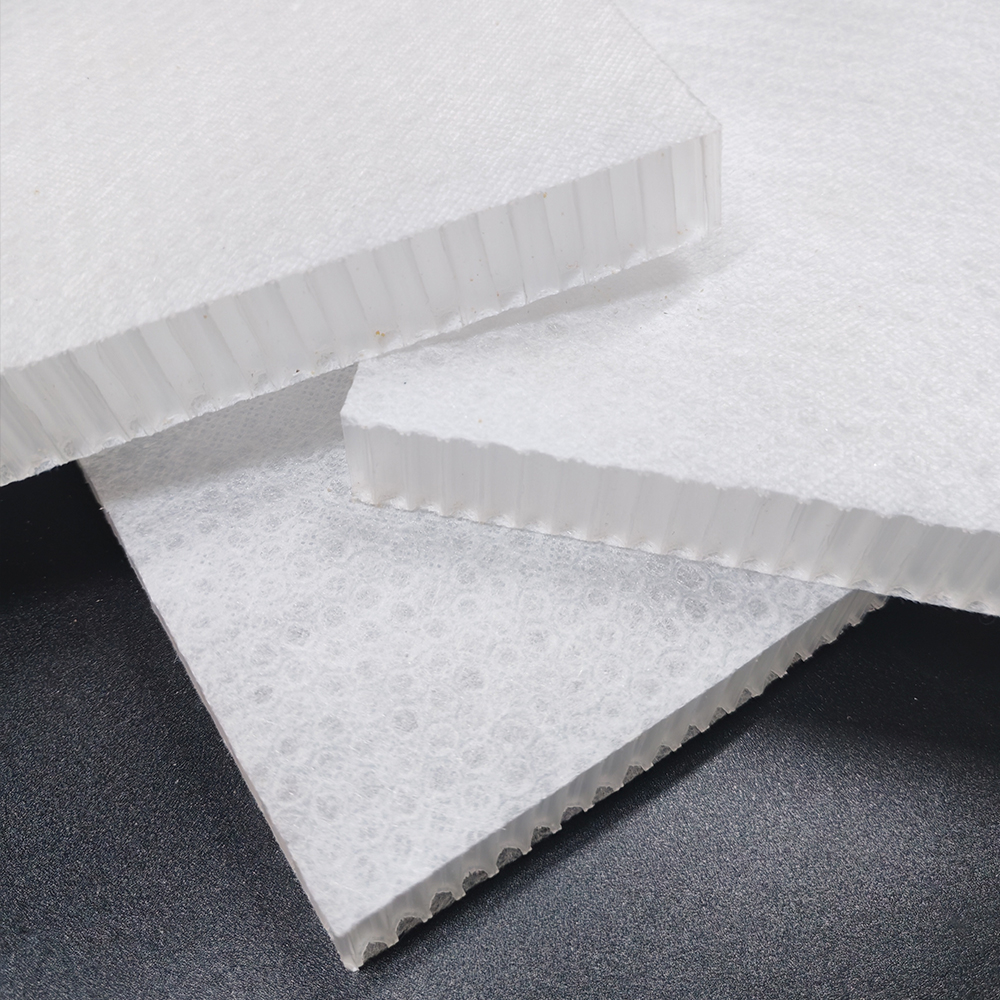
PP honeycomb core is a lightweight cellular material manufactured from polypropylene thermoplastic. Its interconnected hexagonal cells form a honeycomb structure that provides internal support and helps distribute loads across a composite panel.
PP honeycomb core is commonly used in lightweight sandwich structures where low weight, moisture resistance and corrosion-free performance are important.
Depending on the manufacturing process and product configuration, PP honeycomb core can be supplied in different thicknesses, cell sizes, densities and surface configurations.
Common product types include:
- Bare PP Honeycomb Core
- Nonwoven Faced PP Honeycomb Core
- PP Honeycomb Sheets
- Customized PP Honeycomb Core for Composite Panels
PP honeycomb core is frequently considered for FRP composite panels, truck body panels, RV components, transportation structures and industrial sandwich boards.
2. What Is Aluminum Honeycomb Core?
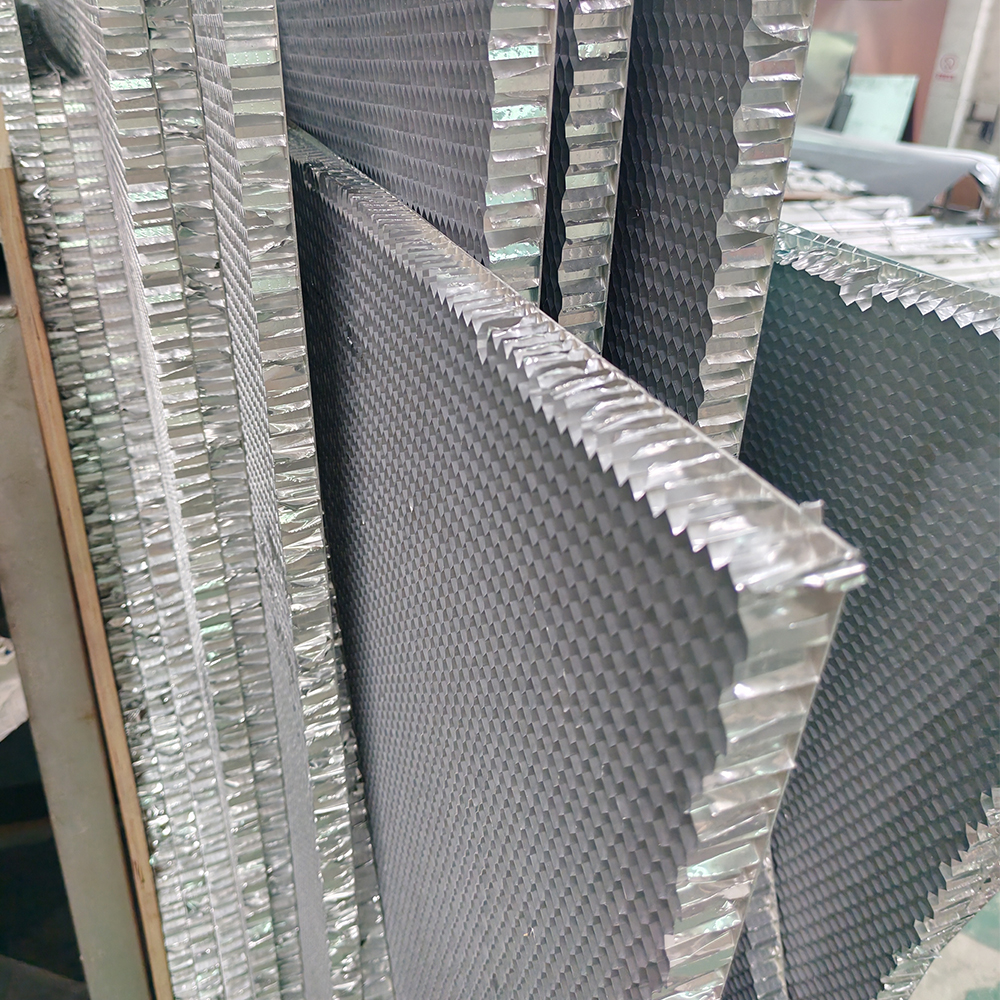
Aluminum honeycomb core is a cellular structural material generally manufactured by bonding and expanding thin aluminum foil into a honeycomb configuration.
The resulting structure combines low structural weight with high stiffness and efficient load distribution. Aluminum honeycomb core is widely used in applications requiring dimensional stability, structural rigidity and high-performance sandwich construction.
Common applications include:
- Aerospace and aviation interior panels
- Rail and metro interior components
- Marine interior panels
- Architectural cladding systems
- Transportation composite panels
- Industrial equipment panels
Aluminum honeycomb core is available in different foil thicknesses, cell sizes, core thicknesses and aluminum alloy configurations. The final mechanical performance depends on these specifications and the direction of loading.
3. PP Honeycomb Core vs Aluminum Honeycomb Core: Main Differences
The two materials share a honeycomb geometry, but their physical and engineering characteristics are different.
| Comparison | PP Honeycomb Core | Aluminum Honeycomb Core |
|---|---|---|
| Base material | Polypropylene thermoplastic | Aluminum alloy foil |
| Structure | Thermoformed cellular structure | Bonded and expanded metal foil structure |
| Material behavior | Flexible thermoplastic behavior | Metallic structural behavior |
| Weight | Generally lightweight; depends on density and thickness | Lightweight for its structural stiffness; depends on foil and cell specifications |
| Corrosion resistance | Does not undergo metallic corrosion | Can be affected by corrosion depending on alloy and environment |
| Moisture behavior | Low water absorption of the PP material | Metal core does not absorb water, but joints and panel interfaces require protection |
| Electrical conductivity | Electrically insulating in its basic form | Electrically conductive |
| Thermal behavior | Thermoplastic; softens at elevated temperatures | Metal; high thermal conductivity |
| Bonding | Requires compatible surface or facing solutions | Requires suitable adhesive and surface preparation |
| Processing | Can be cut and processed using suitable thermoplastic and composite fabrication methods | Requires metal-compatible cutting, machining and handling |
| Typical applications | FRP panels, truck bodies, RV and industrial composite panels | Aerospace, rail, architectural and high-stiffness composite panels |
These are general material characteristics, not guaranteed performance values. Actual properties must be evaluated using the manufacturer’s technical data and the intended panel construction.
4. Weight and Lightweight Performance
Weight reduction is one of the most important reasons manufacturers use honeycomb core materials.
Both PP honeycomb core and aluminum honeycomb core can help reduce the weight of sandwich panels compared with certain solid or heavier-core constructions.
However, comparing the weight of the core alone does not provide a complete picture.
The weight of a honeycomb core depends on several factors:
- Core thickness
- Cell size
- Cell wall thickness or aluminum foil thickness
- Material density
- Manufacturing configuration
- Surface treatment or facing materials
For PP honeycomb core, the apparent density and cellular geometry have a direct influence on core weight.
For aluminum honeycomb core, aluminum foil thickness, cell size, alloy and expansion quality are important factors.
The final panel weight also includes the facing materials, adhesive, coatings and additional structural components.
Procurement consideration: Buyers should compare the areal weight of the complete sandwich panel rather than selecting a material based only on the weight of an individual core sheet.
5. Mechanical Strength and Structural Performance
Mechanical performance is often the deciding factor when selecting honeycomb core materials.
5.1 Compression Performance
Compression performance describes how a core responds to loads applied perpendicular to its surface.
PP honeycomb core can deform through cell wall bending, buckling or collapse, depending on its density, cell geometry and material characteristics.
Aluminum honeycomb core can provide high compression resistance relative to its weight when properly designed. Its performance is influenced by foil thickness, cell size, alloy and manufacturing quality.
Neither material has a universal compression-strength advantage under every configuration.
For a meaningful comparison, buyers should request compression test results obtained under comparable conditions, including specimen dimensions, loading direction and test method.
5.2 Shear Performance
Core shear properties are particularly important in sandwich panels because the core transfers shear loads between the two facing materials.
Aluminum honeycomb core is widely used in engineered sandwich structures where high stiffness and structural efficiency are required.
PP honeycomb core can also be used in structural sandwich panels, provided its core geometry, density, bonding system and facing materials are appropriately selected.
The shear properties of the complete panel depend not only on the core but also on the skin-to-core interface.
5.3 Flexural Performance
A sandwich panel’s bending performance is determined by the combined action of its facings and core.
The facings carry much of the tensile and compressive stress generated during bending, while the core maintains separation between the skins and transfers shear loads.
Therefore, the bending strength and stiffness of an FRP/PP honeycomb panel or an aluminum honeycomb sandwich panel cannot be accurately predicted from core material alone.
Testing the complete sandwich panel is essential when structural performance is a critical requirement.
6. Corrosion Resistance and Environmental Adaptability
Environmental conditions can strongly influence the service life of composite panels.
PP Honeycomb Core
Polypropylene is a thermoplastic polymer and does not undergo metallic corrosion. Its low water absorption makes it a useful option for applications exposed to moisture.
However, this does not mean that every PP honeycomb sandwich panel is waterproof under all conditions. The facings, adhesive interfaces, edges, joints and installation details must also be considered.
Aluminum Honeycomb Core
Aluminum honeycomb core offers good corrosion resistance in many environments, but aluminum can still be affected by corrosion under certain conditions.
Exposure to moisture, salts, chemicals and dissimilar metals may create corrosion risks if the material and panel design are not properly selected.
For marine or outdoor applications, buyers should evaluate alloy selection, protective coatings, edge sealing and the overall panel construction.
Selection advice: PP honeycomb core may be attractive where moisture resistance and avoidance of metallic corrosion are priorities. Aluminum honeycomb core may be suitable where its structural properties and metal-based construction meet the engineering requirements.
7. Bonding and Compatibility with Composite Facings
Bonding is a critical factor in honeycomb sandwich panel manufacturing.
A honeycomb core must be securely connected to its facing materials to transfer loads effectively. Poor bonding can lead to delamination and reduced panel performance.
Bonding PP Honeycomb Core
Polypropylene has relatively low surface energy, which can make direct bonding with conventional adhesives and resins difficult.
Depending on the panel design, manufacturers may consider:
- Nonwoven faced PP honeycomb core
- Appropriate surface treatment
- Compatible adhesive systems
- Suitable lamination conditions
- Process validation through bond testing
For FRP sandwich panels, the compatibility of the PP core, nonwoven facing, adhesive and fiberglass skin should be evaluated together.
When nonwoven faced PP honeycomb core is used, two interfaces require attention:
- The bonding interface between the PP core and nonwoven facing.
- The bonding interface between the nonwoven facing and the FRP skin.
The presence of a nonwoven layer does not automatically guarantee strong bonding. The complete bonding system must be validated.
Bonding Aluminum Honeycomb Core
Aluminum honeycomb core is commonly bonded to aluminum, FRP and other facing materials using suitable structural adhesives.
Surface cleanliness, surface preparation, adhesive selection, curing conditions and process control all affect bonding quality.
In some applications, additional protective or surface-treatment processes may be required to improve long-term interface durability.
For both materials, buyers should request information about the recommended adhesive system and relevant bonding test results.
8. Manufacturing and Processing Differences
The manufacturing methods of PP honeycomb core and aluminum honeycomb core are different.
| Manufacturing Factor | PP Honeycomb Core | Aluminum Honeycomb Core |
|---|---|---|
| Main material | Polypropylene | Aluminum foil |
| Typical production route | Thermoforming and cellular structure forming | Foil bonding, expansion and cutting |
| Core configuration | Bare or faced core | Expanded aluminum honeycomb |
| Cutting | Suitable mechanical cutting and processing | Metal-compatible cutting and machining |
| Surface configuration | Bare or nonwoven faced | Metal surface; optional treatments depending on application |
| Key quality factors | Cell consistency, thickness, density and facing quality | Foil thickness, cell geometry, bonding quality and expansion consistency |
For PP honeycomb core, important manufacturing controls include temperature management, forming consistency, cooling, dimensional stability and surface configuration.
For aluminum honeycomb core, key factors include foil quality, adhesive distribution, expansion accuracy, cell geometry and dimensional control.
The manufacturing process should be matched to the intended core specification and final panel application.
9. Cost Comparison: Which Honeycomb Core Is More Economical?
Cost is an important purchasing consideration, but it should not be evaluated using material price alone.
The total cost of a honeycomb sandwich panel may include:
- Core material cost
- Facing material cost
- Adhesive and surface treatment cost
- Lamination and processing cost
- Cutting and machining cost
- Quality inspection and testing
- Transportation and installation
- Maintenance and service-life considerations
PP honeycomb core may offer cost advantages in certain applications, especially when its material characteristics and processing requirements align with the production system.
Aluminum honeycomb core may justify a higher material or processing cost in applications requiring specific stiffness, dimensional stability or metal-based structural characteristics.
However, the actual cost difference depends on specifications, order volume, manufacturing process and supplier capabilities.
For procurement teams: Request quotations based on the same core thickness, target areal weight, cell size, facing configuration and testing requirements. This provides a more useful comparison than comparing two products with different specifications.
10. Application Comparison: Where Should Each Material Be Used?
The most appropriate core material depends on the application and its performance requirements.
PP Honeycomb Core Applications
Truck Body and Trailer Panels
PP honeycomb core can be considered for lightweight FRP sandwich panels used in truck bodies and trailers. The material can help reduce panel weight while providing a cellular support structure.
The final design should account for compression, shear, impact, fastening points and bonding performance.
RV and Caravan Panels
In recreational vehicle manufacturing, weight reduction and moisture resistance are important considerations.
PP honeycomb core can be used in selected wall, floor, roof and interior panel constructions when the complete sandwich structure meets the required mechanical and durability specifications.
Marine Composite Panels
PP honeycomb core may be considered for selected marine interior and composite panel applications where moisture resistance and low weight are important.
For structural or safety-critical marine applications, fire performance, smoke requirements, mechanical properties and applicable marine regulations must be assessed separately.
Industrial Composite Panels
PP honeycomb core can be used in customized lightweight panels for industrial equipment, protective structures and other applications where a thermoplastic honeycomb structure is suitable.
Aluminum Honeycomb Core Applications
Aerospace and Aviation
Aluminum honeycomb core is widely used in aerospace sandwich structures and aircraft interior components where structural efficiency and weight control are critical.
Rail and Metro Transportation
Aluminum honeycomb core is used in selected rail and metro interior panels, doors and other lightweight structural components.
Architectural Panels
Aluminum honeycomb core can be used in architectural composite panels where flatness, rigidity and dimensional stability are important.
Marine and Industrial Engineering
Aluminum honeycomb core is also used in marine interiors, industrial equipment and other engineered sandwich structures, subject to appropriate corrosion protection and bonding design.
11. How to Choose Between PP Honeycomb Core and Aluminum Honeycomb Core
Before selecting a honeycomb core, buyers should identify the actual requirements of the finished panel.
The following checklist can help organize the selection process.
| Selection Factor | Questions to Ask |
|---|---|
| Application | Is the panel used for a truck body, RV, marine interior, rail or architectural project? |
| Target weight | What is the maximum allowable panel weight per square meter? |
| Mechanical requirements | What compression, shear and flexural performance is required? |
| Core thickness | What core thickness is needed for the panel design? |
| Cell size | Which cell size is suitable for the required support and manufacturing process? |
| Facing materials | Will the panel use FRP, aluminum, fiberglass, wood-based or other skins? |
| Bonding method | Is the selected adhesive compatible with the core and facings? |
| Environment | Will the panel be exposed to water, salt, chemicals, heat or outdoor conditions? |
| Fire requirements | Are there specific fire, smoke or toxicity standards? |
| Production process | Is the panel manufactured through adhesive lamination, vacuum-assisted processing or press lamination? |
| Total cost | What is the target cost of the complete sandwich panel? |
A material should only be selected after its properties and processing compatibility have been evaluated against the actual application requirements.
12. Why Consider ONEBOND PP Honeycomb Core?
ONEBOND focuses on composite core materials and lightweight sandwich panel solutions for industrial applications.
Our PP honeycomb core product range is intended for manufacturers and buyers looking for customized cellular core materials for composite panel production.
Available configurations can be discussed according to project requirements, including:
- Bare PP Honeycomb Core
- Nonwoven Faced PP Honeycomb Core
- Customized PP Honeycomb Sheets
- PP Honeycomb Core for FRP Composite Panels
- PP Honeycomb Core for Truck Body and Transportation Panels
When evaluating a customized PP honeycomb core solution, buyers can discuss core thickness, cell size, density or areal weight, sheet dimensions, facing configuration and intended bonding process.
The right configuration should be selected according to the complete sandwich panel design rather than a single material specification.
13. Request a Customized PP Honeycomb Core Solution
Are you comparing PP honeycomb core with aluminum honeycomb core for your next composite panel project?
ONEBOND can discuss customized PP honeycomb core configurations for FRP composite panels, truck body panels, RV components and other lightweight industrial applications.
To help evaluate a suitable solution, please provide:
- Application and end-use environment
- Required core thickness
- Target cell size
- Target density or areal weight
- Facing material, if required
- Panel dimensions
- Estimated order quantity
- Mechanical or bonding requirements
Contact ONEBOND to discuss your project specifications and request product information.
Frequently Asked Questions
1. What is the main difference between PP honeycomb core and aluminum honeycomb core?
PP honeycomb core is made from polypropylene thermoplastic, while aluminum honeycomb core is made from bonded aluminum foil. They differ in mechanical behavior, corrosion characteristics, bonding requirements and applications.
2. Is PP honeycomb core lighter than aluminum honeycomb core?
It depends on the density, cell size, foil thickness and core dimensions. A meaningful comparison should use equivalent specifications and compare the complete panel weight.
3. Which honeycomb core has better compression strength?
Neither material is universally stronger. Compression performance depends on core density, cell geometry, material thickness and test conditions.
4. Can PP honeycomb core be used with FRP skins?
Yes. PP honeycomb core can be incorporated into FRP sandwich panels, but the bonding system must be carefully selected and validated because polypropylene has relatively low surface energy.
5. Is aluminum honeycomb core suitable for marine applications?
It can be used in selected marine applications, provided alloy selection, corrosion protection, edge sealing and bonding are appropriately designed.
6. Does nonwoven faced PP honeycomb core improve bonding?
A nonwoven facing can provide a more suitable bonding interface for certain composite manufacturing processes. However, both the facing-to-core and skin-to-facing interfaces must be tested.
7. Which honeycomb core is more cost-effective?
The answer depends on material specifications, processing requirements, order quantity and total panel manufacturing costs. Buyers should compare equivalent finished panel configurations.
8. What specifications should buyers provide when ordering PP honeycomb core?
Important specifications include thickness, cell size, density or areal weight, sheet dimensions, facing configuration, application and estimated order quantity.
