
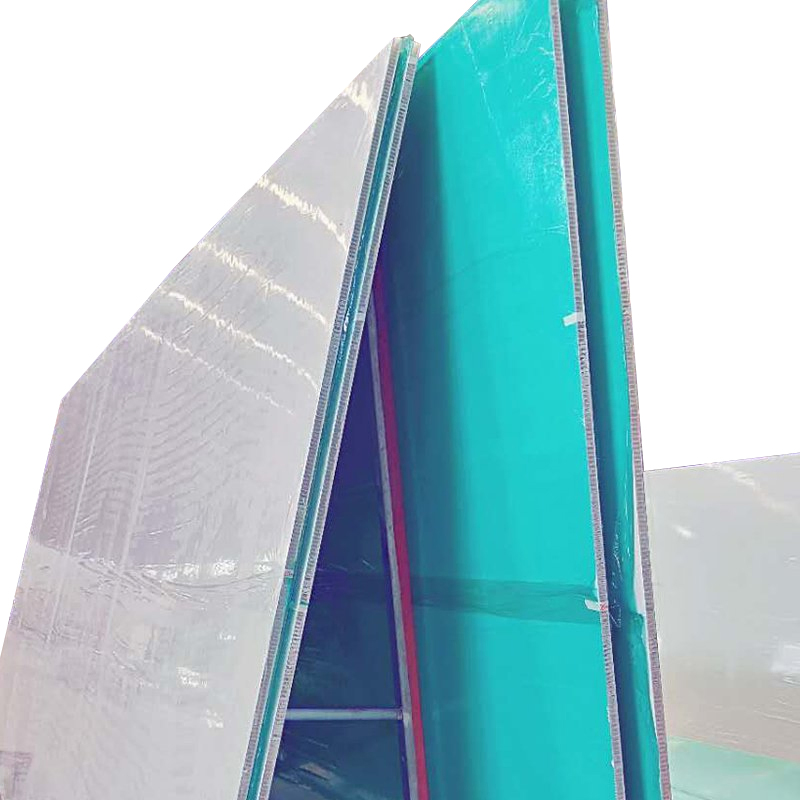
FRP Sandwich Panel Manufacturing Process: Core Preparation, Adhesive Bonding, Pressing and Quality Control
FRP sandwich panels are widely used in truck bodies, refrigerated vehicles, RVs, marine interiors, construction panels, and industrial composite structures. Their lightweight construction, high stiffness-to-weight ratio, corrosion resistance, and design flexibility make them an attractive alternative to conventional solid panels.
However, manufacturing a reliable FRP sandwich panel involves more than placing a core material between two fiberglass sheets. The final panel performance depends on the compatibility of the FRP skins, core material, adhesive system, surface preparation, pressing conditions, curing process, and quality inspection.
For composite panel manufacturers, understanding each production stage is essential to achieving consistent bonding strength, dimensional accuracy, and structural performance.
This guide explains the major stages of the FRP sandwich panel manufacturing process and highlights the technical factors that manufacturers should consider when selecting core materials and production methods.
1. Understanding the Basic Structure of an FRP Sandwich Panel
An FRP sandwich panel generally consists of three main components:
- FRP Skin: The outer fiberglass-reinforced plastic layers provide surface protection, tensile strength, and bending resistance.
- Core Material: The lightweight core separates the two skins and contributes to panel thickness, stiffness, compression resistance, and thermal performance.
- Bonding Interface: The adhesive or resin system transfers loads between the FRP skins and the core.
The core material can be selected according to the intended application.
| Core Material | Typical Characteristics | Potential Applications |
|---|---|---|
| PP Honeycomb Core | Lightweight cellular structure, good thickness stability | Vehicle panels, RV panels, furniture panels |
| PET Foam Core | Closed-cell foam structure, suitable for composite sandwich construction | Transportation, marine, industrial panels |
| PVC Foam Core | Structural foam with configurable density and thickness | Marine, wind energy, transportation |
| XPS Foam Core | Lightweight foam with thermal insulation characteristics | Building panels, insulated composite panels |
| PU Foam Core | Commonly selected for thermal insulation applications | Refrigerated vehicles, insulated panels |
| Aluminum Honeycomb Core | High stiffness-to-weight potential | Architectural, transportation, industrial panels |
The correct core should be selected based on mechanical loading, panel dimensions, operating environment, bonding compatibility, and manufacturing requirements.
Not every core material uses the same bonding process. In particular, polypropylene honeycomb has a relatively low surface energy, so its bonding performance must be carefully evaluated before production.
2. Core Material Preparation
Core preparation is one of the most important stages in FRP sandwich panel manufacturing.
Before assembly, the core must be checked for dimensional accuracy, surface condition, thickness consistency, and suitability for the selected bonding system.
2.1 Cutting and Dimension Control
Core materials are usually cut according to the required panel dimensions.
Depending on the material and production setup, manufacturers may use:
- CNC cutting machines
- Panel saws
- Hot-wire cutting equipment for suitable foam materials
- Specialized trimming equipment
- Automated cutting systems
The core dimensions should match the FRP skin dimensions and the intended bonding area.
Uneven edges, excessive dimensional variation, or damaged corners can create assembly gaps and localized stress concentrations.
2.2 Surface Preparation
The surface condition of the core directly affects the bonding interface.
For foam cores, manufacturers should check for dust, loose particles, contamination, and surface damage.
For PP honeycomb core, additional attention is required because polypropylene has low surface energy. Conventional adhesives and resin systems may not provide reliable adhesion to untreated PP surfaces.
Possible approaches include:
- Corona or plasma treatment
- Flame treatment where appropriate
- Compatible surface primers
- Nonwoven-faced PP honeycomb core
- Other validated surface modification methods
The selected method must be compatible with the adhesive, FRP skin, production conditions, and required service performance.
A nonwoven facing can provide a more suitable bonding surface, but it does not automatically guarantee strong bonding. Manufacturers should verify both the core-to-facing interface and the facing-to-FRP interface.
3. FRP Skin Preparation
FRP skins form the external surfaces of the sandwich panel. Their condition and compatibility with the bonding system are critical to the final product.
FRP skins can be manufactured using different reinforcement materials and resin systems, including:
- Fiberglass-reinforced polyester
- Fiberglass-reinforced vinyl ester
- Fiberglass-reinforced epoxy
- Gel-coated FRP sheets
- Other customized fiberglass composite skins
Before bonding, manufacturers should inspect the skins for:
- Surface contamination
- Scratches, cracks, and visible defects
- Surface flatness
- Thickness consistency
- Resin curing condition
- Compatibility with the selected adhesive
The bonding surface may require cleaning, sanding, or other preparation depending on the skin material and adhesive manufacturer’s instructions.
Excessive sanding should be avoided because it may damage the reinforcement or reduce the effective skin thickness.
4. Adhesive Selection and Bonding Compatibility
Adhesive selection is a major factor in FRP sandwich panel production.
The adhesive must be compatible with both the FRP skin and the core material. It should also meet the requirements of the intended service environment.
Common adhesive categories include:
| Adhesive Type | General Characteristics | Selection Considerations |
|---|---|---|
| Two-component polyurethane adhesive | Can be formulated for flexible or structural bonding | Mixing ratio, curing conditions, substrate compatibility |
| Epoxy adhesive | Available in structural bonding formulations | Surface preparation, working time, curing temperature |
| Polyester-based bonding systems | Used in selected FRP manufacturing processes | Resin compatibility, cure behavior, core resistance |
| Other structural adhesives | Formulated for specific composite structures | Technical data, processing window, service environment |
There is no universal adhesive suitable for every FRP sandwich panel.
For example, an adhesive system suitable for PVC foam may not bond untreated PP honeycomb reliably. Similarly, a resin system used with one foam material may cause surface damage or other compatibility issues with another core.
Before full-scale production, manufacturers should conduct bonding trials using the actual FRP skin, core material, adhesive, and process conditions.
Important evaluation items include:
- Adhesive wetting and spreading
- Open time and working time
- Adhesive thickness
- Curing temperature and duration
- Bonding strength
- Environmental resistance
- Failure mode after testing
5. Adhesive Application
After the materials have been prepared and the bonding system confirmed, adhesive is applied to the designated bonding surfaces.
Depending on the production method, adhesive can be applied manually or through controlled dispensing equipment.
The main objective is to achieve consistent adhesive distribution without excessive or insufficient application.
Manufacturers should control:
- Adhesive quantity per unit area
- Mixing ratio for two-component systems
- Application uniformity
- Open time
- Surface cleanliness
- Assembly time after application
Too little adhesive can lead to incomplete bonding and localized delamination.
Excessive adhesive may increase product weight, create uneven bond lines, and increase material costs.
The optimum adhesive quantity should be determined through production trials and verified against the adhesive supplier’s technical recommendations.
6. Panel Assembly and Positioning
After adhesive application, the FRP skins and core are assembled into the sandwich structure.
A typical assembly sequence includes:
- Position the lower FRP skin.
- Apply adhesive according to the validated process.
- Place the prepared core material.
- Align the core with the panel dimensions.
- Apply adhesive to the upper bonding surface if required.
- Position the upper FRP skin.
- Check alignment and remove unintended assembly gaps.
For large panels, accurate positioning becomes especially important.
Misalignment may cause uneven edges, dimensional errors, and difficulties during subsequent trimming and installation.
For panels with inserts, reinforced sections, mounting points, or special cutouts, these components should be positioned according to the approved panel design.
7. Pressing and Curing Process
Pressing helps maintain contact between the FRP skins and core while the adhesive develops its required bonding strength.
Depending on the materials and adhesive system, manufacturers may use:
- Hydraulic hot presses
- Cold presses
- Vacuum pressing systems
- Other controlled compression equipment
The correct process depends on the core’s compression resistance, skin structure, adhesive chemistry, and panel thickness.
Key Pressing Parameters
| Parameter | Why It Matters |
|---|---|
| Pressing Pressure | Ensures appropriate contact between bonding surfaces |
| Temperature | Influences adhesive curing and material stability |
| Pressing Time | Must match the adhesive curing requirements |
| Panel Flatness | Helps prevent dimensional deformation |
| Core Compression | Prevents excessive crushing or cell deformation |
| Pressure Uniformity | Reduces local bonding defects |
Pressing pressure should not simply be increased to achieve stronger bonding.
Excessive pressure may crush low-density foam, deform honeycomb cells, squeeze out too much adhesive, or cause uneven panel thickness.
Similarly, insufficient pressure may result in incomplete contact and weak bonding.
The correct pressure, temperature, and curing time should be established through material-specific trials and the adhesive manufacturer’s technical recommendations.
8. Trimming, CNC Cutting and Edge Finishing
After the required curing period, the panel can proceed to trimming and finishing.
Typical operations include:
- Edge trimming
- CNC cutting
- Drilling
- Routing
- Opening and cutout machining
- Edge sealing
- Installation of inserts or edge profiles
Cutting conditions should be suitable for the FRP skin and core combination.
For example, cutting a panel with an aluminum honeycomb core may require different tooling and machining parameters from those used for a foam-core panel.
During machining, manufacturers should inspect for:
- FRP skin chipping
- Core tearing or crushing
- Delamination near cut edges
- Dimensional deviations
- Exposed core areas requiring sealing
For panels used in vehicles, marine structures, and humid environments, appropriate edge protection can help reduce moisture ingress and protect the sandwich structure.
9. Quality Control for FRP Sandwich Panels
A reliable FRP sandwich panel manufacturing process requires quality inspection at multiple production stages.
Checking only the finished panel appearance is not sufficient. Internal bonding defects may not be visible from the outside.
9.1 Incoming Material Inspection
Before production, inspect:
- FRP skin thickness and appearance
- Core density and thickness
- Core surface condition
- Adhesive shelf life and storage condition
- Material identification and batch records
9.2 In-Process Inspection
During manufacturing, monitor:
- Cutting dimensions
- Surface preparation
- Adhesive mixing and application
- Assembly alignment
- Pressing conditions
- Curing time and temperature
Production records help manufacturers identify the causes of quality variations.
9.3 Finished Panel Inspection
| Inspection Item | Purpose |
|---|---|
| Panel Thickness | Confirms dimensional consistency |
| Panel Length and Width | Verifies manufacturing dimensions |
| Surface Appearance | Identifies scratches, bubbles, and visible defects |
| Flatness | Evaluates panel deformation |
| Weight per Square Meter | Helps control product consistency |
| Bonding Strength | Evaluates skin-to-core adhesion |
| Compression Performance | Assesses resistance to compressive loading |
| Bending Performance | Evaluates structural behavior |
| Water Absorption | Relevant to selected applications and material systems |
Test methods should be selected according to the panel structure and intended application.
For example, ASTM C297/C297M can be considered for flatwise tensile strength of sandwich constructions, while ASTM C393/C393M is commonly used for flexural testing of sandwich constructions. The applicable test configuration and current standard edition should be confirmed before testing.
9.4 Common Manufacturing Defects and Possible Causes
| Defect | Possible Causes | Recommended Checks |
|---|---|---|
| Skin Delamination | Poor surface preparation or incompatible adhesive | Verify substrate preparation and bonding system |
| Incomplete Bonding | Uneven adhesive application | Check adhesive coverage and assembly timing |
| Core Crushing | Excessive pressing pressure | Review core compression characteristics |
| Panel Warping | Uneven pressure or curing conditions | Check press uniformity and curing process |
| Surface Bubbles | Trapped air or uneven bonding | Review assembly and adhesive application |
| Edge Delamination | Poor edge bonding or machining damage | Inspect trimming and edge protection |
| Inconsistent Thickness | Uneven core thickness or pressing conditions | Check incoming materials and press control |
Manufacturers should identify the root cause rather than simply increasing adhesive quantity or pressing pressure.
10. How Core Material Selection Affects the Manufacturing Process
Different core materials require different preparation and bonding considerations.
| Core Material | Main Manufacturing Consideration | Potential Application |
|---|---|---|
| PP Honeycomb Core | Low surface energy; bonding interface needs validation | RV, truck body, furniture |
| PET Foam Core | Verify surface condition and adhesive compatibility | Transportation, marine, industrial |
| PVC Foam Core | Match adhesive and resin system to foam grade | Marine, wind energy, structural panels |
| XPS Foam Core | Check compatibility with adhesive and resin chemistry | Building and insulated panels |
| PU Foam Core | Verify dimensional stability and adhesive compatibility | Insulated vehicle panels |
| Aluminum Honeycomb Core | Consider foil surface condition, cell structure, and edge treatment | Architectural and industrial panels |
The choice of core should be based on the required panel performance, manufacturing process, and total production cost.
For example, a lightweight PP honeycomb core may be suitable for a particular RV wall panel, while a PVC foam core may be more appropriate for a structural marine application.
The best solution depends on the actual design and performance requirements rather than the material name alone.
11. How to Improve FRP Sandwich Panel Production Efficiency
Manufacturers can improve production consistency and efficiency by focusing on process control rather than relying only on faster equipment.
Key improvement areas include:
1. Standardize Material Specifications
Define the required FRP skin thickness, core thickness, density, adhesive type, and panel dimensions for each product model.
2. Establish a Validated Bonding Process
Create documented procedures for surface preparation, adhesive application, assembly time, pressing, and curing.
3. Improve Cutting Accuracy
Use appropriate cutting equipment and process parameters to reduce material waste and dimensional variation.
4. Monitor Production Data
Record adhesive consumption, pressing parameters, curing conditions, panel weight, and inspection results.
5. Introduce Batch Traceability
Maintain records for core materials, FRP skins, adhesives, and finished panel batches.
6. Optimize Panel Structure
Evaluate core type, thickness, density, and local reinforcement together. A suitable structural design can reduce unnecessary material consumption while maintaining the required performance.
12. What Should Buyers Specify When Sourcing FRP Sandwich Panels or Core Materials?
For composite panel manufacturers, clear technical specifications help suppliers recommend suitable materials and reduce trial-and-error during production.
Buyers should prepare the following information:
| Specification | Information to Provide |
|---|---|
| Application | RV, truck body, marine, construction, industrial |
| Panel Dimensions | Length, width, and thickness |
| FRP Skin | Material type, thickness, surface finish |
| Core Material | PP honeycomb, PET foam, PVC foam, XPS, PU, or aluminum honeycomb |
| Core Density | Required density or target range |
| Core Thickness | Required thickness |
| Bonding Method | Adhesive or resin system |
| Mechanical Requirements | Compression, bending, shear, or bonding requirements |
| Environmental Conditions | Temperature, moisture, chemical exposure |
| Production Quantity | Prototype, trial order, or mass production |
| Customization | Cutting, facing, inserts, special shapes |
If the buyer is purchasing core materials rather than finished panels, additional details such as cell size, foil thickness, facing type, surface treatment, and cutting tolerance may also be required.
13. ONEBOND: Core Materials for FRP Sandwich Panel Manufacturers
ONEBOND focuses on composite core materials for lightweight sandwich panel manufacturing.
Our product range includes:
- PP Honeycomb Core
- PET Foam Core
- PVC Foam Core
- XPS Foam Core
- PU Foam Core
- Aluminum Honeycomb Core
These materials can be evaluated for different FRP sandwich panel structures used in transportation, marine, construction, and industrial applications.
For composite panel manufacturers, selecting the right core material is only one part of the production process. Bonding compatibility, panel structure, processing conditions, and final application requirements must also be considered.
ONEBOND supports material selection and customized core solutions according to project requirements.
Contact our team with your panel structure, core specifications, application, and target performance requirements to discuss a suitable material solution.
Frequently Asked Questions
1. What are the main steps in the FRP sandwich panel manufacturing process?
The main steps include core preparation, FRP skin preparation, adhesive application, panel assembly, pressing, curing, trimming, and finished-product inspection.
2. Which core materials are used in FRP sandwich panels?
Common options include PP honeycomb core, PET foam core, PVC foam core, XPS foam core, PU foam core, and aluminum honeycomb core.
3. What adhesive is used for FRP sandwich panel bonding?
The adhesive depends on the FRP skin, core material, service environment, and required bonding strength. A compatibility test is recommended before mass production.
4. Can PP honeycomb core be bonded directly to FRP skins?
It may be possible with a validated bonding system, but untreated polypropylene has low surface energy. Surface treatment, compatible adhesive systems, or suitable facing materials may be required.
5. What causes delamination in FRP sandwich panels?
Common causes include poor surface preparation, incompatible adhesive, uneven adhesive application, incorrect pressing conditions, and insufficient curing.
6. Does higher pressing pressure always improve bonding strength?
No. Excessive pressure can crush the core, deform honeycomb cells, or squeeze out too much adhesive. Pressure must be matched to the material and process.
7. How is FRP sandwich panel bonding strength tested?
Testing methods depend on the panel design. Flatwise tensile and sandwich beam flexural tests are examples of methods used to evaluate different aspects of sandwich construction performance.
8. Which core material is suitable for RV sandwich panels?
PP honeycomb, PET foam, PVC foam, and XPS foam may all be considered, depending on the panel location, structural requirements, thermal performance, and bonding system.
9. How can manufacturers reduce FRP sandwich panel production defects?
Standardized material specifications, validated bonding procedures, controlled pressing and curing, accurate cutting, and systematic inspection can help reduce defects.
10. What information is needed to customize FRP sandwich panel core materials?
Buyers should provide the application, panel dimensions, core material, density, thickness, facing requirements, bonding method, and target mechanical performance.
Conclusion
FRP sandwich panel manufacturing is a coordinated process involving material selection, surface preparation, adhesive bonding, pressing, curing, machining, and quality control.
The most important factor is compatibility between the FRP skin, core material, and bonding system. A process that works for one core material may not work for another.
For manufacturers producing RV panels, truck body panels, marine structures, or industrial composite boards, validating the complete sandwich structure is essential to achieving stable product quality.
By combining suitable core materials with controlled manufacturing procedures, composite panel producers can improve production consistency, reduce material waste, and develop lightweight panels for demanding applications.
