
Table of Contents
- Introduction: Why Foam Core Matters in Wind Energy
- Understanding Sandwich Structures in Blade Engineering
- Types of Foam Cores Used in Wind Turbine Blades
- Performance Requirements for Structural Core Materials
- PVC, PET, SAN, and Balsa: Comparative Technical Analysis
- Foam Core Density, Strength, and Mechanical Behavior
- Manufacturing Processes: Infusion, Prepreg, and Hybrid Methods
- Foam Core Kit Production & CNC Customization
- Core Surface Treatments: Grooving, Perforation, and Scoring
- Application Zones in Wind Turbine Blades
- Fatigue Performance and Long-Term Durability
- Environmental Factors: Offshore vs. Onshore Conditions
- Sustainability and Recyclability of Core Materials
- Cost, Supply Stability, and Global Material Trends
- Common Failure Modes and Engineering Solutions
- Future Trends: 100m+ Blades, Automation, and Thermoplastic Composites
- Choosing the Right Foam Core Material: Engineering Framework
- Conclusion
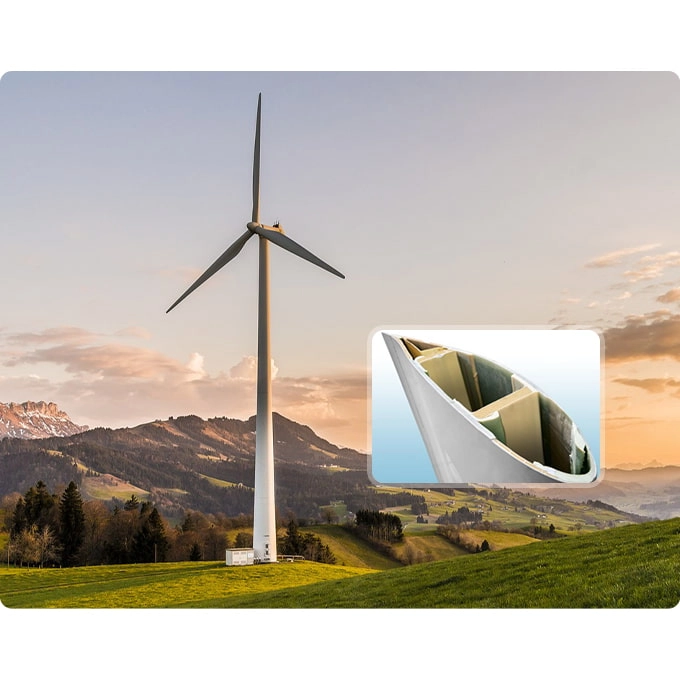
1. Introduction: Why Foam Core Matters in Wind Energy
Wind turbine blades are among the world’s largest composite structures, with modern rotor lengths exceeding 100 meters. As blades grow longer, lighter, and stiffer, the internal sandwich construction becomes increasingly critical. At the center of this construction lies the foam core material.
Foam cores are essential because they enable:
- High stiffness-to-weight ratio
- Reduced structural mass
- Improved fatigue performance
- Optimized load transfer
- Efficient infusion and manufacturing cycles
Without foam cores, blade shells and shear webs would require significantly thicker laminate stacks, increasing mass and reducing aero-structural efficiency.
In short: Foam core materials are fundamental to enabling modern utility-scale wind turbines.
2. Understanding Sandwich Structures in Blade Engineering
Wind turbine blades use a sandwich structure, where a lightweight core material is bonded between two composite skins. This configuration:
- Increases bending stiffness
- Reduces material consumption
- Controls buckling and deformation
- Supports aerodynamic shape retention
Why sandwich structures matter
For a beam or shell, bending stiffness (EI) increases exponentially with thickness. By inserting a foam core, engineers increase the effective thickness of the laminate without adding excessive weight.
Typical sandwich zones:
- Blade shell panels
- Leading and trailing edge reinforcements
- Shear webs
- Spar caps (in specific designs)
Sandwich design has become standard across all major OEM platforms, from onshore turbines to next-generation offshore giants.
3. Types of Foam Cores Used in Wind Turbine Blades
The wind industry uses several types of structural foam cores, each with unique mechanical properties and processing advantages.
3.1 PVC (Polyvinyl Chloride) Foam
Characteristics:
- Closed-cell structure
- High shear strength
- Good fatigue performance
- Processable via thermoforming
PVC is one of the most widely adopted materials due to its strength and production maturity.
3.2 PET (Polyethylene Terephthalate) Foam
Characteristics:
- Fully recyclable thermoplastic
- Consistent mechanical properties
- Favorable cost-performance ratio
- Increasingly used for large offshore blades
PET’s recyclability has made it the fastest-growing core material globally.
3.3 SAN (Styrene-Acrylonitrile) Foam
Characteristics:
- High temperature resistance
- Superior shear modulus
- Excellent dimensional stability
SAN is often specified for high-stress zones in 80–100m+ blades.
3.4 Balsa Wood
Characteristics:
- High compressive and shear strength
- Natural variability
- Moisture sensitivity
Historically dominant, balsa is now being replaced by engineered foams due to supply instability.
4. Performance Requirements for Structural Core Materials
Core materials must meet strict engineering criteria:
Mechanical Properties
- Shear strength
- Shear modulus
- Compression strength
- Tensile properties
- Fatigue resistance
These determine load transfer between skins and overall stiffness.
Thermal Properties
- Heat deflection temperature
- Dimensional stability
- Compatibility with curing cycles
Prepreg blades demand cores that maintain stability during elevated-temperature cures.
Chemical Compatibility
Foam cores must function with:
- Epoxy
- Polyester
- Vinyl ester
- Infusion resins
Processing Requirements
Cores must withstand:
- Vacuum pressure
- Resin flow
- Curing/shrinkage forces
These requirements define how well the core integrates into the blade manufacturing process.
5. PVC, PET, SAN, and Balsa: Comparative Technical Analysis
Shear Strength & Modulus
- SAN > PVC > PET > Balsa (variable)
Thermal Stability
- SAN highest
- High-temp PET emerging
Sustainability
- PET (100% recyclable)
- PVC & SAN partially recyclable
- Balsa biodegradable but supply-volatile
Cost Efficiency
- PET is the cost-performance leader
- PVC moderate
- SAN premium
- Balsa fluctuates
Processing Compatibility
- All foams compatible with infusion
- PVC is easiest to thermoform
Engineers select based on zone-specific requirements and economic considerations.
6. Foam Core Density, Strength, and Mechanical Behavior
Foam cores are offered in densities from 60 kg/m³ to 250 kg/m³, with mechanical properties scaling proportionally.
Low-Density Foams (60–100 kg/m³)
Used for:
- Shell sections
- Low-stress aerodynamics zones
Medium-Density Foams (100–150 kg/m³)
Used for:
- Shear webs
- Stiffeners
- Transition sections
High-Density Foams (150–250 kg/m³)
Used for:
- Bonding inserts
- Root transitions
- High-load zones
Density selection balances stiffness, weight, and cost.
7. Manufacturing Processes: Infusion, Prepreg, and Hybrid Methods
Foam cores must perform reliably across manufacturing processes.
Vacuum Resin Infusion (VARTM)
Most common method for utility-scale blades.
Foam requirements:
- Grooved/perforated channels for resin flow
- Sufficient compression strength
- Low resin uptake
Prepreg Layup
Used by premium OEMs.
Foam requirements:
- High thermal resistance
- Controlled expansion
- Strong surface bonding
Hybrid Methods
Combining prepreg spar caps with infused shells.
8. Foam Core Kit Production & CNC Customization
Foam cores are rarely shipped as raw sheets. Instead, they are converted into core kits, which include:
- Pre-cut shapes
- Thermoformed panels
- Bonded assemblies
- Multi-density configurations
CNC machining ensures:
- Precision fit
- Reduced labor
- Consistent assembly
- Optimized resin usage
Core kits are critical for automation and cycle-time reduction.
9. Core Surface Treatments: Grooving, Perforation, and Scoring
These treatments optimize resin flow and bonding.
Grooving
Machined channels allow resin to move across the core surface.
Perforation
Vertical holes connect grooves to enhance resin distribution.
Scoring
Cuts allow panels to bend and conform to curved blade geometries.
These treatments reduce infusion time and improve laminate-core adhesion.
10. Application Zones in Wind Turbine Blades
Foam cores are strategically placed depending on load requirements.
Shell Panels
Primary use zone, providing stiffness and shape stability.
Shear Webs
Transferring shear loads between spar caps.
Trailing Edge Panels
Preventing flutter and trailing-edge separation.
Leading Edge Reinforcement
Maintaining aerodynamic accuracy.
Root & Transition Areas
High-density foam used to support fasteners and load transfer.
Zone engineering determines foam selection, density, and configuration.
11. Fatigue Performance and Long-Term Durability
Wind turbine blades experience millions of load cycles over 20–30 years. Foam fatigue behavior influences:
- Crack propagation
- Delamination resistance
- Shear failure prevention
- Global blade stiffness retention
High-quality foams offer predictable fatigue performance validated through coupon testing and full-scale blade tests.
12. Environmental Factors: Offshore vs. Onshore Conditions
Offshore blades require:
- Higher fatigue performance
- Lower water absorption
- Superior dimensional stability
- Resistance to temperature swings
PET and SAN foams are increasingly preferred in offshore platforms due to improved consistency and lower water absorption risk.
13. Sustainability and Recyclability of Core Materials
As wind energy targets full circularity, core materials are under scrutiny.
PET Foam
- Fully recyclable
- Lowest carbon footprint
- Meets global green manufacturing directives
PVC & SAN Foams
- Limited recyclability
- Mechanical recycling options emerging
Balsa
- Natural but supply unstable
- Moisture-sensitive
Circular blade concepts heavily favor thermoplastic cores.
14. Cost, Supply Stability, and Global Material Trends
Cost factors include:
- Resin compatibility
- Density
- Machining complexity
- Freight and logistics
Market Trends
- PET dominates new blade designs
- SAN used for high-performance segments
- Balsa declining due to variability
- PVC remains strong for traditional OEMs
PET’s recyclability and scalability align with the wind industry’s sustainability roadmap.
15. Common Failure Modes and Engineering Solutions
Common foam-related blade failures include:
1. Shear Cracking
Solution: higher-density foam, SAN foam, improved bonding.
2. Delamination
Solution: enhanced surface treatment, optimized infusion.
3. Moisture Ingress
Solution: closed-cell foams, improved laminate sealing.
4. Local Crushing
Solution: high-density inserts in high-compression zones.
Failure prevention starts with correct core selection and process control.
16. Future Trends: 100m+ Blades, Automation, and Thermoplastic Composites
Major trends reshaping foam core usage:
Larger Blades
Demand higher stiffness and fatigue performance.
Automation
CNC-ready kits and robotic layup.
Thermoplastic Blades
Driving demand for PET and other recyclable cores.
Multi-density Configurations
Balancing performance and cost.
Predictive Quality Using AI/ML
Foam QC integrated with digital manufacturing.
The industry is transitioning toward scalable, recyclable, automation-friendly core materials.
17. Choosing the Right Foam Core Material: Engineering Framework
Step 1: Define Structural Loads
- Bending
- Shear
- Torsional
Step 2: Segment the Blade into Zones
- Shell
- Web
- Trailing edge
- Root section
Step 3: Match Foam Density to Loads
Step 4: Select Material Type
- PET for sustainability and consistency
- PVC for balanced performance
- SAN for high-temperature or high-stress zones
Step 5: Validate Through Testing
- Shear
- Compression
- Fatigue
- Infusion compatibility
This structured approach ensures optimal material selection.
18. Conclusion
Foam core materials are essential to modern wind turbine blade engineering. As turbines grow in size and offshore deployments increase, the wind industry is shifting toward:
- Higher-performance foams
- Fully recyclable PET thermoplastics
- Automation-ready kit production
- Data-driven structural optimization
Selecting the right foam core material is no longer simply a materials decision—it is a strategic choice that impacts structural performance, manufacturing efficiency, lifecycle cost, and sustainability.
This pillar page provides a full technical foundation for engineers, OEMs, and composite manufacturers aiming to optimize blade structures for the next generation of wind energy.
