
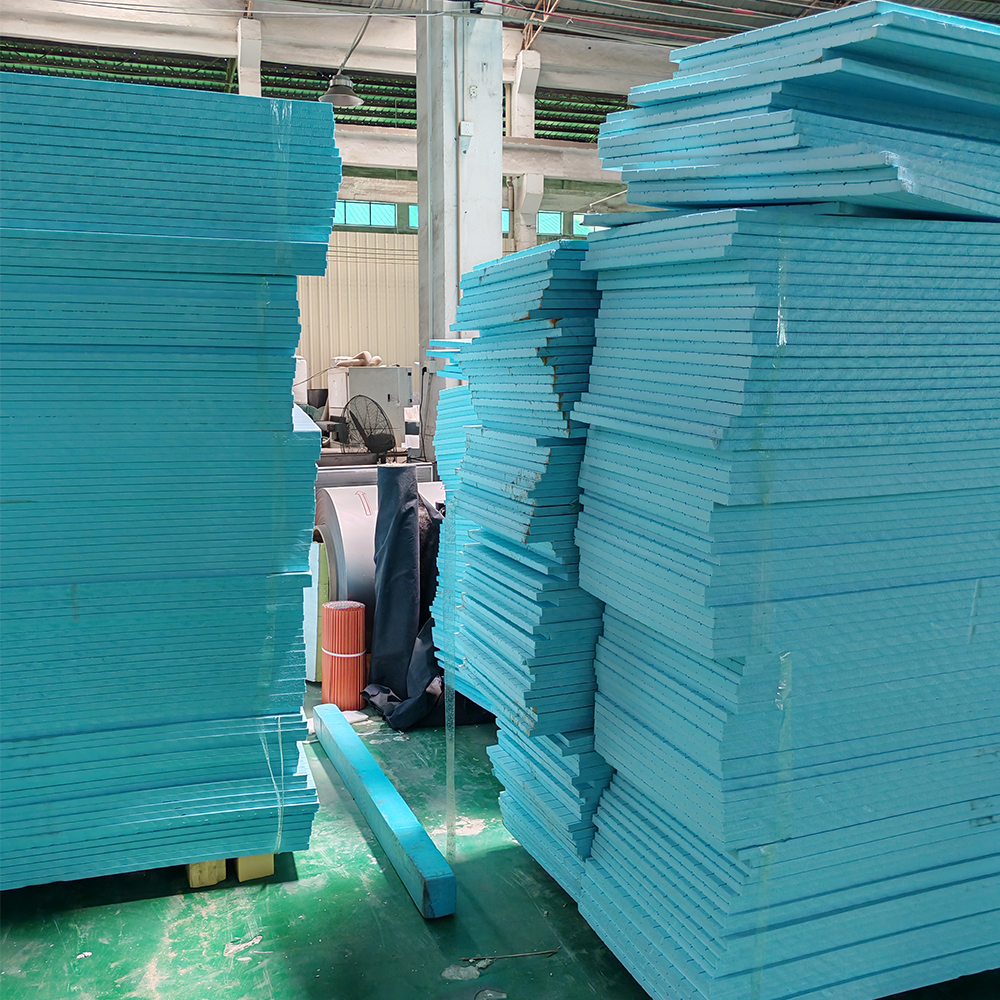
High density XPS foam board is a rigid extruded polystyrene board manufactured with a formulation and process designed to achieve higher density and enhanced mechanical performance compared with lower-density insulation grades. It is typically considered when an insulation material must provide both thermal resistance and the ability to withstand relatively high compressive loads.
Density is an important specification for XPS foam because it is related to the structure and mechanical behavior of the foam. However, density should not be treated as a direct replacement for compressive strength. Professional procurement should always evaluate the manufacturer’s tested compressive strength together with density because two products with similar densities may have different performance depending on formulation, cell structure, processing conditions, and testing methods.
High density XPS foam board can be useful in applications such as floor insulation, foundation insulation, inverted roofs, parking structures, cold-storage floors, industrial buildings, and certain composite sandwich panels. In these applications, the insulation may experience sustained mechanical loading, and insufficient compressive performance can lead to deformation or loss of system performance.
For Middle Eastern projects, high density XPS may be particularly relevant where insulation is incorporated into roofs or floors exposed to substantial loads. Commercial buildings, warehouses, industrial facilities, and infrastructure projects can have different loading requirements, so the required XPS grade should be determined from engineering calculations rather than selected solely according to a standard thickness.
Thickness and density should also be considered together. For example, a 25 mm XPS board and a 100 mm XPS board may serve completely different purposes even if both have similar density. Thickness directly influences thermal resistance, while density and formulation influence mechanical characteristics. A professional specification therefore needs to define both dimensions and performance requirements.
Thermal conductivity remains an important parameter even when the main reason for selecting high density XPS is mechanical strength. The board still needs to provide the required insulation performance. Buyers should request the declared or tested thermal conductivity from the manufacturer and understand the corresponding test conditions.
Water absorption is another advantage commonly associated with the closed-cell structure of XPS. In applications involving ground contact or potential moisture exposure, low water absorption can help maintain insulation performance. Nevertheless, high density XPS should not be considered a substitute for waterproofing systems. Drainage, membranes, joints, and construction detailing remain critical.
For Saudi Arabia, UAE, Qatar, Kuwait, Oman, and Bahrain, buyers should also examine fire performance and compatibility with adjacent materials. XPS is a combustible polymeric foam, so the complete construction assembly must be evaluated according to applicable fire-safety requirements. The correct specification may require protective layers, barriers, or specific installation details depending on the building system.
When purchasing high density XPS foam board from a manufacturer, procurement teams should ask for technical datasheets and test reports covering density, compressive strength, thermal conductivity, water absorption, dimensional stability, thickness tolerance, and fire-related performance where required. For large-volume orders, production consistency is equally important because variations between batches can affect installation and final system performance.
Ultimately, high density XPS foam board should be selected when the project requires a combination of rigid thermal insulation and enhanced compressive performance. The correct product is determined by engineering requirements, not by density alone.
