
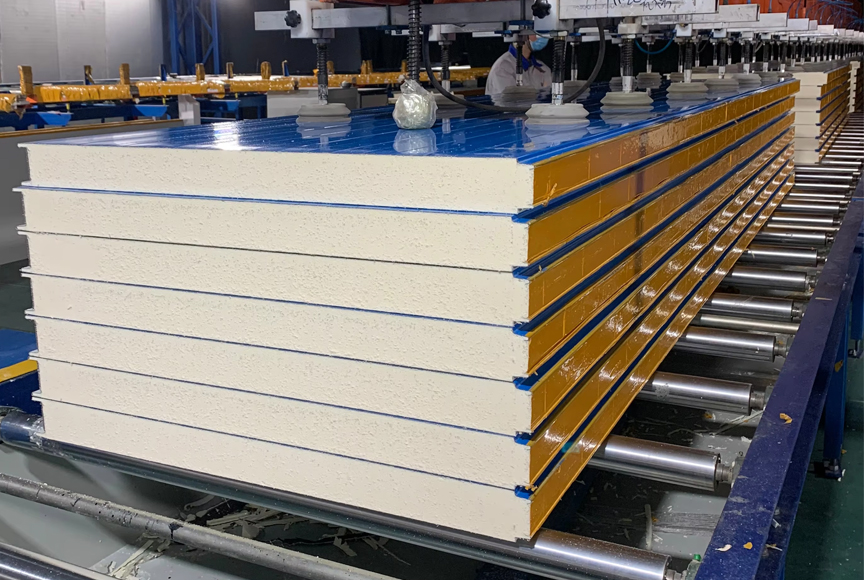
When purchasing sandwich panels for a commercial or industrial project, material price is only one part of the decision. A core material that appears inexpensive at the beginning may require additional reinforcement, insulation, machining, maintenance or replacement over its service life.
This makes Aluminum Honeycomb versus Foam Sandwich Panels an important comparison for procurement managers, engineers and composite-panel manufacturers.
Aluminum honeycomb and foam cores can both produce lightweight structures, but they have different cost structures and performance characteristics. Aluminum honeycomb is known for high stiffness-to-weight performance, while foam cores such as PVC, PET, PMI, PU and XPS offer different combinations of structural strength, thermal insulation, impact resistance and manufacturability.
This article examines the comparison from three perspectives:
- Initial material and manufacturing cost
- Technical performance
- Long-term lifecycle value
Data note: The numerical values in this article are representative industry ranges for preliminary comparison. Actual prices and performance vary by supplier, material grade, density, thickness, alloy, cell size, face-sheet construction, adhesive system, order volume and certification requirements.
1. Why Purchase Price Is Not Enough
A procurement team may initially compare materials according to price per kilogram or price per square meter.
However, this can produce misleading results.
The actual cost of a sandwich panel can include:
- Core material
- Face sheets
- Adhesive
- CNC machining
- Edge treatment
- Inserts
- Reinforcements
- Surface finishing
- Assembly
- Transportation
- Installation
- Maintenance
- Replacement
For example, a higher-priced lightweight core may reduce the required panel weight and installation cost.
Conversely, a lower-cost foam may require additional structural reinforcement or insulation.
Therefore, procurement decisions should consider total cost of ownership, not only the initial purchase price.
2. Basic Material Comparison
The major materials used in this comparison include aluminum honeycomb and several structural foams.
| Core Material | Typical Density | Main Strength | Typical Application |
|---|---|---|---|
| Aluminum Honeycomb | 30–160+ kg/m³ | High stiffness-to-weight | Architecture, marine, transportation |
| PVC Foam | 60–250+ kg/m³ | Balanced structural performance | Marine, wind energy, transportation |
| PET Foam | 60–250+ kg/m³ | Impact resistance and sustainability | Marine, wind energy |
| PMI Foam | 50–200+ kg/m³ | High-performance structural properties | Aerospace, advanced composites |
| XPS Foam | 25–50 kg/m³ | Thermal insulation | Construction |
| PU Foam | 30–200+ kg/m³ | Thermal insulation | Construction and industrial insulation |
These materials should not be treated as direct substitutes in every application.
Each one occupies a different position in the performance and cost spectrum.
3. Initial Core Cost
The initial core price is affected by:
- Density
- Thickness
- Raw material
- Manufacturing process
- Surface treatment
- Order volume
- Custom dimensions
- Certification
- Packaging
- Transportation
A low-density core may have a lower cost per square meter but may not provide enough mechanical performance.
A high-density structural core may cost more but reduce the need for additional reinforcement.
Therefore, buyers should request prices based on the actual specification.
A useful purchasing comparison is:
| Commercial Parameter | Recommended Comparison |
| Core price | USD/m² |
| Core price | USD/m³ |
| Finished panel price | USD/m² |
| Finished panel weight | kg/m² |
| Minimum order quantity | m² or pieces |
| Lead time | Days |
| Production capacity | m²/month |
| Packaging cost | USD/shipment |
| Shipping weight | kg/shipment |
Comparing only USD/kg can be misleading because different core materials may require different thicknesses and densities.
4. Weight and Logistics Cost
Weight can have a significant influence on total project economics.
Consider a 1 m² panel with a 20 mm core:
| Core Material | Density | Approx. Core Weight |
| Aluminum Honeycomb | 40 kg/m³ | 0.8 kg/m² |
| Aluminum Honeycomb | 60 kg/m³ | 1.2 kg/m² |
| Aluminum Honeycomb | 80 kg/m³ | 1.6 kg/m² |
| PVC Foam | 80 kg/m³ | 1.6 kg/m² |
| PVC Foam | 100 kg/m³ | 2.0 kg/m² |
| PET Foam | 100 kg/m³ | 2.0 kg/m² |
| PET Foam | 150 kg/m³ | 3.0 kg/m² |
| XPS Foam | 35 kg/m³ | 0.7 kg/m² |
These figures represent core weight only.
For large projects involving thousands of square meters, even a small difference in finished-panel weight can affect:
- Transportation
- Handling
- Installation
- Structural support requirements
- Labor
- Packaging
For transportation and marine applications, these savings can become particularly valuable.
5. Performance per Unit Cost
A more useful approach is to compare cost against actual performance.
Important performance parameters include:
- Compression strength
- Shear strength
- Shear modulus
- Bending stiffness
- Impact resistance
- Thermal conductivity
- Fire performance
- Water resistance
Representative compression-strength ranges are:
| Core Material | Typical Compression Strength |
| Aluminum Honeycomb | 0.5–8+ MPa |
| PVC Foam | 0.5–8+ MPa |
| PET Foam | 1–7+ MPa |
| PMI Foam | 2–15+ MPa |
| XPS Foam | 0.2–1.0 MPa |
A material with a higher purchase price may provide better performance at the same weight.
This is why procurement teams should compare cost per required performance level, rather than simply choosing the cheapest material.
6. Structural Stiffness and Cost
Structural stiffness is one of the strongest reasons to select aluminum honeycomb.
The cellular structure provides a large separation between the face sheets while maintaining low core mass.
For large-format panels, this can provide:
- High rigidity
- Low deflection
- Low weight
- Good dimensional stability
Typical applications include:
- Architectural cladding
- Ceiling panels
- Doors
- Interior partitions
- Marine furniture
- Transportation interiors
Foam cores can also provide excellent stiffness, especially when higher-density grades are used.
However, increasing foam density generally increases material cost and panel weight.
This creates a trade-off between:
Density → Strength → Weight → Cost
7. Thermal Insulation and Lifecycle Cost
Thermal performance can significantly change the economics of a sandwich panel.
Typical thermal conductivity ranges are:
| Material | Approx. Thermal Conductivity |
| PVC Foam | 0.03–0.06 W/m·K |
| PET Foam | 0.035–0.06 W/m·K |
| PMI Foam | ~0.03–0.05 W/m·K |
| XPS Foam | 0.025–0.035 W/m·K |
| PU Foam | 0.020–0.030 W/m·K |
| Aluminum | 160–235 W/m·K |
When thermal insulation is required, foam can combine two functions:
Structural core + thermal insulation
This can reduce the need for separate insulation materials.
Potential applications include:
- Refrigerated trucks
- Cold-storage facilities
- Insulated doors
- Building wall systems
- HVAC equipment
- Marine cabins
- RV panels
In these applications, the lifecycle value of foam can be higher than its initial material price suggests.
8. Fire Performance and Compliance Cost
Fire performance can influence both material selection and project cost.
Aluminum honeycomb has a non-combustible metallic core.
Foam cores require formulation-specific fire testing.
| Fire Consideration | Aluminum Honeycomb | Foam Core |
| Core combustibility | Non-combustible | Material-dependent |
| Flame resistance | Excellent core performance | Formulation-dependent |
| Smoke behavior | System-dependent | System-dependent |
| Fire certification | Required for complete panel | Required for complete panel |
| High-temperature stability | Excellent | Material-dependent |
For regulated applications, buyers may need:
- Fire-test reports
- Material certificates
- Finished-panel certification
- Factory quality documentation
- Traceability records
These requirements can increase the total procurement cost.
Therefore, certification requirements should be defined before requesting quotations.
9. Manufacturing Cost
Manufacturing is one area where foam cores can provide a major advantage.
Foam is generally easy to:
- Cut
- Route
- Drill
- CNC machine
- Shape
- Contour
- Bond
Aluminum honeycomb can also be machined, but additional attention is often required around:
- Edges
- Cutouts
- Inserts
- Fastener locations
- Reinforced areas
A general comparison is:
| Manufacturing Activity | Aluminum Honeycomb | Foam Core |
| Cutting | Good | Excellent |
| CNC machining | Good | Excellent |
| Complex contouring | Moderate–good | Excellent |
| Edge treatment | More demanding | Easier |
| Insert installation | Requires reinforcement | Easier |
| Prototyping | Good | Excellent |
| Composite molding | Application-dependent | Excellent |
For customized composite components, foam can reduce processing costs.
For standardized large-format panels, aluminum honeycomb can be highly efficient.
10. Edge Treatment and Local Reinforcement
One often-overlooked cost is local reinforcement.
Sandwich panels may require reinforcement around:
- Door hinges
- Bolted connections
- Handles
- Equipment mounts
- Seat attachments
- Floor supports
- Large cutouts
Honeycomb cores may require local inserts or potting to support concentrated loads.
Foam cores can also require reinforcement, but local machining and insert installation can often be straightforward.
This means the procurement price should specify whether the quoted panel includes:
- Inserts
- Edge closure
- Reinforcement
- Machining
- Cutouts
- Drilling
- Surface finishing
Otherwise, a low initial quotation may result in significant additional processing costs.
11. Durability and Maintenance
Lifecycle cost is strongly influenced by durability.
A durable panel may have a higher initial purchase price but lower maintenance requirements.
Important factors include:
- Moisture exposure
- UV exposure
- Corrosion
- Temperature cycling
- Impact
- Fatigue
- Adhesive aging
- Delamination
A general comparison is:
| Durability Factor | Aluminum Honeycomb | PVC Foam | PET Foam | PMI Foam | XPS Foam |
| Moisture resistance | Very good | Excellent | Excellent | Good–very good | Excellent |
| Corrosion resistance | Requires protection | Excellent | Excellent | Excellent | Excellent |
| Fatigue resistance | Excellent | Very good | Very good–excellent | Excellent | Moderate |
| Dimensional stability | Excellent | Very good | Very good | Excellent | Good |
| Impact resistance | Very good | Very good | Excellent | Excellent | Moderate |
| Temperature resistance | Excellent | Good | Good | Excellent | Moderate |
Actual performance depends on the specific grade and finished-panel design.
12. Marine Applications: Lifecycle Considerations
Marine applications provide a good example of lifecycle analysis.
A marine panel may be exposed to:
- Saltwater
- High humidity
- Vibration
- Impact
- Repeated loading
- Temperature changes
Both aluminum honeycomb and structural foam can be suitable.
Aluminum Honeycomb
Advantages:
- High stiffness
- Low weight
- Good dimensional stability
- Non-combustible core
Potential concerns:
- Corrosion
- Galvanic compatibility
- Edge sealing
- Water ingress
Foam Core
Advantages:
- Corrosion-free core
- Good moisture resistance
- Easy machining
- Good composite compatibility
- Excellent for complex shapes
Potential concerns:
- Fire formulation
- Temperature limits
- Long-term bonding
- Material-specific fatigue performance
The lowest initial cost may therefore not correspond to the lowest lifecycle cost.
13. Transportation Applications
Transportation systems place a high value on weight reduction.
Potential applications include:
- Truck bodies
- Trailers
- RVs
- Rail vehicles
- Buses
- Special-purpose vehicles
The economic benefits of reducing panel weight can include:
- Higher payload
- Lower fuel consumption
- Lower energy consumption
- Easier installation
- Reduced structural requirements
For insulated transportation systems, foam cores can provide an additional advantage because they combine structural and thermal functions.
For lightweight interior structures, aluminum honeycomb can provide excellent rigidity with low mass.
14. Architectural Applications
Architectural panels often require:
- Large dimensions
- High flatness
- Low weight
- Good rigidity
- Fire compliance
- Surface quality
- Weather resistance
Aluminum honeycomb is particularly attractive for:
- Exterior cladding
- Interior wall panels
- Ceiling systems
- Decorative panels
- Curtain-wall components
- Large-format architectural elements
The lightweight construction can simplify installation and reduce the load imposed on supporting structures.
Foam cores can also be used where thermal insulation or complex shapes are more important than extremely high panel stiffness.
15. Lifecycle Cost Structure
A useful procurement model should consider several stages.
| Lifecycle Stage | Cost Consideration |
| Material purchase | Core + skins |
| Manufacturing | Cutting + bonding + machining |
| Packaging | Protection and handling |
| Transportation | Weight and volume |
| Installation | Labor and equipment |
| Operation | Energy/insulation performance |
| Maintenance | Repairs and inspection |
| Replacement | Expected service life |
| Disposal | End-of-life requirements |
For an insulated building panel, thermal performance may dominate operating cost.
For a transportation panel, weight may dominate operating economics.
For a marine panel, durability and maintenance may be more important.
Therefore, lifecycle analysis must be application-specific.
16. Aluminum Honeycomb vs Foam: Cost and Performance Matrix
The following matrix provides a preliminary purchasing comparison:
| Factor | Aluminum Honeycomb | PVC Foam | PET Foam | PMI Foam | XPS Foam |
| Initial material cost | Medium–high | Medium | Medium | High | Low–medium |
| Weight efficiency | Excellent | Very good | Very good | Excellent | Excellent |
| Structural stiffness | Excellent | Very good | Very good | Excellent | Moderate |
| Compression performance | Very good–excellent | Good–excellent | Good–very good | Excellent | Low–moderate |
| Thermal insulation | Low | Good | Good | Good | Excellent |
| Machining cost | Medium | Low | Low | Low–medium | Low |
| Fire performance | Excellent core | Grade-dependent | Grade-dependent | Grade-dependent | Grade-dependent |
| Moisture resistance | Very good | Excellent | Excellent | Good–excellent | Excellent |
| Marine suitability | Excellent | Excellent | Excellent | Good–excellent | Good |
| Transportation suitability | Excellent | Excellent | Excellent | Excellent | Moderate |
| Lifecycle potential | Excellent | Very good | Excellent | Excellent | Application-dependent |
This matrix is useful for preliminary supplier discussions but should not replace project-specific testing.
17. When a Higher-Priced Material Can Be More Economical
A common purchasing mistake is automatically selecting the lowest quotation.
Suppose one material has:
- Lower core price
- Higher density
- Lower stiffness
- More reinforcement requirements
Another material has:
- Higher core price
- Lower density
- Higher stiffness
- Less reinforcement
- Lower transportation weight
The second material may have a higher initial price but lower total project cost.
This is particularly relevant for:
- Marine structures
- Transportation equipment
- Large architectural panels
- Aerospace components
- Wind-energy structures
The correct procurement question is therefore:
What is the lowest total cost for achieving the required performance?
18. How to Request Supplier Quotations
For reliable price comparison, procurement teams should provide a complete technical specification.
A quotation request should include:
| Requirement | Example |
| Core type | Aluminum Honeycomb / PVC / PET |
| Core density | 80–120 kg/m³ |
| Core thickness | 20 mm |
| Panel size | Project-specific |
| Face sheet | Aluminum / FRP / other |
| Face-sheet thickness | Project-specific |
| Compression strength | Minimum required value |
| Shear strength | Minimum required value |
| Fire requirement | Project-specific |
| Thermal requirement | Project-specific |
| Surface finish | Required finish |
| Edge treatment | Included / excluded |
| CNC machining | Required / not required |
| Quantity | Annual or project volume |
| Packaging | Export packaging |
| Certification | Required documents |
This prevents suppliers from quoting different specifications under the same product name.
19. Recommended Procurement Strategy
For projects involving significant quantities, a three-stage purchasing process is recommended.
Stage 1 — Technical Screening
Compare:
- Density
- Strength
- Thickness
- Weight
- Thermal performance
- Fire performance
Stage 2 — Prototype Validation
Evaluate:
- Actual panel weight
- Bonding
- Surface quality
- Machining
- Impact resistance
- Dimensional stability
Stage 3 — Commercial Evaluation
Compare:
- Material cost
- Processing cost
- Packaging
- Logistics
- Installation
- Maintenance
- Expected service life
This approach provides a much more reliable basis for supplier selection.
20. Final Decision Guide
Aluminum Honeycomb is often the better choice when:
- Structural stiffness is critical.
- Minimum panel weight is important.
- Large architectural panels are required.
- High dimensional stability is needed.
- Non-combustible core performance is important.
- Transportation weight is a major cost factor.
PVC Foam is often the better choice when:
- A balanced cost/performance solution is required.
- Marine applications are involved.
- Complex composite structures are required.
- Easy machining is important.
- Good structural performance is needed.
PET Foam is often the better choice when:
- Impact resistance is important.
- Lightweight composite structures are required.
- Sustainability is considered.
- Large composite components are being manufactured.
PMI Foam is often the better choice when:
- High-performance structural properties are required.
- Temperature resistance is important.
- Aerospace or advanced composite applications are involved.
XPS or PU Foam is often the better choice when:
- Thermal insulation is the primary requirement.
- Structural loads are relatively moderate.
- Cost-effective insulation is required.
21. Final Procurement Checklist
Before selecting the final material, buyers should confirm:
| Parameter | Required |
| Core density | ✓ |
| Core thickness | ✓ |
| Compression strength | ✓ |
| Shear strength | ✓ |
| Shear modulus | ✓ |
| Finished panel weight | ✓ |
| Thermal conductivity | ✓ |
| Water absorption | ✓ |
| Fire performance | ✓ |
| Impact resistance | ✓ |
| Fatigue performance | ✓ |
| Temperature range | ✓ |
| Adhesive compatibility | ✓ |
| Edge treatment | ✓ |
| CNC requirements | ✓ |
| Certification | ✓ |
| Production capacity | ✓ |
| Lead time | ✓ |
| Minimum order quantity | ✓ |
| Total delivered cost | ✓ |
