
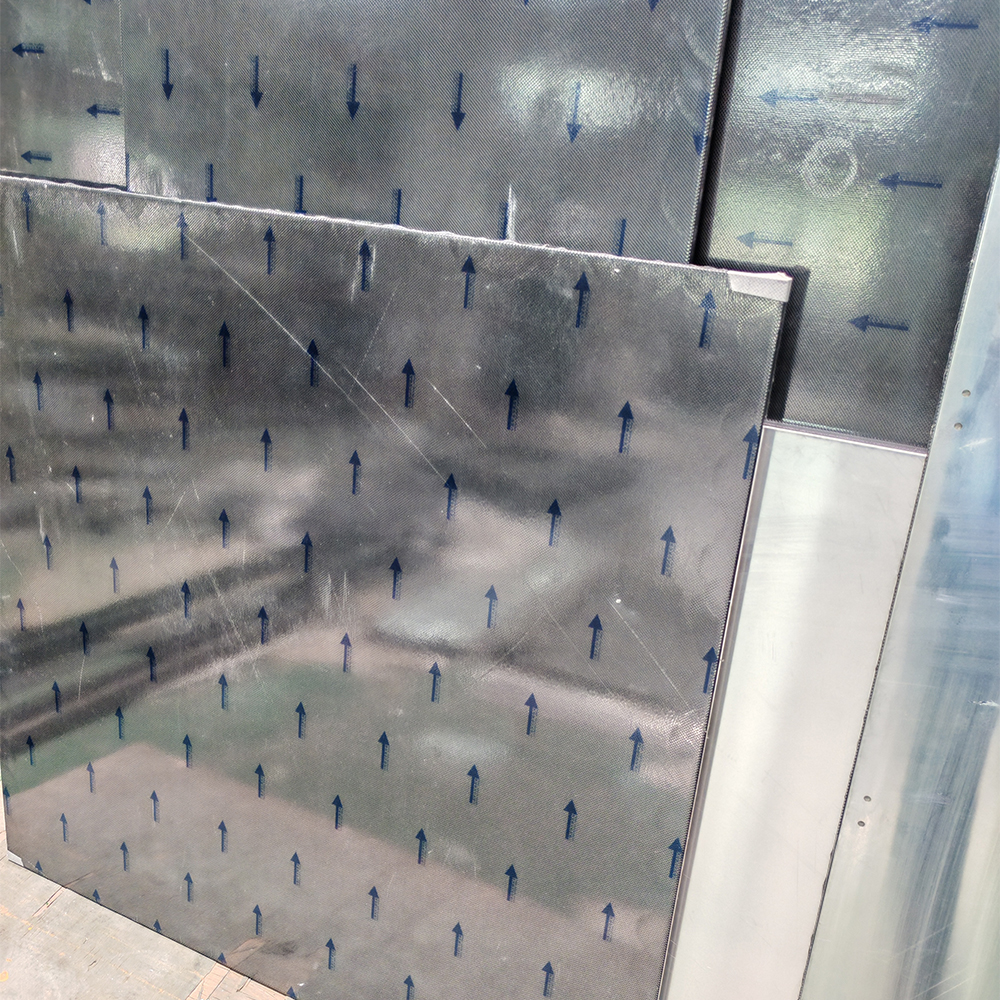
The continuous development of lightweight engineering materials has changed the way manufacturers design structural components. In traditional manufacturing, increasing strength often meant increasing material thickness or using heavier metals. However, modern composite engineering follows a different principle: materials can be combined to achieve a balance between weight, strength, stiffness, corrosion resistance, and processing flexibility.
Within this development, FRP, FRP panel, FRP sheet, and sandwich panels have become important material categories for construction, transportation, marine manufacturing, industrial equipment, refrigerated vehicles, recreational vehicles, wind energy, and many other applications.
FRP, commonly referring to Fiber Reinforced Plastic or Fiber Reinforced Polymer, is not a single material. It is a composite system consisting of reinforcing fibers and a polymer matrix. The performance of the final product depends on multiple variables, including fiber type, resin system, fiber orientation, layer structure, thickness, curing process, and the use of lightweight core materials.
ONEBOND is engaged in the development and manufacturing of composite materials and lightweight structural cores. Its actual product range includes PET Foam, XPS Foam, PU Foam, PVC Foam, PMI Foam, and PP Honeycomb Core. These products can be used as internal structural materials in different composite systems, including lightweight sandwich panels with FRP skins.
The technical relationship between FRP, FRP panel, FRP sheet, and sandwich panels is particularly important. An FRP surface can provide mechanical strength, corrosion resistance, and environmental protection, while a lightweight core can increase structural thickness without significantly increasing total weight.
This article examines the material science, manufacturing processes, structural behavior, application logic, and development trends of these composite materials.
1. Understanding FRP as a Composite Material System
FRP is fundamentally different from a homogeneous material such as aluminum or steel.
An FRP structure normally contains two major components:
- Reinforcing fiber
- Polymer resin matrix
The fibers are primarily responsible for carrying mechanical loads, while the resin binds the fibers together and transfers stress through the composite structure.
Common reinforcement materials include:
- Glass fiber
- Carbon fiber
- Aramid fiber
Common resin systems include:
- Polyester resin
- Vinyl ester resin
- Epoxy resin
- Phenolic resin
The combination of fiber and resin determines the final properties of the FRP product.
For example, a product using glass fiber and polyester resin may be optimized for general industrial applications, while a high-performance epoxy composite may be designed for more demanding structural requirements.
Typical Characteristics of FRP
- High strength-to-weight ratio
- Corrosion resistance
- Electrical insulation
- Design flexibility
- Good fatigue resistance
- Customizable mechanical properties
- Compatibility with lightweight core structures
The ability to engineer the structure is one of the main advantages of FRP.
Unlike a solid metal plate, the reinforcement direction can be designed according to the expected load.
2. FRP Sheet: The Basic Surface Structure of Composite Panels
An FRP sheet is generally a relatively thin composite product manufactured using reinforcing fibers and a resin matrix.
Depending on the application, an FRP sheet can be:
- Smooth
- Textured
- Gel-coated
- Transparent
- Opaque
- Flat
- Corrugated
The surface quality of an FRP sheet is important because it can influence the appearance and durability of the final composite product.
In many applications, an FRP sheet is used as a protective surface layer.
Typical applications include:
- Refrigerated vehicle interiors
- Industrial wall systems
- Cleanroom panels
- Transportation components
- Marine structures
- Equipment housings
Typical FRP Sheet Parameters
| Parameter | Typical Range |
|---|---|
| Thickness | 0.5–5 mm |
| Reinforcement | Glass fiber |
| Resin | Polyester, epoxy or vinyl ester |
| Surface | Smooth, textured or coated |
| Width | Customized |
| Length | Roll or sheet form |
Actual specifications depend on the manufacturing method and application.
Real Application Scenario
A manufacturer of refrigerated transport equipment needs an interior surface that can resist moisture, repeated cleaning, and mechanical wear. An FRP sheet can be laminated onto an insulation or composite core to create a durable interior panel.
3. FRP Panel: From Surface Material to Functional Structural Component
An FRP panel generally refers to a larger composite product in which FRP forms either the complete structure or the outer skin.
The internal structure may consist of:
- Solid FRP laminate
- Foam core
- Honeycomb core
- Insulation material
- Other composite substrates
An FRP panel can therefore be engineered for different functions.
For example:
- High impact resistance
- Corrosion resistance
- Thermal insulation
- Lightweight construction
- Structural stiffness
ONEBOND’s lightweight core materials can be combined with FRP skins to manufacture different types of composite structures.
For example:
FRP + PET Foam + FRP
FRP + PVC Foam + FRP
FRP + PP Honeycomb Core + FRP
Each structure has a different performance profile.
Real Application Scenario
A recreational vehicle manufacturer needs lightweight interior partitions. A solid FRP board may provide durability but add unnecessary weight. An FRP panel using PP Honeycomb Core can provide a lightweight alternative while maintaining structural thickness and rigidity.
4. Sandwich Panels and the Structural Logic of Lightweight Design
sandwich panels are among the most important structural concepts in modern composite engineering.
The typical structure consists of:
- Upper face sheet
- Lightweight core
- Lower face sheet
The face sheets carry tensile and compressive stresses during bending, while the core maintains separation between the skins and supports shear loads.
This allows sandwich panels to achieve significant structural efficiency.
Instead of using a thick solid FRP structure, manufacturers can use thin FRP skins combined with a lightweight core.
The core may consist of:
- PET Foam
- PVC Foam
- XPS Foam
- PU Foam
- PMI Foam
- PP Honeycomb Core
ONEBOND manufactures several of these core material categories.
Typical Sandwich Panel Structure
| Layer | Function |
| FRP Skin | Surface protection and tensile strength |
| Adhesive or Resin | Structural bonding |
| Lightweight Core | Thickness and weight reduction |
| Adhesive or Resin | Bonding |
| FRP Skin | Structural support and protection |
The final performance depends on the interaction between all layers.
5. Comparing Solid FRP and Sandwich Panels
A solid FRP component can provide good mechanical performance, but increasing thickness also increases material consumption and weight.
sandwich panels approach the problem differently.
The lightweight core increases the distance between the two FRP skins.
This can significantly improve bending efficiency.
| Performance Factor | Solid FRP | FRP Sandwich Panels |
| Weight | Medium to High | Low |
| Thickness | Requires more material | Core creates thickness |
| Bending Efficiency | Moderate | High |
| Material Consumption | Higher | Lower |
| Thermal Insulation | Limited | Can be improved |
| Customization | High | Very High |
This is why sandwich panels are widely used in applications where lightweight performance is important.
6. FRP Manufacturing Processes
The final performance of FRP products depends heavily on the manufacturing method.
Common manufacturing processes include:
Hand Lay-Up
One of the most traditional processes.
Fibers are placed into a mold and impregnated with resin.
Advantages:
- Low equipment investment
- Suitable for customized products
- Flexible production
Limitations:
- Labor-intensive
- Variation between operators
- Lower automation
Vacuum Infusion
Vacuum pressure is used to distribute resin through dry reinforcement.
Advantages include:
- Improved resin control
- Lower void content
- Better consistency
This method is often used for larger composite structures.
Pultrusion
Fibers are continuously pulled through resin and a heated die.
The process is suitable for:
- Profiles
- Structural beams
- Continuous FRP products
Press Molding
Suitable for controlled production of flat or shaped components.
The choice of manufacturing process depends on product geometry, production volume, fiber type, and performance requirements.
Real Application Scenario
A marine component manufacturer requires large lightweight composite structures with consistent resin distribution. Vacuum infusion can be used to manufacture an FRP structure with controlled fiber-to-resin ratios and reduced void formation.
7. The Role of Core Materials in FRP Sandwich Panels
The core material is not simply a filler.
It performs several structural functions.
A lightweight core:
- Separates FRP skins
- Supports shear loads
- Prevents skin buckling
- Reduces total weight
- Can provide insulation
ONEBOND provides multiple core material options.
PET Foam
PET Foam can be used in lightweight composite structures where weight reduction and material efficiency are important.
Real Application Scenario
An industrial equipment manufacturer produces large protective doors. PET Foam is combined with FRP skins to reduce the total weight of the moving structure.
PVC Foam
PVC Foam is widely used as a structural core in composite manufacturing.
Real Application Scenario
A marine manufacturer requires lightweight internal structures with good resistance to moisture. PVC Foam can be incorporated into an FRP sandwich structure for interior or structural components.
XPS Foam
XPS Foam is associated with thermal insulation and closed-cell structure.
Real Application Scenario
A modular building manufacturer develops insulated wall structures. XPS Foam is used as an internal material between FRP surfaces to combine insulation with a durable outer surface.
PMI Foam
PMI Foam is designed for more demanding composite applications.
Real Application Scenario
A manufacturer developing high-performance composite components requires a lightweight core that can support demanding processing and structural requirements. PMI Foam may be evaluated as part of the composite structure.
PP Honeycomb Core
PP Honeycomb Core creates a lightweight cellular structure.
Real Application Scenario
A transportation manufacturer develops lightweight floor panels. PP Honeycomb Core is combined with FRP skins to reduce weight while maintaining structural thickness.
8. Mechanical Performance of FRP Composite Structures
The mechanical performance of FRP depends on multiple variables.
These include:
- Fiber type
- Fiber orientation
- Fiber volume fraction
- Resin system
- Core material
- Panel thickness
- Bonding strength
An FRP sheet reinforced with fibers primarily oriented in one direction may perform differently from a randomly reinforced sheet.
Similarly, an FRP panel with a thick lightweight core may provide higher bending stiffness than a solid laminate of similar weight.
Important Mechanical Properties
| Property | Importance |
| Tensile Strength | Resistance to pulling loads |
| Flexural Strength | Resistance to bending |
| Compressive Strength | Resistance to compression |
| Shear Strength | Core and interface performance |
| Impact Resistance | Resistance to sudden loads |
| Fatigue Resistance | Performance under repeated loading |
Manufacturers should select test methods according to the final application and relevant standards.
9. Corrosion Resistance and Environmental Durability
One of the major advantages of FRP is resistance to corrosion.
Metal structures can require protective coatings when exposed to:
- Saltwater
- Chemicals
- Humidity
- Industrial environments
FRP materials can provide an alternative in environments where corrosion is a major concern.
However, environmental performance depends on the resin system.
For example:
- Polyester resin may be suitable for general applications.
- Vinyl ester resin may offer improved chemical resistance.
- Epoxy resin can provide strong mechanical bonding and high performance.
Real Application Scenario
An industrial wastewater facility requires protective wall structures in a humid and chemically demanding environment. An FRP panel can provide corrosion-resistant surfaces where untreated metal may require additional protection.
10. FRP and Sandwich Panels in Transportation
Weight reduction is particularly important in transportation.
Lower structural weight can support:
- Improved energy efficiency
- Increased payload capacity
- Easier installation
- Improved handling
Applications include:
- Buses
- Campervans
- Rail transportation
- Refrigerated vehicles
- Commercial vehicles
An FRP panel combined with lightweight core materials can reduce the weight of:
- Interior walls
- Floors
- Roof panels
- Doors
- Partitions
Real Application Scenario
A campervan manufacturer replaces conventional heavy plywood interior panels with sandwich panels using FRP surfaces and a lightweight core. The result is a lighter panel system that can support vehicle weight reduction.
11. FRP Panels for Construction and Industrial Buildings
In construction, FRP panel products can be used for:
- Cleanroom walls
- Industrial partitions
- Waterproof wall systems
- Protective cladding
- Insulated panels
Compared with traditional materials, FRP can provide:
- Easy cleaning
- Moisture resistance
- Corrosion resistance
- Customizable dimensions
When combined with insulation cores, sandwich panels can provide additional thermal performance.
Real Application Scenario
A food processing facility requires wall surfaces that can be cleaned regularly and exposed to humid conditions. An FRP panel with an appropriate core can provide a smooth and durable wall structure.
12. Bonding Technology in FRP Sandwich Structures
The interface between FRP skins and the core material is critical.
Poor bonding can result in:
- Delamination
- Reduced stiffness
- Local structural failure
- Moisture penetration
Manufacturers must control:
- Surface preparation
- Resin compatibility
- Adhesive selection
- Curing conditions
- Lamination pressure
The bonding process should be evaluated together with the core material.
For example, a foam core with different surface properties may require different bonding systems.
ONEBOND’s core materials are designed for composite applications where customers need to match the material with their selected manufacturing process.
13. Sustainability and Future Material Development
The composite industry is increasingly focused on:
- Recycled materials
- Lower-weight structures
- Material efficiency
- Reduced energy consumption
- Longer service life
PET-based materials are particularly relevant to discussions about recycled polymer resources.
Lightweight sandwich panels can also reduce the amount of material required compared with certain solid structures.
Future research may focus on:
Hybrid Structures
Combining foam and honeycomb materials.
Thermoplastic Composites
Using recyclable or reformable polymer systems.
Automated Manufacturing
Improving consistency in FRP production.
Multi-Functional Panels
Combining:
- Structural strength
- Insulation
- Acoustic performance
- Fire resistance
ONEBOND’s portfolio of PET Foam, XPS Foam, PU Foam, PVC Foam, PMI Foam, and PP Honeycomb Core provides a material foundation for developing different types of advanced sandwich panels.
14. Selecting the Correct FRP Composite Structure
The correct material selection should begin with the application.
For Marine Applications
Consider:
- Moisture resistance
- Corrosion resistance
- Weight
- Structural requirements
Possible materials may include FRP skins combined with PVC Foam or PET Foam.
For Construction
Consider:
- Thermal insulation
- Fire requirements
- Moisture resistance
- Surface durability
Possible systems may include FRP surfaces with XPS or PU-based cores.
For Transportation
Consider:
- Weight reduction
- Impact resistance
- Structural stiffness
Possible solutions include FRP combined with PET Foam or PP Honeycomb Core.
For High-Performance Applications
Consider:
- Processing temperature
- Structural efficiency
- Mechanical requirements
PMI Foam may be evaluated for demanding composite structures.
15. The Future of FRP Panel Engineering
The future of FRP, FRP panel, FRP sheet, and sandwich panels will increasingly depend on system-level material engineering.
Instead of asking only:
“What material is strongest?”
Manufacturers will increasingly ask:
“What combination of skin, core, resin, and manufacturing process provides the best performance for this application?”
This change is important.
A high-performance FRP sheet alone may not create an optimized product.
A properly engineered sandwich structure can sometimes provide better structural efficiency with lower total weight.
The combination of:
FRP Skin + ONEBOND Core Material + Optimized Bonding Process
can be adapted for different industries.
This approach allows manufacturers to develop products specifically for:
- Marine structures
- Transportation
- Construction
- Industrial equipment
- Wind energy
- Recreational vehicles
Conclusion
The development of lightweight engineering materials has made FRP, FRP panel, FRP sheet, and sandwich panels increasingly important in modern manufacturing.
FRP provides a flexible composite platform where fiber reinforcement and resin systems can be designed according to mechanical and environmental requirements.
An FRP sheet can function as a durable protective surface or reinforcing layer.
An FRP panel can combine surface durability with lightweight internal structures.
sandwich panels represent the next level of structural efficiency by combining strong face sheets with lightweight cores.
ONEBOND’s actual product range—including PET Foam, XPS Foam, PU Foam, PVC Foam, PMI Foam, and PP Honeycomb Core—supports this development by providing multiple options for composite core design.
The most effective FRP composite structure is not determined by one material alone. It depends on the complete interaction between:
- Fiber reinforcement
- Resin system
- FRP skin
- Core material
- Adhesive or bonding interface
- Manufacturing process
As industries continue to pursue lighter, stronger, and more efficient products, FRP composite systems and lightweight sandwich panels will continue to develop toward greater material specialization.
The future of composite manufacturing will not simply involve producing more FRP. It will involve engineering better combinations of FRP, FRP panel, FRP sheet, and advanced core materials to create application-specific structures with optimized performance.
