
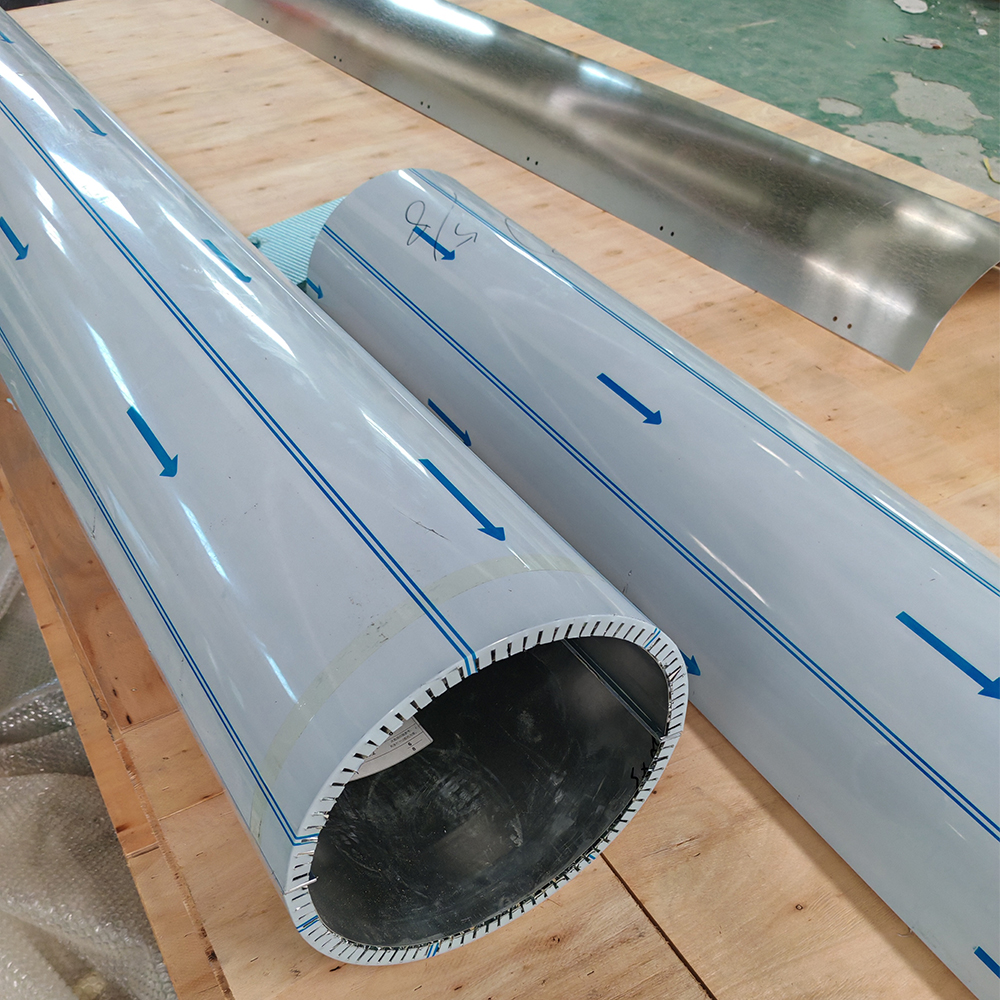
Bathrooms are one of those spaces where a wall or ceiling material has to do more than simply look good. It needs to deal with water vapor, splashing, frequent cleaning, temperature changes, stains and long-term humidity. At the same time, modern bathroom designs increasingly demand large-format surfaces, clean joints and customized colors or textures.
That is why bathroom aluminum composite panel has become an interesting material for interior wall and ceiling applications.
From my perspective as a composite-panel equipment specialist, however, I would make one thing clear from the beginning: the quality of a bathroom aluminum composite panel is determined by much more than the visible surface. The aluminum skin thickness, core structure, bonding quality, coating, flatness, cutting accuracy and even the production-line parameters can affect the final result.
A good panel should not only look attractive when it leaves the factory. It should remain flat, stable and easy to clean after years of exposure to a humid bathroom environment.
So let’s look at bathroom ACP from both the material and manufacturing equipment perspective.
What Is a Bathroom Aluminum Composite Panel?
A bathroom aluminum composite panel is a lightweight multilayer panel designed for wall, ceiling and decorative applications in bathroom environments.
A typical structure consists of:
Surface coating → Aluminum skin → Polymer or FR core → Aluminum back skin → Protective coating
The overall thickness is commonly around:
- 2 mm
- 3 mm
- 4 mm
- 5 mm
For many interior bathroom wall applications, 3 mm or 4 mm panels can provide a good balance between weight, rigidity and fabrication flexibility.
A typical technical specification might look like this:
| Parameter | Typical Range |
|---|---|
| Panel thickness | 2–5 mm |
| Common bathroom specification | 3–4 mm |
| Aluminum skin thickness | 0.20–0.50 mm |
| Panel width | 1000–1600 mm |
| Panel length | 2000–6000 mm |
| Typical panel weight | Approx. 4.5–8.0 kg/m² |
| Aluminum alloy | 3003 / 3005 |
| Core | PE / FR / mineral-filled |
| Surface coating | PE / PVDF / FEVE |
| Surface finish | Matte / Gloss / Wood / Stone / Solid Color |
| Typical flatness target | ≤2–3 mm/m, depending on specification |
The exact values vary by manufacturer and panel construction, so project-specific technical data should always be confirmed before production.
Why Is ACP Suitable for Bathroom Walls?
The first reason is moisture resistance.
Unlike traditional porous materials, properly manufactured aluminum composite panels have a non-absorbent aluminum surface and a relatively closed composite structure.
That makes them attractive for environments where moisture is constantly present.
Think about a typical bathroom:
- Hot shower steam
- Water splashing
- Condensation
- Frequent cleaning
- High humidity
- Temperature fluctuations
The surface needs to remain stable under these conditions.
However, there is an important distinction between water-resistant panel material and a waterproof bathroom wall system.
Even if the ACP itself is highly resistant to water, water can still enter through poorly sealed joints, corners, pipe penetrations or gaps around sanitary fixtures.
So the panel should be considered as one part of the complete wall system.
Large-Format Panels Can Reduce Visible Joints
One of the most attractive features of aluminum composite panels in bathrooms is the ability to manufacture relatively large sheets.
For example, panels may be supplied in sizes such as:
1220 × 2440 mm
1220 × 3050 mm
1500 × 3000 mm
or customized lengths depending on production capability.
A large-format panel can significantly reduce the number of joints compared with small ceramic tiles.
This has two benefits.
First, the bathroom can look cleaner and more contemporary.
Second, fewer joints mean fewer places where dirt, soap residue and moisture can accumulate.
But large panels also create another requirement: flatness.
A 300 × 300 mm tile can hide small dimensional errors.
A 1500 × 3000 mm panel cannot.
If a large panel has visible waviness, the defect becomes much more obvious under strong bathroom lighting.
This is why manufacturing control is extremely important.
From an Equipment Expert: Flatness Starts on the Production Line
When customers ask me why one ACP panel looks much flatter than another, they often expect the answer to be “better raw materials.”
Raw materials matter, but they are only one part of the equation.
The production line itself has a major influence.
A typical aluminum composite panel production process may include:
Aluminum Coil → Uncoiling → Cleaning → Surface Treatment → Coating → Core Extrusion → Lamination → Cooling → Tension Leveling → Cutting → Trimming → Inspection
Every stage needs to be controlled.
If the tension is unstable during lamination, the panel can develop internal stress.
If the lamination temperature is not properly controlled, bonding quality may suffer.
If cooling is uneven, dimensional deformation can occur.
If cutting pressure is inconsistent, the finished edges may not be straight.
This is why a professional ACP manufacturer needs more than a simple laminating machine.
Aluminum Skin Thickness Matters
Let’s compare two common 4 mm panels.
Panel A
4 mm total thickness
0.21 mm aluminum skin
Panel B
4 mm total thickness
0.50 mm aluminum skin
Both are called 4 mm aluminum composite panels, but they are not equivalent products.
The thicker aluminum skin generally provides better resistance to:
- Surface dents
- Edge damage
- Fabrication stress
- Handling damage
- Mechanical deformation
For bathroom applications, the appropriate skin thickness depends on whether the panel is being used for a wall, ceiling, partition or decorative element.
For larger wall panels, a 0.30–0.50 mm aluminum skin can be considered when greater surface durability is required.
What Core Material Should Be Used?
The core is hidden, but from an equipment perspective it is one of the most important parts of the panel.
Common options include:
- PE core
- FR core
- Mineral-filled core
For interior bathroom decoration, a standard PE-core panel may be suitable for certain projects.
But if the building has strict fire-safety requirements, an FR or mineral-filled core may be necessary.
The core formulation also influences the extrusion and lamination process.
For example, mineral-filled cores generally have different processing characteristics from conventional polymer cores.
The production equipment therefore needs to be configured according to the selected core formulation.
This is an area where inexperienced manufacturers can run into problems.
You cannot always use exactly the same extrusion and lamination settings for every core material.
Temperature Control During Lamination
Lamination is one of the critical stages in ACP production.
The aluminum skins and core must be bonded under controlled temperature and pressure.
Depending on the core formulation and adhesive system, processing temperatures can be in the range of approximately 150–250°C.
The exact temperature is not a universal number and should be established according to:
- Core formulation
- Adhesive system
- Aluminum surface treatment
- Line speed
- Panel thickness
- Roller configuration
For example, running a line too quickly without sufficient thermal energy can result in incomplete bonding.
On the other hand, excessive temperature can affect the core or coating and create unnecessary thermal stress.
A modern lamination line therefore needs accurate temperature control rather than simply “high heat.”
Production Line Speed
Production speed is another parameter buyers often ask about.
Industrial aluminum composite panel lines can be designed for different production speeds depending on panel construction and automation level.
For example, a production line may operate around:
3–10 m/min
for certain panel structures, while more advanced high-speed configurations can reach higher speeds.
But maximum line speed should never be the only purchasing criterion.
A line running at 10 m/min but producing inconsistent bonding and flatness is not better than a line running at 6 m/min with stable quality.
For ACP manufacturing, I would prioritize:
Stable quality > maximum theoretical speed
A manufacturer producing premium bathroom panels should focus on consistent output rather than simply advertising the highest meters-per-minute number.
Tension Control Is Critical
This is a technical point that is often underestimated.
Aluminum coil is relatively thin.
Typical aluminum skin thicknesses may be:
0.20–0.50 mm
At these thicknesses, tension variation can have a noticeable effect on the finished panel.
If the tension is too high, the aluminum skin can be stretched.
If tension is too low, wrinkles or alignment problems may occur.
A good production line therefore needs controlled tension through the unwinding, coating, laminating and winding/feeding stages.
For automated equipment, servo-driven tension control can help maintain stable material movement.
This is particularly important when producing large-format bathroom panels.
Coating Quality Is Important in Humid Environments
Bathroom panels are constantly exposed to moisture and cleaning chemicals.
The surface coating therefore needs to be compatible with the intended environment.
Common coating systems include:
PE
Economical and suitable for many interior decorative applications.
PVDF
More commonly associated with demanding exterior applications, but can also be selected for premium products where enhanced coating durability is required.
FEVE
Provides excellent color appearance and can be selected for decorative architectural surfaces.
The coating thickness and formulation should be controlled according to the manufacturer’s specification.
More importantly, the aluminum surface must be properly prepared before coating.
Surface treatment can improve coating adhesion and long-term stability.
Surface Preparation Before Coating
From a manufacturing perspective, coating an aluminum coil is not simply a matter of putting paint onto metal.
The aluminum surface needs proper preparation.
A typical process may include:
Cleaning → Degreasing → Chemical treatment → Drying → Primer → Topcoat → Curing
Poor cleaning can leave oil or contaminants on the aluminum.
That can lead to poor coating adhesion.
In a humid bathroom environment, coating defects can become more noticeable over time.
Therefore, surface-treatment equipment and coating ovens should be properly controlled.
Bathroom Cleaning and Chemical Resistance
Bathrooms are frequently cleaned with detergents and disinfectants.
This creates another material-selection consideration.
A decorative panel should have a coating system compatible with the cleaning products expected in the application.
Avoid assuming that every household chemical is safe for every coating.
Strong acidic, alkaline or abrasive cleaning agents may damage certain surfaces.
For commercial bathrooms, hospitals and public facilities, this issue becomes more important because cleaning frequency can be much higher than in residential bathrooms.
ACP for Bathroom Partitions
Another potential application is the bathroom partition.
Aluminum composite panels can be fabricated into partition panels, cubicles and decorative separators.
A typical partition thickness might be around:
4–10 mm
depending on the structural design.
For larger partitions, the panel can be reinforced with an aluminum frame or internal profile.
The exact design depends on:
- Panel size
- Partition height
- Fixing method
- Impact requirements
- Privacy requirements
- Hardware weight
Again, the panel itself should not be expected to carry every structural load.
CNC Cutting and Fabrication
After panel production, fabrication accuracy becomes important.
Bathroom panels often require cutouts for:
- Faucets
- Sinks
- Toilets
- Electrical sockets
- Drainage pipes
- Ventilation
- Lighting
CNC routers can provide accurate cutting and grooving.
For example, a modern CNC system may achieve positioning accuracy around ±0.1–0.2 mm, depending on the machine configuration and working conditions.
That level of accuracy is useful when producing repeated bathroom modules.
For mass production, automated CNC processing can significantly reduce manual cutting errors.
Edge Treatment Is Extremely Important
The center of an ACP sheet may be completely unaffected by moisture, but the edges are different.
If the panel is cut incorrectly or the edge is poorly sealed, moisture can potentially reach the internal structure.
For bathroom applications, I recommend paying particular attention to:
- Edge sealing
- Corner joints
- Pipe penetrations
- Fastener holes
- Panel-to-floor joints
- Panel-to-ceiling joints
The goal is to prevent water from entering areas where it can remain trapped.
Installation Method for Bathroom ACP
There are several possible installation approaches.
Adhesive Installation
Suitable for certain flat interior walls.
The wall substrate must be clean, dry, flat and structurally suitable.
Mechanical Fixing
Panels can be attached using screws, clips or aluminum profiles.
This can be useful when future removal is required.
Cassette System
Panels are fabricated into cassettes and attached to a supporting frame.
This provides a cleaner architectural appearance and can make individual panel replacement easier.
The installation system should always be selected based on the wall substrate and bathroom environment.
Recommended Bathroom Panel Parameters
For buyers looking for a practical starting specification, the following configuration can be considered:
| Item | Suggested Starting Specification |
|---|---|
| Panel thickness | 3–4 mm |
| Aluminum skin | 0.30–0.50 mm |
| Aluminum alloy | 3003 / 3005 |
| Core | PE / FR / mineral-filled |
| Panel width | 1220–1500 mm |
| Panel length | 2440–6000 mm |
| Surface | Matte / Gloss / Wood / Stone |
| Coating | PE / PVDF / FEVE |
| Flatness | ≤2–3 mm/m target |
| CNC accuracy | Approx. ±0.1–0.2 mm depending on equipment |
| Typical production speed | Approx. 3–10 m/min depending on line configuration |
| Lamination temperature | Approx. 150–250°C depending on materials |
These are reference parameters rather than universal standards. A professional manufacturer should adjust the specification according to the actual core formulation, coating system, panel size and intended application.
How to Select a Bathroom ACP Manufacturer
If I were buying bathroom aluminum composite panels, I wouldn’t judge a factory only by the sample panel.
I would ask about the production equipment.
Specifically:
What type of lamination line do you use?
How is aluminum tension controlled?
How is lamination temperature controlled?
What is the actual production speed under stable quality conditions?
What coating system is used?
What aluminum skin thickness can you produce consistently?
How do you control panel flatness?
What testing is performed after production?
These questions reveal much more about a manufacturer’s actual capability than simply asking for the lowest price.
A factory with automated production equipment, online inspection and controlled process parameters is generally better positioned to maintain consistent panel quality.
Quality Control for Bathroom ACP
A professional production process should include several inspection stages.
Incoming Material Inspection
Check:
- Aluminum thickness
- Coil width
- Alloy
- Surface condition
- Core material
Online Production Inspection
Monitor:
- Temperature
- Line speed
- Tension
- Lamination pressure
- Panel thickness
Finished Product Inspection
Check:
- Panel thickness
- Width and length
- Flatness
- Color consistency
- Coating adhesion
- Surface defects
- Bonding strength
Dimensional consistency becomes especially important when panels are being fabricated into modular bathroom systems.
Final Thoughts
A bathroom aluminum composite panel is much more than a decorative waterproof-looking sheet.
For the end user, the important characteristics are easy cleaning, moisture resistance, attractive appearance, dimensional stability and reliable installation.
For the manufacturer, however, achieving those characteristics requires control over the entire production process.
A practical 3–4 mm panel with a 0.30–0.50 mm aluminum skin, suitable core material and appropriate surface coating can be a strong starting point for many bathroom applications. Large-format panels around 1220–1500 mm wide and customized lengths can help reduce visible joints, while accurate CNC fabrication can improve the quality of openings and connections.
From the equipment side, I would pay particular attention to tension control, lamination temperature, line speed, roller pressure, cooling, leveling and cutting accuracy.
For example, a production line operating at approximately 3–10 m/min can provide efficient output for many ACP configurations, but stable quality is more important than simply achieving maximum speed. Likewise, lamination temperatures around 150–250°C may be encountered depending on the material system, but the correct processing window must be determined experimentally and maintained consistently.
In the end, good bathroom ACP is the result of three things working together:
Good material + precise manufacturing equipment + correct installation.
Get all three right, and aluminum composite panels can provide a clean, modern and practical surface for bathroom walls, ceilings, partitions and decorative areas—without sacrificing the design flexibility that modern interior projects increasingly demand.
