
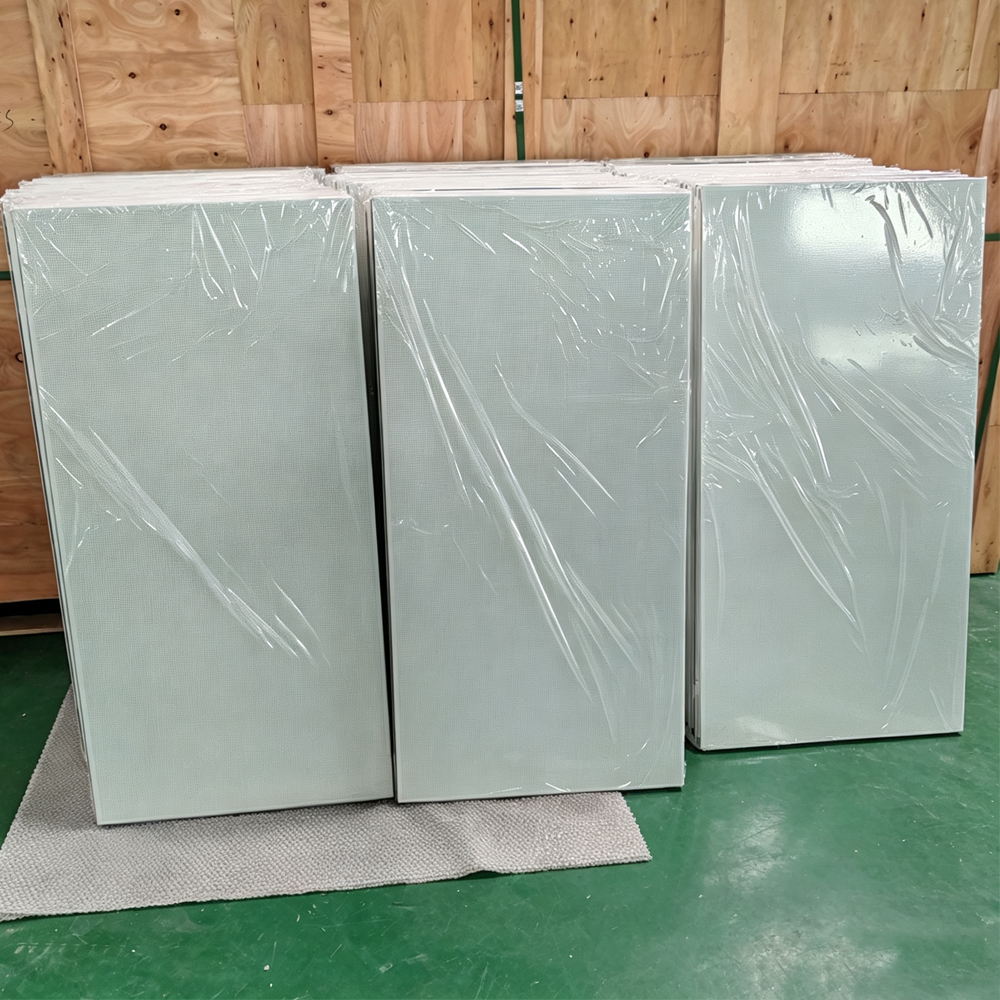
Kitchen cabinets have traditionally been dominated by MDF, particle board, plywood, stainless steel and various laminated boards. But as kitchens become more modern, durable and design-focused, aluminium composite panel for kitchen cabinets is attracting increasing attention.
From a material and equipment perspective, the interesting part is not simply that ACP looks modern. The real advantage comes from the combination of lightweight construction, moisture resistance, surface flexibility and CNC fabrication capability.
For kitchen cabinet manufacturers, however, there is an important distinction between using aluminum composite panels as a decorative cabinet surface and using them as the primary structural cabinet material. ACP is a composite decorative panel, and its performance depends heavily on panel construction, aluminum skin thickness, core material, reinforcement and the cabinet’s overall frame design.
So, if you are considering aluminum composite panels for kitchen cabinets, let’s look at the material from both the application and manufacturing-equipment perspective.
What Is Aluminium Composite Panel for Kitchen Cabinets?
An aluminium composite panel for kitchen cabinets is a multilayer panel consisting of aluminum sheets bonded to a lightweight core.
A typical structure is:
Decorative coating → Aluminum skin → Core → Aluminum skin → Back coating
Common panel thicknesses include:
- 2 mm
- 3 mm
- 4 mm
- 5 mm
For cabinet doors, side panels, decorative panels and furniture components, 3 mm and 4 mm ACP are practical specifications to consider.
Typical reference parameters are:
| Parameter | Typical Range |
|---|---|
| Panel thickness | 2–5 mm |
| Common cabinet thickness | 3–4 mm |
| Aluminum skin thickness | 0.20–0.50 mm |
| Panel width | 1000–1600 mm |
| Panel length | 2000–6000 mm |
| Panel weight | Approx. 4.5–8.0 kg/m² |
| Aluminum alloy | 3003 / 3005 |
| Core | PE / FR / mineral-filled |
| Surface | Matte / Gloss / Wood / Stone / Metallic |
| Coating | PE / PVDF / FEVE |
The exact specification should be selected according to the cabinet construction, panel dimensions, hardware and expected service conditions.
Why Use ACP for Kitchen Cabinets?
The kitchen is a challenging environment for furniture materials.
A cabinet may be exposed to:
- Water
- Steam
- Cooking oil
- Food stains
- Cleaning chemicals
- Temperature changes
- Frequent opening and closing
- Scratches and impacts
This is where aluminum composite panels can offer several advantages.
1. Moisture Resistance
Aluminum itself does not absorb water.
A properly manufactured ACP also has a relatively closed composite structure, making it much less susceptible to moisture-related problems than many conventional wood-based boards.
This is particularly attractive for:
- Under-sink cabinets
- Kitchen wall cabinets
- Cabinet doors
- Side panels
- Backsplash systems
- Decorative cabinet surfaces
However, don’t confuse moisture-resistant material with a completely waterproof cabinet.
Edges, joints, screw holes and connections still need to be properly designed.
2. Lightweight Construction
A typical 4 mm ACP panel may weigh around 5.5–8 kg/m², depending on the aluminum skin and core.
For cabinet doors, reducing weight can be valuable.
A lighter door places less load on hinges and makes daily operation easier.
This becomes especially important for large-format cabinet doors.
For example, suppose a cabinet door measures:
0.8 m × 2.0 m = 1.6 m²
If the panel weighs approximately 6.5 kg/m²:
1.6 × 6.5 = 10.4 kg
The ACP itself would weigh approximately 10.4 kg, before adding the frame, reinforcement and hardware.
That gives cabinet designers a useful starting point when calculating hinge loads.
Is ACP Strong Enough to Make a Complete Kitchen Cabinet?
This is where professional specification matters.
ACP has good rigidity for its weight, but it should not automatically be treated as a direct replacement for structural plywood or thick furniture board.
For many cabinet designs, ACP works best as:
- Cabinet door material
- Side panel
- Decorative panel
- Back panel
- Surface cladding
- Front panel
- Interior decorative lining
For large cabinet doors or load-bearing structures, aluminum profiles or other reinforcement may be integrated into the design.
A typical system could look like:
ACP panel + aluminum frame + internal reinforcement + hinges
This creates a much more stable cabinet component than relying on a thin ACP sheet alone.
Aluminum Skin Thickness Makes a Difference
Two products can both be called 4 mm aluminum composite panels, but their performance can be quite different.
Consider:
4 mm ACP + 0.21 mm aluminum skin
versus:
4 mm ACP + 0.50 mm aluminum skin
The second configuration contains substantially more aluminum and can provide better resistance to dents, edge damage and fabrication stress.
For kitchen cabinets, a practical aluminum skin range may be around 0.20–0.50 mm, depending on the application.
For premium cabinet doors or large panels, thicker skins can be considered when surface durability and rigidity are important.
But thicker is not always better.
Increasing aluminum skin thickness also increases:
- Weight
- Material cost
- Cutting resistance
- Fabrication requirements
The correct choice should therefore be based on the cabinet design rather than simply selecting the thickest available panel.
Core Material Selection
The core is one of the most important hidden components.
Common options include:
PE Core
PE-core ACP is lightweight and economical.
It can be suitable for many decorative interior applications where the relevant fire requirements permit it.
FR Core
Fire-retardant cores are designed to improve the panel’s fire performance.
They may be appropriate for commercial projects, hotels, public buildings and other applications with more demanding fire requirements.
Mineral-Filled Core
Mineral-filled cores can provide higher fire performance and are often selected for projects where fire safety is a major consideration.
From an equipment perspective, mineral-filled cores can also have different processing characteristics from standard polymer cores.
This means the extrusion and lamination process needs to be properly matched to the core formulation.
Surface Finish Is a Major Selling Point
Kitchen furniture is highly visual.
Customers care about color, texture and how the cabinets fit the overall interior.
ACP provides a wide range of finishes.
Matte Finish
Matte surfaces provide a clean, contemporary appearance and can help reduce reflections from kitchen lighting.
High Gloss Finish
Gloss surfaces can create a premium, modern look.
They are often used for minimalist kitchens, but surface scratches and fingerprints may be more visible.
Wood Grain
Wood-effect ACP combines a timber-inspired appearance with the moisture resistance of an aluminum-based surface.
It can be used to create a warmer kitchen aesthetic.
Marble and Stone Effects
Stone-effect finishes can be used for cabinet doors, side panels and decorative kitchen elements.
Metallic Finish
Champagne, silver, bronze and other metallic finishes can create a more industrial or luxury appearance.
This variety gives cabinet manufacturers the opportunity to create different product series without changing the basic panel structure.
Manufacturing ACP for Kitchen Cabinets
Now let’s look at the production side.
As an equipment specialist, I would divide the process into two stages:
Stage 1: ACP panel manufacturing
Stage 2: Cabinet panel fabrication
The first stage creates the composite sheet.
The second stage converts that sheet into the final cabinet component.
A typical ACP production line may include:
Aluminum Coil Uncoiler → Cleaning → Surface Treatment → Coating → Core Extrusion → Lamination → Cooling → Leveling → Cutting
The finished sheet can then be sent to a CNC processing line.
Why Lamination Quality Matters
The aluminum skins and core need to form a stable composite structure.
If the bonding is inconsistent, problems can occur during later cutting, routing or bending.
Typical lamination temperatures can be approximately:
150–250°C
depending on the core, adhesive system, aluminum surface treatment and production speed.
This should not be treated as a universal operating temperature.
Each material combination requires its own process window.
The equipment should provide accurate temperature control across the working width.
For example, if one side of a 1500 mm-wide panel is significantly hotter than the other, internal stresses may develop and panel flatness can be affected.
That is why modern lamination equipment typically uses multiple controlled heating zones.
Production Speed: Faster Is Not Always Better
ACP production lines can be designed for different production speeds.
A practical range for some configurations may be around:
3–10 m/min
More advanced lines may operate faster depending on panel structure and process design.
But from an equipment expert’s perspective, maximum speed is not the most important number.
Imagine two production lines:
Line A: 10 m/min
but inconsistent bonding and flatness.
Line B: 7 m/min
with stable thickness, bonding and surface quality.
For premium kitchen cabinet material, I would choose Line B.
Why?
Because cabinet fabrication requires dimensional consistency.
If one batch is slightly thicker or more distorted than another, CNC processing parameters may need to be adjusted, and assembly accuracy can suffer.
Stable production is more valuable than theoretical maximum speed.
Tension Control During ACP Production
Aluminum skins used in ACP can be only 0.20–0.50 mm thick.
At these thicknesses, tension control becomes very important.
Too much tension can stretch the aluminum.
Too little tension can cause:
- Wrinkles
- Misalignment
- Surface defects
- Edge instability
A modern production line should therefore control coil tension during:
- Unwinding
- Coating
- Laminating
- Feeding
- Cutting
Servo systems and automatic tension control can help maintain stable material movement.
This becomes particularly important for large-width panels used in cabinet manufacturing.
CNC Fabrication of Kitchen Cabinet Panels
After ACP production, the next challenge is precision fabrication.
Cabinet manufacturers commonly need to perform:
- Cutting
- Routing
- Grooving
- Drilling
- Edge preparation
- Corner processing
- Hardware openings
A CNC router can be used to process ACP accurately.
For example, depending on machine configuration, a CNC system may achieve positioning accuracy around:
±0.1–0.2 mm
This is useful when producing repeated cabinet components.
Imagine producing 500 cabinet doors.
If every component is manually cut with slightly different dimensions, assembly problems can quickly appear.
Automated CNC fabrication provides more consistent dimensions and repeatability.
ACP Grooving and Folding
One of the most useful fabrication methods is V-grooving.
The CNC router removes a controlled portion of the core from the back side of the panel while retaining the aluminum skin.
The panel can then be folded into a specific angle.
This allows manufacturers to create:
- Box panels
- Cabinet doors
- Edge returns
- Decorative frames
- Corner sections
- Custom furniture components
Typical groove depth depends on:
- Panel thickness
- Aluminum skin thickness
- Core type
- Tool diameter
- Required folding angle
For a 4 mm panel, the routing process must be controlled carefully.
Cut too deep and the aluminum skin may be damaged.
Cut too shallow and the folding angle may be inaccurate.
This is why CNC tooling quality matters.
Cabinet Door Design
ACP can be particularly attractive for cabinet doors.
A common construction is:
ACP surface + aluminum profile frame + internal reinforcement + hinge system
The frame provides structural support while the ACP provides the visible surface.
This approach can create a lightweight door with a clean appearance.
For large cabinet doors, designers should calculate:
- Door weight
- Hinge capacity
- Hinge quantity
- Door dimensions
- Center reinforcement
- Deflection
- Fixing strength
For example, a door larger than 600 × 2000 mm may require more careful reinforcement than a small 400 × 600 mm door.
There is no single size limit that applies to every design.
Thermal Expansion
Although kitchen interiors experience less temperature variation than exterior facades, temperature movement still exists.
Aluminum has a thermal expansion coefficient of approximately:
23 × 10⁻⁶ /°C
For a 2 m-long aluminum component experiencing a 30°C temperature change:
2 × 23 × 10⁻⁶ × 30 ≈ 1.38 mm
That movement is relatively small, but it should still be considered when designing large framed cabinet components.
The frame and panel should not be assembled in a way that creates unnecessary thermal stress.
Edge Treatment for Kitchen Applications
Edges are especially important around sinks and other wet areas.
Even if the ACP surface is moisture resistant, poorly protected edges can create weak points.
Pay attention to:
- Cut edges
- Corners
- Screw holes
- Hinge openings
- Sink areas
- Cabinet bottom edges
For wet-zone applications, suitable edge sealing and proper cabinet construction are essential.
This is particularly important for under-sink cabinets.
ACP vs. Traditional Cabinet Materials
| Feature | Aluminum Composite Panel | MDF | Plywood | Stainless Steel |
|---|---|---|---|---|
| Weight | Low | Moderate | Moderate | Higher |
| Moisture resistance | High | Depends on grade | Good–Moderate | Excellent |
| Surface finish | Extensive | Extensive | Extensive | Limited |
| CNC processing | Excellent | Excellent | Excellent | More demanding |
| Corrosion resistance | Good | N/A | N/A | Excellent |
| Design flexibility | High | High | High | Moderate |
| Large-format panels | Excellent | Good | Good | Good |
| Maintenance | Easy | Moderate | Moderate | Easy |
ACP is particularly attractive when the project needs low weight, moisture resistance and modern surface design.
Quality Parameters Buyers Should Request
When purchasing aluminum composite panel for kitchen cabinets, don’t just ask for the price per square meter.
Ask for the technical specification.
A professional purchasing specification might include:
| Item | Recommended Reference |
|---|---|
| Panel thickness | 3–4 mm |
| Aluminum skin | 0.20–0.50 mm |
| Aluminum alloy | 3003 / 3005 |
| Core | PE / FR / mineral-filled |
| Width | 1220–1500 mm |
| Length | 2440–6000 mm |
| Flatness | ≤2–3 mm/m target |
| Surface | Matte / Gloss / Wood / Stone / Metallic |
| Coating | PE / PVDF / FEVE |
| CNC positioning accuracy | Approx. ±0.1–0.2 mm |
| ACP line speed | Approx. 3–10 m/min depending on configuration |
| Lamination temperature | Approx. 150–250°C depending on materials |
These figures are reference values rather than universal standards.
What Should a Cabinet Manufacturer Ask an ACP Supplier?
If you’re sourcing ACP specifically for kitchen furniture, I recommend asking these questions:
What is the actual aluminum skin thickness?
What is the core composition?
What is the panel’s actual weight per square meter?
How is panel flatness controlled?
What coating system is used?
Can you provide consistent color batches?
What is the bonding strength?
Can the panel be CNC routed and folded?
What is the recommended cutting tool?
What are the recommended V-groove parameters?
These questions are much more useful than simply asking whether the supplier produces “high-quality ACP.”
Equipment Is the Foundation of Consistent ACP Quality
From the equipment side, I would pay particular attention to five areas:
1. Coating System
The coating line needs stable coating thickness and curing conditions.
2. Core Extrusion
The core must have consistent thickness and formulation.
3. Lamination System
Temperature, pressure and speed need to remain stable.
4. Tension Control
Thin aluminum skins require precise tension management.
5. Leveling and Cutting
The finished panel needs consistent flatness and accurate dimensions.
These five areas have a direct influence on whether the final product is easy to fabricate into high-quality cabinet components.
Final Thoughts
Aluminium composite panel for kitchen cabinets offers an attractive combination of lightweight construction, moisture resistance, surface design flexibility and CNC fabrication capability.
A typical 3–4 mm ACP panel with an aluminum skin of approximately 0.20–0.50 mm can be considered for many cabinet doors, side panels and decorative furniture applications. For larger doors or components that need greater rigidity, an aluminum frame and internal reinforcement can significantly improve structural stability.
But the quality of the final cabinet starts long before the CNC machine.
It starts with the ACP production line.
Stable aluminum tension, controlled lamination temperatures around the appropriate process window, consistent core thickness, accurate leveling and precise cutting all contribute to a panel that cabinet manufacturers can process reliably.
For a manufacturer producing thousands of kitchen cabinets, even a small dimensional variation can become a major production problem.
That’s why I would not judge an ACP supplier only by price per square meter.
Look at the equipment, process control, raw materials, quality inspection and production consistency.
A well-engineered aluminum composite panel, combined with an appropriate aluminum frame and precision CNC fabrication, can provide kitchen cabinet manufacturers with a lightweight, modern and highly customizable alternative to traditional furniture panels—especially for applications where moisture resistance and contemporary appearance are high priorities.
