
Introduction
One of the most important advantages of sandwich structures is their ability to achieve high mechanical performance without adding unnecessary weight. This is particularly important in transportation, marine structures, construction, furniture, and industrial composite panels, where reducing structural weight can improve handling, energy efficiency, installation efficiency, and overall system performance.
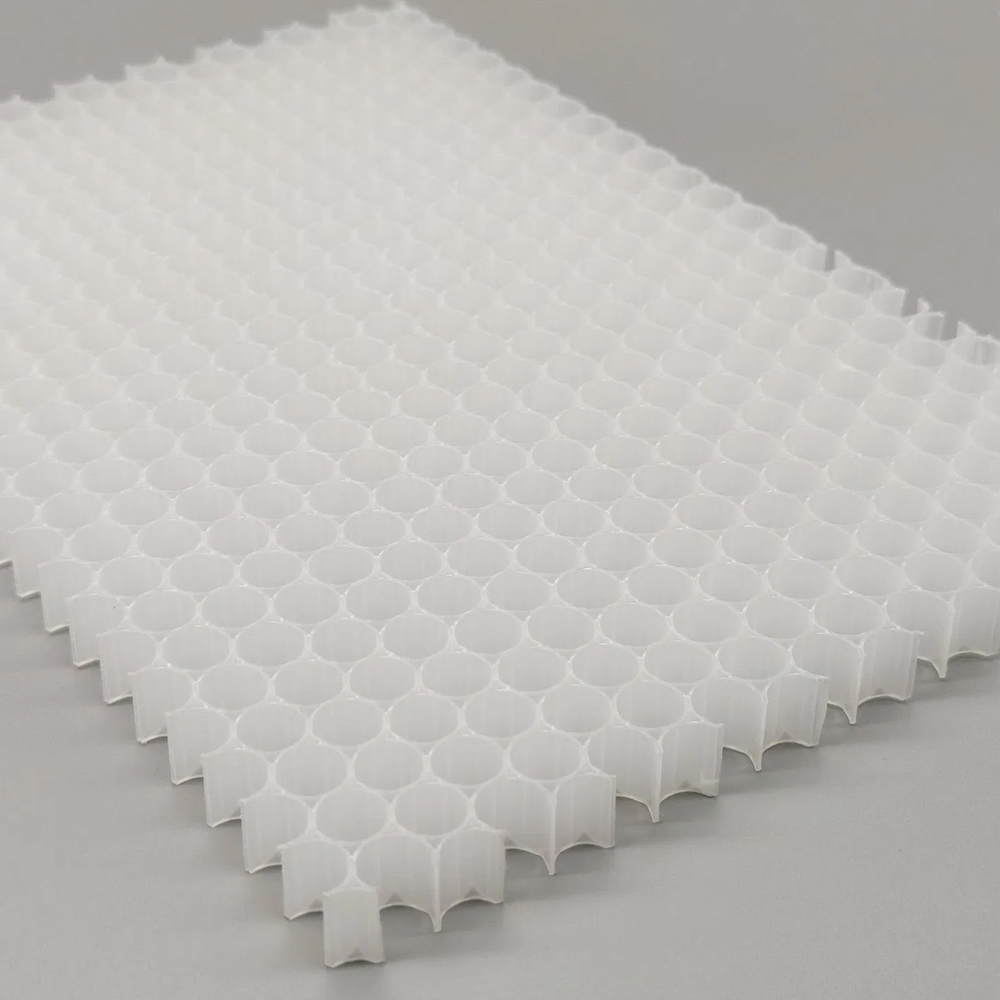
PP honeycomb panels are a typical example of lightweight structural engineering. Instead of using a solid polymer sheet throughout the entire thickness, a PP honeycomb core uses a cellular structure to place material where it can contribute efficiently to structural performance.
The result is a panel with a relatively low mass but useful bending stiffness, compression resistance, shear performance, and impact absorption.
The key principle is not simply that polypropylene is a lightweight material. Rather, the combination of PP material properties, honeycomb geometry, core thickness, cell structure, and face-sheet design determines the final strength-to-weight ratio.
1. What Does Strength-to-Weight Ratio Mean?
Strength-to-weight ratio describes how much mechanical performance a material or structure can provide relative to its mass.
For engineering applications, two related concepts are often considered:
- Specific strength: strength divided by density
- Specific stiffness: stiffness divided by density
A lightweight material is not automatically a lightweight structural solution. A panel must provide sufficient stiffness and strength while keeping mass under control.
For example, a solid PP sheet can provide reasonable impact resistance and chemical resistance, but increasing its thickness means adding polymer throughout the entire cross-section.
A PP honeycomb sandwich structure uses a different approach:
Low-density core + thin structural skins + optimized geometry = efficient structural performance.
This is the fundamental reason sandwich panels can achieve high stiffness and strength relative to their weight.
2. The Role of the PP Honeycomb Core
A PP honeycomb core consists of polypropylene walls arranged into repeated cellular structures.
The cells may be produced with different geometries and dimensions depending on the manufacturing process and final application.
Typical design variables include:
| Parameter | Typical Engineering Consideration |
|---|---|
| Core material | Polypropylene |
| Core density | Application dependent |
| Cell size | Small, medium or large |
| Core thickness | Commonly selected according to stiffness requirements |
| Cell geometry | Often hexagonal or modified cellular structures |
| Face sheet | Aluminum, FRP, PP, composite or other materials |
| Main functions | Weight reduction, spacing, shear transfer, energy absorption |
| Moisture behavior | Closed cellular structure provides good moisture resistance |
These parameters are interconnected.
For example, increasing core thickness generally increases bending stiffness, while increasing core density can improve compression and shear performance but also increases weight.
Therefore, the objective is not simply to maximize density.
3. Why Core Thickness Has Such a Large Effect on Bending Stiffness
The most important structural principle behind a sandwich panel is separation of the face sheets.
Consider a simple sandwich panel consisting of:
- Top face sheet
- PP honeycomb core
- Bottom face sheet
When the panel bends, the two face sheets experience different stresses.
The outer face is primarily subjected to compression, while the opposite face is subjected to tension.
The PP honeycomb core keeps the face sheets separated.
This separation is extremely important because bending stiffness depends strongly on the distance between the load-carrying skins.
In simplified structural terms:
[
D \propto E_f t_f h^2
]
where:
- (D) = bending stiffness
- (E_f) = face-sheet elastic modulus
- (t_f) = face-sheet thickness
- (h) = distance between the effective face-sheet planes
The important factor is the approximate square of the separation distance.
This means increasing the overall sandwich thickness can produce a substantial increase in bending stiffness without proportionally increasing the amount of material.
That is one of the major reasons honeycomb sandwich structures are weight efficient.
4. Material Efficiency: Putting Material Where It Matters
A solid PP board contains polymer throughout its thickness.
A honeycomb sandwich panel replaces a large portion of this solid material with air-filled cellular space while retaining a structural framework.
This creates a more efficient distribution of material.
For example, instead of creating a very thick solid polymer board to achieve greater bending stiffness, engineers can use:
Thin face sheet + thicker lightweight core + thin face sheet
The core does not need to carry all the bending stress.
Its primary structural functions can include:
- Maintaining face-sheet separation
- Carrying transverse shear
- Supporting the face sheets
- Preventing local buckling
- Absorbing impact energy
- Maintaining panel geometry
The face sheets and core therefore work as a structural system.
5. Cell Size Influences Strength and Weight
Cell size is another important design parameter.
A smaller cell generally means more cell walls within a given area. Depending on wall thickness and density, this can improve local support and dimensional stability.
A larger cell can reduce material consumption and weight, but excessive cell size may reduce local support and surface stability.
Therefore:
| Cell Design | Potential Advantage | Potential Limitation |
|---|---|---|
| Small cell | Better local support and surface uniformity | More material and potentially higher weight |
| Medium cell | Balanced structural efficiency | Requires application-specific optimization |
| Large cell | Lower material consumption | Reduced local support if over-designed |
The optimal cell size depends on the complete panel structure rather than the core alone.
For example, a panel intended for a furniture door may require different cellular geometry from a transportation floor panel.
6. Core Density Controls the Performance-to-Weight Balance
PP honeycomb core density is directly related to the amount of polypropylene used in the cellular structure.
Increasing density generally means:
- More polymer per unit volume
- Greater cell-wall material
- Higher compression resistance
- Higher shear capacity
- Higher panel weight
However, the relationship is not simply linear for every mechanical property.
Cell geometry, wall thickness, bonding quality, manufacturing accuracy, and loading direction also affect performance.
This is why material selection should not be based solely on density.
A more useful engineering question is:
How much mechanical performance is obtained for every additional kilogram of core material?
That is the basis of structural optimization.
7. Compression Performance of PP Honeycomb
Honeycomb cores are particularly useful when a sandwich panel experiences distributed or localized compression.
Under compression, the cell walls deform and carry load through the cellular network.
The response can generally be divided into several stages:
- Elastic deformation
- Progressive cell-wall deformation
- Plastic or localized buckling
- Densification
The actual behavior depends on PP grade, density, cell geometry, temperature, loading speed, and manufacturing quality.
One advantage of PP is its relatively good toughness compared with many brittle materials.
This can make PP honeycomb useful where repeated impacts or moderate deformation are expected.
8. Shear Performance Is Also Critical
The honeycomb core must transfer shear forces between the face sheets.
This becomes particularly important when a sandwich panel is subjected to bending.
The face sheets primarily resist tensile and compressive stresses, while the core carries a significant portion of the transverse shear load.
A simplified sandwich structure can therefore be understood as:
Face sheets → bending stresses
Core → shear transfer and separation
If the core is too weak, the panel may experience:
- Core shear failure
- Local buckling
- Face-sheet wrinkling
- Debonding
- Excessive deformation
Therefore, increasing the strength of the face sheet alone does not necessarily solve a structural problem.
The core and skin must be designed as a compatible system.
9. PP Honeycomb vs Solid PP Sheet
The difference becomes particularly clear when comparing honeycomb construction with solid PP.
| Characteristic | Solid PP Sheet | PP Honeycomb Sandwich Panel |
|---|---|---|
| Material distribution | Solid | Cellular core |
| Weight | Higher at equivalent thickness | Lower for many structural designs |
| Bending stiffness efficiency | Limited by solid thickness | High structural efficiency possible |
| Core structure | None | Cellular |
| Impact behavior | Good | Good energy absorption potential |
| Moisture resistance | Good | Good |
| Structural optimization | Thickness-based | Core + skin + geometry |
| Typical advantage | Simple processing | High stiffness-to-weight design |
A solid PP sheet may still be preferable where simplicity, machining, impact resistance, or a relatively thin structure is more important than maximum weight efficiency.
The honeycomb solution becomes more attractive when structural thickness and mass need to be optimized simultaneously.
10. Face Sheets Are Essential to the Strength-to-Weight Ratio
The core is only one component of a sandwich panel.
The face-sheet material can dramatically affect final performance.
Common options include:
- Aluminum sheet
- FRP or fiberglass sheet
- PP sheet
- Composite laminates
- Decorative laminate
- Other engineered skins
For example, an aluminum face sheet can provide high surface stiffness and good dimensional stability, while an FRP skin can provide corrosion resistance and a favorable combination of stiffness, strength, and weight.
A PP honeycomb core with different face sheets can therefore become very different structural products.
This is an important point for product design:
The mechanical performance of a PP honeycomb panel should be evaluated as a complete sandwich system rather than by looking at the core in isolation.
11. Impact Absorption and Energy Dissipation
Another reason PP honeycomb is used in lightweight structures is its cellular architecture.
When subjected to impact, the cell walls can deform progressively.
Instead of transmitting the entire impact force immediately through a solid block, the cellular structure can absorb part of the energy through deformation.
This can be useful for:
- Transportation interiors
- Protective structures
- Packaging systems
- Marine components
- Automotive components
- Lightweight partitions
The actual energy absorption depends strongly on density, cell geometry, wall thickness, impact velocity, temperature, and panel configuration.
Therefore, impact performance should be validated under the actual loading conditions rather than inferred from density alone.
12. Manufacturing Accuracy Directly Affects Structural Efficiency
Even an optimized honeycomb design can lose performance if manufacturing quality is inconsistent.
Important manufacturing parameters include:
- Cell size uniformity
- Cell-wall thickness
- Core thickness
- Flatness
- Dimensional tolerance
- Polymer distribution
- Bonding quality
- Surface preparation
- Cutting accuracy
This makes PP honeycomb machinery an important part of final product quality.
If cell geometry varies significantly across a sheet, the panel may develop local weak areas.
Similarly, inconsistent bonding between the core and face sheets can reduce the load-transfer efficiency of the complete sandwich structure.
For this reason, high-quality PP honeycomb production requires controlled processing rather than simply forming a cellular pattern.
13. Why PP Honeycomb Is Attractive for Lightweight Transportation
Weight reduction is particularly valuable in transportation.
A lighter structural panel can reduce the mass of:
- Vehicle interiors
- Bus components
- Rail interiors
- Truck bodies
- Marine interiors
- Recreational vehicles
- Specialty transportation equipment
The benefits may include easier installation and handling as well as reduced structural mass.
However, weight reduction must always be balanced against:
- Required stiffness
- Compression resistance
- Impact requirements
- Fire-performance requirements
- Temperature conditions
- Environmental exposure
- Connection and fastening requirements
The correct engineering objective is therefore not simply minimum weight, but minimum weight while meeting all required performance criteria.
14. Environmental Efficiency of Lightweight PP Honeycomb
Material efficiency also has an environmental dimension.
Because honeycomb structures can achieve structural thickness with less polymer than an equivalent solid structure, they may reduce material consumption for certain applications.
PP also has the advantage of being a thermoplastic polymer, which creates opportunities for recycling.
However, environmental performance depends on the complete product.
Important variables include:
- Virgin vs recycled PP
- Manufacturing energy
- Transportation distance
- Face-sheet material
- Adhesive system
- Product service life
- Repairability
- End-of-life separation
- Recycling infrastructure
A PP honeycomb panel bonded permanently to incompatible face materials may be more difficult to recycle than a predominantly PP-based monomaterial structure.
Therefore, lifecycle analysis should consider the complete sandwich panel rather than only the polymer core.
15. Typical Design Parameters
The following table provides an illustrative engineering framework, rather than universal specifications. Actual values should be determined through product testing and application requirements.
| Parameter | Design Direction | Main Influence |
|---|---|---|
| Core density | Increase | Compression and shear performance, weight |
| Cell size | Decrease | Local support, dimensional stability |
| Cell-wall thickness | Increase | Strength, weight |
| Core thickness | Increase | Bending stiffness, panel thickness |
| Face-sheet thickness | Increase | Surface strength and stiffness |
| Face-sheet modulus | Increase | Bending stiffness |
| Bonding strength | Increase | Load transfer and durability |
| Manufacturing tolerance | Reduce | Structural consistency |
| Moisture absorption | Minimize | Long-term dimensional stability |
The important concept is optimization rather than maximization.
For example, using the highest-density core available may increase compression strength but can undermine the original objective of weight reduction.
16. PP Honeycomb Panel Design Is a System-Level Problem
A high-performance PP honeycomb panel requires coordination between several factors:
Polymer → Cell Geometry → Core Density → Core Thickness → Face Sheet → Bonding → Manufacturing → Application
Changing one parameter can influence the others.
For example:
If the face sheet becomes thinner, the designer may need a stronger core.
If the core becomes thicker, the panel may achieve higher bending stiffness without dramatically increasing core density.
If cell size becomes smaller, local surface support may improve but material consumption may increase.
If recycled PP is introduced, mechanical properties and processing conditions may need to be re-evaluated.
This system-level approach is essential for reliable lightweight composite design.
Conclusion
The high strength-to-weight ratio of PP honeycomb panels does not come from polypropylene alone. It comes primarily from structural efficiency.
The honeycomb core uses a cellular architecture to reduce unnecessary material while maintaining the geometric separation required for efficient sandwich construction. Thin face sheets carry much of the tensile and compressive bending load, while the PP honeycomb core maintains separation, transfers shear, supports the skins, and can contribute to impact energy absorption.
The major design variables include:
- PP material formulation
- Core density
- Cell size
- Cell-wall thickness
- Core thickness
- Face-sheet material
- Face-sheet thickness
- Bonding quality
- Manufacturing precision
When these factors are properly balanced, PP honeycomb structures can provide an effective combination of low weight, structural stiffness, compression performance, impact resistance, moisture resistance, and material efficiency.
For manufacturers and procurement engineers, the most important lesson is that a PP honeycomb panel should not be evaluated by core density or thickness alone. The complete sandwich construction and its intended loading conditions determine the real structural performance.
This is also why reliable PP honeycomb machinery, consistent cell geometry, controlled processing, and stable bonding processes are important parts of producing high-quality lightweight composite panels.
