
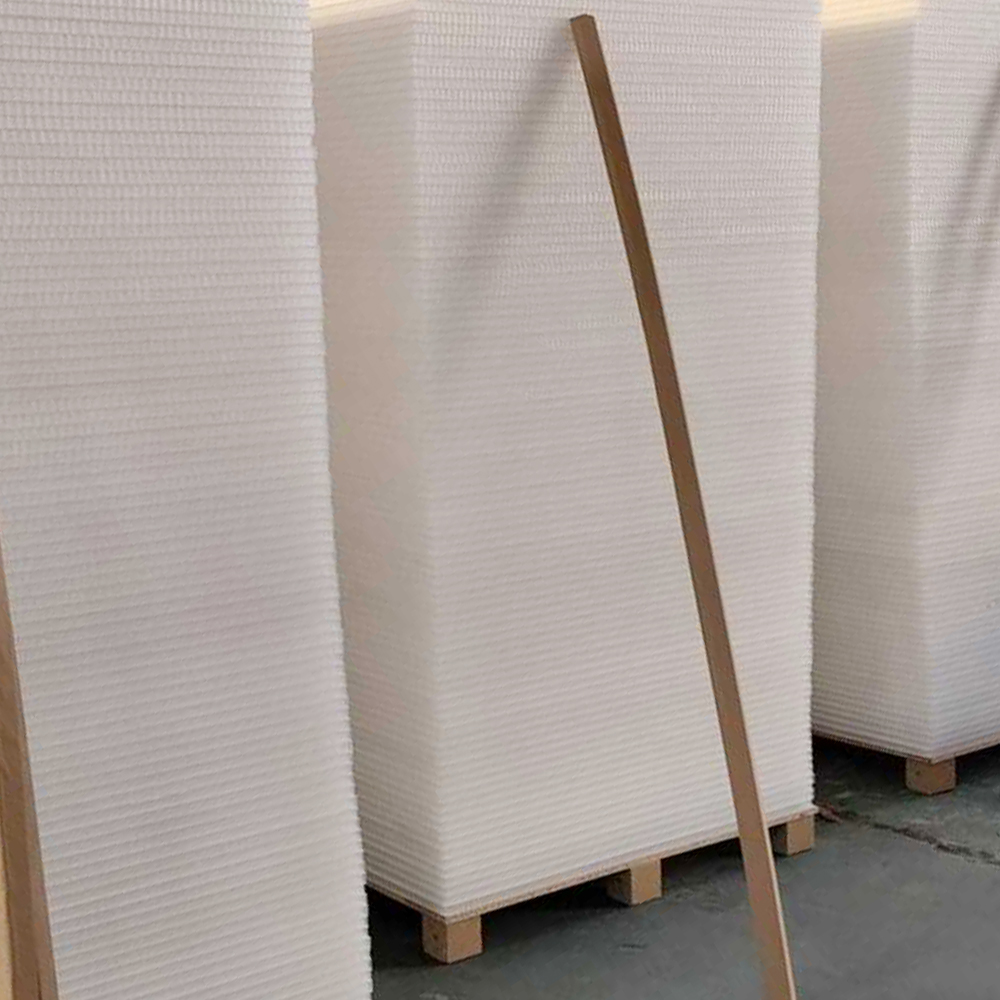
In lightweight composite panels, PP Honeycomb Core, PET Foam Core and PVC Foam Core are three important polymer-based core materials. They can all be used to reduce panel weight while providing structural support, but their material chemistry, cellular structure, mechanical behavior, moisture resistance, processing methods and recycling characteristics are different.
For composite-panel manufacturers and material buyers, the question is not simply which material is “stronger” or “more environmentally friendly.” The more useful approach is to understand how each material is constructed, where its performance comes from, and which properties matter for a particular application.
1. Different Materials, Different Structural Concepts
The first major difference is their cellular architecture.
PP Honeycomb Core
PP honeycomb uses thin polypropylene walls to create interconnected cells.
PP → Thin Cell Walls → Honeycomb Structure
The cells may be hexagonal or another engineered geometry.
PET Foam Core
PET foam is a closed-cell polymer foam.
PET Polymer → Foaming → Closed Cells
The polymer forms the walls surrounding many small gas-filled cells.
PVC Foam Core
PVC foam is also a cellular polymer structure, generally produced from PVC resin combined with blowing agents and other additives.
PVC Resin → Foaming → Closed-Cell Foam
Therefore, although all three are lightweight core materials, their structures are fundamentally different.
| Characteristic | PP Honeycomb | PET Foam | PVC Foam |
|---|---|---|---|
| Base polymer | Polypropylene | Polyethylene terephthalate | Polyvinyl chloride |
| Structure | Honeycomb cells | Closed-cell foam | Closed-cell foam |
| Main load mechanism | Cell-wall architecture | Foam-cell deformation | Foam-cell deformation |
| Typical density range | ~40–200 kg/m³ | ~50–250+ kg/m³ | ~45–250 kg/m³ |
| Thermoplastic | Yes | Yes | Yes |
| Water resistance | Very good | Very good | Very good |
| Typical role | Lightweight structural core | Structural foam core | Structural foam core |
The exact properties vary significantly according to grade and manufacturer.
2. Chemical Composition
PP Honeycomb
Polypropylene is a hydrocarbon-based thermoplastic polymer.
Its relatively simple chemical structure contributes to:
- Low density
- Chemical resistance
- Low water absorption
- Good toughness
- Thermoplastic processing
- Recycling potential
PP honeycomb products may also contain UV stabilizers, antioxidants, pigments, flame retardants or recycled PP.
PET Foam
PET is a polyester polymer containing ester groups in its molecular structure.
PET is widely known from beverage bottles and polyester fibers.
Using PET as a foam core provides an interesting route for incorporating recycled polymer feedstocks into structural products.
PET foam can be produced using recycled PET, although the exact recycled content depends on the manufacturing technology and product specification.
PVC Foam
PVC is a chlorine-containing thermoplastic polymer.
The presence of chlorine gives PVC a fundamentally different chemical composition from PP and PET.
Commercial PVC foam formulations can contain:
- PVC resin
- Stabilizers
- Blowing agents
- Processing aids
- Plasticizers or modifiers
- Pigments
- Other additives
This complex formulation means that PVC foam should not be evaluated solely based on the properties of pure PVC resin.
3. Density Comparison
Density is one of the first specifications engineers examine when selecting a core.
Representative commercial ranges are:
| Core Material | Approximate Density Range |
|---|---|
| PP Honeycomb | 40–200 kg/m³ |
| PET Foam | 50–250+ kg/m³ |
| PVC Foam | 45–250 kg/m³ |
These are broad engineering ranges rather than universal product specifications.
Density has a strong influence on:
- Compression strength
- Shear strength
- Modulus
- Weight
- Cost
- Energy absorption
Generally:
Higher Density → Higher Mechanical Performance → Higher Weight
However, different cellular structures mean that two materials with the same density can behave very differently.
An 80 kg/m³ PP honeycomb core is not mechanically equivalent to an 80 kg/m³ PET foam core.
4. Why PP Honeycomb Can Be Extremely Lightweight
The key advantage of PP honeycomb is its geometric efficiency.
Most of the internal volume is empty space.
The PP exists primarily in thin cell walls.
For example, an 80 kg/m³ PP honeycomb core with a thickness of 20 mm has a theoretical core weight of:
80 × 0.02 = 1.6 kg/m²
The core therefore provides 20 mm of structural depth while containing relatively little polymer.
PET and PVC foam achieve lightweight construction differently.
Instead of large honeycomb cells, the polymer is distributed around numerous small closed cells.
This creates different deformation behavior.
5. Compression Performance
Compression is an important property for:
- Floors
- Vehicle panels
- Furniture
- Marine decks
- Construction panels
- Transportation structures
PP Honeycomb
Compression occurs mainly through deformation and buckling of cell walls.
PET Foam
Compression occurs through deformation of the polymer walls surrounding the foam cells.
PVC Foam
The foam cells deform through a combination of cell-wall bending, polymer compression and local collapse.
Representative compression values vary widely according to density.
| Core | Typical Compression Behavior |
|---|---|
| PP Honeycomb | Strongly influenced by cell size and wall thickness |
| PET Foam | Strongly influenced by foam density and cell structure |
| PVC Foam | Strongly influenced by density and formulation |
For procurement, a manufacturer should provide actual compression-strength data for the selected density and thickness rather than relying on generic material ranges.
6. Shear Strength
Shear performance is particularly important in sandwich structures.
The core must transfer forces between the face sheets.
A simplified sandwich panel can be represented as:
Face Sheet → Bending Load
Core → Shear Load
Face Sheet → Bending Load
PP honeycomb achieves shear resistance through its interconnected cell walls.
PET and PVC foams achieve shear resistance through the continuous polymer structure surrounding their cells.
This produces an important structural difference.
Honeycomb cores are strongly influenced by cell orientation and geometry, whereas foam cores are more continuous and generally less geometrically directional.
7. Anisotropy
PP honeycomb can show pronounced directional behavior.
Mechanical performance may differ in:
- Through-thickness direction
- Ribbon direction
- Transverse direction
This is called anisotropy.
PET and PVC foams can also show some directional differences because foam manufacturing may create cell orientation, but their structure is generally more uniform than a conventional honeycomb architecture.
For applications involving complex loading, engineers should request test data in the actual loading direction.
This is especially important for:
- Vehicle floors
- Marine decks
- Large composite panels
- Wind-energy components
- Structural transportation panels
8. Moisture Resistance
All three materials can provide good moisture resistance compared with many hydrophilic core materials.
PP is particularly resistant to water.
PET foam is also commonly used in applications where moisture resistance is required.
PVC foam has a long history in marine and composite applications because of its low water absorption and resistance to many environmental conditions.
However, the moisture performance of the complete sandwich panel depends on:
- Face-sheet material
- Edge sealing
- Adhesive
- Fasteners
- Joints
- Surface damage
A water-resistant core does not guarantee that the entire panel is waterproof.
9. Temperature Resistance
Temperature is another important selection parameter.
PP has a relatively low melting temperature compared with many engineering polymers. Consequently, high-temperature applications require careful evaluation.
PET has a higher glass-transition temperature than PP, while PVC foam properties depend strongly on formulation and grade.
A simplified comparison is:
| Material | Temperature Consideration |
|---|---|
| PP Honeycomb | Sensitive to elevated temperatures; grade-dependent |
| PET Foam | Good thermal stability for many structural applications |
| PVC Foam | Grade-dependent; commonly available in different thermal-performance grades |
These are general comparisons rather than design limits.
For an actual project, the manufacturer should provide:
- Continuous service temperature
- Short-term temperature limit
- Thermal expansion coefficient
- Compression retention at temperature
10. Environmental Performance
Environmental performance is one of the most interesting differences among the three materials.
PP Honeycomb
PP is a thermoplastic and can be mechanically recycled.
The honeycomb structure also uses relatively little polymer.
Potential advantages include:
- Low material consumption
- Low component weight
- Recyclability potential
- High recycled-PP potential
PET Foam
PET has a particularly interesting recycling story because PET waste streams are already widely established in many regions.
Recycled PET can be used as feedstock for certain PET foam products.
This creates a strong connection between:
Waste PET → Recycled Polymer → Structural Foam
For applications where recycled content is an important procurement requirement, PET foam can therefore be attractive.
PVC Foam
PVC is also thermoplastic, but its recycling pathway is more complicated because PVC formulations can contain multiple additives and because chlorine-containing polymer chemistry requires appropriate processing systems.
PVC can certainly be recycled, but the practical recycling route depends on the specific formulation and waste stream.
11. Environmental Comparison
A simplified comparison is:
| Factor | PP Honeycomb | PET Foam | PVC Foam |
|---|---|---|---|
| Thermoplastic | Yes | Yes | Yes |
| Recycled feedstock potential | High | High | Possible |
| Low weight | Excellent | Excellent | Excellent |
| Material efficiency | Excellent | Very Good | Very Good |
| Water resistance | Excellent | Very Good | Excellent |
| End-of-life complexity | Medium | Medium | Medium–High |
| Recycled-content opportunity | High | High | Grade-dependent |
| Monomaterial design potential | High | High | High |
No material should be declared universally “green” based on this table.
A lifecycle assessment must consider the actual product, manufacturing process, transport distance, service life and recycling infrastructure.
12. PP Honeycomb vs PET Foam: Structural Difference
The most important distinction is architecture.
PP Honeycomb
Large cells + thin walls
This creates:
- Very low weight
- High structural efficiency
- Excellent thickness-to-weight ratio
- Direction-dependent properties
PET Foam
Small closed cells + continuous foam structure
This creates:
- More uniform material distribution
- Good machinability
- Good bonding characteristics
- Useful structural performance
For large lightweight panels, PP honeycomb can be particularly attractive where extremely low core density is required.
PET foam can be attractive where a more conventional foam-core manufacturing and bonding approach is preferred.
13. PP Honeycomb vs PVC Foam
PVC foam has been widely used in composite structures for many years.
Its advantages include:
- Good stiffness
- Good compression performance
- Low water absorption
- Good chemical resistance
- Established composite-processing technology
PP honeycomb offers a different approach.
Its key advantages include:
- Very low density
- Thermoplastic structure
- High material efficiency
- Impact absorption
- Recyclability potential
For marine and transportation applications, both can be technically suitable.
The decision should therefore be based on:
Required density + mechanical loads + temperature + bonding + cost + environmental objectives
rather than material popularity alone.
14. Manufacturing Process Matters
Material performance begins with manufacturing.
PP Honeycomb Manufacturing
A simplified process:
PP Resin
→ Extrusion
→ Sheet Formation
→ Heating
→ Honeycomb Forming
→ Cooling
→ Cutting
→ Surface Treatment
PET Foam Manufacturing
A simplified process:
PET Resin
→ Melting
→ Foaming
→ Cell Formation
→ Cooling
→ Cutting
PVC Foam Manufacturing
A simplified process:
PVC Resin + Additives
→ Mixing
→ Extrusion/Foaming
→ Cell Formation
→ Cooling
→ Cutting
Each process creates different cellular structures.
Therefore, comparing only the polymer chemistry without considering the manufacturing process is incomplete.
15. Which Core Material Should Be Selected?
A practical selection matrix can help:
| Requirement | PP Honeycomb | PET Foam | PVC Foam |
|---|---|---|---|
| Lowest core weight | Excellent | Very Good | Very Good |
| High material efficiency | Excellent | Very Good | Very Good |
| Impact absorption | Excellent potential | Very Good | Good–Very Good |
| Moisture resistance | Excellent | Very Good | Excellent |
| Recycled feedstock | High potential | High potential | Application-dependent |
| Structural foam applications | Good | Excellent | Excellent |
| Complex sandwich structures | Excellent | Excellent | Excellent |
| Thermoplastic recycling | Excellent potential | Excellent potential | More complicated |
Again, this is a selection framework, not a universal ranking.
16. The Importance of the Face Sheet
Core selection cannot be separated from face-sheet selection.
For example:
PP Honeycomb + Aluminum
Provides:
- High surface hardness
- Lightweight construction
- Good impact resistance
- Good dimensional stability
PP Honeycomb + FRP
Provides:
- Corrosion resistance
- Good strength-to-weight ratio
- Suitable composite construction
PET Foam + FRP
A common combination for:
- Marine
- Transportation
- Wind-energy
- General composite structures
PVC Foam + FRP
Widely used in:
- Marine
- Wind blades
- Transportation
- Industrial composite structures
The final product should therefore be evaluated as a sandwich system, not simply as a core material.
Conclusion
PP Honeycomb Core, PET Foam Core and PVC Foam Core all provide lightweight structural solutions, but they achieve their performance through different cellular architectures and polymer chemistries.
PP Honeycomb uses thin polymer walls and engineered geometry to achieve very high material efficiency and low weight.
PET Foam uses a closed-cell foam structure and has an important advantage in applications where recycled PET feedstock is desirable.
PVC Foam provides an established structural foam solution with good moisture resistance and broad composite-processing experience.
From a materials-engineering perspective, the most important selection parameters are:
Density → Cell Structure → Compression → Shear → Temperature → Moisture → Bonding → Recycled Content → End-of-Life
There is no single core material that is optimal for every application.
For manufacturers developing lightweight composite panels, the more advanced approach is to select the core based on the required structural function and lifecycle requirements, then optimize the face sheets, bonding system and manufacturing process around that core.
The real value of PP honeycomb is its combination of low density, cellular structural efficiency, thermoplastic processing and recycling potential. When these properties align with the application, PP honeycomb can become an effective alternative to conventional foam cores while offering a different pathway toward lightweight and more recyclable composite structures.
