
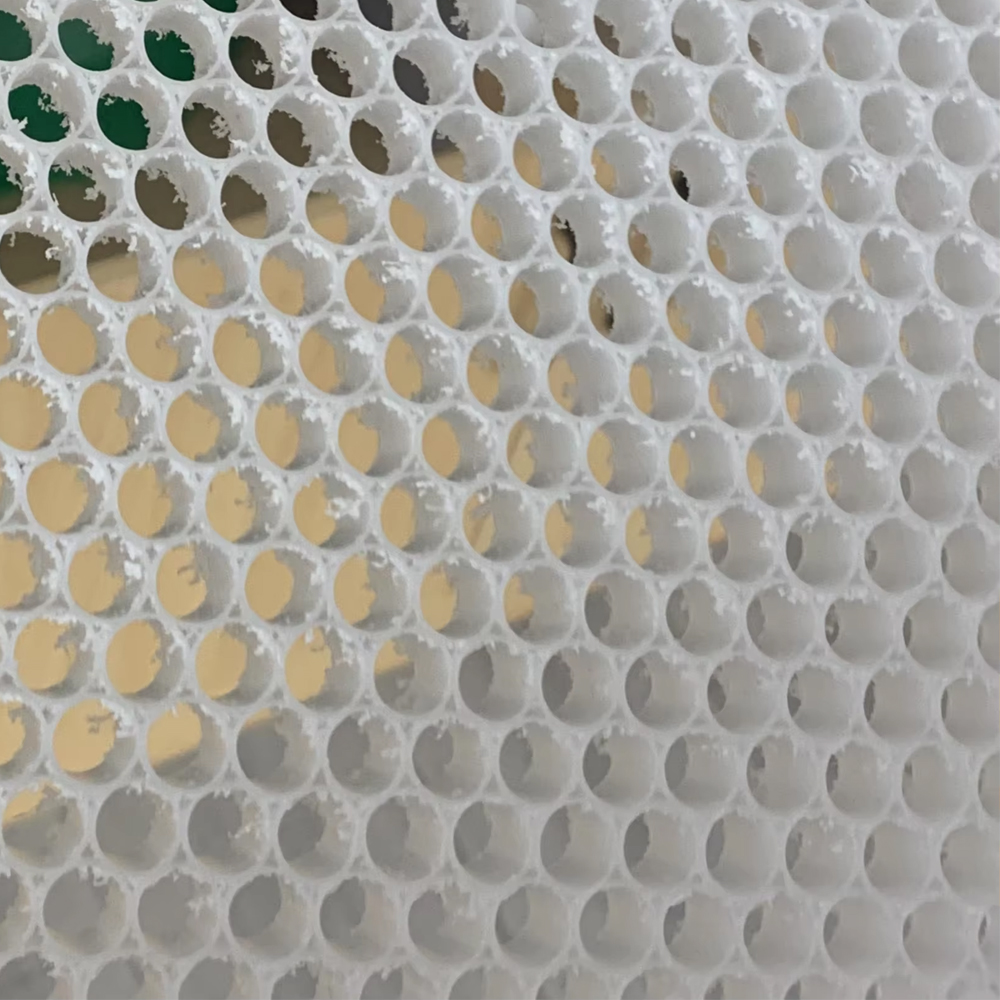
PP honeycomb panel is increasingly used in transportation, furniture, construction, marine interiors and lightweight composite structures. One reason is its low weight and high material efficiency. However, whether a PP honeycomb panel is environmentally friendly cannot be determined simply by saying that polypropylene is recyclable.
A proper environmental assessment needs to consider the entire material system:
Raw Material → Manufacturing → Transportation → Service Life → Reuse → Recycling → End-of-Life
The following analysis examines PP honeycomb panels from material composition, resource consumption, recycling, carbon impact and product design perspectives.
1. Why PP Honeycomb Can Reduce Material Consumption
The fundamental environmental advantage of PP honeycomb comes from its cellular structure.
Solid polypropylene has a density of approximately 900–910 kg/m³, while commercial PP honeycomb cores can have apparent densities of roughly 40–200 kg/m³, depending on cell size, wall thickness and design.
This means a honeycomb core can create a relatively thick structural layer while using much less polymer.
For example, consider 1 m² of a 20 mm core:
| Material | Approx. Density | Approx. Material Weight |
|---|---|---|
| Solid PP | 905 kg/m³ | 18.1 kg |
| PP Honeycomb | 60 kg/m³ | 1.2 kg |
| PP Honeycomb | 80 kg/m³ | 1.6 kg |
| PP Honeycomb | 120 kg/m³ | 2.4 kg |
| PP Honeycomb | 160 kg/m³ | 3.2 kg |
These are theoretical core calculations and exclude skins, adhesives and edge structures.
The important observation is that the cellular structure can dramatically reduce polymer consumption.
However, less material does not automatically mean lower total environmental impact. The entire finished panel must be considered.
2. The Environmental Advantage of Lightweight Design
One of the strongest arguments for PP honeycomb is not necessarily recycling. It is weight reduction.
Imagine two transportation panels performing the same structural function:
- Panel A: 15 kg
- Panel B: 8 kg
If thousands of these panels are installed in vehicles, the cumulative weight difference can become significant.
Lower vehicle weight can potentially reduce energy consumption during operation, particularly in applications where the component contributes meaningfully to total vehicle mass.
This is especially relevant to:
- Automotive interiors
- Trucks
- Trailers
- Rail vehicles
- Ships
- Recreational vehicles
- Aircraft interiors
The environmental benefit therefore depends partly on where the PP honeycomb panel is used.
A lightweight panel in a moving vehicle can potentially provide lifecycle benefits that a stationary interior panel may not.
3. What Makes Polypropylene Recyclable?
Polypropylene is a thermoplastic polymer.
This means that, unlike thermosetting resins, PP can be softened by heating and processed again.
In simplified terms:
PP → Heating → Reprocessing → New PP Product
This gives PP an important recycling advantage.
Potential PP recycling streams include:
- Industrial production scrap
- Post-industrial PP waste
- Post-consumer PP waste
- Recovered PP components
For PP honeycomb manufacturing, clean production scrap can be particularly attractive because the material composition is known and contamination is relatively low.
4. Why Recycling a PP Honeycomb Panel Is More Complicated
The fact that PP itself is recyclable does not mean that every PP honeycomb panel can be easily recycled.
The difficulty often comes from composite construction.
A typical sandwich panel may contain:
Aluminum Skin
↓
Adhesive
↓
PP Honeycomb Core
↓
Adhesive
↓
Aluminum Skin
Now the product contains multiple materials.
Other configurations may use:
- FRP face sheets
- Glass fiber
- Carbon fiber
- PVC film
- Decorative paper
- Wood veneer
- Paint
- Coatings
- Adhesive films
These materials can complicate separation.
Therefore, the recycling question should be:
Can the entire panel be economically separated and recycled, not simply whether the PP polymer is recyclable?
This distinction is important when developing sustainable composite products.
5. Monomaterial PP Structures
One potential solution is to increase the use of compatible PP materials throughout the panel.
For example:
PP Face Sheet + PP Adhesive/Film + PP Honeycomb Core
creates a more compatible material system than:
Aluminum + Epoxy + PP + Fiberglass
The first structure can potentially simplify mechanical recycling because fewer incompatible materials need to be separated.
This approach is sometimes described as design for recycling.
The principle is straightforward:
The easier a product is to disassemble and sort, the greater its potential for material recovery.
For manufacturers developing PP honeycomb panels, recyclability should therefore be considered during product design rather than only at the end of the product’s life.
6. Recycled PP in Honeycomb Cores
Another way to improve resource efficiency is to incorporate recycled polypropylene.
Potential feedstocks include:
- Production scrap
- Recovered PP sheets
- Industrial PP waste
- Post-consumer PP
However, recycled PP is not automatically equivalent to virgin PP.
Repeated processing and contamination can affect:
- Molecular weight
- Melt flow
- Impact resistance
- Tensile strength
- Melt strength
- Long-term durability
These factors are particularly important for honeycomb production because the manufacturing process requires the polymer to form thin and stable cell walls.
If melt strength is insufficient, cell geometry may become inconsistent.
Therefore, recycled PP must be properly sorted and controlled.
7. Virgin PP vs Recycled PP
A simplified comparison is:
| Factor | Virgin PP | Recycled PP |
|---|---|---|
| Polymer consistency | High | Depends on feedstock |
| Contamination | Very low | Potentially higher |
| Mechanical consistency | High | Requires quality control |
| Melt processing | Predictable | Can vary |
| Resource demand | Higher | Lower potential |
| Recycled content | 0% | Potentially high |
| Suitability | High-performance applications | Application-dependent |
For non-critical applications, a high recycled-content formulation may be technically practical.
For highly demanding structural applications, manufacturers may use controlled blends of virgin and recycled PP.
The correct solution depends on required performance rather than simply maximizing recycled content.
8. Carbon Impact: Material Efficiency vs Manufacturing Energy
Carbon impact is another important consideration.
The total carbon footprint of a PP honeycomb panel can be simplified as:
Carbon Impact = Raw Material + Manufacturing + Transportation + Use + End-of-Life
The honeycomb structure can reduce the amount of PP required, which can reduce the embodied impact associated with polymer production.
However, manufacturing the honeycomb also requires energy.
Energy can be consumed during:
- Polymer melting
- Extrusion
- Sheet forming
- Heating
- Honeycomb forming
- Cooling
- Cutting
- Lamination
- Adhesive curing
Therefore, a proper lifecycle comparison should compare the complete finished products, not just kilograms of resin.
9. Transportation Benefits
Weight reduction can provide another environmental advantage.
Suppose a manufacturer exports 10,000 panels.
If one design weighs:
10 kg/panel
the total product mass is:
100,000 kg
If a redesigned honeycomb structure reduces the weight to:
6 kg/panel
the total becomes:
60,000 kg
The difference is:
40,000 kg
This can potentially reduce transportation energy and associated emissions.
The actual benefit depends on:
- Shipping distance
- Transportation method
- Vehicle efficiency
- Packaging
- Loading efficiency
- Number of shipments
For global composite-panel manufacturers, this can be an important consideration because lightweight products can improve logistics efficiency.
10. Service Life Matters
Environmental performance is not only about production and recycling.
A material that lasts longer may avoid repeated replacement.
PP honeycomb panels can offer useful resistance to:
- Moisture
- Corrosion
- Many chemicals
- Impact
- Fatigue
When properly designed and protected, this can provide long service life in applications such as:
- Transportation interiors
- Marine interiors
- Furniture
- Building partitions
- Industrial panels
A longer service life can reduce the need for replacement materials.
Therefore:
Durability is also an environmental parameter.
A lightweight material with poor durability may not be environmentally preferable to a heavier material that lasts significantly longer.
11. Water Resistance and Environmental Durability
PP has very low water absorption compared with many hydrophilic materials.
This can be advantageous in humid environments.
A PP honeycomb core does not easily absorb water like some natural-fiber or hydrophilic core materials.
Potential applications include:
- Marine panels
- Bathroom furniture
- Vehicle floors
- Outdoor structures
- Refrigerated transportation
- Humid environments
However, the complete panel must still be designed properly.
Water can enter through:
- Exposed edges
- Fastener holes
- Damaged skins
- Poorly sealed joints
Therefore, the environmental durability of the finished product depends on both material properties and structural design.
12. PP Honeycomb vs Other Core Materials
Environmental performance becomes more meaningful when PP honeycomb is compared with alternative core materials.
| Core Material | Lightweight | Moisture Resistance | Recycling Potential | Typical Consideration |
|---|---|---|---|---|
| PP Honeycomb | Excellent | Excellent | High potential | Thermoplastic cellular core |
| PET Foam | Very Good | Good | High potential | Recycled-content options |
| PVC Foam | Very Good | Excellent | More complicated | Widely used structural foam |
| PU Foam | Excellent | Good | More challenging | Thermoset-based chemistry |
| Balsa | Good | Moderate | Bio-based | Natural material |
| Aluminum Honeycomb | Excellent | Excellent | High | High material and processing cost |
This table should not be interpreted as a universal environmental ranking.
Each material has different manufacturing routes, service lives, densities and recycling systems.
A meaningful comparison requires a defined application and lifecycle boundary.
13. Flame Retardants and Additives
Environmental analysis must also consider additives.
Some PP honeycomb panels may require:
- UV stabilizers
- Flame retardants
- Antioxidants
- Mineral fillers
- Pigments
These additives can improve performance but may affect recycling or end-of-life processing.
For example, a flame-retardant PP grade can have a different chemical composition from standard PP.
Therefore, buyers should ask manufacturers for:
- Material grade
- Additive information
- Recycled content
- Flame-retardant system
- Applicable environmental certifications
- Recycling information
This is particularly important for transportation and construction projects.
14. How PP Honeycomb Machinery Influences Sustainability
Manufacturing equipment also affects environmental performance.
A well-designed PP honeycomb production line can improve:
- Material utilization
- Dimensional consistency
- Scrap rate
- Energy efficiency
- Production yield
For example, excessive variation in cell size may cause more rejected material.
Similarly, poor extrusion control can increase edge trim and production waste.
Important manufacturing indicators include:
| Manufacturing Indicator | Environmental Significance |
|---|---|
| Material yield | Lower raw-material waste |
| Scrap rate | Lower production waste |
| Energy consumption | Lower manufacturing impact |
| Production stability | Less rejected material |
| Recycled-content capability | Greater circular-material potential |
| Process automation | Better consistency |
Therefore, PP honeycomb machinery is indirectly connected to sustainability.
Better process control can reduce waste and improve material efficiency.
15. A More Accurate Way to Evaluate Environmental Performance
Instead of asking:
“Is PP honeycomb environmentally friendly?”
A better set of questions is:
1. How much material is required?
Lower material consumption can reduce resource demand.
2. How much recycled PP is used?
Higher recycled content can reduce dependence on virgin polymer, provided performance remains suitable.
3. How long will the product last?
Long service life can reduce replacement frequency.
4. How much does the finished panel weigh?
Lower weight can improve transportation efficiency.
5. Can the panel be recycled?
The complete panel should be considered, not just the PP core.
6. How much manufacturing waste is generated?
High production yield improves material efficiency.
7. Can the materials be separated?
Designing for disassembly can improve end-of-life recovery.
16. The Lifecycle Perspective
The environmental performance of a PP honeycomb panel can be represented as:
Raw Material
↓
Virgin / Recycled PP
↓
Honeycomb Manufacturing
↓
Energy + Material Yield
↓
Panel Assembly
↓
Core + Face Sheets + Adhesive
↓
Transportation
↓
Lightweight Advantage
↓
Service Life
↓
Durability + Maintenance
↓
End-of-Life
↓
Reuse / Recycling / Disposal
This lifecycle perspective is much more useful than focusing on a single parameter.
Conclusion
PP honeycomb panel has several characteristics that can support more sustainable product design: low density, efficient material utilization, lightweight construction, moisture resistance, long service life and the recycling potential of polypropylene.
However, it would be inaccurate to describe every PP honeycomb panel as automatically environmentally friendly.
The environmental performance depends on the complete system:
Polymer Source + Recycled Content + Manufacturing Energy + Material Yield + Panel Weight + Service Life + Face-Sheet Compatibility + End-of-Life Recycling
For manufacturers, one of the most promising directions is to combine high-performance PP honeycomb geometry with recycled PP and design-for-recycling principles.
For buyers, the most useful environmental questions are therefore not simply “Is this PP?” or “Is it recyclable?” Instead, ask for recycled content, material composition, production scrap rate, energy data where available, product lifetime, and end-of-life recycling options.
In this sense, the real environmental advantage of PP honeycomb is not one single property. It comes from the ability to use less material to create a lightweight, durable structural product while retaining the possibility of recovering the thermoplastic material at the end of its service life.
