
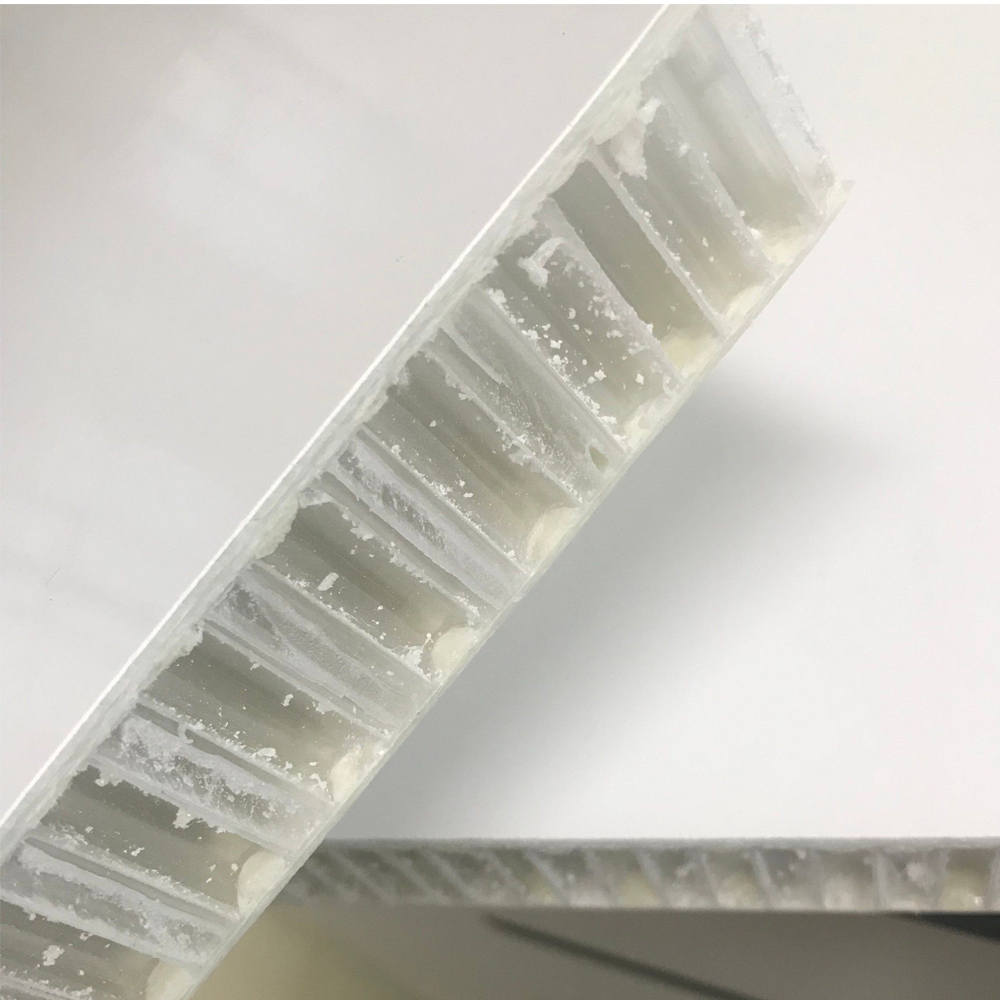
PP honeycomb sheet is a lightweight cellular material manufactured primarily from polypropylene. Compared with a solid polypropylene sheet, its most important feature is not the polymer itself, but the engineered honeycomb structure.
For buyers, engineers and composite-panel manufacturers, four parameters are particularly important when evaluating PP honeycomb sheet:
Density + Cell Size + Sheet/Core Thickness + Mechanical Performance
These parameters are closely connected. Changing one parameter often affects the others, which means that selecting PP honeycomb should not be based on thickness or density alone.
1. What Is PP Honeycomb Sheet?
PP honeycomb sheet generally refers to a lightweight polypropylene cellular sheet or honeycomb core that contains a regular arrangement of cells.
A simplified structure is:
Face Sheet
━━━━━━━━━━━━━━━━
PP Honeycomb Sheet
⬡ ⬡ ⬡ ⬡ ⬡
Face Sheet
━━━━━━━━━━━━━━━━
The cells contain mostly air, while the PP material forms the cell walls.
This allows the product to achieve a much lower apparent density than solid PP while maintaining useful structural performance.
Commercial PP honeycomb cores are commonly available in densities ranging from approximately 40 to 200 kg/m³, although the exact range varies according to manufacturer, cell geometry and manufacturing technology.
The most important point is that:
PP honeycomb sheet is a structural material whose performance comes from both polypropylene and cellular geometry.
2. Density: The Foundation of Performance
Density describes how much PP material exists within a given volume.
For solid polypropylene, density is typically around 900–910 kg/m³.
A PP honeycomb core can have an apparent density several times lower.
For example:
| Material | Approx. Density |
|---|---|
| Solid PP | 900–910 kg/m³ |
| PP Honeycomb | 40–60 kg/m³ |
| PP Honeycomb | 60–80 kg/m³ |
| PP Honeycomb | 80–120 kg/m³ |
| PP Honeycomb | 120–200 kg/m³ |
The actual value depends on the cell design and wall thickness.
Higher density normally means more polymer is available to carry load.
As a general tendency:
Density ↑ → Compression Strength ↑
Density ↑ → Shear Strength ↑
Density ↑ → Stiffness ↑
But:
Density ↑ → Weight ↑
Therefore, the highest-density PP honeycomb is not automatically the best product.
The objective is normally to achieve the required performance with the minimum practical density.
3. Cell Size and Its Influence
Cell size is another critical parameter.
Common PP honeycomb products may use cell sizes such as approximately 5, 8, 10, 12, 19 or 25 mm, although custom sizes are also possible.
Cell size determines how many cells exist within a given area.
Smaller Cells
Smaller cells generally provide:
- More cell walls per unit area
- Better local load distribution
- Better surface support
- Higher resistance to local deformation
- More uniform support for thin face sheets
Larger Cells
Larger cells generally provide:
- Lower material consumption
- Lower weight
- Higher open volume
- Potentially lower cost
- Faster coverage during manufacturing
However, larger cells can also be more susceptible to local deformation if the cell walls are too thin.
This produces an important engineering relationship:
Cell size should be selected together with density and wall thickness.
Simply selecting the largest possible cell is not a reliable lightweight-design strategy.
4. Cell Size vs Density
Consider two PP honeycomb sheets with the same overall thickness.
Product A
- Cell size: 8 mm
- Density: 80 kg/m³
Product B
- Cell size: 20 mm
- Density: 80 kg/m³
Even though the average density is identical, their local structural behavior may differ.
The smaller-cell structure provides more cellular divisions and generally better local support.
The larger-cell structure has fewer walls and larger unsupported areas.
However, if Product B uses thicker cell walls, it may compensate for some of this difference.
Therefore, engineers should avoid making simple assumptions such as:
“8 mm is always stronger than 20 mm.”
The real question is:
What are the density, wall thickness, cell geometry and test direction?
5. Wall Thickness
Cell-wall thickness is one of the most direct factors controlling mechanical performance.
A honeycomb cell wall that is too thin can experience:
- Buckling
- Bending
- Local crushing
- Damage during processing
Increasing wall thickness generally increases the amount of polymer available to carry load.
However, thicker walls also increase density and weight.
The relationship can therefore be expressed as:
Thin Wall → Low Weight → Lower Structural Capacity
Thick Wall → Higher Strength → Higher Weight
The optimum wall thickness depends on the required application.
For a lightweight interior panel, a thin-wall core may be sufficient.
For a transportation floor or heavy-duty sandwich panel, a higher-density structure may be more appropriate.
6. Sheet Thickness and Core Thickness
The term “thickness” can cause confusion because PP honeycomb products may refer to:
- Cell-wall thickness
- Honeycomb core thickness
- Total sandwich-panel thickness
These are completely different parameters.
Cell-Wall Thickness
Controls local cellular strength.
Core Thickness
Controls the structural depth of the sandwich panel.
Total Panel Thickness
Includes:
Face Sheet + Adhesive + Honeycomb Core + Adhesive + Face Sheet
For example:
| Component | Example Thickness |
|---|---|
| Aluminum Face Sheet | 1.0 mm |
| Adhesive | 0.2 mm |
| PP Honeycomb Core | 20 mm |
| Adhesive | 0.2 mm |
| Aluminum Face Sheet | 1.0 mm |
| Total | ~22.4 mm |
The 20 mm core is therefore not the same thing as a 20 mm finished panel.
7. Why Core Thickness Strongly Affects Bending
One of the major reasons to use PP honeycomb is to increase the structural depth of a panel without dramatically increasing its mass.
Suppose two face sheets are separated by a thin core.
The farther apart the face sheets are, the more effectively they can resist bending.
This is the basic principle behind sandwich construction.
A simplified relationship is:
Bending Stiffness ∝ Core Depth²
This is an idealized relationship, not a complete design equation, because real panels also depend on face-sheet modulus, core shear modulus, adhesive properties and boundary conditions.
Nevertheless, it explains why increasing core thickness can produce a large improvement in bending stiffness.
For this reason, a 30 mm PP honeycomb core may be more useful for a large lightweight panel than simply using a much denser 10 mm core.
8. Compression Performance
PP honeycomb sheet can provide useful compressive performance because load is distributed through the cell walls.
Under compression, several deformation mechanisms can occur:
- Elastic deformation
- Cell-wall bending
- Local buckling
- Plastic collapse
Representative commercial PP honeycomb products can have compressive strengths around 1–several MPa, depending on density and geometry.
For example, commercial data for some PP honeycomb configurations show values around:
| Density | Example Cell Size | Approx. Compression Strength |
|---|---|---|
| ~60–70 kg/m³ | ~10–12 mm | ~1–1.5 MPa |
| ~75–85 kg/m³ | ~8–10 mm | ~1.5–2 MPa |
| ~100+ kg/m³ | Varies | Can exceed 2 MPa |
These numbers are representative rather than universal.
Testing conditions, cell orientation, specimen dimensions and manufacturing quality can significantly affect results.
9. Shear Performance
For sandwich panels, compression is only one part of the story.
The core must also transfer shear between the face sheets.
Shear performance is influenced by:
Density + Cell Size + Wall Thickness + Cell Orientation
Representative commercial PP honeycomb cores can provide shear strength roughly in the range of 0.3–0.9 MPa, depending on the product configuration.
For a finished sandwich panel, however, the core is only one component.
The adhesive interface is equally important.
If the adhesive bond fails before the honeycomb core reaches its mechanical limit, the theoretical strength of the core cannot be fully utilized.
Therefore, panel testing should include:
- Core shear
- Skin-to-core adhesion
- Flatwise tensile strength
- Compression
- Bending
- Impact
10. Weight Calculation
One of the simplest ways to understand PP honeycomb is to calculate its theoretical weight.
For an area of 1 m²:
10 mm Core at 80 kg/m³
Volume:
1 × 0.01 = 0.01 m³
Weight:
0.01 × 80 = 0.8 kg/m²
20 mm Core at 80 kg/m³
Volume:
1 × 0.02 = 0.02 m³
Weight:
0.02 × 80 = 1.6 kg/m²
30 mm Core at 80 kg/m³
Volume:
1 × 0.03 = 0.03 m³
Weight:
0.03 × 80 = 2.4 kg/m²
Therefore:
| Core Thickness | Density | Core Weight |
|---|---|---|
| 10 mm | 80 kg/m³ | 0.8 kg/m² |
| 20 mm | 80 kg/m³ | 1.6 kg/m² |
| 30 mm | 80 kg/m³ | 2.4 kg/m² |
| 40 mm | 80 kg/m³ | 3.2 kg/m² |
This calculation excludes face sheets, adhesive, edge reinforcement and other components.
11. Environmental Performance
PP honeycomb sheet can provide environmental advantages because polypropylene is a thermoplastic material.
Potential advantages include:
- Low material consumption
- Lightweight transportation
- Long service life
- Low moisture absorption
- Recycling potential
- Possibility of using recycled PP
However, environmental performance must be evaluated through the complete product lifecycle.
A PP honeycomb panel combined with aluminum, fiberglass or other materials may be more difficult to recycle than a predominantly PP-based structure.
Therefore, an environmentally optimized product should consider:
Material Selection → Manufacturing → Product Lifetime → Disassembly → Recycling
rather than simply claiming that “PP is recyclable.”
12. Manufacturing Quality
The final performance of PP honeycomb sheet depends heavily on manufacturing consistency.
Important production parameters include:
| Production Parameter | Effect |
|---|---|
| PP resin quality | Polymer consistency |
| Melt temperature | Processing stability |
| Sheet thickness | Density consistency |
| Forming temperature | Cell geometry |
| Forming pressure | Cell uniformity |
| Cooling | Dimensional stability |
| Welding | Node strength |
| Cutting | Panel dimensional accuracy |
A high-quality PP honeycomb production line should therefore control both material parameters and geometric parameters.
Even if the average density is correct, significant variation in cell size or wall thickness can create local weak points.
13. How to Select PP Honeycomb Sheet
For practical purchasing, the selection process can follow this sequence:
Step 1 — Define the application
Is the product used for:
- Furniture
- Automotive interiors
- Truck bodies
- Marine panels
- Construction
- Packaging
- Industrial panels?
Step 2 — Define the load
Determine:
- Compression load
- Bending load
- Shear load
- Impact requirement
Step 3 — Define the weight target
Choose the lowest practical density that can satisfy the structural requirement.
Step 4 — Select cell size
Choose smaller cells where local support and surface quality are important.
Consider larger cells where low weight and material efficiency are more important.
Step 5 — Select core thickness
Use core thickness to achieve the required bending stiffness.
Step 6 — Evaluate the complete sandwich
Always consider:
Core + Face Sheet + Adhesive + Edge Structure
rather than evaluating the PP honeycomb core alone.
Conclusion
PP honeycomb sheet is a good example of how material science and structural engineering interact.
Its performance does not come from polypropylene alone. It comes from the combination of:
Density + Cell Size + Wall Thickness + Core Thickness + Cell Geometry + Manufacturing Quality
Density determines how much PP is present. Cell size determines the cellular architecture. Wall thickness influences local strength. Core thickness determines structural depth and has a major effect on bending stiffness.
For lightweight composite structures, the most effective design is rarely the one with the highest density. Instead, engineers should seek the best balance between weight, compression strength, shear strength, stiffness, impact resistance and manufacturing cost.
This is why PP honeycomb sheet has become an important core material for lightweight sandwich structures: it transforms a relatively small amount of polypropylene into a large, lightweight and structurally useful volume.
