
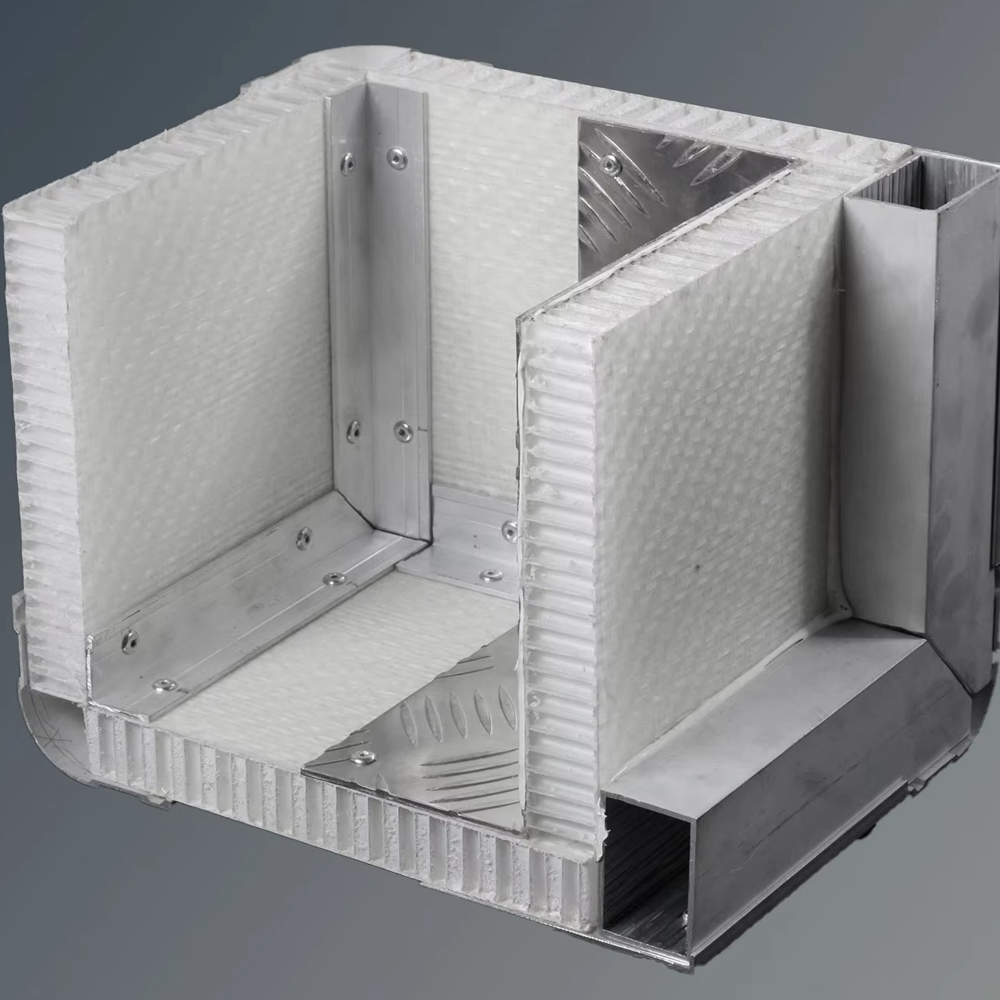
When selecting polypropylene materials for lightweight panels, two products are often considered: PP honeycomb board and solid PP sheet. Both are based on polypropylene, but their internal structures are fundamentally different.
A solid PP sheet is a continuous polymer structure, while PP honeycomb board contains a cellular core that uses a relatively small amount of polymer to create a much thicker structural section. As a result, the two materials can have very different relationships between weight, thickness, stiffness, strength and material consumption.
This article compares them from a materials-engineering perspective.
1. The Fundamental Structural Difference
A solid PP sheet is relatively straightforward:
PP Polymer → Extrusion → Solid Sheet
The entire cross-section is filled with polypropylene.
A PP honeycomb board is different:
PP Polymer → Thin Cellular Walls → Honeycomb Core → Composite Board
The core contains interconnected cells, with air occupying most of the internal volume.
A simplified structure is:
Solid PP Sheet
━━━━━━━━━━━━━━━━
PP Honeycomb Board
━━━━━━━━━━━━━━━━
⬡ ⬡ ⬡ ⬡ ⬡
━━━━━━━━━━━━━━━━
The honeycomb structure therefore separates material quantity from structural thickness.
This distinction is critical.
A 20 mm thick solid PP board requires considerably more polymer than a 20 mm PP honeycomb core. However, the honeycomb core can still provide structural support when combined with suitable face sheets.
2. Material Composition
Both products are primarily based on polypropylene.
Typical PP provides:
- Low density
- Good chemical resistance
- Low water absorption
- Good impact resistance
- Thermoplastic processability
- Recyclability potential
However, commercial products may contain additives such as:
- Antioxidants
- UV stabilizers
- Pigments
- Nucleating agents
- Flame-retardant additives
- Mineral modifiers
- Recycled PP
The main difference is therefore not necessarily chemical composition.
It is primarily structural architecture.
| Characteristic | Solid PP Sheet | PP Honeycomb Board |
|---|---|---|
| Basic polymer | PP | PP |
| Internal structure | Solid | Cellular |
| Air volume | Very low | Very high |
| Material consumption | High | Low |
| Structural depth | Equal to sheet thickness | Can be relatively large |
| Typical role | Sheet / panel | Structural core or sandwich panel |
This is why comparing the two solely by polymer properties can be misleading.
3. Density and Weight
The density of solid polypropylene is generally around 900–910 kg/m³, although the exact value depends on resin grade and additives.
A PP honeycomb core, by contrast, can have an apparent density many times lower.
Representative commercial PP honeycomb products may be available around 40–200 kg/m³, depending on cell geometry and construction.
This creates a substantial weight difference.
For example, consider a theoretical 1 m² panel with a thickness of 20 mm.
Solid PP
Volume:
1 × 0.02 = 0.02 m³
At approximately 905 kg/m³:
0.02 × 905 ≈ 18.1 kg/m²
PP Honeycomb Core
If the apparent density is 80 kg/m³:
0.02 × 80 = 1.6 kg/m²
The difference is substantial.
| 20 mm Material | Approx. Density | Approx. Weight |
|---|---|---|
| Solid PP | 905 kg/m³ | 18.1 kg/m² |
| PP Honeycomb Core | 80 kg/m³ | 1.6 kg/m² |
| PP Honeycomb Core | 100 kg/m³ | 2.0 kg/m² |
| PP Honeycomb Core | 150 kg/m³ | 3.0 kg/m² |
These calculations describe the core alone. A finished PP honeycomb sandwich panel will be heavier because it includes face sheets and adhesive or bonding layers.
Nevertheless, the calculation demonstrates the fundamental advantage of cellular construction.
4. Why Lower Weight Does Not Mean Weakness
At first glance, the difference between approximately 900 kg/m³ solid PP and an 80–150 kg/m³ honeycomb core appears enormous.
Why can such a lightweight material still be useful structurally?
The answer is geometry.
In a sandwich panel, the core increases the distance between the upper and lower face sheets.
Consider a simple beam.
If the material is concentrated close to the neutral axis, its contribution to bending stiffness is relatively limited.
If the material is separated farther from the neutral axis, bending resistance increases substantially.
A sandwich panel takes advantage of this principle:
Face Sheet → carries bending stress
Honeycomb Core → maintains separation + carries shear
Face Sheet → carries bending stress
Therefore, the honeycomb core is not designed to behave like a solid PP block.
Its purpose is to create a lightweight structural depth.
5. Bending Performance
Bending is one of the areas where PP honeycomb sandwich construction can have a major advantage.
A solid PP sheet can resist bending, but increasing its bending stiffness normally requires increasing its thickness.
Increasing thickness means increasing polymer volume and therefore weight.
With a honeycomb sandwich panel, the designer can increase the core thickness while keeping the core density relatively low.
For example:
| Panel Concept | Core/Sheet Thickness | Material Efficiency |
|---|---|---|
| Thin solid PP sheet | 5 mm | Low–Moderate |
| Thick solid PP sheet | 20 mm | Higher weight |
| PP honeycomb sandwich | 20 mm core + skins | High |
| PP honeycomb sandwich | 30 mm core + skins | Higher structural depth |
The last two designs use a low-density core to create a relatively thick structural section.
This is particularly useful when bending stiffness is more important than bulk material strength.
6. Compression Performance
The situation changes when we consider direct compression.
A solid PP sheet has continuous polymer throughout the cross-section.
Consequently, it can carry substantial compressive loads simply because the material is continuous.
A honeycomb core instead distributes the load through cell walls.
The cell walls can experience:
- Compression
- Bending
- Buckling
- Plastic deformation
Therefore, the compressive strength of PP honeycomb depends heavily on:
Density + Cell Size + Wall Thickness + Manufacturing Quality
Representative commercial PP honeycomb products can have compressive strengths from roughly 1 MPa to several MPa, depending on their construction.
The appropriate comparison therefore should not be:
“Which material has higher compression strength?”
A more useful engineering question is:
“How much structural performance is obtained per kilogram of material?”
This is where honeycomb structures become particularly interesting.
7. Shear Performance
Shear is another critical parameter.
A solid PP sheet has a continuous cross-section, so shear stress can be distributed through the polymer.
In a honeycomb sandwich panel, the core is specifically designed to transfer shear between the face sheets.
Typical commercial PP honeycomb cores can provide shear strengths in the approximate range of 0.3–0.9 MPa, depending on density, cell size and construction.
The final panel performance also depends strongly on the interface between:
Face Sheet ↔ Adhesive ↔ PP Honeycomb Core
Even a high-quality core can perform poorly if the bonding interface is weak.
Therefore, when purchasing PP honeycomb board, buyers should evaluate not only core properties but also the complete sandwich construction.
8. Impact Performance
PP is naturally a relatively tough thermoplastic.
A honeycomb structure adds another mechanism for energy absorption.
During impact, the cells can progressively deform and collapse.
This can absorb energy through:
- Cell-wall bending
- Plastic deformation
- Local buckling
- Progressive crushing
This makes PP honeycomb particularly interesting for:
- Vehicle interior panels
- Truck body panels
- Protective structures
- Transportation components
- Marine interiors
- Packaging systems
Solid PP can also absorb impact energy, but the cellular structure provides another degree of freedom for controlled deformation.
9. Water and Chemical Resistance
Both solid PP and PP honeycomb can offer good resistance to moisture and many chemicals.
PP has very low water absorption compared with many hydrophilic polymeric materials.
For a honeycomb core, however, the final water resistance depends on the entire construction.
The core may be highly moisture resistant, but water can potentially enter through:
- Cut edges
- Damaged face sheets
- Joints
- Fastener holes
- Poorly sealed interfaces
Therefore, a PP honeycomb panel should be evaluated as a complete system rather than simply by the water resistance of the PP polymer.
10. Manufacturing Differences
Solid PP sheet production is relatively straightforward.
A typical process is:
PP Resin → Melting → Extrusion → Calendering → Cooling → Cutting
PP honeycomb production is more complex.
A simplified process can involve:
PP Resin
↓
Extrusion
↓
PP Sheet/Film
↓
Heating
↓
Cell Forming
↓
Honeycomb Formation
↓
Cooling
↓
Cutting
↓
Surface Treatment / Lamination
↓
Finished Core
This means PP honeycomb production is more sensitive to process control.
Important variables include:
- Melt temperature
- Sheet thickness
- Forming temperature
- Cooling rate
- Cell dimensions
- Wall thickness
- Welding quality
Poor process control can create nonuniform cell geometry and inconsistent mechanical performance.
11. Environmental Considerations
Both solid PP and PP honeycomb have recycling potential because polypropylene is a thermoplastic.
However, the environmental comparison should consider the amount of material used.
If a honeycomb panel achieves the required structural function with substantially less polymer, it can potentially reduce:
- Raw material consumption
- Component weight
- Transportation energy
- Structural dead weight
But this does not mean every PP honeycomb product automatically has a lower environmental impact.
The final lifecycle depends on:
Raw Material → Manufacturing → Transportation → Service Life → Repair → Recycling
A PP honeycomb core combined with incompatible materials can also create recycling challenges at the end of its service life.
For this reason, monomaterial or compatible-material sandwich structures are particularly interesting for circular-material design.
12. PP Honeycomb Board vs Solid PP Sheet: Summary
| Property | Solid PP Sheet | PP Honeycomb Board |
|---|---|---|
| Polymer | PP | PP |
| Apparent density | ~900 kg/m³ | ~40–200 kg/m³ |
| Weight | High | Low |
| Internal structure | Solid | Cellular |
| Bending efficiency | Moderate | High when used as sandwich |
| Compression | High potential | Moderate–High depending on density |
| Shear | Continuous material | Core-dependent |
| Impact absorption | Good | Good–Very good potential |
| Moisture resistance | Very good | Very good |
| Material efficiency | Moderate | High |
| Manufacturing complexity | Lower | Higher |
| Recycling potential | High | High if material system is compatible |
| Main advantage | Continuous material | Lightweight structural architecture |
13. Which Material Should Be Used?
There is no universal answer.
Solid PP Sheet is suitable when:
- Continuous material is required
- High local load is expected
- Simple fabrication is important
- Machining or thermoforming is required
- Panel thickness is relatively small
PP Honeycomb Board is more suitable when:
- Weight reduction is important
- Large panels are required
- Bending stiffness is important
- Sandwich construction is acceptable
- Material efficiency is a priority
- Impact absorption is beneficial
For example, a lightweight vehicle interior panel may benefit from a PP honeycomb core, while a small machined component may be better served by a solid PP sheet.
Conclusion
PP Honeycomb Board and Solid PP Sheet use the same fundamental polymer but exploit it in completely different ways.
Solid PP relies primarily on the intrinsic properties of the polymer. PP honeycomb relies on both polymer properties and cellular architecture.
The solid sheet uses more material to create continuous structural capacity. The honeycomb board uses less material but creates structural depth through its cellular geometry.
This makes PP honeycomb particularly attractive where the engineering target is not simply maximum strength, but strength-to-weight ratio, stiffness-to-weight ratio and efficient material utilization.
For procurement and product development, the most useful specifications are therefore not simply “PP” or “PP board.” A complete PP honeycomb specification should include core density, cell size, wall thickness, core thickness, compression strength, shear strength, face-sheet material and bonding method.
That combination determines whether a PP honeycomb panel is merely lightweight—or genuinely lightweight and structurally efficient.
