
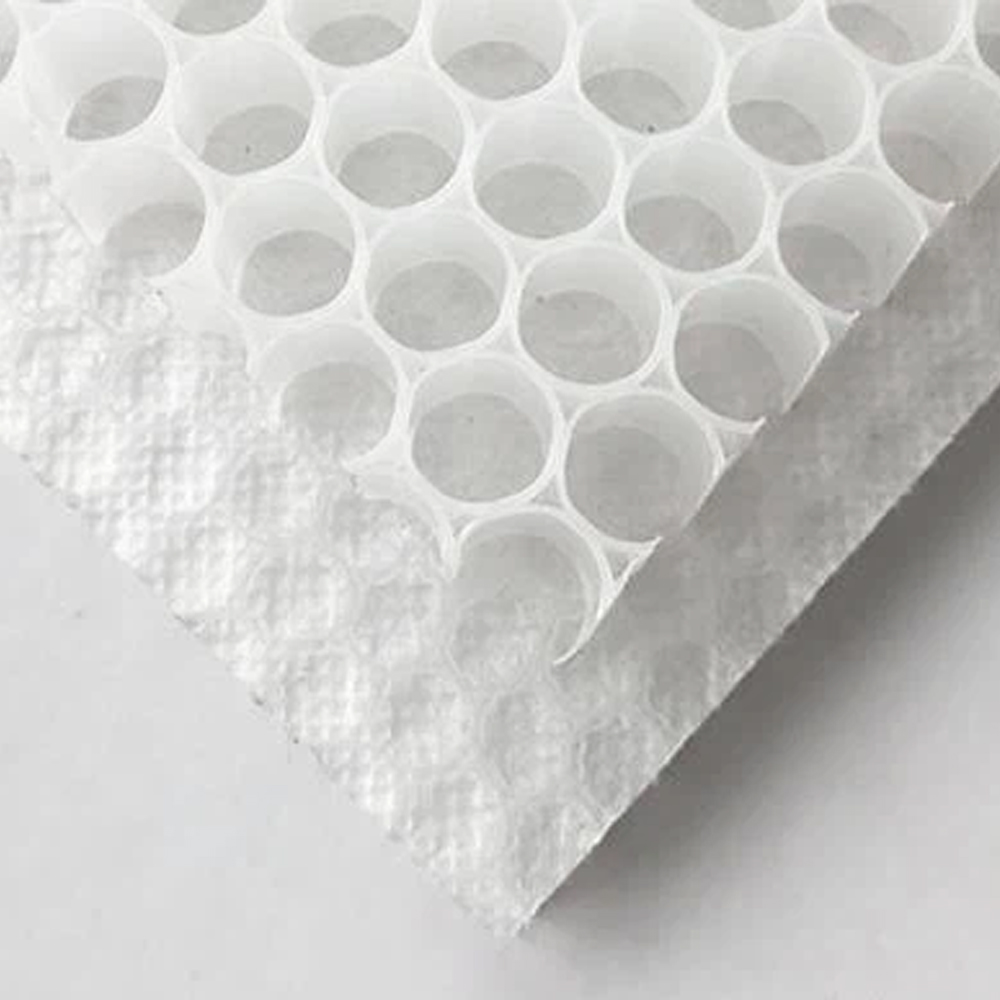
PP honeycomb panel is a lightweight sandwich structure that combines polypropylene honeycomb core with one or more face sheets. Its performance does not depend only on the properties of polypropylene. In practice, cell geometry, cell size, wall thickness, core density, core thickness and face-sheet design determine how efficiently the panel carries loads.
The fundamental advantage of a honeycomb structure is simple: it uses a relatively small amount of material to create a thick, lightweight structural layer. This makes PP honeycomb panels attractive for transportation, furniture, construction, marine interiors and other applications where strength-to-weight ratio is important.
1. Why Cell Geometry Matters
A solid PP sheet carries load through a continuous mass of polymer. A PP honeycomb core takes a different approach.
The core consists of thin walls forming repeated cells:
Face Sheet
━━━━━━━━━━━━━━
PP Honeycomb Core
⬡ ⬡ ⬡ ⬡ ⬡
Face Sheet
━━━━━━━━━━━━━━
The empty spaces reduce weight, while the cell walls provide structural support.
A honeycomb core therefore converts a two-dimensional sheet material into a three-dimensional cellular structure.
The basic relationship can be expressed as:
Lower material consumption + optimized geometry = lower weight with useful structural performance
This is the same fundamental principle used in many lightweight structural materials, including aluminum honeycomb, polymer honeycomb and foam cores.
2. Hexagonal Cells and Load Distribution
The traditional honeycomb cell is approximately hexagonal.
The hexagonal geometry is attractive because it provides a relatively efficient arrangement of material around empty spaces.
When an external load is applied, the load is distributed through the interconnected cell walls.
Under compression, the walls can experience:
- Axial compression
- Bending
- Local buckling
- Plastic deformation
Under shear, the cell walls deform in a different mode, allowing the core to transfer shear forces between the two face sheets.
This means that the honeycomb core is not simply “filled with air.” The air contributes little to structural strength; the cell-wall architecture is responsible for most of the mechanical performance.
3. Cell Size vs Weight
Cell size is one of the most important design parameters.
Typical commercial PP honeycomb products may use cell sizes ranging from several millimeters to more than 20 mm, depending on the intended application.
A simplified comparison is:
| Cell Size | Material Usage | Weight | Local Support | Typical Application |
|---|---|---|---|---|
| Small | Higher | Higher | Better | High-load panels |
| Medium | Moderate | Moderate | Balanced | General sandwich panels |
| Large | Lower | Lower | Lower | Lightweight structures |
However, cell size cannot be considered independently from wall thickness.
For example, a large cell with very thin walls can be extremely lightweight, but its resistance to local buckling may be limited.
Conversely, a small cell with relatively thick walls can provide higher compression and shear performance but will increase material consumption.
Therefore:
The optimum cell size is determined by the required performance rather than simply by the lowest possible weight.
4. How Cell Size Influences Compression Strength
Under compression, the honeycomb walls progressively deform.
Smaller cells generally provide more cell walls within a given area. This can improve load distribution and reduce the size of unsupported wall sections.
As a result, smaller-cell structures can provide higher resistance to localized compression.
For example, representative commercial PP honeycomb data show that products around 8 mm cell size and 80 kg/m³ density can reach approximately 2 MPa compressive strength, while lower-density configurations can have significantly lower values. Actual performance varies with manufacturer, test method, density and geometry.
This demonstrates why it is misleading to specify PP honeycomb only by thickness.
A more complete specification should include:
Core Thickness + Density + Cell Size + Compression Strength
5. Core Thickness and Bending Stiffness
Core thickness has a particularly important effect on sandwich-panel bending stiffness.
Consider two panels made with the same face-sheet material.
Panel A
Core thickness = 10 mm
Panel B
Core thickness = 30 mm
Panel B can achieve significantly greater separation between the two face sheets.
This increases the structural depth of the sandwich.
For an idealized sandwich beam, bending stiffness is strongly related to the distance between the face sheets. In simplified form:
Bending stiffness ∝ face-sheet modulus × face-sheet area × core depth²
The relationship is not intended as a universal design equation, because real panels also involve core shear deformation, skin thickness, adhesive layers and boundary conditions. But it illustrates the fundamental principle:
Increasing core thickness can dramatically increase bending stiffness without proportionally increasing material weight.
This is one of the biggest advantages of honeycomb sandwich construction.
6. Cell Wall Thickness
Cell wall thickness determines how much polymer is available to carry load.
If the walls are too thin:
- Compression strength decreases
- Buckling becomes easier
- Local damage becomes more likely
- Dimensional stability may decrease
If the walls are too thick:
- Density increases
- Weight increases
- Material efficiency decreases
- Cost may increase
Therefore, an optimized PP honeycomb structure requires a balance between:
Cell Size + Wall Thickness + Density
The goal is not maximum wall thickness.
The goal is maximum structural efficiency per unit mass.
7. Density and Structural Performance
Density is often used as a convenient indicator of PP honeycomb performance.
Representative commercial products may fall into density ranges such as:
| Core Density | Relative Weight | Expected Structural Performance |
|---|---|---|
| 50 kg/m³ | Very Low | Lightweight applications |
| 60–80 kg/m³ | Low | General structural panels |
| 90–120 kg/m³ | Medium | Higher load requirements |
| 120–200 kg/m³ | High | Heavy-duty applications |
These should be considered design ranges rather than universal specifications.
Higher density normally means more PP material in the cellular structure, which can increase:
- Compressive strength
- Shear strength
- Stiffness
- Local load capacity
But it also increases weight.
This produces a fundamental engineering trade-off:
Strength ↑ → Material Usage ↑ → Weight ↑
The correct solution is therefore application-specific.
8. Cell Geometry and Shear Strength
A sandwich panel does not only experience bending.
The core also carries shear forces.
During bending, the upper face sheet may experience compression while the lower face sheet experiences tension. The core transfers shear between them.
If the core has insufficient shear strength, the panel can experience:
- Core shear failure
- Face-sheet separation
- Local buckling
- Adhesive failure
Therefore, increasing panel thickness without considering core shear strength can create an unbalanced design.
For PP honeycomb, shear performance is affected by:
Density + Cell Size + Wall Thickness + Cell Orientation + Manufacturing Quality
Representative commercial PP honeycomb products can have shear strengths in the range of approximately 0.3–0.9 MPa, depending on construction and density.
9. Cell Orientation and Anisotropy
Another important characteristic of honeycomb materials is anisotropy.
An isotropic material has approximately similar properties in different directions.
A honeycomb structure is different.
Its mechanical response can vary depending on:
- Through-thickness direction
- In-plane direction
- Ribbon direction
- Transverse direction
This means that the same PP honeycomb core can exhibit different mechanical behavior depending on how the load is applied.
For simple panels this may not be critical. For engineered structures such as vehicle floors, marine components or large transportation panels, however, directional performance can become important.
Material suppliers should therefore provide mechanical data with clearly defined:
- Test direction
- Test standard
- Specimen thickness
- Cell size
- Density
- Temperature
Without this information, two apparently identical PP honeycomb products cannot be reliably compared.
10. Manufacturing Accuracy and Cell Geometry
The theoretical geometry of a honeycomb core is only part of the story.
Actual production quality can influence the final structure.
Important manufacturing parameters include:
| Manufacturing Factor | Potential Effect |
|---|---|
| PP melt temperature | Cell-wall formation |
| Sheet thickness | Density variation |
| Forming temperature | Cell geometry |
| Forming pressure | Cell uniformity |
| Cooling rate | Dimensional stability |
| Welding quality | Node strength |
| Cutting accuracy | Panel assembly |
| Surface treatment | Adhesion |
Poorly controlled production can create uneven cell sizes or inconsistent wall thickness.
This may produce localized weak areas even when the average density meets the specification.
Therefore, PP honeycomb machinery is a critical part of material performance.
The production line does not merely manufacture the core; it effectively determines how consistently the designed cellular structure is reproduced.
11. Designing for Strength-to-Weight Ratio
For most PP honeycomb panel applications, the objective is not simply maximum strength.
The more useful parameter is:
Strength-to-weight ratio
A lightweight panel that provides adequate structural performance can be more valuable than a heavier panel with unnecessarily high strength.
A simplified design strategy is:
Step 1: Determine required load
↓
Step 2: Determine required bending stiffness
↓
Step 3: Select core thickness
↓
Step 4: Select cell size
↓
Step 5: Adjust density/wall thickness
↓
Step 6: Select suitable face sheets
↓
Step 7: Verify compression, shear and bonding performance
This approach prevents over-engineering.
12. PP Honeycomb Panel: Structure vs Material
The key lesson is that the performance of a PP honeycomb panel comes from the combination of material and architecture.
Polypropylene provides:
- Low density
- Chemical resistance
- Toughness
- Moisture resistance
- Thermoplastic processing
The honeycomb structure provides:
- High material efficiency
- Increased structural depth
- Compression resistance
- Shear transfer
- Weight reduction
- Impact-energy absorption
Therefore, a useful engineering expression is:
Panel Performance = PP Material Properties × Cell Geometry × Core Density × Core Thickness × Face-Sheet Design × Manufacturing Quality
Changing any one of these parameters can change the final panel performance.
Conclusion
The strength and weight of a PP honeycomb panel are determined not by polypropylene alone, but by the geometry of the cellular structure.
Cell size, wall thickness and density control the amount of polymer available to carry load. Core thickness determines the distance between face sheets and therefore has a major influence on bending stiffness. Meanwhile, cell orientation and manufacturing accuracy influence directional mechanical properties and consistency.
For lightweight applications, the objective should not be to maximize density or minimize cell size. Instead, the material should be engineered around the required load, stiffness, weight, thickness and service environment.
This is what makes PP honeycomb different from a conventional PP sheet: the geometry itself becomes part of the material.
