
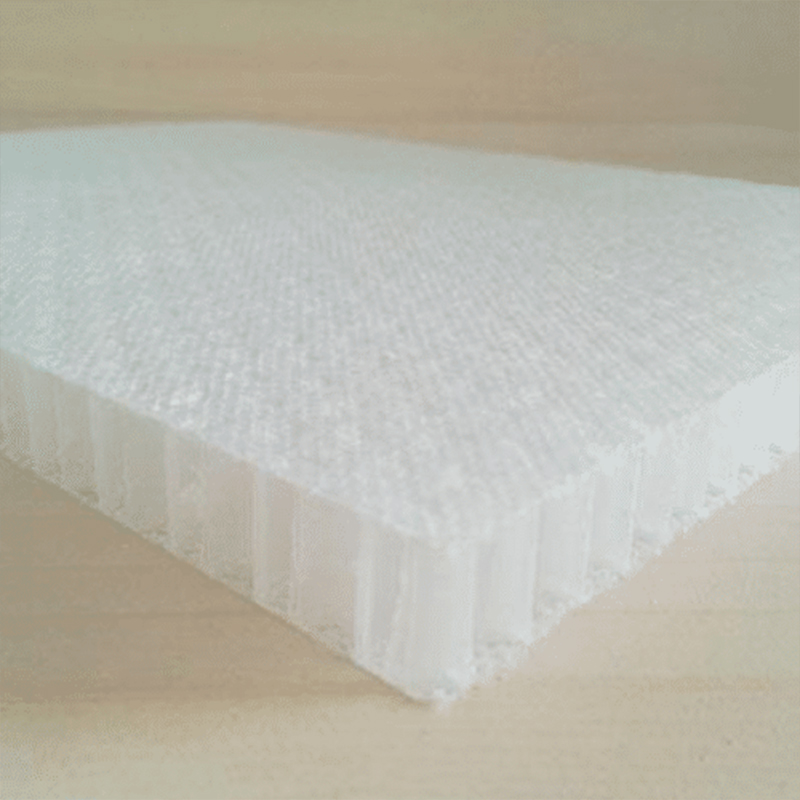
PP honeycomb core is a lightweight structural material based primarily on polypropylene (PP). Unlike a conventional solid plastic board, a PP honeycomb core uses a cellular architecture to place material where it contributes most effectively to structural performance. The result is a core that can provide a useful combination of low weight, compressive strength, shear resistance, impact absorption, moisture resistance and recyclability.
Today, PP honeycomb core is used in sandwich panels, automotive components, transportation structures, furniture, construction panels, marine interiors and other lightweight composite structures. Its performance, however, cannot be evaluated simply by looking at the PP resin itself. The final properties depend on the interaction between polymer composition, cell geometry, density, wall thickness, core thickness, processing technology and face-sheet bonding.
This article analyzes PP honeycomb core from a materials-engineering perspective, moving from molecular composition to cellular structure and finally to mechanical performance.
1. What Is PP Honeycomb Core?
PP honeycomb core is a cellular structural material manufactured primarily from polypropylene thermoplastic resin.
The basic structure consists of many interconnected cells. In a conventional hexagonal configuration, thin PP walls form repeating honeycomb cavities.
Instead of filling an entire volume with solid PP, the material is concentrated into thin cell walls. Most of the internal volume is therefore occupied by air.
A typical commercial PP honeycomb core can have densities around 40–200 kg/m³, depending on the product architecture and manufacturing process. One manufacturer, for example, specifies standard PP honeycomb products around 80 kg/m³, with cell sizes from several millimeters to several tens of millimeters.
Representative commercial data also show that an 8 mm cell-size PP honeycomb can have a density around 80 kg/m³, compressive strength around 1.5–2.0 MPa, and shear strength around 0.5–0.6 MPa, although these values vary substantially with density, geometry and test method.
Typical PP Honeycomb Core Parameters
| Property | Typical Range / Example | Main Influencing Factor |
|---|---|---|
| Base polymer | Polypropylene | Resin grade |
| Core density | 40–200 kg/m³ | Wall thickness and cell geometry |
| Cell size | 3–30 mm+ | Design/application |
| Core thickness | 3–500 mm | Structural requirement |
| Compressive strength | 0.8–8.1 MPa* | Density and cell structure |
| Shear strength | 0.3–0.9 MPa* | Density, wall geometry |
| Water absorption | Very low | Closed-cell structure |
| Operating temperature | Approx. -40 to +80°C* | PP grade and design |
| Recycling potential | High | Product composition and contamination |
*Representative manufacturer specifications rather than universal material limits.
The important point is that PP honeycomb core is not a single material specification. Two products both described as “PP honeycomb” can have significantly different mechanical properties.
2. Material Composition: What Is PP Honeycomb Actually Made Of?
The first component is polypropylene.
PP is a thermoplastic polymer produced from propylene monomers. Its molecular structure consists of repeating hydrocarbon units with methyl groups attached to the polymer backbone.
This relatively nonpolar molecular structure contributes to several characteristics important for honeycomb applications:
- Low density
- Good chemical resistance
- Low water absorption
- Good fatigue resistance
- Thermoplastic processability
- Re-meltability
- Relatively good impact resistance
However, commercial PP honeycomb cores may contain more than polymer resin alone.
Depending on the grade, the formulation can include:
- Virgin PP resin
- Recycled PP
- Processing stabilizers
- Antioxidants
- UV stabilizers
- Pigments
- Nucleating agents
- Flame-retardant additives
- Mineral or other modifiers
Therefore, when evaluating PP honeycomb for a demanding application, it is insufficient to ask only:
“Is the core made from PP?”
The better question is:
“What PP grade and formulation are used, and how does that formulation interact with the honeycomb manufacturing process?”
This becomes especially important when recycled PP is incorporated.
Research on recycled PP sandwich structures has shown that contamination from other polymers or inorganic materials can have a significant effect on strength and impact performance, even when stiffness-related performance remains acceptable.
3. Why PP Is Suitable for Honeycomb Structures
The key advantage of PP is not simply that it is lightweight.
Its greater advantage is that it is a thermoplastic material that can be repeatedly heated and reshaped, allowing PP to be converted into thin sheets, films, profiles and cellular structures.
For honeycomb manufacturing, this creates several possibilities.
Material → Sheet → Cellular Structure
A simplified manufacturing sequence is:
PP Resin
↓
Melting and Extrusion
↓
PP Sheet / Film
↓
Cell Forming
↓
Honeycomb Expansion or Assembly
↓
Core Stabilization
↓
Surface Treatment / Film Lamination
↓
Finished PP Honeycomb Core
↓
Composite Sandwich Panel
The processing route matters because the polymer’s melt strength, viscosity and thermal behavior influence the stability of thin honeycomb walls.
Research into melt-stretched PP honeycomb structures has specifically demonstrated the relationship between polymer molecular structure, rheology and honeycomb architecture. High-melt-strength PP is particularly suitable for melt-stretching processes because strain hardening can help produce stable honeycomb webs.
4. The Honeycomb Structure Is More Important Than the Resin Alone
This is the fundamental principle behind PP honeycomb.
Consider two panels:
Panel A
Solid PP sheet
Panel B
Thin PP skins + PP honeycomb core
If both use the same polymer, their structural performance can be dramatically different.
The honeycomb structure introduces a large second moment of area around the neutral axis of a sandwich panel.
In simple terms, increasing the distance between the upper and lower face sheets can dramatically increase bending stiffness without proportionally increasing mass.
This is why sandwich construction is so effective.
A simplified representation is:
Face Sheet
────────────
PP Honeycomb Core
⬡ ⬡ ⬡ ⬡ ⬡
────────────
Face Sheet
The face sheets primarily carry tensile and compressive bending stresses, while the honeycomb core maintains separation between the skins and carries much of the transverse shear load.
Therefore:
The face sheets provide bending strength, while the core provides thickness, shear support and structural separation.
This is why a PP honeycomb panel should not be evaluated solely according to the compressive strength of its core.
5. Cell Size and Its Effect on Performance
Cell size is one of the most important design variables.
Commercial PP honeycomb products commonly use cell sizes such as 6, 8, 10, 12, 19 and 25 mm, although larger and smaller configurations are also possible.
Generally:
Smaller Cell
Smaller cells usually provide:
- More cell walls per unit area
- More uniform load distribution
- Higher structural stability
- Better surface support
- Potentially higher compressive performance
Larger Cell
Larger cells generally provide:
- Lower material consumption
- Lower weight
- Higher air volume
- Faster material coverage
- Potential cost advantages
However, increasing cell size indefinitely is not desirable.
The relationship is not simply:
Larger cell = better lightweight performance.
Instead, the designer must balance cell size, wall thickness and density.
Example of Commercial Data
One PP honeycomb specification gives the following representative values:
| Cell Size | Density | Compressive Strength | Shear Strength |
|---|---|---|---|
| 8 mm | 80 kg/m³ | ~2.0 MPa | ~0.6 MPa |
| 10 mm | 64 kg/m³ | ~1.0 MPa | ~0.3 MPa |
This illustrates an important engineering principle:
Changing cell size can change both weight and structural performance.
The exact relationship depends on how the cell wall thickness and density are adjusted.
6. Density: The Most Important Performance Parameter?
Density is one of the easiest parameters to compare, but it is often misunderstood.
A higher-density PP honeycomb generally contains more polymer per unit volume.
This normally means:
- Higher compressive strength
- Higher shear strength
- Higher modulus
- Higher local load capacity
- Higher weight
For example, one commercial PP honeycomb series reports approximately:
| Density | Cell Size | Compressive Strength | Shear Strength |
|---|---|---|---|
| 70 kg/m³ | 12 mm | 1.47 MPa | 0.40 MPa |
| 75 kg/m³ | 10 mm | 1.58 MPa | 0.45 MPa |
| 80 kg/m³ | 8 mm | 1.66 MPa | 0.50 MPa |
These are representative tested values, not universal values for all PP honeycomb products.
The engineering objective is therefore not necessarily to select the highest density.
Instead:
Select the lowest density capable of meeting the required structural performance.
That is the basis of lightweight structural design.
7. Compression Performance
Compression is particularly important for:
- Vehicle floors
- Truck bodies
- Furniture panels
- Walkable sandwich structures
- Construction boards
- Marine decks
- Protective panels
Under compression, the honeycomb walls carry load through a combination of:
- Cell-wall bending
- Cell-wall buckling
- Local deformation
- Material compression
When the applied load exceeds the elastic range, the cells may progressively collapse.
This progressive collapse can be useful in impact applications because the structure can absorb energy instead of transmitting the entire impact load directly to the surrounding structure.
Commercial PP honeycomb data show compressive strengths ranging from roughly 1 MPa to several MPa, depending strongly on density and configuration.
8. Shear Performance
For sandwich structures, shear performance is equally important.
The core sits between the face sheets and prevents them from sliding relative to each other.
Under bending:
Upper Skin → Compression
Core → Shear
Lower Skin → Tension
Therefore, increasing panel thickness can substantially improve bending stiffness, while the core must remain sufficiently strong to carry the resulting shear stress.
Representative PP honeycomb products show shear strengths around 0.3–0.9 MPa, depending on density and construction.
This is why a high-quality PP honeycomb panel should be evaluated using the complete sandwich structure rather than only the core’s compression value.
9. Impact Absorption and Energy Dissipation
PP has relatively good toughness compared with many brittle polymeric materials.
Combined with a cellular architecture, this can produce useful impact-energy absorption.
When an impact occurs, the honeycomb cells can deform progressively.
Instead of transmitting all the energy instantaneously through the panel, part of the impact energy is consumed through:
- Cell-wall bending
- Plastic deformation
- Local buckling
- Friction and interfacial deformation
Research on recyclable sandwich structures has investigated PP-based skins combined with PP honeycomb cores specifically for impact performance.
This characteristic is particularly relevant to:
- Automotive interiors
- Transportation panels
- Protective structures
- Packaging
- Sports equipment
- Marine components
10. Why PP Honeycomb Has Good Moisture Resistance
PP itself has very low affinity for water compared with many hydrophilic materials.
A commercial PP honeycomb specification reports water absorption below 0.1% under its stated test conditions.
This is important for applications exposed to:
- Humidity
- Rain
- Condensation
- Washing
- Marine environments
- Water-based processing
The honeycomb geometry itself does not automatically guarantee waterproofing, however.
The final panel may contain:
- PP core
- Adhesive
- Fiberglass skin
- Aluminum skin
- Fabric
- Surface coating
Water resistance therefore needs to be evaluated at the complete panel system, particularly at edges, joints and interfaces.
11. Environmental Advantages of PP Honeycomb
PP honeycomb has an important sustainability advantage because PP is a thermoplastic.
A thermoplastic material can theoretically be:
heated → reshaped → processed again
rather than permanently crosslinked like a thermoset resin.
This creates an important potential advantage in recycling.
Research has specifically examined recyclable sandwich structures using PP-based skins and PP honeycomb cores.
However, it is important not to oversimplify the environmental argument.
“Recyclable” Does Not Automatically Mean “Environmentally Friendly”
The real environmental impact depends on:
- Virgin vs recycled PP
- Production energy
- Panel weight
- Transportation distance
- Service life
- Adhesive selection
- Face-sheet material
- Contamination
- End-of-life recycling infrastructure
For example, if a PP core is bonded permanently to aluminum, fiberglass or another incompatible material, separating the components at end-of-life can become more difficult.
Therefore, monomaterial PP sandwich structures can offer an especially interesting route toward improved recyclability.
12. Virgin PP vs Recycled PP
Recycled PP can reduce dependence on virgin polymer feedstock, but its quality must be controlled.
The biggest issue is contamination.
Post-consumer PP may contain:
- Other polymers
- Fillers
- Pigments
- Metals
- Organic contamination
- Degraded polymer chains
Research on a recycled-PP sandwich structure containing 45 wt% recycled content found that contaminants could have little effect on stiffness-controlled behavior while significantly affecting strength and impact-related properties.
This leads to an important material-selection principle:
Recycled content should be evaluated together with contamination level, mechanical consistency and intended application.
For structural applications, batch-to-batch consistency is often more important than simply maximizing recycled content.
13. The Role of PP Honeycomb Machinery
Material performance begins with the manufacturing process.
A PP honeycomb production line may involve processes such as:
- PP extrusion
- Sheet forming
- Heating
- Cellular forming
- Thermoforming
- Welding or bonding
- Expansion
- Cutting
- Surface-film application
- Dimensional calibration
Manufacturing parameters can affect:
Cell size → Density → Wall thickness → Uniformity → Mechanical properties
For example, inconsistent thermal conditions during forming can produce variation in cell geometry.
That variation can subsequently cause:
- Uneven density
- Local weak points
- Inconsistent compression strength
- Poor surface flatness
- Reduced bonding quality
Therefore, when evaluating PP Honeycomb Machinery, the key question is not simply production speed.
A more meaningful evaluation includes:
| Manufacturing Factor | Effect on Final Core |
|---|---|
| Extrusion temperature | Melt quality |
| Melt strength | Cell-wall stability |
| Sheet thickness | Density and strength |
| Forming temperature | Cell geometry |
| Forming pressure | Cell consistency |
| Cooling rate | Dimensional stability |
| Welding/bonding | Node strength |
| Cutting accuracy | Panel dimensional accuracy |
| Online inspection | Quality consistency |
The relationship between polymer rheology and honeycomb architecture has also been demonstrated experimentally in PP melt-stretching research.
14. PP Honeycomb Core vs Solid PP Board
The difference can be summarized as follows:
| Property | Solid PP Board | PP Honeycomb Core |
|---|---|---|
| Material usage | High | Low |
| Density | High | Low |
| Weight | High | Low |
| Internal structure | Solid | Cellular |
| Compression resistance | High | Moderate–High |
| Bending stiffness in sandwich | Limited alone | High when combined with skins |
| Impact absorption | Good | Very good potential |
| Material efficiency | Moderate | High |
| Recyclability | High | High if monomaterial |
| Typical role | Skin / board | Structural core |
The important distinction is that a PP honeycomb core is normally not intended to replace a structural face sheet by itself.
Its greatest value appears when it is integrated into a sandwich construction.
15. PP Honeycomb Core as an Engineering Material
From a materials-science perspective, PP honeycomb is interesting because its performance comes from two levels simultaneously:
Level 1 — Material
The PP polymer provides:
- Toughness
- Chemical resistance
- Low density
- Thermoplastic processing
- Moisture resistance
- Recyclability potential
Level 2 — Architecture
The honeycomb structure provides:
- High material efficiency
- Low weight
- Compressive support
- Shear resistance
- Impact energy absorption
- Large panel thickness without excessive mass
This can be expressed as:
Performance = Polymer Properties × Cellular Architecture × Manufacturing Quality × Sandwich Design
Changing any one of these factors can significantly alter the final product.
Conclusion
PP Honeycomb Core is not simply a lightweight plastic board. It is an engineered cellular material in which polymer chemistry, cell geometry and manufacturing technology work together.
The basic PP material provides low density, chemical resistance, toughness and thermoplastic recyclability. The honeycomb architecture then converts a relatively small amount of polymer into a three-dimensional structural core capable of carrying compression and shear loads.
Typical commercial products demonstrate densities from approximately 40 to 200 kg/m³, with representative compressive strengths from around 1 MPa to several MPa, depending on density and architecture.
For material selection, however, density alone is not enough. Engineers should evaluate:
PP grade → additive system → cell size → wall thickness → density → core thickness → compression → shear → impact → bonding → service temperature → recycling pathway.
This is also why PP Honeycomb Panel, PP Honeycomb Board, PP Honeycomb Sheet and PP Honeycomb Core should be treated as different engineering products rather than interchangeable keywords.
Ultimately, the biggest advantage of PP honeycomb lies in the combination of material efficiency and structural efficiency. By putting polymer where it contributes most to load transfer and leaving the remaining volume as lightweight cellular space, PP honeycomb can achieve a useful balance between weight, strength, durability and material consumption—particularly when it is properly engineered as part of a complete sandwich structure.
