
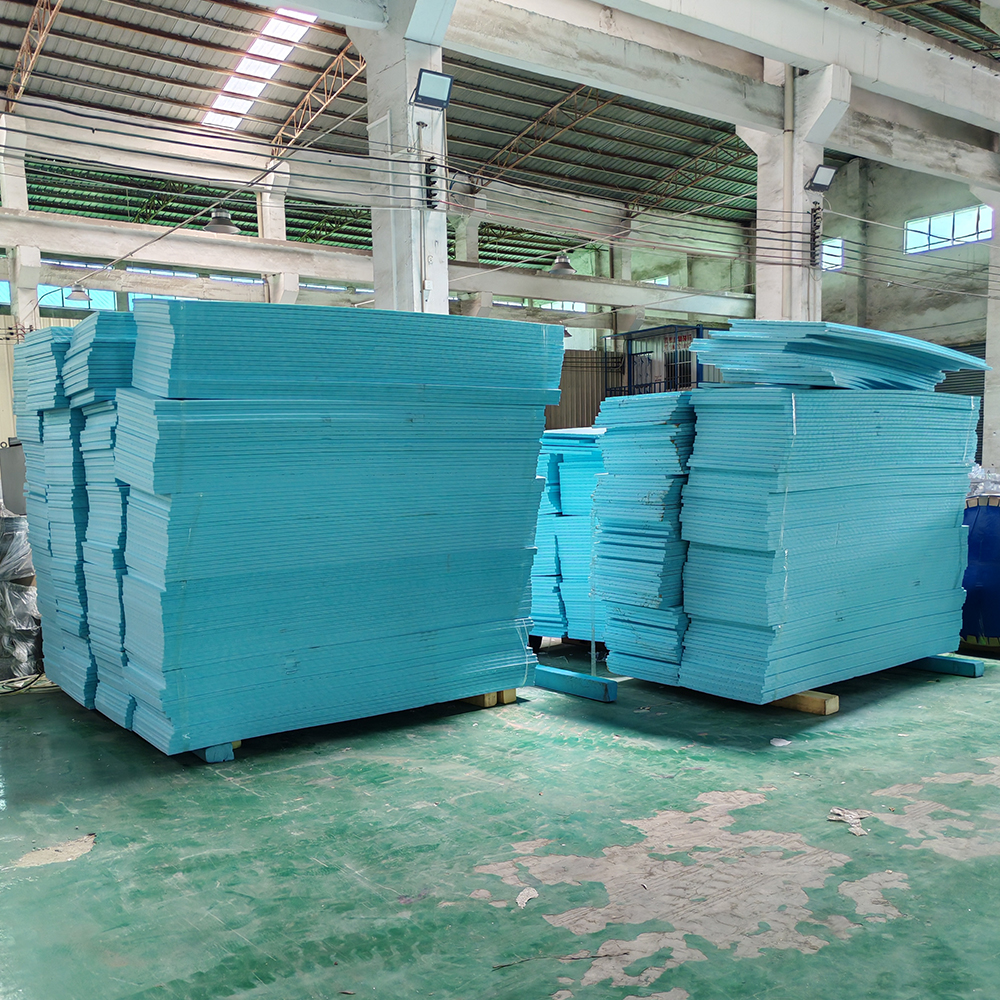
XPS foam sheet is a rigid extruded polystyrene foam material supplied in sheet or board form. It is manufactured through a continuous extrusion foaming process that creates a closed-cell structure. The material is lightweight, rigid, relatively moisture resistant, and available in different thicknesses and densities, making it suitable for insulation, fabrication, composite structures, and specialty applications.
The terminology used in the international market can sometimes create confusion. “XPS foam sheet,” “XPS foam board,” “XPS insulation board,” and “extruded polystyrene foam board” may refer to similar products, although manufacturers may use these terms differently depending on dimensions, surface treatment, or intended application. Therefore, professional buyers should focus on the technical specification rather than the product name alone.
For building applications, XPS foam sheet can be used in walls, roofs, floors, foundations, and other thermal insulation systems. The closed-cell structure provides relatively low water absorption and good resistance to compressive loads. These characteristics make XPS particularly attractive for applications where insulation may need to tolerate moisture or mechanical pressure.
In the Middle East, XPS foam sheet can be considered for residential construction, commercial buildings, industrial facilities, warehouses, prefabricated structures, and composite panels. Saudi Arabia and the UAE, for example, have extensive construction activity in hot climates where thermal insulation is an important consideration. Qatar, Kuwait, Oman, and Bahrain also have projects where building-envelope thermal performance can be a major design factor.
The first technical parameter buyers should consider is thickness. XPS foam sheets can be supplied in specifications such as 10 mm, 25 mm, 30 mm, 40 mm, 50 mm, and 100 mm. Thin sheets may be suitable for limited-space applications, liners, composite structures, or specialty fabrication, while thicker boards are generally selected when greater thermal resistance is required.
Density is another important factor. It influences the weight and mechanical characteristics of the material, but it should be evaluated together with compressive strength. For floor, foundation, and heavy-duty applications, buyers should obtain tested compressive-strength data rather than assuming that a particular density automatically meets the project’s loading requirements.
Surface condition can also influence application performance. Standard XPS foam sheets may have a relatively smooth surface, while specialized products can be processed with grooves, textures, or other surface patterns. These modifications can be useful for specific bonding, installation, or composite manufacturing requirements.
For sandwich-panel applications, XPS foam sheet can function as a lightweight core between face materials. The final panel’s strength and stiffness depend heavily on the skins and adhesive bond as well as the foam core. Therefore, panel manufacturers should evaluate shear strength, peel strength, dimensional stability, and adhesive compatibility in addition to basic insulation properties.
When purchasing XPS foam sheet internationally, a professional buyer should request the manufacturer’s technical datasheet, product dimensions, thickness tolerance, density, thermal conductivity, compressive strength, water absorption, fire-performance information, packaging specifications, and production capacity. For Middle East shipments, packaging should also be designed to minimize damage and deformation during transportation and storage.
In summary, XPS foam sheet is a flexible raw material category with applications extending beyond simple wall insulation. The correct specification depends on the required thermal performance, mechanical loading, moisture conditions, fabrication method, panel structure, and project standards. A technically capable manufacturer should be able to recommend the appropriate XPS formulation and specification based on the buyer’s actual application rather than offering only a generic foam sheet.
