
Introduction
PP honeycomb panels are lightweight sandwich structures designed to provide a practical balance between weight, stiffness, strength, impact resistance, moisture resistance, and manufacturing flexibility.
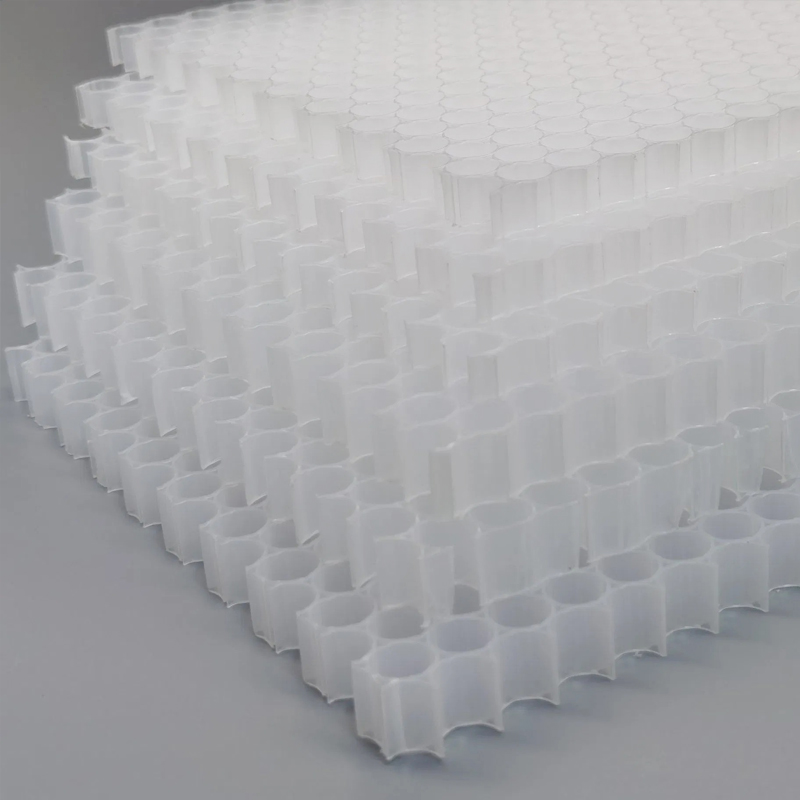
Unlike solid polypropylene sheets, PP honeycomb panels use a cellular core to reduce material consumption while maintaining structural thickness. When combined with suitable face sheets, the resulting sandwich panel can be used in a wide range of lightweight structural and semi-structural applications.
Today, PP honeycomb panels are increasingly considered for applications where conventional solid boards, plywood, metal sheets, or heavier composite structures may add unnecessary weight.
Four major application areas are particularly important:
- Transportation
- Construction
- Marine
- Furniture
However, there is no single PP honeycomb configuration that is ideal for every application.
A transportation floor panel may require high compression and impact resistance, while a furniture door may prioritize lightweight construction and surface flatness. A marine panel may require excellent moisture resistance, whereas a construction partition may place greater emphasis on fire performance, dimensional stability, and panel thickness.
Therefore, selecting a PP honeycomb panel should always begin with the application requirements.
1. Why PP Honeycomb Panels Are Used in Different Industries
The basic structure of a PP honeycomb sandwich panel consists of:
Face Sheet + PP Honeycomb Core + Face Sheet
Each layer has a specific function.
The face sheets provide surface strength, stiffness, impact resistance, appearance, and protection.
The PP honeycomb core provides:
- Low weight
- Structural thickness
- Shear transfer
- Compression support
- Impact energy absorption
- Face-sheet separation
- Material efficiency
The combination creates a lightweight structure that can be engineered for different applications.
The most important design variables are:
| Parameter | Main Function |
|---|---|
| Core density | Controls weight, compression and shear performance |
| Cell size | Influences local support and material efficiency |
| Core thickness | Strongly affects bending stiffness |
| Face-sheet material | Determines much of the surface strength and stiffness |
| Face-sheet thickness | Influences bending and impact performance |
| Bonding | Transfers load between skin and core |
| Overall thickness | Determines structural geometry and stiffness |
These parameters should be selected according to the application rather than standardized across all products.
2. PP Honeycomb Panels in Transportation
Transportation is one of the most suitable application areas for lightweight sandwich structures.
Vehicles often contain large panels where reducing mass can improve handling, installation, payload efficiency, or overall vehicle design.
PP honeycomb panels can be used for applications such as:
- Bus interior panels
- Rail vehicle interior panels
- RV components
- Truck body panels
- Vehicle partitions
- Ceiling panels
- Floor structures
- Sidewall panels
- Door panels
- Storage compartments
Why Lightweight Construction Matters
A conventional solid board may provide sufficient strength but can add considerable mass when used over a large surface area.
A PP honeycomb sandwich structure allows engineers to create a thicker structural panel without filling the entire volume with solid material.
This is especially useful for large-format transportation panels.
For example, a relatively thin face sheet combined with a thicker lightweight core can produce substantially greater structural depth than the face sheet alone.
The increased structural depth improves bending efficiency while the cellular core limits weight growth.
3. Transportation Panel Selection
Transportation applications usually require a balance between:
- Low weight
- Bending stiffness
- Compression resistance
- Impact resistance
- Dimensional stability
- Fastening performance
- Surface durability
For floor or high-load applications, the core generally needs greater compression and shear capability than an interior decorative panel.
For sidewalls and ceiling panels, weight reduction and bending stiffness may be more important than extremely high compression strength.
A simplified selection framework is:
| Transportation Application | Core Density | Cell Size | Core Thickness | Recommended Face Sheet Direction |
|---|---|---|---|---|
| Interior Wall | Low–Medium | Medium | Medium | FRP, PP or decorative composite |
| Ceiling Panel | Low–Medium | Medium–Large | Medium | Lightweight FRP or PP |
| Door Panel | Medium | Small–Medium | Medium | Aluminum, FRP or PP |
| Floor Panel | Medium–High | Small–Medium | Medium–High | Aluminum or high-strength FRP |
| Partition Panel | Low–Medium | Medium | Medium–High | FRP, PP or laminate |
| Truck/RV Panel | Medium | Medium | Medium–High | FRP or aluminum |
These are engineering selection directions, not universal specifications. Final values should be established through mechanical testing and the actual loading requirements.
4. PP Honeycomb Panels in Construction
Construction applications provide another important market for PP honeycomb structures.
Potential applications include:
- Interior partitions
- Lightweight wall panels
- Ceiling systems
- Decorative panels
- Modular construction panels
- Temporary structures
- Prefabricated components
- Door and cabinet panels
- Building interior systems
One of the main advantages is the ability to manufacture a relatively thick panel without the weight associated with a solid board of similar dimensions.
This can simplify:
- Transportation
- Manual handling
- Installation
- Cutting
- Assembly
- Modular construction
Moisture Resistance
PP itself has very low water absorption compared with many traditional porous materials.
This can make PP honeycomb attractive for applications where moisture exposure is a concern.
Potential examples include:
- Bathrooms
- Utility rooms
- Modular buildings
- Interior partitions
- Areas with periodic humidity exposure
However, the complete panel should be evaluated.
The core may have good moisture resistance while the face sheet, adhesive, edge treatment, or connection system may have different environmental limitations.
5. Construction Requirements Are Different from Transportation
Construction panels may be subjected to different requirements than vehicle panels.
Depending on the application, important considerations may include:
- Fire performance
- Smoke requirements
- Acoustic performance
- Thermal insulation
- Moisture resistance
- Surface durability
- Impact resistance
- Dimensional stability
- Building-code compliance
This means a lightweight PP honeycomb core cannot automatically be substituted for another construction material simply because it has a lower density.
For building applications, the entire panel system must be evaluated against the relevant project specifications and regulations.
6. PP Honeycomb Panels in Marine Applications
Marine applications are another strong candidate for PP honeycomb structures because weight and moisture resistance are both important.
Potential applications include:
- Yacht interiors
- Boat partitions
- Cabin walls
- Ceiling panels
- Furniture
- Storage structures
- Interior doors
- Lightweight flooring systems
- Decorative marine panels
Traditional marine construction may use plywood, solid plastic, aluminum, or other composite structures.
PP honeycomb panels can provide an alternative when weight reduction is important.
Why Moisture Resistance Matters
Marine environments expose materials to:
- High humidity
- Water
- Salt
- Temperature changes
- Repeated wetting and drying
Polypropylene is inherently resistant to water and many common chemicals.
However, marine panel performance depends on more than the polymer core.
The following must also be considered:
Core + Face Sheet + Adhesive + Edge Sealing + Fasteners
A poorly protected panel edge can become a weak point even when the PP honeycomb core itself has excellent moisture resistance.
7. Marine Panel Selection
Marine panels typically require a careful balance between low weight and durability.
| Marine Application | Core Density | Cell Size | Core Thickness | Face Sheet |
|---|---|---|---|---|
| Cabin Wall | Low–Medium | Medium | Medium | FRP |
| Ceiling Panel | Low | Medium–Large | Medium | FRP or PP |
| Interior Door | Medium | Small–Medium | Medium | FRP or aluminum |
| Furniture | Low–Medium | Medium | Medium | FRP, laminate or decorative skin |
| Floor Panel | Medium–High | Small–Medium | Medium–High | FRP or aluminum |
| Storage Panel | Medium | Small–Medium | Medium | FRP or aluminum |
For marine applications, the face sheet and adhesive system should be selected for the expected moisture, temperature, and chemical environment.
8. PP Honeycomb Panels in Furniture Manufacturing
Furniture is another application where low weight can be extremely valuable.
PP honeycomb panels can be considered for:
- Cabinet doors
- Wardrobe doors
- Kitchen cabinet components
- Bathroom cabinets
- Shelving
- Table panels
- Decorative partitions
- Interior doors
- Lightweight furniture
- RV and marine furniture
The primary advantages include:
- Reduced panel weight
- Large-format panel construction
- Good dimensional efficiency
- Moisture resistance
- Impact tolerance
- Design flexibility
For example, a large cabinet door made from a conventional solid board can become relatively heavy.
A honeycomb sandwich structure can reduce mass while maintaining sufficient panel thickness and rigidity.
9. Furniture Panel Selection
Furniture applications generally have different requirements from transportation floors.
The designer may prioritize:
- Low weight
- Surface flatness
- Screw and hardware compatibility
- Edge finishing
- Appearance
- Moisture resistance
- Bending stiffness
A typical design direction may be:
| Furniture Application | Core Density | Cell Size | Core Thickness | Face Sheet |
|---|---|---|---|---|
| Cabinet Door | Low–Medium | Small–Medium | Medium | Aluminum, laminate or decorative sheet |
| Wardrobe Door | Low–Medium | Medium | Medium | Decorative laminate or composite |
| Kitchen Cabinet | Medium | Small–Medium | Medium | Moisture-resistant skin |
| Bathroom Cabinet | Medium | Small–Medium | Medium | Moisture-resistant face sheet |
| Table Panel | Medium | Small–Medium | Medium–High | Laminate, aluminum or FRP |
| Shelving | Medium–High | Small–Medium | Medium–High | Aluminum or reinforced composite |
For furniture, edge design is especially important.
Honeycomb cores are lightweight, but hardware such as hinges, handles, screws, and brackets may introduce concentrated loads.
Therefore, local reinforcement may be required around connection points.
10. Core Density: How Should It Be Selected?
Core density is one of the most important parameters when purchasing PP honeycomb core.
A higher-density core generally contains more PP material per unit volume and can provide higher resistance to compression and shear.
However, higher density also means greater weight.
The basic design relationship can be expressed as:
Higher Density → Higher Material Content → Higher Weight
but potentially:
Higher Density → Greater Core Mechanical Capacity
The correct density therefore depends on the expected load.
Low-Density Core
Suitable for applications where:
- Weight reduction is the primary objective
- Loads are relatively low
- Large surface areas need to remain lightweight
- The panel mainly functions as a partition or interior panel
Medium-Density Core
Suitable for:
- General structural panels
- Doors
- Furniture
- Transportation interiors
- Marine interiors
Higher-Density Core
More appropriate when:
- Compression loads are significant
- Floor panels are required
- Local impact is important
- Heavy equipment may be supported
- Higher shear capacity is required
11. Cell Size Selection
Cell size influences the balance between structural efficiency, local support, manufacturing cost, and surface quality.
Smaller Cell
Advantages:
- Better local support
- More uniform surface
- Better support for thin face sheets
- Useful for concentrated loads
Potential disadvantages:
- Higher material consumption
- More complex processing
- Potentially higher cost
Larger Cell
Advantages:
- Lower material consumption
- Lower weight
- Potentially lower production cost
Potential limitations:
- Reduced local support
- Greater sensitivity to face-sheet thickness
- May require careful surface bonding
Therefore, cell size should be selected together with face-sheet thickness.
A thin skin combined with a large cell may not provide the same surface stability as a thicker skin combined with a smaller cell.
12. Core Thickness and Bending Stiffness
Core thickness is especially important for large panels.
A thicker core increases the separation between the face sheets.
This can significantly improve bending stiffness without requiring a proportional increase in material density.
This makes core thickness one of the most effective ways to optimize a lightweight sandwich panel.
For example:
Thin Core + Thick Skin
may provide high surface strength but relatively high weight.
Whereas:
Thicker Core + Thin Skin
can potentially provide a better stiffness-to-weight balance.
The correct combination depends on:
- Span
- Load
- Deflection limit
- Face-sheet modulus
- Core shear strength
- Local impact requirements
- Connection design
13. Face Sheet Selection
The face sheet determines much of the surface behavior of the finished panel.
Common options include:
Aluminum Face Sheet
Advantages:
- High stiffness
- Good dimensional stability
- Attractive metallic appearance
- Good impact resistance
Potential applications:
- Transportation
- Marine
- Industrial panels
- Doors
- Architectural panels
FRP Face Sheet
Advantages:
- Corrosion resistance
- Lightweight
- Good environmental durability
- Flexible surface design
Potential applications:
- Marine
- Transportation
- Construction
- Refrigerated structures
- Interior panels
PP Face Sheet
Advantages:
- Material compatibility
- Good moisture resistance
- Thermoplastic characteristics
- Potential recycling advantages
Potential applications:
- Lightweight partitions
- Transportation
- Industrial panels
- Furniture
Decorative Face Sheet
Suitable when appearance is a primary requirement.
Applications include:
- Furniture
- Cabinet doors
- Interior decoration
- Wall panels
- Doors
14. PP Honeycomb Panel Selection Matrix
The following matrix summarizes the main selection logic.
| Application | Core Density | Cell Size | Core Thickness | Face Sheet Priority |
|---|---|---|---|---|
| Transportation Interior | Low–Medium | Medium | Medium | Lightweight + durable |
| Transportation Floor | Medium–High | Small–Medium | Medium–High | High compression and impact resistance |
| Construction Partition | Low–Medium | Medium | Medium–High | Surface durability + project compliance |
| Construction Wall Panel | Medium | Small–Medium | Medium–High | Stiffness + environmental durability |
| Marine Cabin | Low–Medium | Medium | Medium | Moisture and corrosion resistance |
| Marine Floor | Medium–High | Small–Medium | Medium–High | Compression + moisture resistance |
| Furniture Door | Low–Medium | Small–Medium | Medium | Surface appearance + low weight |
| Cabinet Panel | Low–Medium | Medium | Medium | Surface finish + hardware compatibility |
| Table Panel | Medium | Small–Medium | Medium–High | Bending stiffness |
| Lightweight Partition | Low | Medium–Large | Medium | Minimum weight |
Again, these categories are starting points rather than fixed specifications.
15. Don’t Select the Core Before Defining the Load
One of the most common mistakes in lightweight sandwich panel design is choosing the core first and then trying to make it work for the application.
The correct sequence is usually:
Application → Load → Required Stiffness → Required Strength → Core → Face Sheet → Bonding → Manufacturing
For example, if a panel will be used as a transportation floor, the engineer should first determine:
- Static load
- Distributed load
- Point load
- Impact load
- Span
- Maximum allowable deflection
- Temperature range
- Environmental exposure
- Fastening requirements
Only then should the appropriate core and skin combination be selected.
16. The Importance of Edge Reinforcement
Honeycomb panels are highly efficient in the center of the panel, but edges and connection points require additional attention.
Potential reinforcement methods include:
- Solid PP inserts
- Composite inserts
- Aluminum inserts
- Reinforced edge strips
- Local high-density core
- Embedded hardware
These reinforcements can provide stronger locations for:
- Hinges
- Screws
- Bolts
- Handles
- Brackets
- Mounting points
This is particularly important for furniture, doors, vehicle interiors, and marine structures.
17. Manufacturing Quality Determines Real-World Performance
The theoretical performance of a PP honeycomb design can only be achieved if the manufacturing process produces consistent geometry.
Important quality-control factors include:
- Cell size
- Cell-wall thickness
- Density consistency
- Core thickness
- Flatness
- Surface condition
- Bonding strength
- Dimensional tolerance
This is where PP honeycomb machinery becomes directly connected to final panel performance.
Production equipment must maintain stable processing conditions so that the honeycomb structure remains consistent throughout the sheet.
For large-volume applications, production consistency can be just as important as the nominal material specification.
18. How to Choose the Right PP Honeycomb Panel
A practical selection process can be divided into seven steps.
Step 1: Define the Application
Transportation, construction, marine, furniture, or another sector.
Step 2: Define the Loading Condition
Determine compression, bending, shear, impact, vibration, and point-load requirements.
Step 3: Select the Core Density
Choose a density that provides the required mechanical performance without unnecessary weight.
Step 4: Select Cell Size
Balance local support, surface quality, weight, and manufacturing requirements.
Step 5: Select Core Thickness
Use thickness to achieve the required bending stiffness and structural depth.
Step 6: Select Face Sheet
Choose aluminum, FRP, PP, laminate, or another material according to surface and environmental requirements.
Step 7: Validate the Complete Panel
Test the complete sandwich structure rather than evaluating the honeycomb core alone.
Conclusion
PP honeycomb panels can be adapted to a wide range of applications because their structure is highly configurable.
In transportation, lightweight construction and bending stiffness are major advantages.
In construction, low weight, moisture resistance, panel thickness, and system-level compliance can be important.
In marine applications, low weight and resistance to moisture make PP honeycomb attractive for interior structures and selected semi-structural components.
In furniture, lightweight doors, cabinets, tables, and partitions can benefit from the combination of low mass and structural thickness.
However, the correct PP honeycomb panel is not determined by one parameter.
Core density, cell size, core thickness, face-sheet material, face-sheet thickness, bonding, edge reinforcement, and manufacturing quality must be considered together.
For manufacturers and buyers, the most useful approach is therefore to define the required application and loading conditions first, then optimize the sandwich structure around those requirements.
This application-driven approach allows PP honeycomb technology to deliver what it is fundamentally designed for: efficient structural performance with significantly reduced material and weight compared with many conventional solid-panel constructions.
