
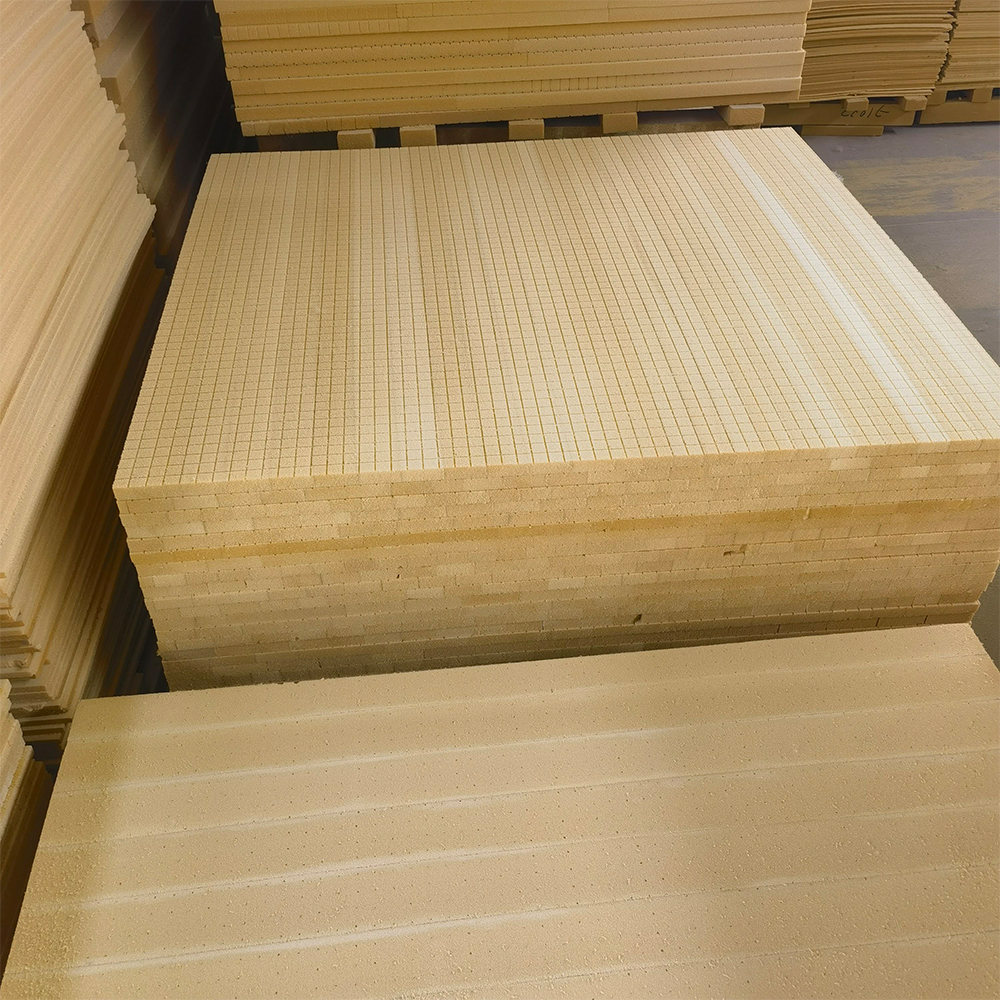
A Complete Engineering and Procurement Handbook for Composite Sandwich Structures
1. Introduction
PVC Foam Core is widely used in lightweight sandwich structures because it can provide a useful combination of low density, compressive performance, shear performance, dimensional stability and closed-cell structure.
However, the performance of a finished sandwich panel does not come from the PVC Foam Core alone.
A sandwich structure is a system:
Face Sheet + Adhesive/Resin + PVC Foam Core + Geometry + Manufacturing Process + Environmental Conditions
This distinction is critical.
An 80 kg/m³ PVC Foam Core can perform very differently depending on:
- core thickness
- cell structure
- density uniformity
- surface condition
- face-sheet material
- adhesive
- resin system
- bonding process
- groove or perforation design
- temperature
- moisture
- impact
- fatigue
- manufacturing quality
Therefore, engineering a PVC Foam Core sandwich panel should not begin with:
“Which PVC Foam Core has the highest strength?”
It should begin with:
“What structural requirements must the complete sandwich panel satisfy?”
This article provides an end-to-end engineering framework covering material selection, density, thickness, structural design, manufacturing, machining, bonding, testing, quality control and supplier qualification.
2. The Complete PVC Foam Core Engineering Chain
A typical project can be represented as:
Application Requirement
↓
Load Case Definition
↓
Face Sheet Selection
↓
PVC Foam Core Density Selection
↓
Core Thickness Selection
↓
Core Geometry and Machining
↓
Resin / Adhesive Selection
↓
Manufacturing Process
↓
Bonding and Curing
↓
Finished Sandwich Testing
↓
Environmental / Fatigue Validation
↓
Production QC
↓
Supplier Qualification
↓
Final Composite Performance
Each stage affects the next.
A mistake early in the chain can create problems later.
For example:
wrong density → excessive core shear → thicker structure required → increased material consumption → manufacturing redesign
Or:
poor surface preparation → weak bonding → face-core debonding → premature structural failure
The engineering objective is therefore to optimize the whole system, not one material property.
3. Step One: Define the Application
Before selecting PVC Foam Core, engineers should identify the application.
Typical applications include:
| Application | Typical Structural Concern |
|---|---|
| Marine hull | Water, impact, shear, fatigue |
| Yacht deck | Distributed load, local compression, moisture |
| Wind turbine blade | Shear, compression, fatigue, weight |
| Transportation floor | Compression, impact, durability |
| Vehicle panel | Weight, stiffness, vibration |
| Industrial panel | Stiffness, durability, dimensional stability |
| Building sandwich panel | Thermal, fire, stiffness, dimensional stability |
| Composite enclosure | Weight, surface quality, environmental durability |
The same PVC Foam Core density should not automatically be used for every application.
4. Step Two: Define the Load Case
The next question is:
What is the panel expected to do?
Possible loads include:
- bending
- transverse shear
- compression
- tension
- local indentation
- impact
- fatigue
- vibration
- buckling
- thermal loading
- pressure loading
A simplified sandwich structure contains two major load-carrying faces separated by a lightweight core.
The face sheets primarily contribute to bending resistance, while the core separates the faces and carries much of the transverse shear while supporting the skins against local instability.
This is why increasing core thickness can be highly effective for bending stiffness.
5. Step Three: Select the Face Sheet
PVC Foam Core cannot be selected independently from the face sheet.
Common face materials include:
- fiberglass
- carbon fiber
- aramid fiber
- aluminum
- steel
- composite laminates
The face sheet determines much of the:
- tensile capacity
- compressive capacity
- bending contribution
- surface durability
- impact resistance
The core determines much of the:
- separation between faces
- shear transfer
- local support
- compression resistance
- weight contribution
Therefore:
Core optimization without face-sheet optimization is incomplete.
6. Step Four: Select PVC Foam Core Density
Density is one of the most important variables.
A conceptual engineering framework can divide PVC Foam Core into:
| Density Range | General Engineering Position |
|---|---|
| 45–60 kg/m³ | Very lightweight applications |
| 60–80 kg/m³ | Lightweight structural applications |
| 80–100 kg/m³ | General structural sandwich applications |
| 100–130 kg/m³ | Higher load requirements |
| 130–160 kg/m³ | High-load structural zones |
| 160–200 kg/m³ | High compression/shear demand |
| >200 kg/m³ | Specialized high-performance regions |
These are engineering selection ranges rather than universal product classifications. Actual mechanical properties must come from the specific PVC Foam Core grade and test data.
The key principle is:
Higher density generally increases mechanical capability, but also increases weight and material cost.
The best density is therefore not necessarily the highest density.
7. Density vs Thickness
Density and thickness are two different structural design variables.
Consider:
- Option A: 80 kg/m³ × 30 mm
- Option B: 100 kg/m³ × 25 mm
- Option C: 80 kg/m³ × 40 mm
These are not structurally equivalent.
Core Mass
For a simple flat panel:
[
M_c=\rho_c A t_c
]
where:
- (M_c) = core mass
- (\rho_c) = core density
- (A) = panel area
- (t_c) = core thickness
For the same area, increasing either density or thickness increases core mass.
But their structural effects are different.
8. Why Core Thickness Has a Large Effect on Bending Stiffness
A simplified sandwich bending-stiffness relationship can be expressed conceptually as:
[
D \approx 2E_f t_f\left(\frac{h}{2}\right)^2
]
where:
- (D) = approximate bending stiffness
- (E_f) = face-sheet modulus
- (t_f) = face-sheet thickness
- (h) = distance between the face-sheet centroids
Because the face separation appears approximately as a squared term, increasing sandwich thickness can be a powerful way to increase bending stiffness.
This explains an important engineering principle:
When bending stiffness is the dominant requirement, increasing core thickness can be more efficient than simply increasing core density.
However, this does not mean “thicker is always better.”
Core shear, compression, local loading, buckling, manufacturing constraints and geometry must also be checked.
9. Core Shear Design
When a sandwich panel experiences transverse shear force (V), a simplified relationship is:
[
\tau \approx \frac{V}{b t_c}
]
where:
- (\tau) = approximate core shear stress
- (V) = transverse shear force
- (b) = effective panel width
- (t_c) = core thickness
As core thickness increases, the average shear stress decreases.
This creates an important design trade-off.
Example
| Core Thickness | Relative Shear Stress |
|---|---|
| 10 mm | 100% |
| 20 mm | 50% |
| 30 mm | 33% |
| 40 mm | 25% |
| 50 mm | 20% |
This simplified comparison assumes the same load and width. Actual structural analysis must account for geometry, facesheets, boundary conditions and core properties.
10. Core Compression
Core compression becomes important when the panel experiences:
- point loads
- equipment supports
- fastener loads
- wheel loads
- foot traffic
- impact
- local clamping
- concentrated pressure
Low-density PVC Foam Core may provide excellent weight reduction but may not be appropriate for a highly concentrated load without reinforcement.
Possible solutions include:
- higher-density inserts
- local core replacement
- additional face-sheet reinforcement
- load-spreading plates
- structural inserts
- density zoning
This is often more efficient than manufacturing the entire panel from high-density foam.
11. Density Zoning
One of the most effective approaches for large composite structures is local density optimization.
Instead of:
100% high-density PVC Foam Core
the structure can use:
high-density core in high-load areas + lower-density core in low-load areas
Example:
| Structural Zone | Suggested Concept |
|---|---|
| Main load path | 130–160 kg/m³ |
| General panel | 80–100 kg/m³ |
| Low-load region | 60–80 kg/m³ |
| Equipment support | 160–200+ kg/m³ |
| Edge reinforcement | Higher-density insert |
| Joint area | Higher-density core / structural insert |
This approach can reduce weight while preserving structural performance.
12. Core Thickness Zoning
Density is not the only variable that can be zoned.
Core thickness can also change throughout a structure.
For example:
40 mm → 30 mm → 20 mm → 15 mm
may be used to create controlled transitions.
Typical applications include:
- wind turbine blades
- marine hulls
- aerodynamic structures
- curved composite panels
- tapered sandwich structures
The transition must be designed carefully because abrupt geometry changes can create stress concentrations.
13. Tapered PVC Foam Core
Tapering can provide a smoother transition between sandwich regions.
A tapered core may be used near:
- blade spar transitions
- panel edges
- structural joints
- inserts
- local reinforcement
- changes in panel thickness
The key manufacturing parameters include:
| Parameter | Importance |
|---|---|
| Taper angle | Stress distribution |
| Transition length | Load transfer |
| Residual thickness | Core integrity |
| Surface quality | Bonding |
| Dimensional tolerance | Assembly accuracy |
| Symmetry | Structural balance |
Published wind-blade studies have investigated tapered PVC foam cores and shown that taper geometry can influence static and fatigue performance. Such results are application- and specimen-specific and should not be treated as universal design values.
14. Core Machining
PVC Foam Core is often machined before composite processing.
Common configurations include:
- grooves
- perforations
- kerfs
- channels
- slots
- contour cuts
- tapering
- scarf joints
Machining can improve:
- resin distribution
- mold conformity
- assembly
- bending around curves
- local structural transitions
But machining also removes core material.
Therefore:
Every groove or perforation is both a manufacturing feature and a structural modification.
15. Groove Design
For vacuum infusion, grooves can provide resin-flow paths.
However, groove dimensions should be specified carefully.
Important parameters include:
| Parameter | Engineering Requirement |
|---|---|
| Groove width | Controlled |
| Groove depth | Controlled |
| Groove spacing | Controlled |
| Orientation | Defined |
| Edge distance | Defined |
| Residual core thickness | Controlled |
| Surface cleanliness | Controlled |
For example, a 30 mm core with a 5 mm groove retains approximately 25 mm of uncut core beneath the groove.
A 15 mm groove leaves only approximately 15 mm.
These structures should not be considered equivalent.
16. Vacuum Infusion Considerations
PVC Foam Core is widely used in vacuum infusion and related composite manufacturing processes.
The process chain is approximately:
Dry Face Sheet → PVC Foam Core → Resin Flow Network → Vacuum Bag → Vacuum → Resin Infusion → Cure
Key variables include:
- vacuum pressure
- resin viscosity
- resin temperature
- core permeability
- groove design
- perforation
- laminate architecture
- infusion distance
- cure temperature
A core with poor flow design can contribute to:
- dry spots
- incomplete wet-out
- resin-rich areas
- local voids
- inconsistent bonding
Therefore, the core design must be compatible with the resin-infusion process.
17. Bonding Quality
The core-face interface is one of the most critical regions of a sandwich structure.
Potential failure modes include:
- adhesive failure
- cohesive failure
- interface debonding
- voids
- resin starvation
- contamination
- insufficient cure
Bonding quality depends on:
Surface + Adhesive + Pressure + Temperature + Cure + Compatibility
not simply the core material.
A professional supplier should therefore be able to discuss the intended:
- resin
- adhesive
- surface preparation
- curing conditions
- vacuum process
- bonding validation
18. Manufacturing Quality Control
The manufacturing quality chain should include:
Raw Material
- polymer composition
- additive control
- batch traceability
Foaming
- temperature
- pressure
- expansion
- cell formation
Block Processing
- density
- cell structure
- dimensional stability
Sheet Cutting
- thickness
- flatness
- dimensions
Surface Processing
- sanding
- cleaning
- treatment
CNC Machining
- grooves
- perforations
- contours
- tapers
Final Inspection
- appearance
- dimensions
- mechanical properties
- packaging
This is why two manufacturers producing nominally identical 80 kg/m³ PVC Foam Core can deliver different levels of consistency.
19. Cell Structure Quality
The internal cell structure should be evaluated for:
- cell size
- cell uniformity
- cell-wall integrity
- local collapse
- excessive cell coalescence
- density gradients
A stable cellular structure helps create more predictable mechanical behavior.
For critical applications, buyers should consider requesting:
- representative cross-sectional images
- density mapping
- mechanical-property data
- production-batch records
20. Thickness and Density Quality
A basic incoming inspection system can use:
| Parameter | Inspection |
|---|---|
| Density | Multi-point sampling |
| Thickness | Grid measurement |
| Length | Dimensional inspection |
| Width | Dimensional inspection |
| Flatness | Surface inspection |
| Surface | Visual / tactile inspection |
| Machining | Drawing-based inspection |
| Mechanical properties | Periodic laboratory testing |
ASTM C271/C271M covers core density measurement, while ASTM C366/C366M covers sandwich core thickness measurement. ASTM C273/C273M addresses core shear properties and ASTM C365/C365M addresses flatwise compression. ASTM C272/C272M covers water absorption.
21. Finished Sandwich Testing
Testing the bare core is not enough.
The final structure should be validated where practical.
Important tests may include:
| Property | Relevant Test |
|---|---|
| Core density | ASTM C271/C271M |
| Core thickness | ASTM C366/C366M |
| Core shear | ASTM C273/C273M |
| Core compression | ASTM C365/C365M |
| Water absorption | ASTM C272/C272M |
| Sandwich flexure/shear | ASTM C393/C393M |
| Flatwise tensile | ASTM C297/C297M |
| Face-sheet properties | ASTM D7249/D7249M |
| Sandwich stiffness | ASTM D7250/D7250M |
| Dimensional stability | ASTM D6772/D6772M |
| Damage resistance | ASTM D7766/D7766M |
The exact test program should be selected according to the final application and applicable project standards.
22. Why Complete Sandwich Testing Matters
Suppose a PVC Foam Core passes its core shear test.
The final panel can still fail because of:
- poor face-sheet laminate
- inadequate adhesive
- poor bonding
- excessive resin content
- voids
- incorrect cure
- manufacturing defects
- local stress concentrations
Therefore:
Core qualification ≠ sandwich qualification
The final sandwich panel should be treated as an integrated structural system.
23. Environmental Qualification
Environmental conditions can change composite behavior.
Potential factors include:
- water absorption
- saltwater
- humidity
- temperature
- thermal cycling
- UV exposure
- freeze-thaw conditions
- chemical exposure
For marine applications, water absorption and long-term interface behavior can be especially important.
For outdoor applications, thermal and dimensional stability may become important.
For wind energy, long-term fatigue and environmental conditioning should be considered.
24. Fatigue Design
A sandwich panel may experience millions of load cycles.
Typical applications include:
- wind turbine blades
- marine structures
- vehicle structures
- transportation floors
- industrial machinery covers
Static strength alone cannot establish fatigue performance.
A complete qualification program may therefore include:
Static Test → Environmental Conditioning → Fatigue Test → Post-Fatigue Inspection
Potential fatigue damage includes:
- core shear cracking
- interface debonding
- face-sheet cracking
- local crushing
- progressive delamination
25. Impact Performance
Impact can damage sandwich structures without immediately producing catastrophic external damage.
Potential impact sources include:
- dropped equipment
- marine debris
- hail
- tools
- vehicle impact
- maintenance operations
Damage may include:
- face-sheet cracking
- core crushing
- internal debonding
- local delamination
Therefore, a panel that passes static bending may still require impact qualification.
ASTM D7766/D7766M provides a framework for damage resistance characterization of sandwich constructions.
26. Engineering Case: Marine Deck
Consider a yacht deck requiring:
- lightweight construction
- high bending stiffness
- resistance to foot loading
- moisture resistance
- local equipment loads
A conceptual design could compare:
| Option | Core | Structural Concept |
|---|---|---|
| A | 60 kg/m³ × 40 mm | Lightweight |
| B | 80 kg/m³ × 30 mm | Balanced |
| C | 100 kg/m³ × 25 mm | Higher density |
| D | 80 kg/m³ × 40 mm | Higher stiffness potential |
The correct option cannot be selected from density alone.
Engineers should compare:
- bending stiffness
- core shear
- compression
- local indentation
- weight
- bonding
- moisture exposure
- cost
A local high-density insert may be preferable under equipment mounting points.
27. Engineering Case: Wind Turbine Blade
A wind blade must balance:
low mass + high stiffness + shear performance + fatigue resistance
A conceptual structure might use:
| Blade Region | Core Strategy |
|---|---|
| Main spar region | Higher-performance structural core |
| General shell | Medium-density core |
| Leading edge | Impact-oriented reinforcement |
| Trailing edge | Lightweight tapered structure |
| Transition zones | Machined/tapered core |
| Local attachment | High-density insert |
The key is density zoning + thickness zoning + fatigue validation.
Wind turbine blade studies have demonstrated that core machining and geometric transitions can affect structural behavior, reinforcing the need to qualify the actual machined configuration rather than relying only on flat unmachined-core test data.
28. Engineering Case: Transportation Floor
Transportation floors often experience:
- distributed passenger loads
- concentrated wheel loads
- vibration
- impact
- repeated loading
A possible design strategy is:
medium-density PVC Foam Core + increased thickness + local high-density inserts
instead of:
high-density PVC Foam Core across the entire floor
This can reduce mass while maintaining local load capacity.
However, fastener zones and wheel-load areas should be analyzed separately.
29. Engineering Case: Industrial Composite Panel
For an industrial enclosure or equipment panel, the main requirements may be:
- stiffness
- dimensional stability
- surface quality
- low weight
- vibration resistance
The design may favor:
moderate-density PVC Foam Core + relatively thick core + controlled face-sheet laminate
rather than simply increasing core density.
This illustrates the importance of identifying the dominant failure mode before selecting material.
30. Failure Mode-Based Design
A useful engineering workflow is:
If the problem is excessive deflection:
Consider:
increase core thickness
If the problem is core shear:
Consider:
increase density and/or thickness
If the problem is local crushing:
Consider:
higher-density insert or load-spreading reinforcement
If the problem is face-sheet wrinkling:
Consider:
better core support and stronger face sheet
If the problem is debonding:
Investigate:
surface + adhesive + cure + interface quality
If the problem is fatigue:
Investigate:
core shear + interface + laminate + manufacturing defects
This is more effective than simply choosing a higher-density foam.
31. Supplier Qualification
A supplier should be evaluated across five major areas.
| Category | Key Questions |
|---|---|
| Material | Can density and cell structure be controlled? |
| Production | Is manufacturing stable? |
| Machining | Can customized core geometry be produced accurately? |
| Testing | Can material and sandwich properties be verified? |
| Traceability | Can every batch be identified? |
A supplier’s product catalog is less important than its process capability.
32. Supplier Audit Scorecard
A practical scoring system can use:
| Evaluation Category | Weight |
|---|---|
| Density consistency | 15% |
| Cell structure | 10% |
| Thickness control | 10% |
| Mechanical performance | 15% |
| Machining capability | 10% |
| Surface/bonding control | 10% |
| Testing capability | 10% |
| Traceability | 5% |
| Production capacity | 5% |
| Technical support | 5% |
| Corrective action | 5% |
| Total | 100% |
This framework can be adjusted for each project.
33. Procurement: Price per Cubic Meter Is Not Enough
The apparent purchase price is:
[
C_{material} = Price/m^3 \times Volume
]
But actual project cost is closer to:
[
C_{total}=C_{material}+C_{machining}+C_{handling}+C_{waste}+C_{rework}+C_{failure}
]
A lower-cost core may become more expensive if it creates:
- poor infusion
- excessive waste
- machining problems
- bonding defects
- panel rejection
- production delays
Therefore, procurement should compare total cost of ownership.
34. RFQ Structure for PVC Foam Core
A professional RFQ should define:
Material
PVC Foam Core
Density
Specify nominal grade.
Thickness
Specify nominal thickness and tolerance.
Sheet Size
Specify length × width.
Surface
Specify:
- standard
- sanded
- grooved
- perforated
- custom
Machining
Provide CAD drawing when required.
Resin Compatibility
Specify intended resin or adhesive.
Application
State:
- marine
- wind energy
- transportation
- building
- industrial
Testing
Define required:
- density
- compression
- shear
- water absorption
- bonding
- sandwich testing
Documentation
Request:
- TDS
- test reports
- batch certificate
- inspection report
- traceability information
35. From Prototype to Mass Production
A professional project should move through several stages.
Stage 1 — Material Screening
Compare:
- density
- thickness
- compression
- shear
- cost
Stage 2 — Coupon Testing
Test:
- core
- adhesive
- face/core interface
Stage 3 — Small Sandwich Panel
Evaluate:
- infusion
- bonding
- cure
- machining
- dimensional stability
Stage 4 — Full-Scale Prototype
Evaluate:
- actual load paths
- manufacturing variation
- installation
- local reinforcement
Stage 5 — Qualification
Conduct:
- environmental testing
- fatigue
- impact
- structural testing
Stage 6 — Mass Production
Implement:
- incoming inspection
- process control
- batch traceability
- final inspection
36. Production Quality Plan
A mass-production quality plan can be organized as follows:
| Production Stage | Control Point |
|---|---|
| Raw material | Batch verification |
| Foaming | Process parameters |
| Block | Density and cell structure |
| Cutting | Thickness |
| Surface treatment | Surface quality |
| CNC | Geometry |
| Final inspection | Dimensions |
| Laboratory | Mechanical properties |
| Packaging | Damage protection |
| Shipment | Traceability |
The inspection frequency should increase for higher-risk applications.
37. Engineering Documentation Package
A mature PVC Foam Core supplier should be capable of providing an organized technical package.
A typical package can include:
- Product datasheet
- Technical specification
- Density information
- Thickness tolerance
- Mechanical test data
- Water absorption data where applicable
- Surface treatment specification
- Machining drawings
- Processing recommendations
- Batch inspection report
- Certificate of conformity
- Packaging specification
- Traceability information
This makes supplier qualification faster and more transparent.
38. The Most Important Engineering Variables
If an engineer has limited time, the following parameters deserve priority.
| Priority | Parameter | Why It Matters |
|---|---|---|
| 1 | Core shear | Structural load transfer |
| 2 | Core compression | Local load capacity |
| 3 | Density | Weight and mechanical performance |
| 4 | Thickness | Stiffness and shear stress |
| 5 | Bonding | Interface reliability |
| 6 | Cell structure | Consistency |
| 7 | Environmental stability | Service life |
| 8 | Machining | Manufacturing and resin flow |
| 9 | Fatigue | Long-term structural reliability |
| 10 | Traceability | Quality management |
This list is more useful than evaluating a supplier by product name alone.
39. A Complete Engineering Decision Matrix
The final material selection can be structured like this:
| Engineering Question | Decision Variable |
|---|---|
| What load dominates? | Bending / shear / compression |
| How much weight is allowed? | Density |
| How stiff must the panel be? | Core thickness |
| Where are local loads? | Density zoning |
| Is resin infusion used? | Groove/perforation |
| Is bonding critical? | Surface treatment |
| Is fatigue important? | Core + interface qualification |
| Is moisture important? | Water/environmental testing |
| Is impact expected? | Damage qualification |
| Is production customized? | CNC capability |
| Is volume high? | Process capability |
| Is the application safety-critical? | Full qualification |
40. The End-to-End Optimization Principle
The engineering problem can be simplified as a multi-objective optimization:
Minimize:
- mass
- material cost
- manufacturing cost
- production risk
Subject to:
- stiffness requirement
- strength requirement
- shear requirement
- compression requirement
- fatigue requirement
- impact requirement
- environmental requirement
- dimensional requirement
- manufacturing requirement
This is why the optimal PVC Foam Core design is usually not:
“maximum strength.”
It is:
“minimum total system cost and mass while satisfying all structural requirements.”
41. Recommended Design Workflow
For a new sandwich-panel project, the following workflow is practical:
Step 1
Define application and service environment.
Step 2
Identify dominant load cases.
Step 3
Select preliminary face-sheet materials.
Step 4
Select a preliminary PVC Foam Core density range.
Step 5
Optimize core thickness.
Step 6
Identify local high-load regions.
Step 7
Apply density or thickness zoning.
Step 8
Design grooves, perforations and contours.
Step 9
Select resin/adhesive and bonding process.
Step 10
Build laboratory sandwich specimens.
Step 11
Test core and finished sandwich.
Step 12
Conduct environmental and fatigue qualification when required.
Step 13
Audit the supplier’s manufacturing capability.
Step 14
Run pilot production.
Step 15
Release mass production under a controlled QC plan.
42. Common Engineering Mistakes
Mistake 1: Selecting by Density Alone
An 80 kg/m³ material is not automatically better than a 60 kg/m³ material.
Mistake 2: Selecting the Highest Density
Higher density increases mass and cost.
Mistake 3: Ignoring Thickness
Core thickness strongly affects sandwich stiffness and shear stress.
Mistake 4: Ignoring Local Loads
A lightweight core may need local reinforcement.
Mistake 5: Ignoring Bonding
Core mechanical strength cannot compensate for poor face-core adhesion.
Mistake 6: Ignoring Machining
Grooves and perforations change structural geometry.
Mistake 7: Testing Only the Bare Core
The finished sandwich is the actual structural system.
Mistake 8: Ignoring Fatigue
Static strength does not represent millions of service cycles.
Mistake 9: Comparing Only Price
The cheapest core can create the highest total project cost.
Mistake 10: Ignoring Supplier Process Capability
A good sample does not automatically mean stable mass production.
43. PVC Foam Core Selection Checklist
Before finalizing a specification, engineers should confirm:
Material
- PVC Foam Core grade selected
- Density defined
- Density tolerance defined
- Cell structure reviewed
- Mechanical data available
Structure
- Core thickness selected
- Bending stiffness checked
- Core shear checked
- Core compression checked
- Local loads identified
Manufacturing
- Resin system selected
- Surface treatment defined
- Groove/perforation design completed
- CNC drawing approved
- Bonding process validated
Qualification
- Core testing completed
- Sandwich testing completed
- Environmental testing completed if required
- Fatigue testing completed if required
- Impact testing completed if required
Supplier
- Factory audited
- Production capacity verified
- QC process verified
- Traceability verified
- Pilot production completed
44. Final Engineering Perspective
PVC Foam Core should not be treated as a simple foam board.
In a structural sandwich panel, it functions as part of an engineered load-bearing system.
Its performance depends on the interaction between:
Density
Cell Morphology
Thickness
Core Shear
Core Compression
Face Sheet
Bonding Interface
Machining
Environmental Conditions
Fatigue
Manufacturing Quality
The most reliable engineering approach is therefore to move through the complete chain:
Application → Load → Material → Density → Thickness → Geometry → Manufacturing → Bonding → Testing → Qualification → Production
This approach reduces the risk of selecting a material that looks attractive on a datasheet but performs poorly in the finished structure.
45. Conclusion
Engineering a PVC Foam Core sandwich panel is fundamentally a system optimization problem.
The correct PVC Foam Core is not simply the one with:
- the highest density
- the highest shear strength
- the lowest price
- the lowest weight
The correct material is the one that satisfies the complete project requirements when combined with the selected face sheets, adhesive or resin, geometry and manufacturing process.
For engineers, the key principle is:
Select the core according to the structural load path, not according to the product name.
For manufacturers, the key principle is:
Control density, cell structure, thickness, surface condition, machining and traceability as one integrated quality system.
For procurement teams, the key principle is:
Evaluate total structural value and supplier process capability rather than price alone.
And for composite projects, the final principle is:
The real performance of PVC Foam Core is demonstrated by the finished sandwich structure, not by the core datasheet alone.
A successful PVC Foam Core project therefore follows a complete engineering loop:
Material Selection → Structural Design → Core Optimization → Manufacturing → Bonding → Testing → Environmental Qualification → Supplier Control → Mass Production → Final Composite Performance
When these stages are connected, PVC Foam Core can become more than a lightweight filler.
It becomes a precisely engineered component of a high-performance sandwich structure.
