
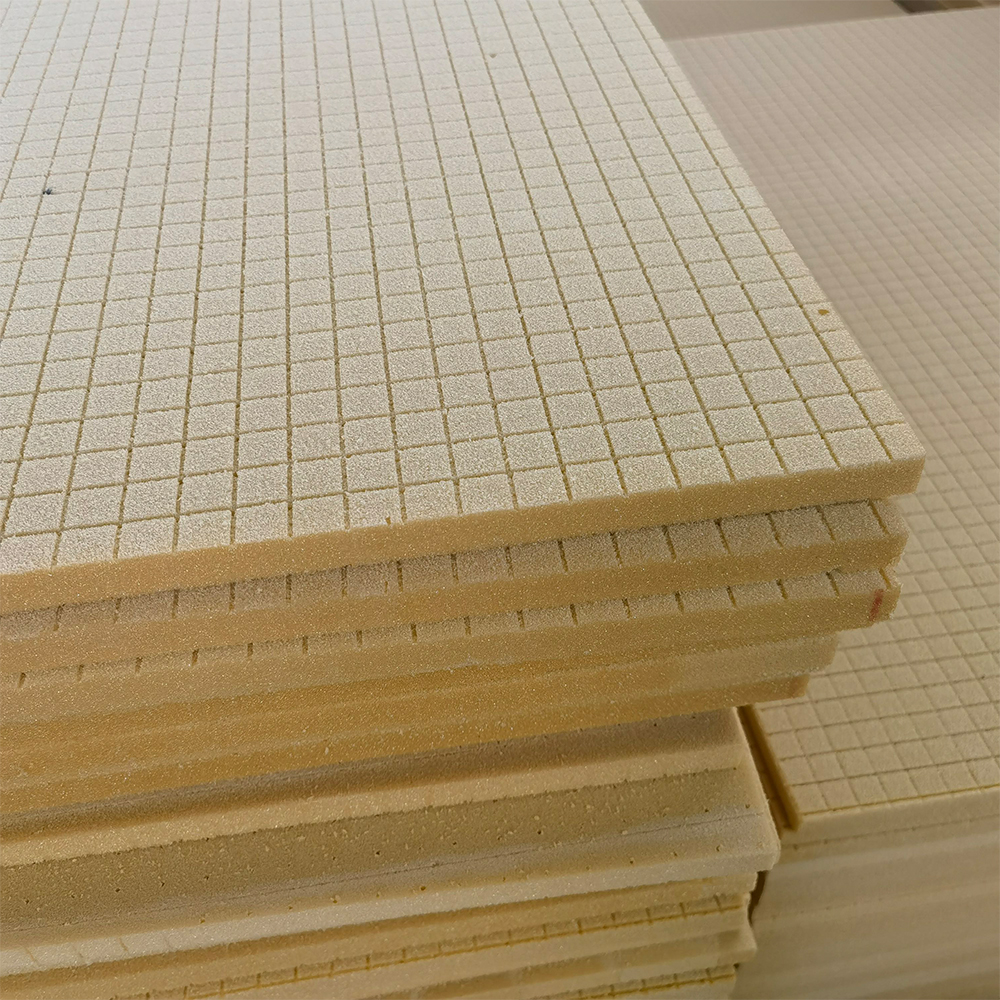
Manufacturing Quality Control & Supplier Audit Report for Composite Engineers and B2B Buyers
1. Introduction: PVC Foam Core Quality Starts Before the Composite Panel
When engineers evaluate PVC Foam Core for a sandwich structure, the discussion often starts with density, thickness, compressive strength and shear strength.
However, two PVC Foam Core sheets can have the same nominal density and thickness while producing very different composite results.
The reason is that manufacturing quality is not defined by density alone.
The internal cell morphology, density distribution, thickness uniformity, surface condition, machining quality, moisture condition, dimensional stability and bonding surface can all affect the final sandwich structure.
ASTM C271/C271M specifically recognizes that measured core density is influenced by material fabrication, core geometry, specimen preparation, measurement methods, conditioning and moisture content. ASTM C273/C273M similarly identifies density, cell size, adhesive thickness, fabrication method, specimen preparation and conditioning among the factors that can influence measured core shear performance.
Therefore, for a professional PVC Foam Core procurement program, the correct question is not:
“What is the density of this PVC Foam Core?”
The more useful question is:
“Can the manufacturer repeatedly produce the same cell structure, density distribution, thickness, surface condition and bonding performance from batch to batch?”
This article examines PVC Foam Core manufacturing from that perspective.
2. Manufacturing Quality Chain
A structural PVC Foam Core can be viewed as a quality chain:
Polymer Raw Material → Foaming → Cell Formation → Density Control → Block Formation → Sheet Cutting → Thickness Calibration → Surface Treatment → CNC Machining → Packaging → Composite Bonding → Finished Sandwich Performance
A weakness at any stage can appear later as:
- inconsistent resin uptake
- poor skin-core adhesion
- local core crushing
- core shear failure
- debonding
- dimensional variation
- thickness variation
- uneven panel stiffness
- resin-rich or resin-starved areas
- local voids
- inconsistent machining
- poor repeatability between production lots
This is why supplier evaluation should examine the entire manufacturing process, rather than relying only on a laboratory certificate.
3. PVC Foam Core Cell Structure
PVC Foam Core is a cellular polymeric material. Its mechanical behavior is strongly influenced by the structure of the cells inside the material.
Important structural variables include:
| Cell Structure Variable | Manufacturing Concern | Potential Engineering Effect |
|---|---|---|
| Cell size | Excessive variation | Local mechanical inconsistency |
| Cell shape | Irregular formation | Uneven stress distribution |
| Cell-wall thickness | Poor process control | Compression/shear variation |
| Cell orientation | Process-dependent variation | Directional property variation |
| Cell connectivity | Defective foaming | Resin or moisture behavior changes |
| Local voids | Processing defect | Reduced mechanical performance |
| Cell collapse | Heat/pressure problem | Local density and thickness changes |
| Cell coalescence | Excessive processing | Weak local regions |
| Density distribution | Poor foaming control | Uneven mechanical properties |
Research on PVC foam core materials has shown that cellular structure and density are closely related to mechanical behavior. One study of PVC foam reported different density grades and observed different compression mechanisms depending on density and loading conditions.
Another published study used PVC foam cores with nominal densities of 80 and 200 kg/m³ and reported different compression strengths for the two materials, illustrating the strong relationship between density and mechanical performance.
For production engineering, however, the objective is not simply to increase density.
The objective is:
controlled and repeatable cellular structure at the required density.
4. Why Density Uniformity Matters
A specification such as:
PVC Foam Core — 80 kg/m³
does not necessarily mean every location in the sheet contains exactly 80 kg/m³ material.
The actual sheet may have a density distribution around the nominal value.
For example:
| Location | Nominal Density | Example Measured Density |
|---|---|---|
| Center | 80 kg/m³ | 81 kg/m³ |
| Upper edge | 80 kg/m³ | 78 kg/m³ |
| Lower edge | 80 kg/m³ | 82 kg/m³ |
| Left side | 80 kg/m³ | 79 kg/m³ |
| Right side | 80 kg/m³ | 81 kg/m³ |
This is very different from a sheet containing:
| Location | Example Density |
|---|---|
| Center | 82 kg/m³ |
| Edge A | 70 kg/m³ |
| Edge B | 91 kg/m³ |
| Corner | 68 kg/m³ |
| Corner | 94 kg/m³ |
Both materials could potentially be described commercially as an “80 kg/m³ PVC Foam Core,” but their structural consistency is not equivalent.
ASTM C271/C271M identifies fabrication method, core geometry, specimen preparation, conditioning and moisture as factors that should be considered when determining and reporting density.
Therefore, serious quality control should consider density distribution, not only average density.
5. Density Uniformity Control
A practical production QC system can divide density control into three levels.
| QC Level | Measurement | Purpose |
|---|---|---|
| Level 1 | Average density | Confirm material grade |
| Level 2 | Multiple-point density | Detect density gradients |
| Level 3 | Batch statistical analysis | Monitor process stability |
A useful production sampling plan can include measurements from:
- center
- four edges
- corners
- different production positions
- different blocks
- different batches
For large structural orders, statistical monitoring is more valuable than testing only one specimen.
Example Internal QC Framework
| Parameter | Example Target |
|---|---|
| Nominal density | 80 kg/m³ |
| Average measured density | 78–82 kg/m³ |
| Maximum local deviation | Defined by project specification |
| Density sampling | Multiple locations |
| Batch traceability | Required |
| Retest | Required when out of specification |
| Corrective action | Required for repeated deviation |
These values are examples of a QC framework rather than universal PVC Foam Core acceptance limits. The actual tolerance should be established according to the product grade, application and customer specification.
6. Thickness Uniformity Is Equally Important
Density receives significant attention, but thickness is another critical manufacturing parameter.
Consider two sheets:
Sheet A
- nominal thickness: 30 mm
- measured thickness: 29.8–30.2 mm
Sheet B
- nominal thickness: 30 mm
- measured thickness: 28.5–31.5 mm
Both may be sold as:
30 mm PVC Foam Core Sheet
But they will not necessarily behave identically during composite manufacturing.
Thickness variation can affect:
- total sandwich thickness
- bending stiffness
- adhesive thickness
- resin consumption
- panel geometry
- dimensional tolerances
- local pressure distribution
- final panel weight
ASTM C366/C366M is specifically listed by ASTM for measurement of sandwich core thickness.
7. Thickness Control During Production
A typical manufacturing QC system should monitor:
| Parameter | Inspection Method |
|---|---|
| Overall thickness | Caliper / thickness gauge |
| Thickness distribution | Multiple-point measurement |
| Flatness | Straightedge / surface measurement |
| Edge condition | Visual inspection |
| Surface parallelism | Multiple-point measurement |
| Local compression | Visual + dimensional inspection |
| Machined thickness | CNC measurement |
| Final panel thickness | Assembly inspection |
Thickness measurement should not be limited to one location.
For large-format PVC Foam Core sheets, a grid measurement system can provide significantly better process information.
Example Thickness Grid
| Position | Measured Thickness |
|---|---|
| Top-left | 30.1 mm |
| Top-center | 30.0 mm |
| Top-right | 29.9 mm |
| Center-left | 30.2 mm |
| Center | 30.0 mm |
| Center-right | 30.1 mm |
| Bottom-left | 29.9 mm |
| Bottom-center | 30.0 mm |
| Bottom-right | 30.2 mm |
The purpose is not simply to create inspection paperwork.
It is to identify whether the production process is stable.
8. Surface Condition: The Hidden Variable in Bonding
A PVC Foam Core can meet its density and thickness specification but still produce poor bonding.
Why?
Because bonding is controlled by the interface.
The core surface may be affected by:
- cutting method
- blade condition
- machining
- sanding
- skin formation
- contamination
- dust
- moisture
- release agents
- storage conditions
- surface oxidation or chemical modification
- resin compatibility
The bonding system is therefore:
Face Sheet + Adhesive/Resin + PVC Foam Surface + Pressure + Temperature + Cure Time
not simply:
Face Sheet + PVC Foam
9. Surface Treatment and Bonding Performance
Different composite manufacturing processes may require different core surface conditions.
Common approaches include:
9.1 As-Cut Surface
The core is supplied directly after cutting.
Advantages:
- low processing cost
- simple production
- minimal additional handling
Potential concerns:
- loose particles
- machining dust
- surface irregularity
- inconsistent resin wet-out
9.2 Sanded Surface
Controlled sanding can remove loose material and improve surface consistency.
However, excessive sanding can:
- reduce actual core thickness
- damage cell walls
- create dust
- change surface geometry
Therefore, sanding must be controlled rather than treated as a cosmetic operation.
9.3 Grooved Surface
Grooves are commonly used when resin flow is required.
Typical applications include:
- vacuum infusion
- VARTM
- large marine structures
- wind turbine components
- large composite panels
Groove geometry must be controlled because excessive cutting can reduce effective core cross-section.
9.4 Perforated Surface
Perforations can help resin movement through the core.
However, hole diameter, spacing, penetration depth and distribution must be controlled.
A core with excessive perforation may experience reduced effective structural area.
10. Surface Treatment vs Bonding: Do Not Confuse Them
A common purchasing mistake is to specify:
“PVC Foam Core with good bonding.”
This is too vague.
A professional specification should identify:
- face-sheet material
- resin or adhesive system
- bonding process
- surface preparation
- core density
- core thickness
- machining pattern
- cure temperature
- cure pressure/vacuum
- final bonding test
ASTM C273/C273M explicitly notes that core shear results can be influenced by the facing material, adhesive material, fabrication method, core geometry, adhesive thickness, specimen preparation, conditioning and adhesive void content.
This means a PVC Foam Core certificate alone cannot fully predict finished sandwich bonding performance.
11. Adhesive Compatibility
PVC Foam Core may be combined with different resin systems, including:
- epoxy
- polyester
- vinyl ester
- polyurethane adhesive
- structural adhesive systems
The correct selection depends on the final composite process.
A supplier should therefore be able to provide information on:
| Compatibility Item | Supplier Response |
|---|---|
| Resin system | Required |
| Recommended adhesive | Required |
| Cure temperature | Required |
| Maximum processing temperature | Required |
| Vacuum compatibility | Required |
| Resin uptake behavior | Recommended |
| Surface preparation | Required |
| Bonding strength data | Required |
| Recommended machining | Required |
Published research has specifically examined PVC foam/glass-fiber sandwich structures manufactured by VARTM and investigated ways to improve the interface between PVC foam and composite skins.
12. CNC Machining Quality
Modern PVC Foam Core is often supplied with customized machining.
Typical machining includes:
- grooves
- perforations
- kerfs
- channels
- slots
- contour cutting
- tapering
- scarf joints
- edge machining
- 3D contouring
Machining quality becomes especially important for wind turbine blades, marine structures and complex composite components.
CNC Quality Parameters
| Parameter | Typical QC Concern |
|---|---|
| Groove width | Dimensional consistency |
| Groove depth | Structural integrity |
| Hole diameter | Resin flow consistency |
| Hole spacing | Resin distribution |
| Cut angle | Assembly accuracy |
| Taper angle | Structural transition |
| Sheet contour | Mold conformity |
| Edge quality | Joint quality |
| Residual dust | Bond contamination |
The manufacturing process should ensure that the machining operation does not unintentionally create a weak zone.
13. Groove Depth and Residual Core Thickness
Consider a 30 mm PVC Foam Core.
If a 5 mm groove is machined into the sheet:
Residual core thickness = 30 − 5 = 25 mm
If the groove is 15 mm deep:
Residual core thickness = 15 mm
These two configurations should not be treated as equivalent.
The deeper groove removes a much larger portion of the load-carrying core.
Therefore, the CNC drawing should specify:
- groove width
- groove depth
- groove pitch
- groove orientation
- edge distance
- minimum residual core thickness
This is particularly important in structural sandwich panels.
14. Manufacturing Quality Parameters
A complete PVC Foam Core quality-control system can be organized into the following matrix.
| Quality Category | Key Parameters | QC Method |
|---|---|---|
| Raw material | Polymer composition | Incoming inspection |
| Foaming | Expansion behavior | Process monitoring |
| Cell structure | Cell size / morphology | Visual / microscopic analysis |
| Density | Average density | ASTM C271/C271M |
| Density uniformity | Multi-point density | Internal QC |
| Thickness | Nominal thickness | ASTM C366/C366M |
| Compression | Compressive properties | ASTM C365/C365M |
| Shear | Shear strength/modulus | ASTM C273/C273M |
| Water absorption | Moisture behavior | ASTM C272/C272M |
| Dimensional stability | Thermal/dimensional behavior | ASTM D6772/D6772M |
| Bonding | Interface performance | Sandwich testing |
| Machining | Groove/hole dimensions | CNC inspection |
| Traceability | Batch/lot information | Production records |
| Packaging | Damage/moisture protection | Final inspection |
ASTM currently lists C271/C271M for core density, C366/C366M for thickness, C273/C273M for core shear, C365/C365M for flatwise compression, C272/C272M for water absorption, C393/C393M for sandwich core shear properties and D6772/D6772M for dimensional stability, among other sandwich-core standards.
15. Mechanical Testing Should Not Replace Process Control
A common factory mistake is:
“The mechanical test passed, therefore production quality is good.”
This conclusion is incomplete.
A mechanical test represents the tested specimen.
Production quality represents the entire batch.
For example:
A batch could contain:
- 98% acceptable material
- 2% local density defects
A random test may pass while a customer later cuts a panel from the defective region.
Therefore:
Laboratory testing + dimensional inspection + process control + traceability
is stronger than laboratory testing alone.
16. Recommended Factory QC Structure
A mature PVC Foam Core production system can use five QC gates.
Gate 1 — Raw Material Inspection
Check:
- polymer raw materials
- additives
- batch information
- supplier certificates
- storage conditions
Gate 2 — Foaming Process
Monitor:
- processing temperature
- pressure
- expansion
- cell formation
- production stability
Gate 3 — Block and Sheet Processing
Check:
- density
- thickness
- flatness
- surface quality
- dimensions
Gate 4 — Machining
Check:
- groove dimensions
- perforation
- contour
- taper
- residual thickness
- machining dust
Gate 5 — Final Inspection
Check:
- appearance
- dimensions
- packaging
- batch identification
- test documentation
- customer-specific requirements
17. Case Study 1: Density Uniformity in a Marine Deck
Consider a marine deck using:
- PVC Foam Core
- nominal density: 80 kg/m³
- core thickness: 30 mm
- fiberglass/epoxy face sheets
The engineering design assumes consistent core shear performance.
During production inspection, however, the supplier finds:
| Zone | Density |
|---|---|
| Center | 81 kg/m³ |
| Port side | 78 kg/m³ |
| Starboard side | 80 kg/m³ |
| Front edge | 72 kg/m³ |
| Rear edge | 83 kg/m³ |
The average density may still look acceptable.
But the 72 kg/m³ region may represent a significantly different local mechanical condition.
The correct corrective action is not automatically to reject the entire grade.
The supplier should investigate:
- foaming uniformity
- block position
- cutting location
- edge effects
- local cell morphology
- production parameters
This is an example of why process capability is more informative than one average density value.
18. Case Study 2: Surface Contamination and Debonding
Consider a 20 mm PVC Foam Core used for a vacuum-infused composite panel.
The core passes:
- density inspection
- thickness inspection
- visual inspection
But the finished sandwich develops local face-core debonding.
The investigation identifies:
CNC machining → excessive loose dust → insufficient cleaning → contaminated interface → reduced bonding quality
The problem was not the nominal PVC Foam Core density.
It was the manufacturing process after the foam was produced.
This is why the supplier audit should include the post-processing environment, not only the foam production line.
19. Case Study 3: Excessive Groove Depth
A 40 mm PVC Foam Core is supplied with longitudinal resin-flow grooves.
The drawing requires:
- groove width: 3 mm
- groove depth: 5 mm
Actual production shows:
- groove width: 3.5–4.0 mm
- groove depth: 8–10 mm
The panel still looks acceptable after infusion.
However, the effective residual core thickness has been reduced.
Possible consequences include:
- lower local shear capacity
- greater local compliance
- resin-rich channels
- altered failure location
- reduced structural efficiency
This is a classic example of a machining defect that may not be visible after final composite fabrication.
20. Case Study 4: Thickness Variation During Composite Assembly
Suppose a project requires:
30 mm PVC Foam Core
A supplier delivers sheets varying from:
28.8–31.2 mm
A composite manufacturer then applies fixed-pressure processing.
The result can include:
- uneven sandwich thickness
- local resin thickness variation
- mold contact differences
- dimensional variation
- inconsistent panel stiffness
For large structural panels, a thickness map may therefore be more useful than a single thickness reading.
21. Testing Standards for Manufacturing Qualification
A supplier qualification program can combine core-material and finished-sandwich tests.
| Test | Standard | Main Purpose |
|---|---|---|
| Density | ASTM C271/C271M | Confirm core density |
| Thickness | ASTM C366/C366M | Confirm dimensional accuracy |
| Shear | ASTM C273/C273M | Core shear properties |
| Compression | ASTM C365/C365M | Flatwise compression |
| Water absorption | ASTM C272/C272M | Moisture behavior |
| Sandwich shear | ASTM C393/C393M | Finished sandwich behavior |
| Flatwise tensile | ASTM C297/C297M | Face-core adhesion |
| Dimensional stability | ASTM D6772/D6772M | Environmental dimensional stability |
| Sandwich stiffness | ASTM D7250/D7250M | Flexural/shear stiffness |
| Damage resistance | ASTM D7766/D7766M | Sandwich damage behavior |
ASTM’s composite standards catalog currently lists these methods within its sandwich-construction standards.
22. Why ASTM C273 and C393 Should Not Be Treated as the Same Test
This distinction is important for procurement.
ASTM C273/C273M
Primarily addresses:
core shear properties
including shear strength and shear modulus.
ASTM notes that measured core shear performance is affected by material fabrication, core geometry, adhesive, specimen preparation, conditioning and other factors.
ASTM C393/C393M
Addresses:
sandwich construction behavior
including core shear properties and related sandwich flexural response.
Therefore:
C273 → understand the core
C393 → understand the sandwich structure
A supplier claiming only “ASTM tested” is not enough.
The buyer should ask:
Which ASTM method was used, and what exactly was tested?
23. Supplier Audit: What Should Buyers Check?
A professional supplier audit should cover five dimensions.
A. Material Control
Ask:
- Where are polymer raw materials sourced?
- Are incoming batches traceable?
- Are raw materials tested?
- How are materials stored?
- Is moisture controlled?
B. Production Control
Ask:
- How is density controlled?
- How is cell structure monitored?
- How is thickness controlled?
- Are production parameters recorded?
- Is process data retained?
C. Machining Control
Ask:
- Is CNC machining used?
- How are groove dimensions checked?
- How is residual thickness measured?
- How is machining dust removed?
- Are CNC programs controlled?
D. Laboratory Capability
Ask:
- What internal tests are available?
- Which tests are outsourced?
- Are test instruments calibrated?
- Can production batches be traced to test reports?
E. Quality System
Ask:
- Is each batch identifiable?
- What happens when a batch fails?
- Is there a corrective-action procedure?
- Are customer complaints analyzed?
- Can historical quality records be provided?
24. PVC Foam Core Supplier Audit Scorecard
A practical supplier comparison can use a weighted score.
| Category | Weight |
|---|---|
| Density control | 15% |
| Cell structure consistency | 15% |
| Thickness control | 10% |
| Mechanical testing | 15% |
| Surface treatment | 10% |
| CNC machining | 10% |
| Traceability | 10% |
| Packaging/logistics | 5% |
| Technical support | 5% |
| Corrective action capability | 5% |
| Total | 100% |
The exact weighting should be adjusted according to the application.
For example:
- marine → water resistance + bonding + impact
- wind energy → fatigue + shear + machining
- transportation → compression + impact + dimensional stability
- building → thermal performance + dimensional stability + fire requirements
25. Supplier Quality Questions for an RFQ
A strong RFQ should contain more than:
“Please quote PVC Foam Core 80 kg/m³, 30 mm.”
A better RFQ can state:
Material
PVC Foam Core
Density
80 kg/m³ nominal
Thickness
30 mm
Density Requirement
Supplier to provide nominal density and production tolerance.
Thickness Requirement
Supplier to provide thickness tolerance and measurement method.
Surface
Specify:
- standard surface
- sanded surface
- grooved
- perforated
- custom treatment
Machining
Provide:
- groove width
- groove depth
- pitch
- perforation diameter
- hole spacing
- contour requirements
Bonding System
Specify:
- epoxy
- vinyl ester
- polyester
- polyurethane
- other structural adhesive
Documentation
Require:
- batch number
- material certificate
- density data
- thickness data
- mechanical test data
- inspection report
This transforms procurement from price comparison into technical supplier qualification.
26. Batch Traceability
For structural composite materials, traceability is often underestimated.
A good production record should connect:
Raw Material Batch → Production Batch → Foam Block → Sheet → Machining → Inspection → Packing → Shipment
For example:
| Traceability Item | Example |
|---|---|
| Raw material batch | RM-260901 |
| Foam production batch | PF-260905 |
| Block number | B-260905-08 |
| Sheet number | S-260905-08-17 |
| CNC batch | CNC-260907-04 |
| Inspection report | QC-260907-18 |
| Packing list | PK-260908-03 |
If a customer discovers a problem six months later, traceability allows the supplier to identify the affected production range.
27. Statistical Process Control
For high-volume orders, statistical process control can provide a better picture of production stability.
Potential variables include:
- density
- thickness
- length
- width
- groove depth
- groove width
- perforation diameter
- moisture
- compression strength
- shear strength
Instead of asking:
“Did this batch pass?”
the factory can ask:
“Is the process becoming unstable?”
For example:
80 → 81 → 82 → 83 → 85 kg/m³
may still meet a broad specification today, but it may indicate process drift.
Trend monitoring can therefore identify problems before they become customer complaints.
28. Visual Inspection Is Still Important
Not every defect requires laboratory testing.
Operators should inspect for:
- cracks
- edge damage
- collapsed cells
- discoloration
- delamination
- surface contamination
- machining defects
- inconsistent grooves
- broken corners
- warped sheets
- crushed areas
- packaging damage
A visual inspection standard should contain photographs or defined defect examples whenever possible.
“Good appearance” is too subjective for a large industrial order.
29. Packaging and Transportation Quality
PVC Foam Core can be damaged after leaving the production line.
Potential problems include:
- compression from stacking
- edge impact
- moisture exposure
- UV exposure during outdoor storage
- contamination
- deformation
- improper pallet support
Therefore:
Production Quality ≠ Delivery Quality
A supplier should control:
- pallet support
- stacking height
- protective film
- corner protection
- moisture protection
- loading method
- container arrangement
For customized CNC-machined cores, packaging becomes even more important because thin residual sections can be more vulnerable to handling damage.
30. Manufacturing Quality and Final Composite Performance
The most important concept in this entire article is:
PVC Foam Core quality should ultimately be evaluated by its ability to produce a stable and repeatable composite structure.
A perfect density certificate does not guarantee:
- good resin wet-out
- good bonding
- good infusion
- good impact performance
- good fatigue performance
- good dimensional stability
Similarly, excellent core mechanical properties do not guarantee good bonding if the interface is contaminated or improperly prepared.
Published work on glass/polyester-PVC foam sandwich structures has shown that manufacturing and face/core bonding conditions can influence impact damage behavior, demonstrating why the manufacturing route itself matters to final sandwich performance.
31. The Four-Layer Quality Model
A practical way to evaluate PVC Foam Core is to divide quality into four layers.
Layer 1 — Material Quality
- polymer
- density
- cell structure
- mechanical properties
Layer 2 — Dimensional Quality
- thickness
- length
- width
- flatness
- tolerances
Layer 3 — Interface Quality
- surface cleanliness
- surface treatment
- resin compatibility
- bonding
Layer 4 — Process Quality
- machining
- infusion
- curing
- handling
- final inspection
A supplier that controls only Layer 1 is not necessarily a qualified structural-core supplier.
32. Quality Failure Root-Cause Matrix
| Problem | Possible Root Cause | Recommended Investigation |
|---|---|---|
| Low density | Foaming instability | Production parameter review |
| Density gradient | Uneven expansion | Multi-point density mapping |
| Thickness variation | Cutting/calibration | Thickness grid |
| Poor bonding | Contaminated surface | Interface inspection |
| Core crushing | Low local strength | Compression test |
| Core shear failure | Density/geometry/process | ASTM C273 |
| Resin-rich grooves | Excessive machining | CNC inspection |
| Dry spots | Poor flow design | Infusion process review |
| Local debonding | Interface problem | C297 / sandwich analysis |
| Dimensional deformation | Thermal/process instability | D6772 |
| Edge damage | Packaging/handling | Logistics inspection |
33. How a Factory Should Handle a Nonconforming Batch
A mature supplier should not simply say:
“We will replace it.”
Replacement is useful, but it does not solve the root cause.
A proper corrective-action process should include:
Step 1 — Identify
Determine the exact batch and defect.
Step 2 — Contain
Stop shipment of potentially affected material.
Step 3 — Investigate
Analyze:
- raw materials
- production records
- equipment
- operators
- machining
- inspection data
Step 4 — Correct
Modify the process.
Step 5 — Verify
Retest the corrected material.
Step 6 — Prevent Recurrence
Update:
- SOP
- inspection plan
- operator training
- machine parameters
- supplier controls
This is the difference between a supplier that reacts to problems and a manufacturer that controls them.
34. Three-Level Supplier Qualification
For a new PVC Foam Core supplier, a three-stage qualification process is recommended.
Stage 1 — Documentation Review
Review:
- TDS
- SDS
- test reports
- density data
- thickness tolerance
- machining capability
- certifications
- production capacity
Stage 2 — Sample Qualification
Request samples representing the actual production configuration.
Test:
- density
- thickness
- compression
- shear
- bonding
- dimensional stability
Stage 3 — Pilot Production
Place a controlled pilot order.
Evaluate:
- batch consistency
- packaging
- machining accuracy
- delivery quality
- production repeatability
- technical response
Only after successful pilot production should a supplier move into full-volume procurement.
35. What Buyers Should Avoid
Red Flag 1: Only One Test Report
A single laboratory report does not demonstrate long-term production stability.
Red Flag 2: No Batch Number
Without traceability, quality investigations become difficult.
Red Flag 3: “Same as Brand X”
Material equivalence should be demonstrated by measurable properties, not marketing language.
Red Flag 4: No Thickness Tolerance
Nominal thickness alone is insufficient.
Red Flag 5: No Machining Drawing
Customized grooves or perforations require controlled geometry.
Red Flag 6: No Bonding Information
A core material should be evaluated together with its intended composite process.
Red Flag 7: Lowest Price as the Main Selection Criterion
The cheapest material can become the most expensive option if it causes:
- production delays
- panel rejection
- rework
- bonding failures
- inconsistent structural performance
36. Procurement Decision Matrix
A professional buyer can compare suppliers using the following framework.
| Factor | Supplier A | Supplier B | Supplier C |
|---|---|---|---|
| Density consistency | ★★★ | ★★★★★ | ★★★★ |
| Thickness consistency | ★★★ | ★★★★★ | ★★★★ |
| Cell structure control | ★★★ | ★★★★★ | ★★★★ |
| CNC capability | ★★★★ | ★★★★★ | ★★★ |
| Bonding support | ★★★ | ★★★★★ | ★★★★ |
| Test capability | ★★★ | ★★★★★ | ★★★★ |
| Traceability | ★★★ | ★★★★★ | ★★★ |
| Production capacity | ★★★★ | ★★★★ | ★★★★★ |
| Technical response | ★★★ | ★★★★★ | ★★★★ |
| Price | ★★★★★ | ★★★★ | ★★★ |
| Overall technical risk | Medium | Low | Medium |
The purpose of this table is not to select a supplier based on the highest number of stars.
It is to prevent procurement from becoming a simple price comparison.
37. Recommended Incoming Inspection Plan
For a production buyer receiving a large shipment, an incoming inspection program can include:
100% Visual Inspection
Check:
- cracks
- broken edges
- contamination
- obvious deformation
- machining defects
Sampling Inspection
Check:
- density
- thickness
- dimensions
- groove dimensions
- perforation dimensions
Periodic Mechanical Testing
Check:
- compression
- shear
- bonding
- dimensional stability
The exact sampling frequency should be based on application criticality, order volume, supplier history and customer requirements.
38. A Practical PVC Foam Core Quality Specification
A professional specification could look like this:
| Parameter | Requirement |
|---|---|
| Material | PVC Foam Core |
| Density | Customer-specified |
| Thickness | Customer-specified |
| Density tolerance | Agreed before production |
| Thickness tolerance | Agreed before production |
| Surface | Standard / sanded / custom |
| Cell structure | Uniform closed-cell structure |
| Machining | According to approved drawing |
| Groove depth | Drawing controlled |
| Groove width | Drawing controlled |
| Perforation | Drawing controlled |
| Moisture condition | Controlled |
| Shear test | ASTM C273/C273M where applicable |
| Compression test | ASTM C365/C365M where applicable |
| Density | ASTM C271/C271M |
| Thickness | ASTM C366/C366M |
| Water absorption | ASTM C272/C272M where required |
| Sandwich validation | ASTM C393/C297 where applicable |
| Traceability | Required |
| Packaging | Project-specific |
39. The Engineering Meaning of “Consistent Quality”
For PVC Foam Core, consistent quality does not mean every sheet is mathematically identical.
It means that the production variation is:
known → measured → controlled → traceable → acceptable for the intended application
This is a much more useful engineering definition.
A professional manufacturer should therefore be able to answer four questions:
1. What is the nominal property?
Example:
80 kg/m³ density
2. What is the actual production distribution?
Example:
multi-point density data
3. What is the allowable variation?
Example:
customer-approved tolerance
4. What happens if the process moves outside the target?
Example:
hold → investigate → correct → retest → release
40. Final Supplier Audit Checklist
Before approving a PVC Foam Core manufacturer, the buyer should verify:
Material
- Raw materials are controlled
- Production batches are traceable
- Density is measured consistently
- Cell structure is controlled
- Mechanical properties are verified
Dimensions
- Thickness is controlled
- Thickness tolerance is documented
- Sheet dimensions are consistent
- Flatness is controlled
Surface
- Surface condition is defined
- Machining dust is controlled
- Bonding surface is clean
- Surface treatment is repeatable
CNC
- Groove dimensions are controlled
- Perforation is controlled
- Residual core thickness is checked
- CNC drawings are traceable
Testing
- Density testing available
- Thickness testing available
- Compression testing available
- Shear testing available
- Water absorption testing available when required
- Finished sandwich testing available when required
Quality System
- Batch traceability
- Inspection records
- Calibration records
- Nonconformance procedure
- Corrective-action procedure
- Customer complaint analysis
Commercial
- Production capacity verified
- Lead time verified
- Packaging verified
- Customization capability verified
- Technical support verified
41. Conclusion: Manufacturing Quality Is the Real PVC Foam Core Advantage
PVC Foam Core is often purchased using simple parameters such as:
density + thickness + price
For basic applications, this may be sufficient.
For structural composite applications, it is not.
A high-quality PVC Foam Core manufacturing system must control:
Cell Structure → Density Uniformity → Thickness → Surface Condition → Machining → Bonding → Testing → Traceability
The core material is only one part of the final composite system.
The manufacturing process determines whether the specified material properties can be delivered consistently across thousands of sheets and multiple production batches.
For engineers, this means evaluating the supplier’s process capability, not just the datasheet.
For procurement teams, it means comparing technical risk and total cost, not simply price per cubic meter.
For manufacturers, it means building a quality system in which every important parameter can be:
measured, controlled, recorded and improved.
The strongest PVC Foam Core supplier is therefore not necessarily the company offering the highest density, the lowest price or the longest product list.
It is the manufacturer that can repeatedly deliver:
uniform cellular structure, stable density, controlled thickness, reliable surface quality, accurate machining, predictable bonding behavior and complete production traceability.
That is the foundation of reliable PVC Foam Core sandwich construction.
Key Engineering Principle
The quality of a PVC Foam Core is not defined by one number on a datasheet. It is defined by how consistently the manufacturing process converts the specified material design into repeatable engineering performance.
