
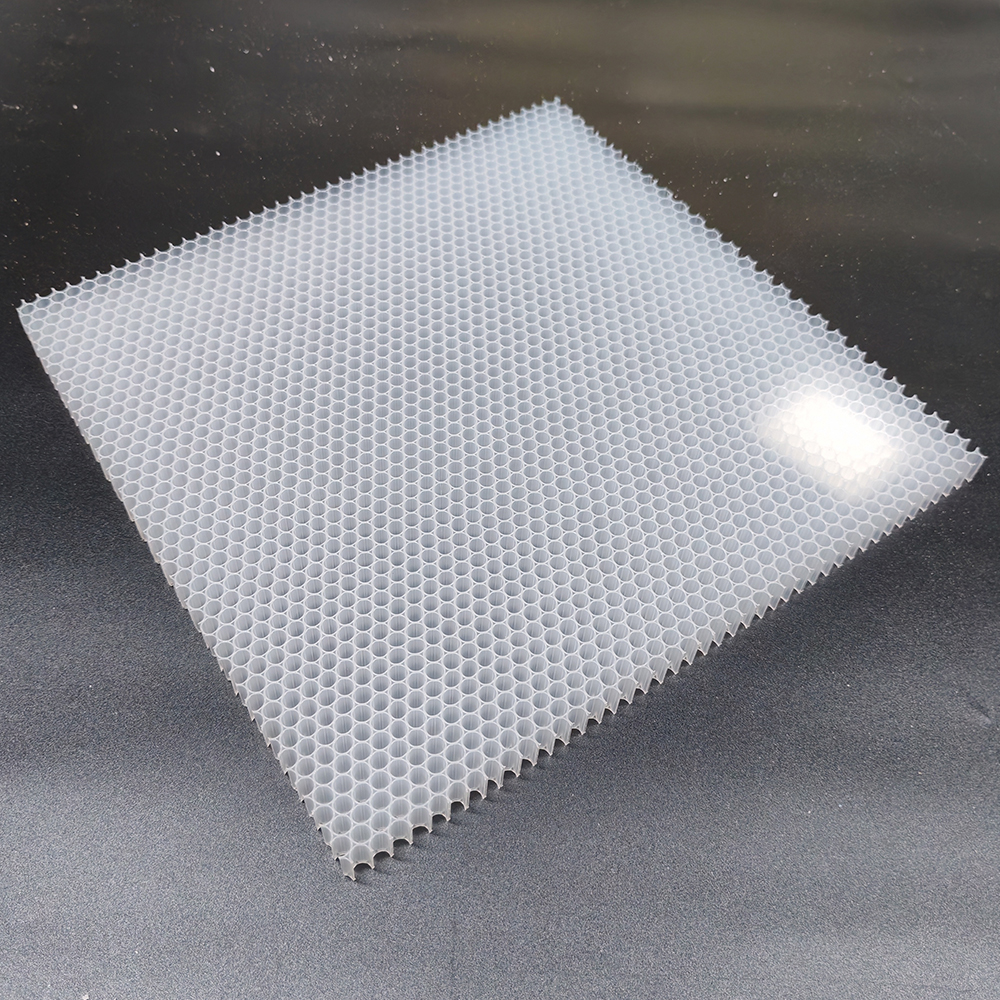
When manufacturers develop lightweight composite panels, selecting the right core material is an important decision. The core directly influences panel weight, structural performance, processing compatibility, and overall production cost. PP Honeycomb Core, also known as Polypropylene Honeycomb Core, is a thermoplastic cellular material increasingly considered for lightweight sandwich panel constructions. Its honeycomb structure provides a…
When manufacturers develop lightweight composite panels, selecting the right core material is an important decision. The core directly influences panel weight, structural performance, processing compatibility, and overall production cost.
PP Honeycomb Core, also known as Polypropylene Honeycomb Core, is a thermoplastic cellular material increasingly considered for lightweight sandwich panel constructions. Its honeycomb structure provides a lightweight internal framework that can be combined with FRP, fiberglass, and other facing materials.
For composite panel manufacturers, truck body producers, marine material suppliers, and industrial buyers, PP honeycomb core offers an alternative core solution worth evaluating.
ONEBOND manufactures thermoformed PP Honeycomb Core, including bare polypropylene honeycomb core, nonwoven faced PP honeycomb core, and customized PP honeycomb sheets for different industrial applications.
This article explains what PP honeycomb core is, how it works, its main characteristics, and what buyers should consider when sourcing this material.
1. What Is PP Honeycomb Core?
PP Honeycomb Core is a lightweight cellular material manufactured from polypropylene (PP), a thermoplastic polymer. It features a honeycomb-shaped internal structure consisting of interconnected cells.
The cellular design creates a lightweight core structure while providing a framework that can be incorporated into composite sandwich panels.
In a typical sandwich panel construction, the PP honeycomb core is positioned between two external face sheets. These face sheets may be made from fiberglass reinforced plastic (FRP), aluminum, or other suitable materials.
The core separates the face sheets and contributes to the overall structural behavior of the finished panel.
Basic Structure of PP Honeycomb Core
A typical composite sandwich panel using PP honeycomb core consists of three main components:
- Top Skin: The external surface material, such as FRP or fiberglass.
- Honeycomb Core: The internal polypropylene cellular structure.
- Bottom Skin: The opposite facing material, which may use the same or a different surface material.
The performance of the finished sandwich panel depends on the combined properties of the core, face sheets, adhesive system, manufacturing process, and panel design.
Why Do Manufacturers Use PP Honeycomb Core?
Traditional solid sheets and many conventional core materials can add considerable weight to composite products.
PP honeycomb core provides an alternative cellular construction that allows manufacturers to design lightweight panels with customized core thicknesses and cell geometries.
It is particularly relevant for manufacturers looking to:
- Develop lightweight composite sandwich panels.
- Reduce material consumption in selected panel structures.
- Manufacture FRP honeycomb panels.
- Explore alternative core materials for transportation products.
- Customize core dimensions for specific production equipment.
- Develop thermoplastic-based composite structures.
2. Main Properties of Polypropylene Honeycomb Core
When purchasing PP Honeycomb Core, buyers should evaluate its material characteristics and suitability for the intended manufacturing process.
2.1 Lightweight Cellular Structure
The honeycomb structure contains internal cells rather than a solid mass of plastic material.
This structure makes it possible to produce lightweight core products with different thicknesses and cellular geometries.
For truck body panels, transportation components, and industrial sandwich panels, reducing core weight can help manufacturers optimize the overall panel construction.
However, actual weight savings depend on the complete panel design and should be verified through product calculations and testing.
2.2 Moisture Resistance
Polypropylene has low water absorption compared with many water-absorbing materials.
This property makes PP honeycomb core a potential option for composite products exposed to humid environments.
For marine and transportation applications, buyers should also consider the moisture resistance of the complete sandwich panel, including the face sheets, bonding system, joints, and exposed edges.
2.3 Chemical Resistance
Polypropylene generally offers good resistance to many common chemicals, although compatibility depends on the chemical type, concentration, temperature, and exposure duration.
This characteristic can be useful in industrial composite applications where material selection involves chemical exposure considerations.
2.4 Thermoplastic Material
PP is a thermoplastic material that can be processed through suitable thermal forming methods.
Thermoformed PP honeycomb core can be manufactured into cellular structures according to specific product designs and manufacturing requirements.
For buyers, this means that the manufacturing process and product configuration can be discussed together when developing customized materials.
2.5 Customizable Cellular Geometry
Different composite products require different core configurations.
PP honeycomb core can be specified according to parameters such as:
- Core thickness
- Cell size
- Density
- Sheet dimensions
- Cellular geometry
- Surface configuration
- Nonwoven facing requirements
The correct combination should be selected according to the intended panel structure and production process.
3. Different Types of PP Honeycomb Core
Not all polypropylene honeycomb products have the same surface configuration or processing characteristics.
For B2B buyers, understanding the differences between product types helps avoid material compatibility problems during production.
3.1 Bare PP Honeycomb Core
Bare PP Honeycomb Core is supplied without an additional facing layer.
It is suitable for manufacturers who have their own surface preparation, bonding, or composite lamination processes.
Typical applications include:
- Customized composite sandwich panels
- FRP panel manufacturing
- Industrial lightweight structures
- Special-purpose composite components
Buyers selecting bare PP honeycomb core should pay attention to the adhesive system and surface compatibility with their face materials.
3.2 Nonwoven Faced PP Honeycomb Core
Nonwoven Faced PP Honeycomb Core incorporates a nonwoven fabric layer on one or both sides, depending on the product configuration.
The facing layer can provide an additional interface for selected bonding and lamination processes.
It may be considered for FRP sandwich panels, fiberglass panels, truck body panels, and other composite structures.
Before mass production, manufacturers should evaluate the compatibility between the nonwoven facing, adhesive, resin system, and external skin material.
3.3 PP Honeycomb Sheet
PP Honeycomb Sheet refers to polypropylene honeycomb core supplied in sheet form for further fabrication or integration into finished products.
It is suitable for customers requiring standardized or customized sheet dimensions for their downstream production processes.
Typical applications include composite boards, industrial partitions, lightweight panels, and packaging structures.
4. Applications of PP Honeycomb Core in Different Industries
PP Honeycomb Core can be used in various industries where lightweight cellular structures are required.
The final application depends on the mechanical requirements, manufacturing process, bonding performance, and environmental conditions.
4.1 FRP Composite Panel Manufacturing
FRP Composite Panels are among the important potential applications for PP honeycomb core.
A typical FRP sandwich panel combines fiberglass reinforced plastic face sheets with an internal honeycomb core.
This construction can be used in:
- FRP wall panels
- Fiberglass sandwich boards
- Industrial composite panels
- Interior partitions
- Lightweight equipment panels
For FRP panel manufacturers, selecting the appropriate core thickness, cell size, facing configuration, and adhesive system is essential.
4.2 Truck Body and Trailer Panels
Truck body manufacturers continuously evaluate panel materials to balance weight, stiffness, durability, and production cost.
PP honeycomb core can be considered for selected FRP truck body panel and trailer sandwich panel constructions.
Potential applications include:
- Truck side wall panels
- Truck roof panels
- Cargo box panels
- Trailer composite panels
- Commercial vehicle interior structures
For these applications, buyers should evaluate bending performance, core shear properties, skin-to-core bonding, impact resistance, fastening design, and environmental durability of the finished panel.
4.3 Marine and Boat Composite Products
Marine composite manufacturers use different core materials depending on structural requirements and operating environments.
PP honeycomb core may be evaluated for suitable interior panels, partitions, furniture components, and other lightweight composite products.
The selection process should consider bonding compatibility, water exposure, temperature conditions, and the structural requirements of the specific marine application.
4.4 RV and Caravan Panels
RV and caravan manufacturers use sandwich panel structures in walls, roofs, floors, furniture, and interior components.
PP honeycomb core can be considered as an alternative core material for selected lightweight panel designs.
4.5 Automotive and Industrial Applications
PP honeycomb core may also be evaluated for automotive interior components, industrial partitions, protective panels, and customized composite structures.
The exact suitability depends on design requirements, processing conditions, fire performance, and applicable industry standards.
5. PP Honeycomb Core Specifications: What Should Buyers Check?
Technical specifications are among the most important factors when purchasing PP Honeycomb Core.
Different manufacturers may offer different product ranges, and buyers should compare products using clearly defined measurement methods.
The following parameters should be included in a technical inquiry.
| Specification | Description | Why It Matters |
|---|---|---|
| Material | Polypropylene (PP) | Confirms the base material |
| Core Thickness | Overall honeycomb core thickness | Influences panel design |
| Cell Size | Internal cell opening dimension | Affects cellular geometry |
| Density | Mass per unit volume | Helps calculate material weight |
| Areal Weight | Mass per unit area | Useful for sheet weight comparison |
| Sheet Width | Sheet dimension | Matches production equipment |
| Sheet Length | Sheet dimension | Supports material planning |
| Facing Type | Bare or Nonwoven Faced | Influences processing compatibility |
| Color | Product color | Meets customer specifications |
| Tolerance | Dimensional variation | Supports consistent production |
How to Select the Right Thickness
Core thickness should be selected according to the finished panel design, loading conditions, face sheet materials, and manufacturing equipment.
For example, a manufacturer producing thick FRP sandwich panels may require a different core configuration from a company manufacturing thin interior composite boards.
Buyers should provide their target panel thickness and intended application when requesting quotations.
How to Select Cell Size
Cell size is an important structural parameter.
Different cell geometries can affect the interaction between the core and face materials, adhesive distribution, and the behavior of the finished sandwich panel.
The appropriate cell size should be selected based on the panel design and verified bonding process.
Why Density Matters
Density influences the amount of material used per unit volume.
When comparing PP honeycomb core products, buyers should also check areal weight, thickness, and measurement methods.
Two products with different cellular geometries may have different mechanical behavior even when their nominal density values are similar.
6. PP Honeycomb Core vs Other Core Materials
For manufacturers developing composite panels, PP honeycomb core is not the only available option.
PVC foam core, PET foam core, and aluminum honeycomb core are also widely considered in different composite applications.
| Comparison | PP Honeycomb Core | PVC Foam Core | PET Foam Core | Aluminum Honeycomb |
|---|---|---|---|---|
| Base Material | Polypropylene | PVC | PET | Aluminum |
| Structure | Cellular honeycomb | Closed-cell foam | Foam | Metallic honeycomb |
| Material Type | Thermoplastic | Polymer foam | Polymer foam | Metal |
| Moisture Behavior | Low water absorption of PP | Depends on foam formulation and structure | Depends on foam formulation and structure | Corrosion protection may be required |
| Main Selection Factors | Cell geometry and bonding | Density and mechanical properties | Density and mechanical properties | Strength, stiffness, and corrosion resistance |
| Typical Uses | Lightweight composite panels | Marine and industrial panels | Transportation and wind energy composites | Aerospace, rail, and architectural panels |
Which Core Material Is Better for Composite Panels?
There is no universally suitable core material for every composite panel.
PP honeycomb core is worth evaluating when the manufacturer requires a thermoplastic cellular structure and a customized honeycomb configuration.
PVC and PET foam cores may be more appropriate for certain applications requiring specific foam mechanical properties or established resin processing systems.
Aluminum honeycomb is often selected for applications with particular stiffness, temperature, or structural requirements.
The best choice should be based on complete panel testing, processing compatibility, and total manufacturing cost.
7. What Should You Consider When Choosing a PP Honeycomb Core Manufacturer?
Selecting a supplier is not only about comparing unit prices.
For industrial buyers, supplier evaluation should cover manufacturing capability, product consistency, customization, technical communication, and long-term supply reliability.
7.1 Manufacturing Capability
Check whether the supplier has relevant PP honeycomb core manufacturing equipment and a clear production process.
A manufacturer with direct production capabilities may provide better communication regarding specifications, production adjustments, and customization requirements.
7.2 Product Customization
Different panel manufacturers may require different thicknesses, cell sizes, sheet dimensions, and facing configurations.
Confirm whether the supplier can manufacture products according to technical drawings or agreed specifications.
7.3 Quality Control
Ask about inspection procedures and available test reports.
Important parameters may include density, thickness, cell dimensions, compression properties, shear properties, and dimensional stability.
7.4 Sample Evaluation
Before placing a large order, buyers should evaluate samples using their own production equipment and bonding process.
A small-scale trial can help identify potential compatibility issues before mass production.
7.5 Long-Term Supply
For manufacturers with continuous production requirements, supply stability and consistent product specifications are important.
Discuss production lead times, minimum order quantities, packaging, delivery arrangements, and quality documentation before confirming a purchase.
8. Why Source PP Honeycomb Core from ONEBOND?
ONEBOND focuses on thermoformed PP honeycomb core and customized composite material manufacturing.
Our product portfolio includes:
- Bare PP Honeycomb Core
- Nonwoven Faced PP Honeycomb Core
- PP Honeycomb Sheets
- Customized PP Honeycomb Core
- FRP Composite Panel Solutions
We work with international B2B buyers seeking polypropylene honeycomb core materials for transportation, marine, automotive, construction, packaging, and industrial composite applications.
Customized Product Specifications
We support product discussions based on core thickness, cell size, density, sheet dimensions, and facing configuration.
Multiple Product Configurations
Customers can discuss bare core, nonwoven faced core, and customized sheet products according to their downstream production processes.
Application-Oriented Communication
Our team can evaluate customer requirements based on the intended composite panel structure and application.
Direct Manufacturing Cooperation
ONEBOND welcomes inquiries from composite panel factories, FRP manufacturers, truck body producers, marine composite manufacturers, and international distributors.
9. Request a Quote for PP Honeycomb Core
Are you looking for a PP Honeycomb Core Manufacturer for your composite panel production?
ONEBOND welcomes inquiries from international manufacturers and industrial material buyers.
To help us provide an accurate quotation, please share:
- Required product type: Bare or Nonwoven Faced PP Honeycomb Core.
- Core thickness.
- Cell size or aperture.
- Required density or areal weight.
- Sheet width and length.
- Intended application.
- Estimated order quantity.
- Technical drawings or product samples, if available.
If you are still developing your product structure, our team can discuss your requirements and help identify suitable PP honeycomb core configurations for further evaluation.
ONEBOND – Your PP Honeycomb Core Manufacturing Partner.
Contact ONEBOND Today to Discuss Your PP Honeycomb Core Requirements and Request a Customized Quotation.
Frequently Asked Questions About PP Honeycomb Core
Q1: What is PP Honeycomb Core made of?
PP Honeycomb Core is made from polypropylene, a thermoplastic polymer formed into a cellular honeycomb structure.
Q2: What is PP Honeycomb Core used for?
It is used in lightweight composite sandwich panels, FRP panels, truck body panels, marine interior panels, RV components, and industrial structures.
Q3: What is the difference between PP Honeycomb Core and PP Honeycomb Sheet?
PP Honeycomb Core describes the cellular core material, while PP Honeycomb Sheet generally refers to the material supplied in sheet form for further processing or panel manufacturing.
Q4: Can PP Honeycomb Core be bonded with FRP skins?
Yes, it can be used with FRP face sheets when a suitable bonding system, surface configuration, and manufacturing process are established and validated.
Q5: Is PP Honeycomb Core suitable for truck body panels?
It can be considered for selected lightweight truck body and trailer sandwich panels, subject to structural and bonding performance validation.
Q6: Can PP Honeycomb Core be customized?
Yes. Product thickness, cell size, density, sheet dimensions, and facing configuration can be discussed according to manufacturing requirements.
Q7: What is the difference between bare and nonwoven faced PP honeycomb core?
Bare PP honeycomb core has no additional facing layer, while nonwoven faced PP honeycomb core includes a nonwoven fabric layer on one or both sides.
Q8: How do I choose a PP Honeycomb Core supplier?
Evaluate manufacturing capability, product specifications, customization options, quality control, sample availability, and long-term supply capacity.
Q9: Can I request PP Honeycomb Core samples?
Sample availability and specifications can be discussed with ONEBOND according to your intended application and technical requirements.
Q10: What information is needed to purchase PP Honeycomb Core?
Buyers should provide thickness, cell size, density or areal weight, sheet dimensions, product configuration, application, and estimated order quantity.
