
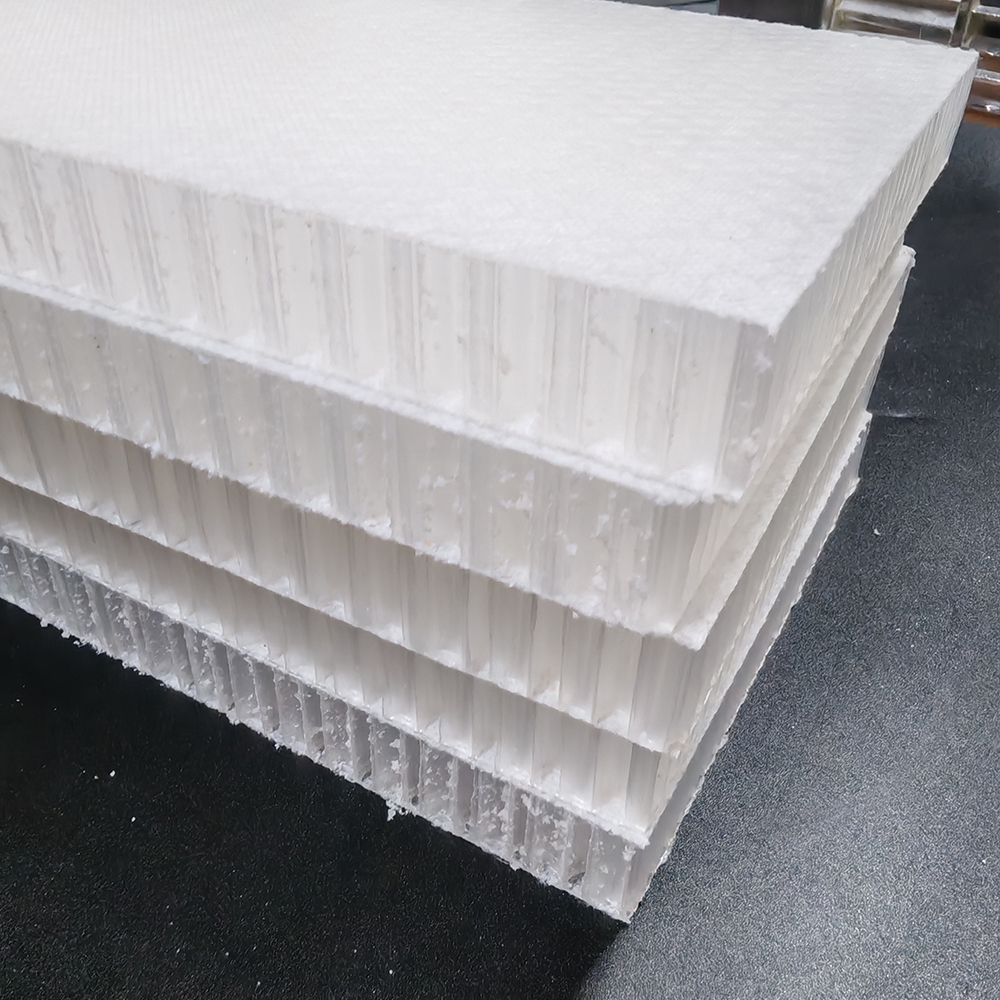
Learn how thermoformed PP honeycomb core is manufactured, including material preparation, forming, cooling, cell structure control and quality inspection. Explore customized PP honeycomb core solutions from ONEBOND.
The manufacturing process plays an important role in determining the structure, consistency, and quality of PP Honeycomb Core. For composite panel manufacturers and industrial material buyers, understanding how polypropylene honeycomb core is produced helps them evaluate suppliers, compare product specifications, and select suitable materials for their applications.
Thermoformed PP Honeycomb Core is a lightweight cellular material made from polypropylene (PP), a thermoplastic polymer. Through specialized forming processes, polypropylene is transformed into a honeycomb structure that can be supplied as a bare core, nonwoven faced core, or customized honeycomb sheet.
Unlike solid plastic boards, PP honeycomb core features an internal cellular structure designed for lightweight composite constructions. Its manufacturing process therefore requires attention to material preparation, forming conditions, cell geometry, dimensional stability, and product inspection.
ONEBOND focuses on thermoformed PP honeycomb core manufacturing, supplying customized polypropylene honeycomb materials for FRP composite panels, truck body panels, marine products, transportation components, and industrial applications.
This article explains the typical thermoforming process, important manufacturing considerations, quality control requirements, and what international buyers should look for when choosing a PP honeycomb core manufacturer.
1. What Is Thermoformed PP Honeycomb Core?
Thermoformed PP Honeycomb Core is manufactured by processing polypropylene material under controlled thermal and forming conditions to create a cellular honeycomb structure.
Polypropylene is a thermoplastic material. It can soften when heated and become formable under suitable processing conditions. After forming and cooling, the material retains its designed geometry.
The resulting cellular structure provides a lightweight core that can be incorporated into sandwich panels and other composite constructions.
How Does the Honeycomb Structure Work?
The internal honeycomb geometry consists of interconnected cells arranged to create a lightweight cellular framework.
In a composite sandwich panel, this core is positioned between two face materials. The face sheets and core work together to determine the overall panel performance.
For example, a typical FRP sandwich panel may contain:
- An upper fiberglass reinforced plastic skin.
- A polypropylene honeycomb core.
- A lower fiberglass reinforced plastic skin.
- An appropriate adhesive or bonding interface.
The core thickness, cell geometry, density, facing material, and bonding method all influence the finished panel.
Why Is Thermoforming Used?
Thermoforming is a suitable manufacturing approach for shaping thermoplastic materials into designed structures.
For PP honeycomb core production, thermal processing allows polypropylene to be formed into a cellular configuration rather than remaining as a flat solid sheet.
The process must be carefully controlled to achieve the required product geometry and consistency.
2. Thermoformed PP Honeycomb Core Manufacturing Process
The exact equipment configuration and production parameters vary between manufacturers and product designs. However, a typical manufacturing workflow involves several important stages.
2.1 Raw Material Preparation
The first stage is preparing the polypropylene material.
Material selection is important because the polymer formulation influences processing behavior and the characteristics of the finished product.
Manufacturers need to consider:
- PP material grade.
- Melt processing characteristics.
- Material consistency.
- Required product thickness.
- Target cellular structure.
- Intended application.
For industrial buyers, understanding the raw material specification is useful when comparing products from different suppliers.
A consistent material supply helps manufacturers maintain stable processing conditions and product quality.
2.2 Heating and Thermal Conditioning
Polypropylene must be heated to a suitable processing condition before forming.
Temperature control is important because insufficient heating may affect formability, while excessive or uneven heating can lead to material deformation or inconsistent forming.
Important considerations include:
- Heating temperature.
- Heating uniformity.
- Material thickness.
- Heating duration.
- Production speed.
- Thermal stability.
These parameters should be established according to the material grade, equipment design, and target cellular geometry.
2.3 Honeycomb Structure Forming
The forming stage is one of the most important steps in PP honeycomb core production.
During this stage, the heated polypropylene material is shaped into the required cellular configuration using the manufacturer’s forming technology.
The target structure is determined by the product design, including cell size, core thickness, and other dimensional requirements.
Manufacturing control at this stage affects:
- Cell geometry.
- Cell wall consistency.
- Overall thickness.
- Structural uniformity.
- Surface condition.
For composite panel manufacturers, consistency in the cellular structure is important because variations may influence downstream lamination and finished panel performance.
2.4 Cooling and Shape Stabilization
After forming, the polypropylene structure needs to be cooled and stabilized.
Cooling conditions influence the final shape and dimensional stability of the formed material.
Inadequate cooling or uneven temperature distribution may contribute to deformation, dimensional variation, or inconsistent cellular geometry.
Manufacturers should therefore control cooling conditions according to product specifications and production requirements.
2.5 Cutting and Dimensional Processing
After the cellular structure has stabilized, the material can be processed into the required dimensions.
Common dimensional requirements include:
- Core thickness.
- Sheet width.
- Sheet length.
- Edge condition.
- Dimensional tolerance.
For B2B customers, customized sheet dimensions can help improve material utilization and reduce unnecessary processing during composite panel manufacturing.
2.6 Nonwoven Facing and Surface Configuration
Some PP honeycomb core products are supplied with nonwoven fabric facing.
Depending on the product design, the facing may be applied to one or both sides of the core.
Nonwoven faced PP honeycomb core is often considered by manufacturers seeking a different surface interface for their lamination or bonding process.
The effectiveness of the facing depends on several factors:
- Nonwoven material properties.
- Facing attachment method.
- Adhesive compatibility.
- FRP skin material.
- Lamination temperature and pressure.
- Final application requirements.
The facing material should be evaluated together with the customer’s actual bonding system rather than selected based on appearance alone.
2.7 Final Quality Inspection
The final stage is checking whether the PP honeycomb core meets the agreed product specifications.
Depending on customer requirements, inspection may include:
- Overall thickness.
- Cell size.
- Sheet dimensions.
- Density or areal weight.
- Surface appearance.
- Cellular structure consistency.
- Facing condition.
- Dimensional stability.
For customers using PP honeycomb core in composite sandwich panels, additional testing should be performed on the complete panel structure.
3. Key Manufacturing Factors Affecting PP Honeycomb Core Quality
A well-designed production process is not defined by equipment alone. Material properties, thermal conditions, forming technology, and quality control all contribute to product consistency.
3.1 Material Selection
Polypropylene is the foundation of PP honeycomb core manufacturing.
Different material grades may have different processing characteristics and mechanical properties.
Manufacturers should select suitable PP materials according to the intended forming process and product specifications.
For buyers, material grade and product consistency should be included in technical discussions with the supplier.
3.2 Heating Uniformity
Uniform heating is essential for stable thermoplastic forming.
If the material is heated unevenly, different areas may respond differently during forming.
This can contribute to variations in cell geometry, thickness, and product appearance.
A controlled heating process helps improve forming consistency.
3.3 Cell Size and Geometry Control
Cell size is one of the important parameters in honeycomb core manufacturing.
Different cell geometries can influence material distribution, core structure, and the interaction between the core and face sheets.
Buyers should confirm how the supplier defines and measures cell size.
It is also important to check whether the supplied product matches the technical drawing or agreed specification.
3.4 Thickness and Dimensional Stability
Core thickness influences the overall design of a sandwich panel.
For composite panel factories, inconsistent thickness may create difficulties during lamination, pressing, cutting, and assembly.
Manufacturers should establish dimensional inspection procedures to maintain the agreed thickness and sheet dimensions.
3.5 Density and Material Distribution
Density and areal weight are important for material consumption and product weight calculations.
However, density alone does not determine the mechanical performance of a honeycomb structure.
Cell geometry, wall thickness, material formulation, and manufacturing quality must also be considered.
For accurate product comparison, buyers should request clearly defined test methods and technical data.
4. PP Honeycomb Core Product Types and Manufacturing Configurations
Different applications require different product configurations. Manufacturers should therefore provide more than one standard product option.
4.1 Bare PP Honeycomb Core
Bare PP Honeycomb Core is supplied without an additional nonwoven facing layer.
It is suitable for customers who prefer to manage their own bonding, surface preparation, or composite lamination process.
Potential applications include:
- Customized FRP sandwich panels.
- Industrial composite structures.
- Lightweight panel manufacturing.
- Specialized thermoplastic composite products.
4.2 Nonwoven Faced PP Honeycomb Core
Nonwoven Faced PP Honeycomb Core includes a nonwoven layer on one or both sides, depending on the product specification.
This configuration can provide a different interface for selected bonding and lamination systems.
It is commonly considered for:
- FRP honeycomb panels.
- Fiberglass composite panels.
- Truck body sandwich panels.
- RV and caravan panels.
- Customized industrial boards.
Before bulk production, customers should verify the compatibility between the facing, adhesive, resin system, and external face sheets.
4.3 Customized PP Honeycomb Sheets
Customized PP honeycomb sheets are supplied according to specific dimensional and structural requirements.
Common customization items include:
- Core thickness.
- Cell size.
- Density or areal weight.
- Sheet width and length.
- Facing configuration.
- Color.
- Cutting requirements.
For manufacturers with dedicated production equipment, customized dimensions may help improve downstream processing efficiency.
5. PP Honeycomb Core Manufacturing Specifications
When purchasing thermoformed PP honeycomb core, buyers should request a clear technical specification sheet.
The following table lists the main parameters commonly discussed during product development and procurement.
| Parameter | Description | Buyer Consideration |
|---|---|---|
| Base Material | Polypropylene (PP) | Material grade and consistency |
| Manufacturing Process | Thermoforming | Forming capability |
| Product Structure | Honeycomb cellular core | Cell geometry |
| Core Thickness | Overall core thickness | Finished panel design |
| Cell Size | Internal cell opening | Panel structure and bonding |
| Density | Mass per unit volume | Material weight |
| Areal Weight | Mass per unit area | Material consumption |
| Sheet Width | Customized dimensions | Production equipment compatibility |
| Sheet Length | Customized dimensions | Cutting and material planning |
| Facing | Bare / Nonwoven Faced | Bonding process |
| Color | According to product requirements | Product identification |
| Tolerance | Agreed dimensional variation | Production consistency |
Actual production ranges and tolerances should be confirmed with ONEBOND based on the required product configuration.
6. How Manufacturing Quality Affects Composite Panel Performance
PP honeycomb core is normally used as part of a larger composite structure. Therefore, its manufacturing quality should be evaluated in relation to the finished panel.
6.1 Bonding Between Core and Face Sheets
The connection between the honeycomb core and the external skins is an important consideration.
Polypropylene has relatively low surface energy, which can make direct bonding challenging with some adhesive systems.
Depending on the product design, manufacturers may need to evaluate surface treatment, nonwoven facing, adhesive selection, or other bonding methods.
A bonding trial using the actual face sheet and adhesive system is recommended before mass production.
6.2 Finished Panel Strength
The mechanical performance of a sandwich panel depends on the combined behavior of the face sheets, core, and bonding interface.
Important evaluation parameters may include:
- Flexural properties.
- Core shear properties.
- Compression properties.
- Skin-to-core bond strength.
- Impact resistance.
- Panel dimensional stability.
The finished panel should be tested according to the requirements of its intended application.
6.3 Lightweight Panel Design
A suitable honeycomb core can help manufacturers develop lightweight composite constructions.
However, weight reduction should always be evaluated alongside panel stiffness, strength, durability, and safety requirements.
The objective is not simply to select the lightest core, but to select the most appropriate core structure for the finished product.
7. What Should Buyers Look for in a PP Honeycomb Core Manufacturer?
For international B2B buyers, choosing a supplier involves more than comparing quotations.
A reliable manufacturer should be able to communicate technical specifications, production capabilities, customization options, and quality requirements.
7.1 Direct Manufacturing Capability
Confirm whether the supplier has actual PP honeycomb core manufacturing capabilities.
Ask about the manufacturing process, product range, production equipment, and available customization options.
7.2 Consistent Product Specifications
Check whether the supplier can maintain agreed thickness, cell size, density, and sheet dimensions.
Request product samples and compare them with the technical specification sheet.
7.3 Customization Capability
Different composite panel manufacturers use different production processes.
A suitable supplier should be able to discuss product customization based on drawings, samples, or technical requirements.
7.4 Quality Inspection and Testing
Ask the supplier about inspection procedures and available test reports.
Important evaluation items may include density, thickness, cell dimensions, compression, shear, and dimensional stability.
7.5 Technical Communication and Supply Cooperation
For long-term cooperation, buyers should also evaluate communication efficiency, sample support, lead time, packaging, and production planning.
A supplier who understands the customer’s final application can often provide more useful material recommendations than one who only offers standard product dimensions.
8. Why Choose ONEBOND for Thermoformed PP Honeycomb Core?
ONEBOND focuses on manufacturing polypropylene honeycomb core materials for international composite material buyers.
Our product range includes:
- Bare PP Honeycomb Core.
- Nonwoven Faced PP Honeycomb Core.
- PP Honeycomb Sheets.
- Customized PP Honeycomb Core.
We support customers in transportation, marine, automotive, construction, packaging, and industrial composite applications.
Customized Manufacturing
We can discuss core thickness, cell size, density, sheet dimensions, and facing requirements according to customer specifications.
Multiple Product Configurations
Our product range covers bare core, nonwoven faced core, and customized PP honeycomb sheet configurations.
Application-Oriented Product Development
We welcome technical discussions with FRP panel manufacturers, truck body panel producers, marine composite manufacturers, and industrial panel factories.
B2B Supply Cooperation
ONEBOND aims to support international manufacturers and distributors seeking customized PP honeycomb core materials and long-term supply cooperation.
9. Request Customized PP Honeycomb Core from ONEBOND
Are you looking for a manufacturer of thermoformed PP honeycomb core?
Whether you need bare polypropylene honeycomb core, nonwoven faced PP honeycomb core, or customized PP honeycomb sheets, ONEBOND welcomes your inquiry.
To help us evaluate your requirements, please provide:
- Required core thickness.
- Cell size or aperture.
- Density or target areal weight.
- Sheet width and length.
- Bare or nonwoven faced configuration.
- Intended application.
- Estimated order quantity.
- Technical drawings or product samples, if available.
Our team can review your requirements and discuss a suitable PP honeycomb core configuration for your production process.
ONEBOND – Thermoformed PP Honeycomb Core Manufacturer
Contact ONEBOND Today for Customized PP Honeycomb Core Solutions.
Frequently Asked Questions About Thermoformed PP Honeycomb Core
Q1: What is the manufacturing process of PP Honeycomb Core?
PP honeycomb core is manufactured through a thermoplastic forming process that transforms polypropylene material into a cellular honeycomb structure, followed by cooling, dimensional processing, and quality inspection.
Q2: What is thermoforming in PP honeycomb manufacturing?
Thermoforming is a process that uses heat to make polypropylene formable so it can be shaped into the required honeycomb structure.
Q3: What factors affect PP honeycomb core quality?
Material grade, heating uniformity, forming conditions, cell geometry, cooling, thickness control, and quality inspection all influence product consistency.
Q4: Can PP honeycomb core be customized?
Yes. Thickness, cell size, density, sheet dimensions, and facing configuration can be discussed according to customer requirements.
Q5: What is the difference between bare and nonwoven faced PP honeycomb core?
Bare PP honeycomb core has no additional facing layer, while nonwoven faced PP honeycomb core incorporates a nonwoven fabric layer on one or both sides.
Q6: How is PP honeycomb core used in FRP panel manufacturing?
It can be incorporated between FRP face sheets to form a lightweight sandwich panel, provided the bonding system and panel construction are properly validated.
Q7: How do buyers evaluate a PP honeycomb core manufacturer?
Buyers should evaluate manufacturing capability, dimensional consistency, customization options, quality control, sample availability, and long-term supply reliability.
Q8: What technical information should be included in a PP honeycomb core quotation request?
Buyers should provide thickness, cell size, density or areal weight, sheet dimensions, facing type, application, and estimated order quantity.
