
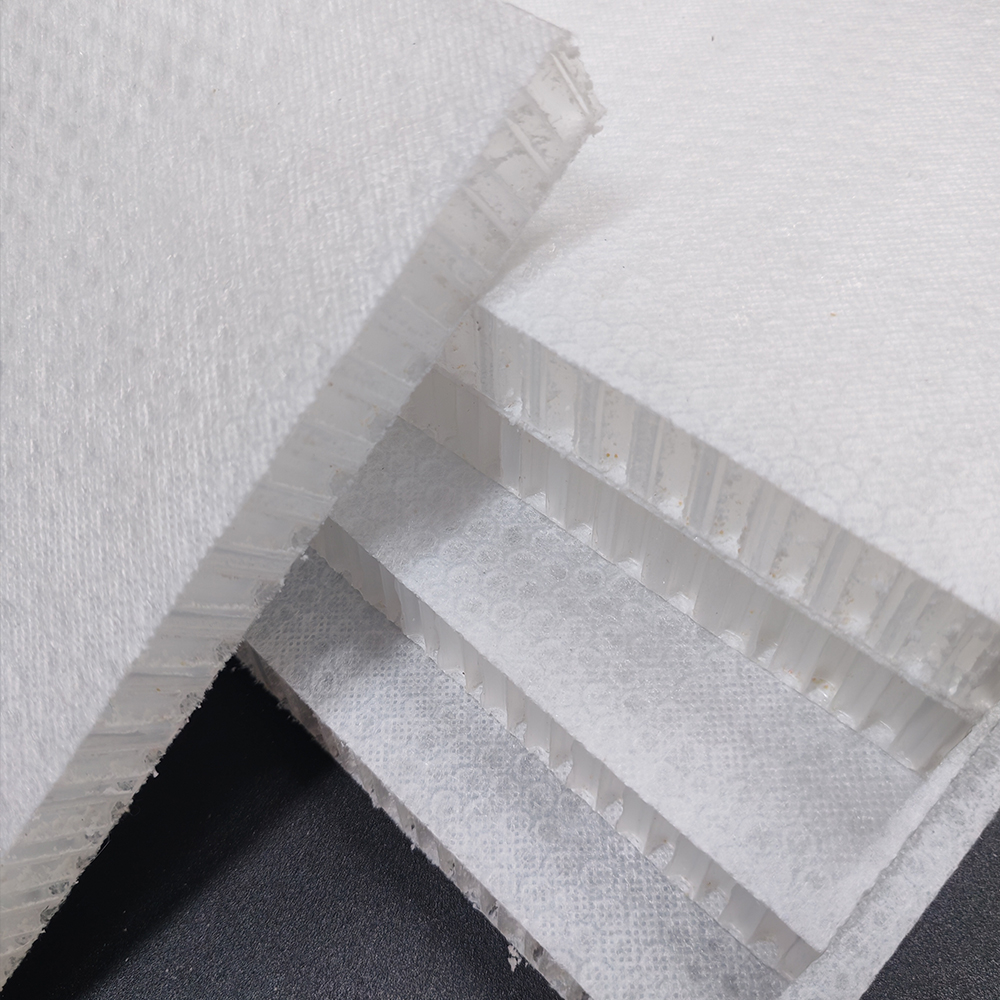
When selecting PP honeycomb core for composite panel manufacturing, buyers often focus on three basic specifications: density, thickness and cell size. These parameters directly influence material weight, structural configuration, processing requirements and the performance of the final sandwich panel. However, choosing a suitable polypropylene honeycomb core involves more than comparing individual numbers. The relationship between…
When selecting PP honeycomb core for composite panel manufacturing, buyers often focus on three basic specifications: density, thickness and cell size. These parameters directly influence material weight, structural configuration, processing requirements and the performance of the final sandwich panel.
However, choosing a suitable polypropylene honeycomb core involves more than comparing individual numbers. The relationship between the honeycomb geometry, polymer material, facing structure and bonding process must also be considered.
For FRP sandwich panel manufacturers, truck body panel producers, marine composite manufacturers and industrial composite buyers, understanding these specifications helps reduce material selection errors and improve production consistency.
ONEBOND supplies customized PP honeycomb core solutions for composite material manufacturers, with product configurations developed according to application requirements, panel structures and processing conditions.
1. What Are the Main Specifications of PP Honeycomb Core?
PP honeycomb core is a lightweight thermoplastic structural material featuring a cellular configuration. Its hexagonal or other engineered cell structures create a balance between material consumption, weight and structural support.
The main specifications buyers should evaluate include:
| Specification | Description | Why It Matters |
|---|---|---|
| Material | Polypropylene (PP) | Determines the basic material characteristics |
| Density | Mass per unit volume | Helps evaluate material weight and structural configuration |
| Thickness | Overall core thickness | Influences sandwich panel thickness and structural depth |
| Cell Size | Dimension of individual honeycomb cells | Affects cell geometry and compatibility with the intended structure |
| Areal Weight | Weight per square meter | Helps calculate material consumption |
| Sheet Dimensions | Length and width | Determines production compatibility and material utilization |
| Facing | Nonwoven or other surface configurations | Influences bonding and composite processing |
| Tolerance | Permitted dimensional variation | Important for consistent panel manufacturing |
Not every manufacturer defines these specifications in exactly the same way. Buyers should confirm measurement methods, units and testing conditions before comparing products from different suppliers.
2. PP Honeycomb Core Density: Understanding Material Weight
Density is one of the most important parameters when selecting polypropylene honeycomb core.
It describes the mass of material per unit volume, commonly expressed in kilograms per cubic meter (kg/m³).
For honeycomb materials, apparent density generally refers to the mass of the complete cellular structure divided by its external volume. It should not be confused with the solid density of polypropylene resin.
2.1 How Does Density Affect PP Honeycomb Core?
Density is related to the amount of material contained within a given volume of honeycomb structure.
In general, a higher apparent density means more material is present per unit volume. This can influence:
- Material weight
- Material consumption
- Cell wall configuration
- Mechanical behavior
- Cost per unit volume
- Processing characteristics
However, higher density does not automatically mean better performance in every application.
The actual compression, shear and bending behavior also depends on cell geometry, wall thickness, material distribution, manufacturing consistency and loading direction.
2.2 Density vs. Areal Weight
Density and areal weight are closely related but represent different measurements.
Density is measured in kg/m³, while areal weight is measured in kg/m².
For a uniform core:
Areal Weight = Apparent Density × Core Thickness
For example, if a hypothetical PP honeycomb core has an apparent density of 80 kg/m³ and a thickness of 20 mm:
Areal weight = 80 × 0.020 = 1.6 kg/m².
This is a simplified calculation. Actual product weight should be verified by weighing the finished material, especially when nonwoven facing, surface treatments or additional layers are included.
2.3 How Should Buyers Choose PP Honeycomb Core Density?
The appropriate density depends on the intended panel structure and performance requirements.
| Application | Key Selection Considerations |
|---|---|
| Truck body panels | Panel weight, compression behavior and bonding compatibility |
| FRP sandwich panels | Skin thickness, bonding process and panel stiffness |
| Marine panels | Moisture exposure, structural requirements and material compatibility |
| RV and caravan panels | Weight reduction, panel dimensions and manufacturing process |
| Industrial composite panels | Load requirements, processing conditions and dimensional stability |
| Packaging panels | Weight, impact requirements and cost efficiency |
Instead of selecting density based on a single target number, buyers should evaluate the complete sandwich panel design.
3. PP Honeycomb Core Thickness: How to Select the Right Thickness
Thickness refers to the overall depth of the PP honeycomb core, measured between its two outer surfaces.
It is a critical dimension because it contributes to the total thickness and structural depth of a sandwich panel.
3.1 Why Does Core Thickness Matter?
The thickness of a honeycomb core influences several aspects of composite panel design.
Panel structural depth
Increasing core thickness can increase the distance between the two facing skins. In a properly designed sandwich structure, this separation can improve bending stiffness without requiring a proportional increase in facing material.
Total panel thickness
The final sandwich panel thickness is determined by the core thickness, facing thickness and adhesive or bonding layers.
Material weight
For a given apparent density, increasing core thickness increases the core’s areal weight.
Processing compatibility
Core thickness must match the equipment, pressing conditions, cutting methods and panel design used by the manufacturer.
3.2 How to Calculate the Total Sandwich Panel Thickness
For a simple symmetrical sandwich panel:
Total Panel Thickness = Top Skin Thickness + Core Thickness + Bottom Skin Thickness
For example:
| Component | Hypothetical Thickness |
|---|---|
| Top FRP Skin | 2 mm |
| PP Honeycomb Core | 20 mm |
| Bottom FRP Skin | 2 mm |
| Total Panel Thickness | 24 mm |
This example excludes any additional adhesive layers or surface finishing materials.
For actual production, the final dimensions should be confirmed after considering the bonding process and manufacturing tolerances.
3.3 Selecting Thickness for Different Applications
Different applications require different structural configurations.
- Truck body panels: Core thickness should be selected according to panel span, expected loading, skin material and vehicle body design.
- RV sandwich panels: Lightweight construction and dimensional compatibility are important.
- Marine composite panels: Thickness should be evaluated together with water exposure, structural loads and skin construction.
- FRP industrial panels: Core thickness should match the required panel stiffness, production equipment and final installation conditions.
A thicker core is not automatically the best choice. The optimal thickness is determined by the complete panel structure and its working conditions.
4. PP Honeycomb Cell Size: Why Cell Geometry Matters
Cell size is another important specification when purchasing polypropylene honeycomb core.
It generally refers to the characteristic dimension of an individual honeycomb cell. Depending on the product design, it may be specified as the distance between opposite cell walls or by another defined geometric measurement.
Buyers should confirm exactly how the manufacturer measures cell size before comparing different products.
4.1 How Does Cell Size Affect Honeycomb Structure?
Cell size influences the geometry of the cellular structure and can affect the way loads are distributed through the core.
Important considerations include:
- Cell wall dimensions
- Cell geometry
- Local support for facing materials
- Resin and adhesive interaction
- Core deformation behavior
- Compatibility with the manufacturing process
Cell size should not be evaluated independently of wall thickness and apparent density.
Two PP honeycomb cores with the same cell size may have different mechanical properties because their cell walls, material distribution and manufacturing conditions are different.
4.2 Small Cell Size vs. Large Cell Size
| Comparison | Smaller Cells | Larger Cells |
|---|---|---|
| Cell Geometry | More individual cells per unit area | Fewer individual cells per unit area |
| Local Support | May provide more frequent support points | Support distribution depends on cell design |
| Material Distribution | Depends on wall thickness and forming process | Depends on wall thickness and forming process |
| Facing Compatibility | Requires evaluation with the selected skin and adhesive | Requires evaluation with the selected skin and adhesive |
| Structural Performance | Cannot be determined by cell size alone | Cannot be determined by cell size alone |
There is no universally optimal cell size for all composite panels.
For example, a truck body panel manufacturer may prioritize panel stiffness, impact requirements and production efficiency. A lightweight interior panel manufacturer may focus more on weight, surface quality and processing compatibility.
The correct specification should be established through structural design and processing trials.
5. PP Honeycomb Core Density, Thickness and Cell Size: How Do They Work Together?
One of the most common mistakes in material selection is evaluating density, thickness and cell size separately.
In practical composite manufacturing, these parameters interact.
5.1 Density and Thickness Determine Core Areal Weight
For a given apparent density, increasing thickness increases the amount of core material per square meter.
This relationship is useful when estimating material consumption and calculating the weight of a finished sandwich panel.
5.2 Cell Size and Wall Thickness Affect Cellular Geometry
Cell size determines the dimensions of the cellular structure, while wall thickness influences how much polymer is distributed within that structure.
Both should be evaluated when assessing compression behavior, shear behavior and bonding compatibility.
5.3 Core Specifications Must Match the Facing Materials
PP honeycomb core is frequently used with FRP, fiberglass and other composite skins.
However, polypropylene has relatively low surface energy, which can make direct adhesive bonding challenging for certain adhesive systems.
Depending on the application, surface treatment, compatible adhesive systems or nonwoven facing may be considered.
The final bonding solution should be validated using the actual skin material, adhesive, resin system and manufacturing process.
6. PP Honeycomb Core Specification Reference Table
The following table provides a practical template for technical evaluation and purchasing communication.
It is not a declaration of standard ONEBOND production specifications. Actual available values should be confirmed with the manufacturer.
| Parameter | Unit | Specification to Confirm |
|---|---|---|
| Material | — | Polypropylene |
| Product Type | — | Bare Core / Nonwoven Faced Core |
| Apparent Density | kg/m³ | Customized |
| Core Thickness | mm | Customized |
| Cell Size | mm | Customized |
| Cell Wall Thickness | mm | Subject to product design |
| Areal Weight | kg/m² | Confirmed by product measurement |
| Sheet Length | mm | Customized |
| Sheet Width | mm | Customized |
| Facing Material | — | According to requirements |
| Thickness Tolerance | mm | To be confirmed |
| Density Tolerance | % | To be confirmed |
| Surface Configuration | — | According to requirements |
For professional procurement, it is recommended to request a technical data sheet (TDS) that identifies the measurement methods and test conditions for each key parameter.
7. How to Select PP Honeycomb Core for FRP Sandwich Panels
FRP sandwich panel manufacturing is one of the important application areas for PP honeycomb core.
A typical panel consists of an FRP skin on both sides and a lightweight cellular core in the middle.
The core provides structural separation between the skins, while the facing materials contribute significantly to the panel’s bending and tensile performance.
When choosing PP honeycomb core for FRP panels, manufacturers should consider the following factors.
7.1 FRP Skin Thickness
The thickness and mechanical properties of the FRP skins influence the overall panel performance.
A core specification should therefore be selected according to the intended skin construction rather than independently.
7.2 Core Thickness
Core thickness affects the structural depth of the sandwich panel and should be matched to the panel dimensions, loading conditions and design requirements.
7.3 Bonding Compatibility
The interface between the PP honeycomb core and FRP skins is critical.
Because polypropylene has low surface energy, manufacturers should assess whether direct bonding is suitable or whether additional surface treatment or nonwoven facing is required.
7.4 Manufacturing Process
Different manufacturing processes may require different core configurations.
For example, vacuum-assisted processing, adhesive lamination and other composite panel manufacturing methods can involve different pressure, temperature, resin and bonding requirements.
The selected core must be compatible with the actual process.
7.5 Finished Panel Testing
The performance of a complete sandwich panel should be evaluated through appropriate tests, such as:
- Flatwise compression testing
- Core shear testing
- Skin-to-core adhesion testing
- Flexural testing
- Impact testing
- Environmental conditioning
Test selection should reflect the intended application and applicable industry requirements.
8. PP Honeycomb Core vs. Other Core Materials
PP honeycomb core is not the only option for lightweight sandwich panel manufacturing.
Buyers may also compare polypropylene honeycomb with PVC foam, PET foam and aluminum honeycomb.
| Material | Main Characteristics | Common Applications |
|---|---|---|
| PP Honeycomb Core | Lightweight thermoplastic cellular structure | Truck body panels, FRP panels, transportation panels |
| PVC Foam Core | Rigid closed-cell polymer foam | Marine panels, wind energy and industrial composites |
| PET Foam Core | Thermoplastic foam with a cellular structure | Wind turbine blades, transportation and construction |
| Aluminum Honeycomb Core | Metallic cellular structure with high stiffness-to-weight potential | Aerospace, rail transit, architectural panels |
The best material depends on the required mechanical properties, fire performance, temperature resistance, moisture exposure, bonding system, cost and production process.
A material comparison should always use equivalent test conditions and complete panel configurations.
9. What Information Should Buyers Provide When Requesting PP Honeycomb Core?
To receive an accurate quotation and technical recommendation, buyers should provide more than a product name.
The following information helps manufacturers evaluate the appropriate configuration.
Basic product requirements
- Required core thickness
- Target apparent density or areal weight
- Cell size
- Sheet length and width
- Bare or nonwoven-faced configuration
Application information
- Truck body panel
- FRP sandwich panel
- Marine composite panel
- RV and caravan panel
- Industrial composite panel
Processing information
- Adhesive lamination
- Vacuum-assisted processing
- Pressing or other manufacturing methods
- Skin material and resin system
Performance requirements
- Compression requirements
- Shear requirements
- Bonding strength
- Temperature exposure
- Fire performance, if required
Providing these details allows the manufacturer to assess the material configuration more accurately and avoid unnecessary specification changes during production.
10. Customized PP Honeycomb Core Manufacturer – ONEBOND
ONEBOND focuses on composite core materials and lightweight sandwich panel solutions for international industrial customers.
For PP honeycomb core applications, product configurations can be evaluated according to the customer’s required thickness, cell structure, surface configuration, sheet dimensions and processing conditions.
ONEBOND understands that different composite panel manufacturers have different production requirements. A suitable core material should not only meet dimensional specifications but also work with the customer’s facing materials, adhesive system and manufacturing process.
Our product development and customization approach focuses on:
- Customized PP honeycomb core configurations
- Bare and nonwoven-faced product options
- Dimensional and structural specification evaluation
- Application-oriented material recommendations
- Technical communication for composite panel manufacturers
Whether you manufacture FRP sandwich panels, truck body panels, RV panels or industrial composite boards, selecting the right honeycomb core is an important step toward achieving a consistent final product.
Contact ONEBOND to discuss your PP honeycomb core requirements and request a customized technical specification.
Frequently Asked Questions
Q1: What are the most important PP honeycomb core specifications?
The most important specifications include apparent density, core thickness, cell size, cell wall thickness, areal weight, sheet dimensions and facing configuration.
Q2: What is the difference between PP honeycomb core density and areal weight?
Density is measured in kg/m³ and describes mass per unit volume, while areal weight is measured in kg/m² and describes mass per unit surface area.
Q3: Does thicker PP honeycomb core provide better strength?
A thicker core can increase the structural depth of a sandwich panel, but overall strength and stiffness also depend on skin materials, bonding quality, core properties and panel design.
Q4: Does smaller PP honeycomb cell size mean higher strength?
Not necessarily. Mechanical performance depends on cell size, wall thickness, apparent density, material distribution and loading direction.
Q5: Can PP honeycomb core be used with FRP panels?
Yes. PP honeycomb core can be used in FRP sandwich panel structures, but bonding compatibility must be evaluated because polypropylene has relatively low surface energy.
Q6: Can ONEBOND customize PP honeycomb core thickness and cell size?
ONEBOND can evaluate customized specifications according to application requirements, production feasibility and the intended composite panel structure. Specific available dimensions should be confirmed with the manufacturer.
