
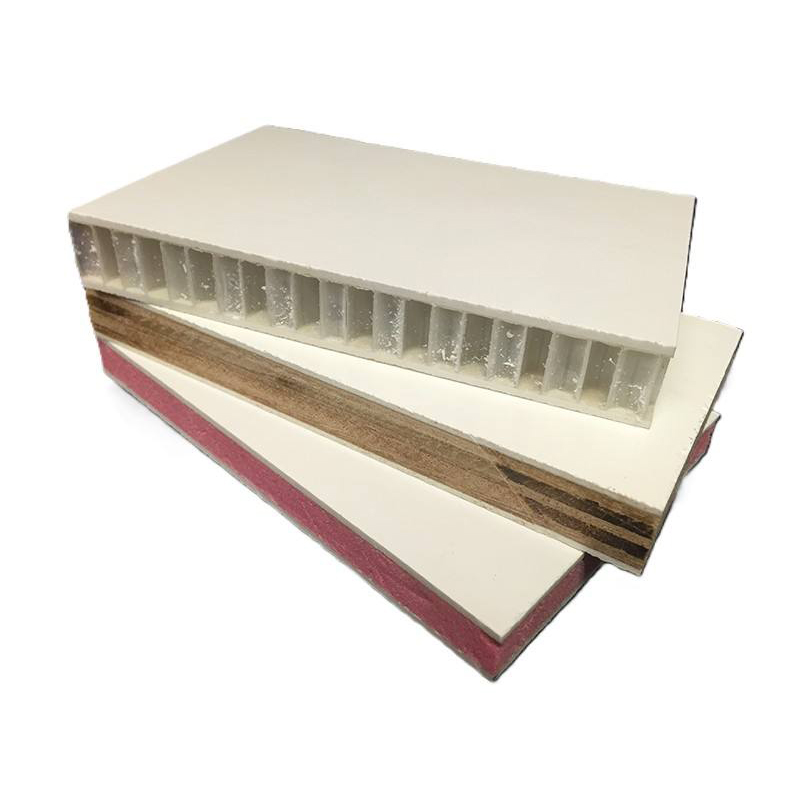
PP Honeycomb Core vs Foam Core for RV Sandwich Panels: Which Material Is Better?
1. Introduction: Choosing the Right Core Material for RV Sandwich Panels
Lightweight construction is an important consideration in recreational vehicle manufacturing.
RV manufacturers need materials that can reduce overall vehicle weight while maintaining structural performance, insulation, durability and production efficiency.
FRP sandwich panels are widely considered for RV walls, roofs, floors, partitions and furniture structures. These panels typically consist of two surface skins bonded to a lightweight core.
However, selecting the core material can be challenging.
Two major categories are commonly considered:
- PP Honeycomb Core
- Foam Core Materials, including PET, PVC, XPS and PU foam
Both material categories can be used in composite sandwich structures, but their internal structures and performance characteristics are different.
PP honeycomb has a cellular structure designed to provide lightweight structural support. Foam cores have a continuous cellular material structure, with properties depending on their polymer chemistry, density and formulation.
So, which material is better for RV sandwich panels?
The answer depends on the application.
A material suitable for an RV interior partition may not be the best choice for an exterior wall or insulated roof. Manufacturers should evaluate the complete panel structure rather than comparing core materials based on density or price alone.
This article compares PP honeycomb and foam core materials from the perspective of RV panel manufacturing.
2. Understanding PP Honeycomb Core and Foam Core Structures
Before comparing performance, it is important to understand the structural differences between these materials.
2.1 PP Honeycomb Core
PP Honeycomb Core is manufactured from polypropylene and formed into a cellular honeycomb structure.
The material consists of interconnected cell walls that create a lightweight core.
Its main characteristics include:
- Cellular thermoplastic structure
- Low weight relative to many solid materials
- Moisture resistance
- Customizable cell size and thickness
- Potential for lightweight sandwich panel construction
PP honeycomb is used in various composite applications, including vehicle panels, furniture boards, packaging structures and industrial sandwich panels.
For RV manufacturers, it can be considered for interior partitions, lightweight wall panels, furniture structures and other applications where its mechanical properties and bonding system meet the design requirements.
One important consideration is polypropylene’s relatively low surface energy. The bonding interface between PP honeycomb and FRP skins needs careful design.
2.2 Foam Core Materials
Foam cores have a cellular structure formed throughout the material.
Several foam materials are used in composite sandwich panel manufacturing.
PET Foam Core
PET foam is a thermoplastic structural foam used in lightweight composite panels.
It offers structural design flexibility and can be evaluated for RV walls, roofs, floors and interior structures.
PVC Foam Core
PVC foam is a rigid structural foam used in FRP and other composite applications.
It is available in different density grades and can be selected according to compression, shear and bonding requirements.
XPS Foam Core
XPS is extruded polystyrene foam with a closed-cell structure.
It is often considered for applications where thermal insulation and moisture resistance are important.
PU Foam Core
PU foam is widely used in insulation-focused sandwich panels.
Its thermal properties depend on the specific formulation, density, processing conditions and product structure.
These foam materials should not be treated as one identical category. Their mechanical, thermal and bonding properties can differ significantly.
3. PP Honeycomb Core vs Foam Core: Main Differences
The following table provides a general comparison for RV sandwich panel manufacturers.
| Comparison Factor | PP Honeycomb Core | Foam Core |
|---|---|---|
| Internal Structure | Cellular honeycomb geometry | Continuous cellular foam structure |
| Material Type | Polypropylene thermoplastic | PET, PVC, XPS, PU and other polymers |
| Weight | Depends on cell geometry, thickness and density | Depends on foam chemistry, density and thickness |
| Compression Performance | Depends on cell geometry, wall thickness and material grade | Depends on foam type, density and formulation |
| Shear Performance | Depends on cell structure and orientation | Depends on foam chemistry and density |
| Thermal Insulation | Requires evaluation; generally not the primary reason for selection | Can be suitable for insulation, depending on foam type |
| Moisture Resistance | PP itself has low moisture absorption | Varies by foam type and product structure |
| Bonding | Requires attention to PP surface energy and facing | Depends on foam chemistry and adhesive compatibility |
| Customization | Cell size, thickness, density and facing | Density, thickness, grade and sheet dimensions |
| Typical RV Applications | Interior panels, furniture, selected structural panels | Walls, roofs, floors and insulation-focused panels |
The comparison is a material-selection guide, not a universal performance ranking.
Actual values should be confirmed using the technical datasheets and test results of the selected products.
4. Weight Comparison: Which Core Is Lighter?
Weight reduction is one of the main reasons RV manufacturers consider honeycomb and foam core materials.
However, comparing material density alone can lead to incorrect conclusions.
The weight of a core per unit area can be estimated using:
Core Weight (kg/m²) = Core Density (kg/m³) × Core Thickness (m)
For example, consider two hypothetical materials:
- Core A: 60 kg/m³ density, 20 mm thickness
- Core B: 80 kg/m³ density, 20 mm thickness
Their calculated core weights are:
| Parameter | Core A | Core B |
|---|---|---|
| Density | 60 kg/m³ | 80 kg/m³ |
| Thickness | 20 mm | 20 mm |
| Core Weight | 1.2 kg/m² | 1.6 kg/m² |
These are mathematical examples, not actual ONEBOND product specifications.
The finished panel weight also includes:
- Outer FRP skin
- Inner FRP skin
- Adhesive or resin
- Facing materials
- Reinforcement
- Edge profiles and other components
A lightweight core does not necessarily produce the lightest finished panel.
For RV manufacturers, the correct comparison should be based on the complete panel weight at equivalent structural and functional performance.
5. Mechanical Performance: Compression, Shear and Bending
Mechanical performance is a major factor when selecting a core material for RV panels.
Different vehicle components experience different loading conditions.
5.1 Compression Performance
Compression strength measures the ability of a material to withstand compressive loading.
This property is particularly important for:
- RV flooring
- Furniture support panels
- Cabinet structures
- Equipment mounting areas
- Localized load-bearing sections
PP honeycomb compression performance depends on cell geometry, wall thickness, material grade and loading direction.
Foam compression performance depends on foam chemistry, density, cell structure and testing conditions.
Neither category should be assumed to have higher compression strength without product-specific test data.
5.2 Shear Performance
Core shear performance is important because the core transfers loads between the two skins.
Poor shear performance can affect the overall bending behavior of a sandwich panel.
For RV exterior walls and roofs, core shear properties should be considered together with skin stiffness, panel span and support spacing.
5.3 Bending Performance
The bending behavior of a sandwich panel depends on several factors:
- FRP skin thickness
- Skin tensile and compressive properties
- Core thickness
- Core shear modulus
- Core shear strength
- Bonding integrity
- Panel support conditions
A thicker core can increase the distance between the skins and improve bending stiffness under suitable conditions.
However, increasing core thickness does not automatically guarantee better panel performance.
Finished panel testing is necessary for critical structural applications.
6. Thermal Insulation: Where Foam Core Has an Advantage
Thermal insulation is one of the major differences between PP honeycomb and many foam core materials.
RV walls and roofs are exposed to changing outdoor temperatures.
A suitable insulation structure can help improve indoor comfort and reduce the heating or cooling load.
Foam Core for Thermal Insulation
Among common foam materials, PU and XPS are frequently considered for insulation-focused panel structures.
Their actual insulation performance depends on:
- Thermal conductivity
- Material thickness
- Density and formulation
- Temperature conditions
- Aging and conditioning
- Joint and edge design
PET and PVC foam can also be evaluated, but their thermal properties should be checked against the actual product data.
PP Honeycomb for Structural Applications
PP honeycomb is generally selected for its lightweight cellular structure rather than as a dedicated thermal insulation material.
It can be used in panel applications where structural weight reduction and moisture resistance are important.
If PP honeycomb is used in a panel requiring substantial insulation, the complete structure may need additional insulation design.
Thermal Performance Comparison
| Material | Thermal Design Consideration |
|---|---|
| PP Honeycomb | Evaluate complete panel thermal performance; not generally selected as the primary insulation core |
| PET Foam | Verify grade-specific thermal conductivity |
| PVC Foam | Verify grade-specific thermal conductivity |
| XPS Foam | Commonly evaluated for insulation-focused structures |
| PU Foam | Commonly evaluated for insulation-focused structures |
For RV manufacturers, the correct approach is to compare the finished panel’s thermal resistance or U-value rather than relying only on the core material name.
7. Bonding Compatibility: An Important Difference
Bonding is one of the most important considerations in FRP sandwich panel production.
The surface chemistry of the core material influences the selection of adhesives, resins and surface preparation processes.
PP Honeycomb Bonding
Polypropylene has relatively low surface energy.
This makes direct bonding more challenging than bonding some other materials.
Manufacturers may need to consider:
- Corona or plasma treatment
- Other suitable surface treatments
- Nonwoven facing
- Compatible adhesive systems
- Resin compatibility
- Process validation
Nonwoven-faced PP honeycomb may offer a more suitable bonding surface for certain panel systems.
However, the complete bonding structure should be evaluated.
The manufacturer needs to verify both:
- PP core-to-facing bonding
- Facing-to-FRP skin bonding
The presence of a nonwoven layer does not automatically guarantee high bonding strength.
Foam Core Bonding
Foam core bonding depends on the polymer type, surface condition and selected adhesive or resin.
Some foam grades are designed for composite manufacturing, while others may require additional preparation.
Manufacturers should verify:
- Adhesive compatibility
- Resin compatibility
- Surface condition
- Chemical resistance
- Pressing conditions
- Curing requirements
The best bonding system is the one validated for the actual core, skin and manufacturing process.
8. Cost Comparison: Core Price vs Finished Panel Cost
Material purchasing decisions are often influenced by price.
However, the cheapest core material does not always produce the lowest finished panel cost.
Manufacturers should consider the total production cost.
Core Material Cost
The price per cubic meter is only one purchasing factor.
Core thickness, density, facing and processing requirements also influence the actual material cost per square meter.
Adhesive and Bonding Cost
PP honeycomb may require specific surface treatment, facing or adhesive solutions.
Foam materials may have different bonding requirements depending on their chemistry and product grade.
These additional processes should be included in the cost comparison.
Processing Efficiency
Consider:
- Cutting and machining efficiency
- Material handling
- Panel assembly
- Pressing time
- Curing time
- Scrap rate
- Production consistency
Finished Panel Performance
A panel that requires fewer repairs, provides stable performance and meets customer requirements may offer better overall value even if its core material price is higher.
A useful purchasing comparison should include:
| Cost Factor | Evaluation |
|---|---|
| Core Material Price | Price per m² or m³ |
| Facing Material | Additional facing cost |
| Adhesive System | Adhesive and resin consumption |
| Surface Treatment | Additional preparation cost |
| Processing | Labor, machinery and cycle time |
| Scrap Rate | Material loss during production |
| Quality Control | Inspection and testing cost |
| Finished Panel Performance | Structural and functional value |
9. Which Core Material Is Better for Different RV Components?
The best core material depends on the function of the panel.
The following matrix provides a preliminary selection guide.
| RV Component | PP Honeycomb | PET/PVC Foam | XPS/PU Foam |
|---|---|---|---|
| Interior Partition | Can be considered | Can be considered | Depends on requirements |
| Furniture Panels | Can be considered | Can be considered | Depends on requirements |
| Exterior Wall | Requires structural and bonding validation | Can be considered | Can be considered where insulation is required |
| Roof Panel | Requires thermal and structural evaluation | Can be considered | Can be considered for insulation |
| Floor Panel | Requires compression and point-load validation | Can be considered with suitable density and design | Requires load and compression validation |
| Insulated Wall Panel | May require additional insulation design | Evaluate actual thermal data | Often evaluated for insulation-focused designs |
| Cabinet Doors | Can be considered | Can be considered | Depends on surface and load requirements |
This table is intended as a starting point for material selection.
The final configuration should be confirmed through engineering calculations, sample production and finished panel testing.
10. How RV Manufacturers Should Select the Right Core Material
A practical material selection process can be divided into six steps.
Step 1: Define the Panel Application
Identify whether the material will be used for an exterior wall, roof, floor, partition or furniture panel.
Step 2: Determine the Performance Requirements
Define the required weight, stiffness, compression strength, shear strength, insulation and environmental resistance.
Step 3: Select Candidate Materials
Compare PP honeycomb with suitable foam grades according to the application.
Do not compare PP honeycomb with an unspecified general category of foam. Compare it with actual PET, PVC, XPS or PU products.
Step 4: Confirm Bonding Compatibility
Evaluate the core surface, FRP skin, adhesive and manufacturing process.
Step 5: Produce Trial Panels
Manufacture representative samples using the intended production process.
Step 6: Test the Finished Structure
Evaluate the finished panel for:
- Weight per square meter
- Compression performance
- Core shear performance
- Flexural performance
- Flatwise tensile strength
- Bonding integrity
- Thermal performance where required
- Water absorption or moisture-related performance where relevant
This process helps manufacturers avoid selecting materials based on incomplete information.
11. RFQ Specification Checklist for RV Sandwich Panel Core Materials
When requesting quotations from core material suppliers, buyers should provide sufficient technical information.
| Parameter | Information Required |
|---|---|
| Application | RV wall, roof, floor, partition or furniture |
| Core Type | PP Honeycomb / PET / PVC / XPS / PU |
| Core Density | Target density or required range |
| Core Thickness | Required thickness |
| Cell Size | Required for PP honeycomb |
| Facing | Bare, nonwoven-faced or other facing |
| Panel Dimensions | Length and width |
| FRP Skin | Material, thickness and surface finish |
| Bonding System | Adhesive or resin requirements |
| Weight Target | Target core or finished panel weight |
| Mechanical Requirements | Compression, shear and bending |
| Thermal Requirements | Conductivity or finished panel U-value |
| Order Quantity | Trial order and estimated annual demand |
| Production Process | Vacuum bonding, pressing or other process |
A detailed RFQ helps suppliers recommend more suitable material options and reduces unnecessary sample iterations.
12. ONEBOND: PP Honeycomb and Foam Core Materials for RV Panel Manufacturers
ONEBOND supplies composite core materials for lightweight sandwich panel production.
Our product range includes:
- PP Honeycomb Core
- Nonwoven Faced PP Honeycomb Core
- PET Foam Core
- PVC Foam Core
- XPS Foam Core
- PU Foam Core
These materials can be evaluated for FRP sandwich panels used in RVs, motorhomes, caravans, truck bodies, marine structures and industrial composite applications.
We understand that different RV panel manufacturers have different requirements for weight, thickness, density, bonding compatibility and finished panel performance.
Rather than recommending one material for every application, ONEBOND focuses on understanding the target panel structure and helping buyers evaluate suitable core material options.
If you are developing lightweight RV sandwich panels or expanding your composite panel production range, contact ONEBOND to discuss your required specifications.
ONEBOND – Composite Core Materials for Lightweight Sandwich Panel Manufacturing.
13. Frequently Asked Questions
Q1. What is the difference between PP honeycomb core and foam core?
PP honeycomb has a cellular honeycomb geometry made from polypropylene, while foam core has a continuous cellular structure made from materials such as PET, PVC, XPS or PU.
Q2. Is PP honeycomb lighter than foam core?
It depends on the material grade, cell structure, density and thickness. Buyers should compare core weight per square meter and the finished panel weight at equivalent performance requirements.
Q3. Which core material is better for RV wall panels?
PP honeycomb, PET foam and PVC foam can all be evaluated for RV wall panels. The best option depends on structural requirements, bonding compatibility, weight and thermal performance.
Q4. Which core material is better for RV insulation panels?
PU and XPS foam are commonly evaluated for insulation-focused structures. Actual selection should be based on thermal conductivity, panel thickness, environmental conditions and the complete panel design.
Q5. Can PP honeycomb be bonded directly to FRP skins?
Not every adhesive or resin system can reliably bond directly to PP. Surface treatment, suitable facing materials and adhesive compatibility should be evaluated and validated.
Q6. Is nonwoven-faced PP honeycomb better for FRP sandwich panels?
Nonwoven facing may provide a more suitable bonding surface for certain FRP panel systems. However, both the core-to-facing and facing-to-skin interfaces need to be tested.
Q7. Can PET foam replace PP honeycomb in RV panels?
PET foam can be considered as an alternative for certain applications, but it is not a direct one-to-one replacement. Mechanical properties, thermal performance, bonding and finished panel weight must be compared.
Q8. Which core material is suitable for RV flooring?
The selected core should meet the required compression, shear, bending and point-load performance. PP honeycomb and structural foam materials can be evaluated through finished panel testing.
Q9. How do I compare the cost of honeycomb and foam core materials?
Compare the total finished panel cost, including core material, facing, adhesive, processing, scrap rate, quality control and finished panel performance.
Q10. Can ONEBOND supply both PP honeycomb and foam core materials?
Yes. ONEBOND’s composite core product range includes PP honeycomb, PET foam, PVC foam, XPS foam and PU foam, subject to the required specifications and production feasibility.
