
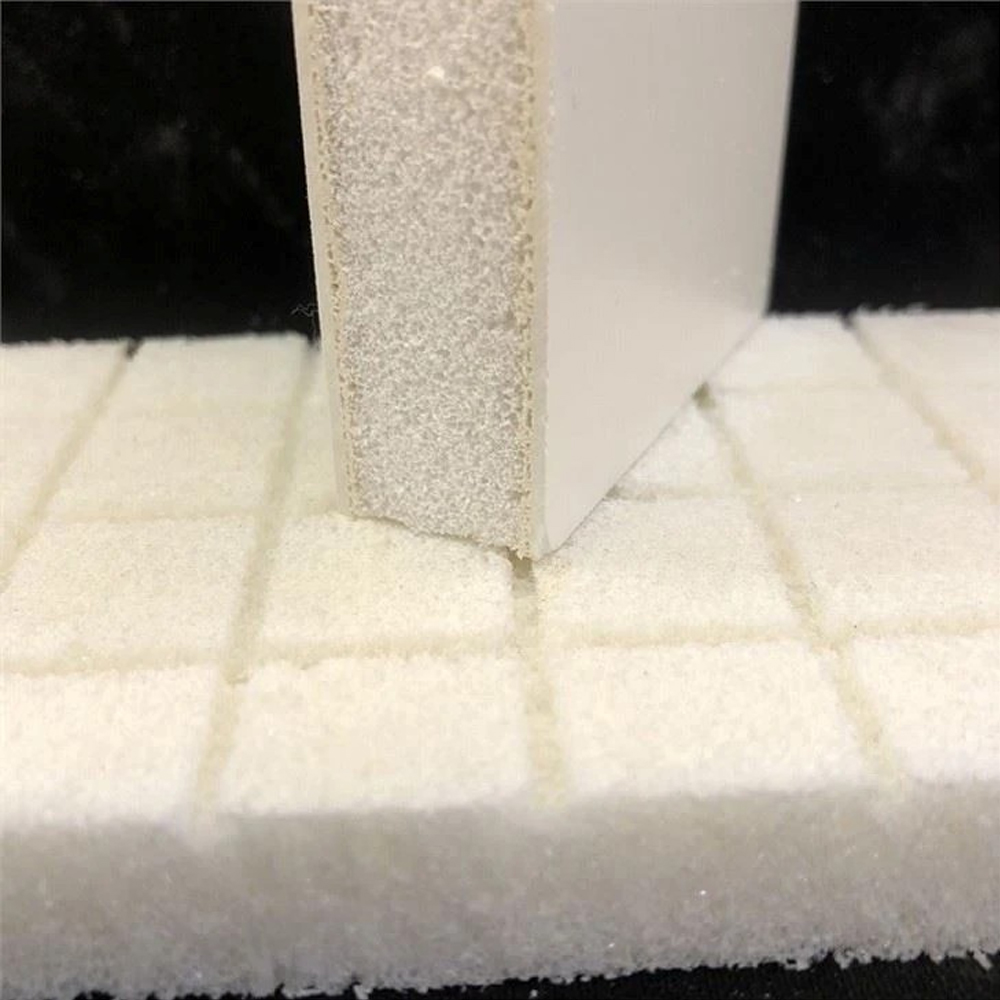
Yes. Composite core materials can be highly customized to meet the structural, manufacturing, dimensional, and environmental requirements of different engineering applications. For professional buyers, customization is particularly important when standard foam sheets or honeycomb panels cannot provide the required combination of weight, strength, thickness, geometry, and processing efficiency.
The most common customization options include density, thickness, sheet dimensions, surface treatment, perforation, grooving, scoring, contouring, CNC machining, edge processing, and pre-cutting. Depending on the material and manufacturing process, suppliers can also provide different surface conditions to improve resin flow or adhesive bonding.
Density customization is particularly useful for sandwich structures with different load zones. A low-density core may be appropriate for areas with relatively low structural loads, while higher-density composite core materials can be used around mounting points, equipment bases, structural joints, or areas exposed to concentrated loads.
Thickness is another major customization parameter. Increasing core thickness can significantly improve bending stiffness without adding the same amount of weight as a solid structural material. However, the optimal thickness depends on the required bending stiffness, shear strength, buckling resistance, available installation space, and manufacturing process.
Common Customization Options for Composite Core Materials
| Customization | Typical Purpose |
|---|---|
| Density | Adjust strength-to-weight ratio |
| Thickness | Optimize structural stiffness |
| Sheet size | Reduce joints and material waste |
| Perforation | Improve resin flow |
| Grooving | Facilitate infusion and bending |
| Scoring | Improve forming flexibility |
| CNC contouring | Match curved structures |
| Surface treatment | Improve bonding |
| Edge processing | Improve assembly accuracy |
| Pre-cutting | Reduce production labor |
| Laminated surface | Improve handling or bonding |
For marine applications, for example, a supplier may provide curved or CNC-machined PET or PVC foam cores that follow the geometry of a hull. For wind turbine blades, composite core materials may require complex contouring, grooves, or perforations to support resin infusion. In architectural panels, large-format sheets may be required to reduce the number of joints.
Customization can also reduce production costs. If a factory purchases standard sheets and performs all cutting and machining internally, significant labor and material waste may occur. A supplier that provides near-net-shape core kits can reduce these costs.
However, customization requires close communication between the buyer and supplier. The RFQ should include CAD drawings, required dimensions, tolerances, material grade, density, thickness, processing method, annual volume, and packaging requirements.
For complex projects, buyers should first request prototype samples or first-article production before placing a large-volume order.
The key advantage of customized composite core materials is therefore not simply that the material can be made in a different size. The real value lies in optimizing the core for the complete manufacturing process and structural design.
For OEMs and engineering companies, a capable supplier should be able to provide both standard materials and engineering customization, allowing the core design to evolve together with the finished composite structure.
