
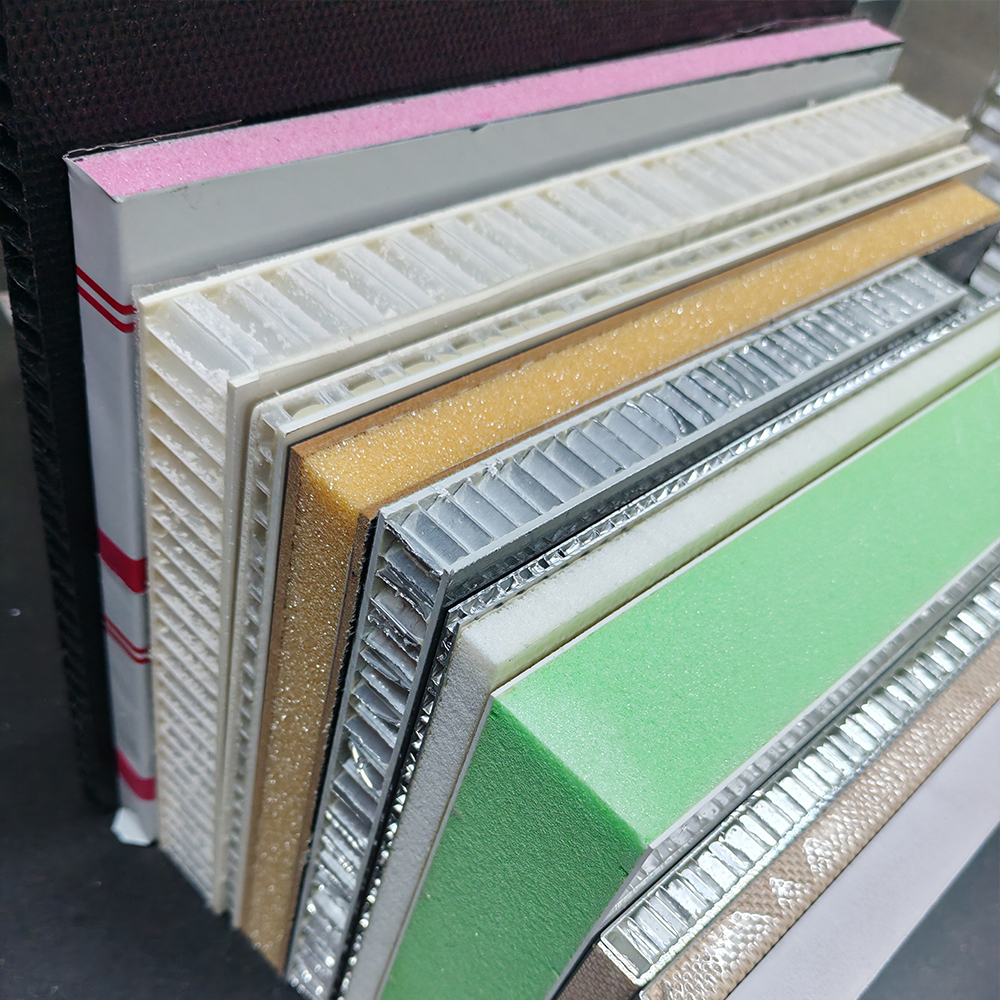
1. What Is Composite Core Material?
Composite Core Material is a lightweight structural material used in sandwich composite structures to improve stiffness, strength, and overall structural performance while reducing weight. It is typically positioned between two outer skin layers, such as fiberglass, carbon fiber, aluminum, or other composite materials, to create a high-performance sandwich panel.
Unlike conventional solid materials, composite sandwich structures use a lightweight core to separate and support the outer skins. This structural design increases bending stiffness without significantly increasing overall weight.
Today, composite core materials are widely used in wind turbine blades, marine vessels, aircraft interiors, automotive components, truck bodies, construction panels, furniture, and industrial equipment.
Common composite core materials include:
- PVC Foam Core
- PET Foam Core
- XPS Foam Core
- PU Foam Core
- PMI Foam Core
- SAN Foam Core
- PP Honeycomb Core
- Aluminum Honeycomb Core
- Fiberglass Honeycomb Core
- Balsa Wood Core
Each material offers different mechanical, thermal, chemical, and processing properties. Selecting the right core material depends on the application, manufacturing process, operating environment, and required structural performance.
2. How Does a Composite Sandwich Structure Work?
A typical composite sandwich panel consists of three main components: the upper skin, the core material, and the lower skin.
The outer skins carry most of the tensile and compressive stresses during bending, while the core maintains the separation between the skins and transfers shear loads. The core also helps prevent local buckling and supports the overall panel structure.
A typical sandwich construction includes:
- Top Skin: Fiberglass, FRP, carbon fiber, aluminum, or steel.
- Adhesive Layer: Structural adhesive or resin bonding system.
- Core Material: Foam core, honeycomb core, or another structural core.
- Adhesive Layer: Bonds the core to the bottom skin.
- Bottom Skin: Provides structural support and completes the sandwich construction.
The effectiveness of a sandwich structure depends on the combined properties of its skins, core, adhesive interface, and manufacturing process.
For example, a fiberglass sandwich panel with a PVC foam core can provide good structural strength, low weight, moisture resistance, and corrosion resistance, making it suitable for marine applications.
3. Main Types of Composite Core Materials
Different composite core materials are designed for different performance requirements. Understanding their characteristics is essential for composite manufacturers and industrial buyers.
3.1 PVC Foam Core
PVC Foam Core, also known as PVC Structural Foam Core or Cross-Linked PVC Foam, is one of the most widely used structural foam materials in composite manufacturing.
It features a closed-cell structure, good mechanical strength, relatively low water absorption, and compatibility with various composite manufacturing processes.
Key characteristics:
- Lightweight closed-cell structure
- Good compressive and shear properties
- Good moisture resistance
- Compatibility with vacuum infusion and resin processing
- Available in different densities and thicknesses
- Suitable for CNC machining and customized cutting
Typical applications include:
- Boat hulls and yacht decks
- Wind turbine blades
- Marine sandwich panels
- FRP composite structures
- Industrial composite panels
PVC foam core is particularly suitable for applications requiring a balance between structural performance, durability, and processing flexibility.
3.2 PET Foam Core
PET Foam Core is a thermoplastic structural foam material increasingly used in lightweight composite structures.
It is often manufactured from polyethylene terephthalate and can incorporate recycled raw materials depending on the production process and grade.
Key characteristics:
- Lightweight structural performance
- Good compressive and shear strength
- Potential for recycled material content
- Good dimensional stability
- Compatibility with composite manufacturing processes
Typical applications include:
- Wind turbine blades
- Automotive composite panels
- Marine structures
- Railway components
- Industrial sandwich panels
PET foam core is an attractive option for manufacturers seeking a balance between mechanical performance, cost efficiency, and material sustainability.
3.3 XPS Foam Core
XPS Foam Core, also called Extruded Polystyrene Foam Core, is a closed-cell rigid foam produced through an extrusion process.
It is widely used in insulation applications because of its low thermal conductivity, low water absorption, and lightweight structure.
Key characteristics:
- Excellent thermal insulation performance
- Lightweight rigid structure
- Closed-cell construction
- Good moisture resistance
- Easy cutting and processing
Typical applications include:
- Building insulation panels
- Roofing sandwich panels
- Wall insulation systems
- Decorative composite panels
- Lightweight construction boards
Compared with structural PVC or PET foam, XPS is generally more suitable for insulation-oriented applications than highly loaded structural sandwich applications. Its suitability for a structural design should be confirmed through mechanical testing.
3.4 PU Foam Core
PU Foam Core, also known as Polyurethane Foam Core, is used in insulation panels and various lightweight composite structures.
Its main advantage is its thermal insulation capability. Different formulations and densities can be designed for specific processing and performance requirements.
Typical applications include:
- Insulated sandwich panels
- Refrigerated truck bodies
- Cold storage panels
- Building insulation systems
- Industrial thermal insulation structures
PU foam is especially important in applications where thermal insulation is a major design requirement.
3.5 PMI Foam Core
PMI Foam Core is a high-performance structural foam based on polymethacrylimide.
It is designed for demanding applications requiring high strength-to-weight ratios, dimensional stability, and elevated-temperature performance.
Typical applications include:
- Aerospace components
- High-performance sporting goods
- Racing vehicles
- Advanced carbon fiber structures
- Specialized industrial composites
PMI foam is generally positioned in the premium segment of the structural foam core market, where performance requirements justify higher material costs.
3.6 SAN Foam Core
SAN Foam Core is a structural foam material based on styrene-acrylonitrile chemistry.
It offers a combination of mechanical performance, toughness, and fatigue resistance, depending on the specific formulation and grade.
Typical applications include:
- Wind turbine blades
- Marine composite structures
- Transportation panels
- Industrial sandwich structures
3.7 PP Honeycomb Core
PP Honeycomb Core is a lightweight structural core made from polypropylene with a honeycomb cell structure.
It provides a favorable strength-to-weight ratio and is commonly used in lightweight sandwich panels.
Key characteristics:
- Lightweight honeycomb construction
- Good moisture resistance
- Corrosion resistance
- Thermoplastic processing compatibility
- Good potential for recycling
Typical applications include:
- Truck body panels
- Trailer sandwich panels
- Automotive interior components
- Furniture panels
- Construction boards
- Packaging and transportation panels
PP honeycomb core is particularly attractive for manufacturers producing large lightweight panels.
3.8 Aluminum Honeycomb Core
Aluminum Honeycomb Core is a metallic structural core with a regular hexagonal cell structure.
It provides high stiffness at relatively low weight and is widely used in applications requiring dimensional stability and structural efficiency.
Typical applications include:
- Aircraft interior panels
- Railway interior panels
- Architectural wall panels
- Aluminum composite panels
- Marine interior structures
- Industrial equipment panels
Its selection requires consideration of corrosion protection, bonding compatibility, cell geometry, and the intended service environment.
3.9 Other Core Materials
Other materials used in composite sandwich structures include:
- Fiberglass Honeycomb Core
- Aramid Honeycomb Core
- Balsa Wood Core
- Aluminum Corrugated Core
- MPP Foam Core
- Syntactic Foam Core
These materials serve specialized applications where specific mechanical, thermal, electrical, or environmental properties are required.
4. Key Properties of Composite Core Materials
When selecting a composite core material, buyers should evaluate more than density and thickness. Mechanical performance, manufacturing compatibility, and environmental resistance are equally important.
Density
Density directly affects the weight of the final composite panel. Different applications require different density ranges.
Lower-density cores can reduce overall structural weight, while higher-density cores may provide improved compressive or shear properties.
Compressive Strength
Compressive strength measures the ability of a core material to withstand loads perpendicular to its surface.
It is important for sandwich panels exposed to concentrated loads, impact, or structural pressure.
Shear Strength
Shear strength is particularly important in sandwich structures because the core transfers shear loads between the outer skins.
Wind turbine blades, boat hulls, and transportation panels require appropriate shear performance.
Thermal Conductivity
Thermal conductivity is a critical property for insulation-oriented applications.
XPS, PU, and other insulation foam materials are commonly selected based on thermal performance.
Water Absorption
For marine, outdoor, and humid environments, water absorption and long-term moisture resistance are important selection criteria.
Closed-cell foam cores and suitable honeycomb materials can help reduce moisture-related problems.
Temperature Resistance
Operating temperature and processing temperature must be considered, especially for vacuum infusion, elevated-temperature curing, and high-performance composite manufacturing.
Bonding Compatibility
The bonding interface between the core and outer skins is critical. Resin compatibility, surface preparation, perforation, grooving, and adhesive selection can influence the final sandwich panel performance.
5. Major Applications of Composite Core Materials
Composite core materials are used across multiple industries because they offer lightweight structural solutions.
Wind Energy
Wind turbine blades require lightweight materials with suitable stiffness, shear strength, fatigue resistance, and dimensional stability.
PET foam, PVC foam, SAN foam, and balsa wood are commonly considered for different blade sections and structural requirements.
Marine and Shipbuilding
Marine composite structures require materials that can withstand moisture, saltwater exposure, vibration, and repeated loading.
PVC foam core and PET foam core are widely used in boat hulls, yacht decks, bulkheads, and marine sandwich panels.
Aerospace and Aviation
Aerospace applications demand high structural efficiency and strict quality control.
PMI foam, aramid honeycomb, and aluminum honeycomb are used in selected aircraft components and interior sandwich panels.
Automotive and Transportation
Lightweight composite materials are increasingly used in commercial vehicles, refrigerated trucks, trailers, buses, recreational vehicles, and railway interiors.
PET foam, PP honeycomb, PVC foam, and aluminum honeycomb can be selected according to the required panel structure and operating conditions.
Building and Construction
Composite core materials are used in insulated sandwich panels, architectural cladding, roofing systems, wall panels, cleanroom panels, and prefabricated buildings.
XPS and PU foam are especially relevant to thermal insulation, while PET foam and honeycomb cores can serve structural panel applications.
Furniture and Interior Decoration
Lightweight honeycomb and foam cores are used in doors, cabinets, partitions, decorative panels, and lightweight furniture.
PP honeycomb and aluminum honeycomb are particularly useful where low weight and panel rigidity are required.
6. Composite Core Materials Comparison
The following table provides a general material selection reference. Actual properties vary according to density, grade, manufacturing process, and supplier specifications.
| Core Material | Main Advantage | Typical Application |
|---|---|---|
| PVC Foam | Structural strength and moisture resistance | Marine, wind energy |
| PET Foam | Lightweight and recyclable options | Wind energy, transportation |
| XPS Foam | Thermal insulation | Construction |
| PU Foam | Thermal insulation | Building, refrigeration |
| PMI Foam | High-performance structural properties | Aerospace |
| SAN Foam | Toughness and fatigue performance | Wind energy, marine |
| PP Honeycomb | Lightweight and moisture resistance | Truck bodies, furniture |
| Aluminum Honeycomb | High stiffness-to-weight ratio | Aerospace, rail, architecture |
| Aramid Honeycomb | Lightweight structural performance | Aerospace |
| Balsa Wood | High specific stiffness | Wind energy, marine |
7. How to Choose the Right Composite Core Material
Choosing the correct core material requires a systematic evaluation of the final product and manufacturing conditions.
Step 1: Identify the End Application
First, determine whether the core will be used in wind turbine blades, boat hulls, truck bodies, construction panels, or furniture.
Each application has different structural and environmental requirements.
Step 2: Define Mechanical Requirements
Evaluate:
- Density
- Compressive strength
- Shear strength
- Shear modulus
- Tensile properties
- Fatigue resistance
These properties should be evaluated using appropriate standardized test methods.
Step 3: Consider the Manufacturing Process
Common composite manufacturing processes include:
- Vacuum Infusion
- Resin Transfer Molding (RTM)
- Hand Lay-Up
- Vacuum Bagging
- Compression Molding
- Thermoplastic Forming
The core material must be compatible with the selected resin system, curing temperature, and processing conditions.
Step 4: Evaluate Environmental Conditions
Consider operating temperature, moisture exposure, UV exposure, chemicals, vibration, and expected service life.
Step 5: Compare Total Manufacturing Cost
Material price is only one part of the total cost.
Machining, cutting waste, bonding performance, processing time, panel weight, and long-term durability should also be included.
8. Customized Composite Core Material Manufacturing
Different industries require different core material specifications. Therefore, customized manufacturing is important for composite material suppliers.
Typical customization options include:
- Custom Density
- Custom Thickness
- Custom Sheet Size
- CNC Cutting
- Contour Cutting
- Double-Sided Grooving
- Perforation
- Scrim or Surface Treatment
- Custom Cell Size for Honeycomb Core
For example, a boat manufacturer may require 80 kg/m³ PVC foam core with customized grooves and perforations for vacuum infusion. A truck body panel manufacturer may require PP honeycomb core with a specified cell size and thickness.
A professional supplier should provide technical specifications, material samples, processing recommendations, and consistent production quality.
9. Why Choose ONEBOND as Your Composite Core Material Supplier?
ONEBOND is a composite material manufacturer in China, specializing in lightweight core materials and composite panel solutions.
With advanced production equipment, extensive manufacturing facilities, skilled technical workers, and an experienced international sales team, ONEBOND serves customers in different industries and international markets.
Our main product range includes:
- PVC Foam Core
- PET Foam Core
- XPS Foam Core
- PU Foam Core
- PMI Foam Core
- PP Honeycomb Core
- MPP Foam Core
We focus on supplying composite core materials for wind energy, marine, transportation, construction, furniture, and industrial applications.
Our manufacturing and customization capabilities support different material densities, thicknesses, dimensions, and processing requirements.
Whether you are manufacturing fiberglass sandwich panels, wind turbine blades, marine composite structures, truck body panels, or lightweight architectural panels, ONEBOND can help you identify suitable core material options.
10. Conclusion
Composite Core Material plays an essential role in modern lightweight structural engineering. From foam core materials such as PVC, PET, XPS, PU, and PMI to honeycomb structures such as PP and aluminum honeycomb, different materials offer specific advantages for different industries.
As demand for lightweight, energy-efficient, and high-performance composite structures continues to develop, the importance of structural core materials will remain significant.
For manufacturers, selecting the right core material is not simply a matter of choosing a lightweight board. It requires balancing mechanical performance, manufacturing compatibility, environmental resistance, and overall production cost.
ONEBOND is committed to supplying reliable composite core materials and customized solutions for global composite manufacturers.
