
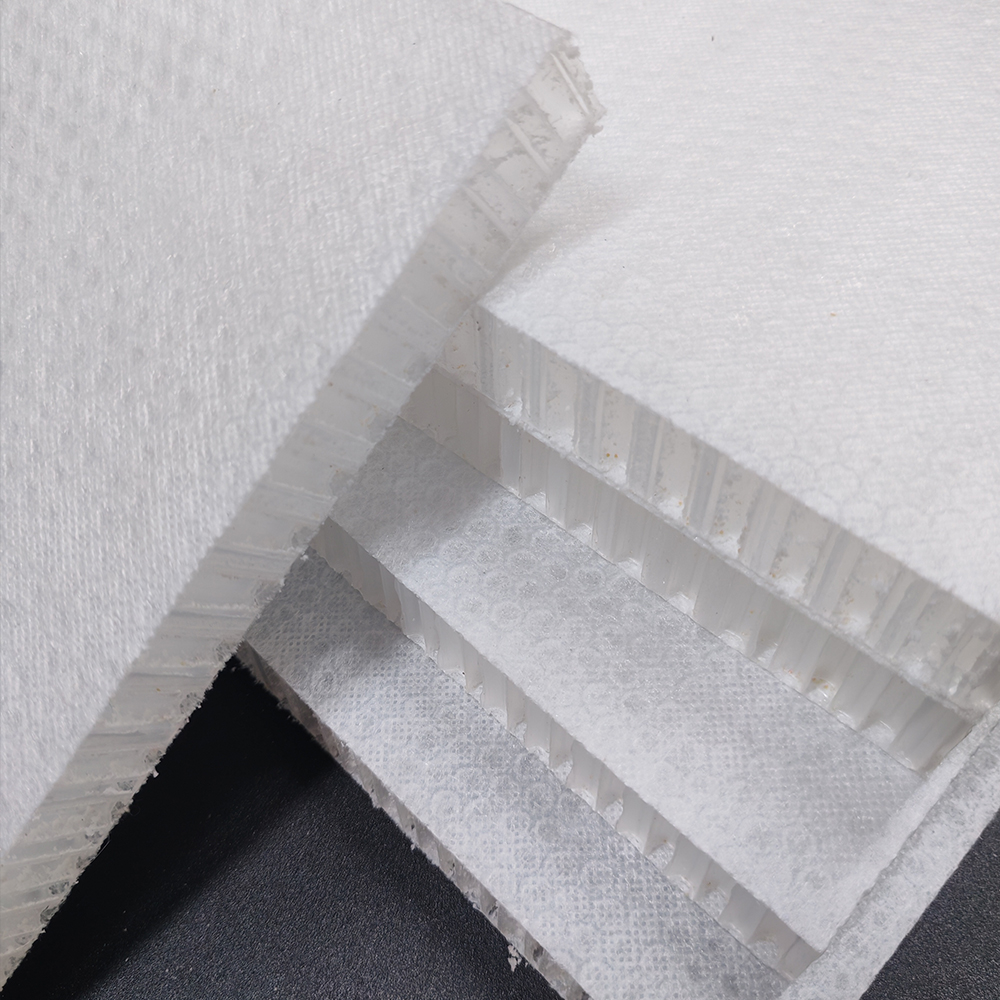
1. Introduction: Lightweight Composite Materials for Trailer Manufacturing
Trailer manufacturers face increasing pressure to improve payload capacity, reduce vehicle weight and maintain reliable structural performance.
The materials used in trailer floors, side walls, roofs and doors directly affect the overall vehicle weight, manufacturing cost and service life.
Traditional trailer construction may involve plywood, steel, aluminum sheets, solid plastic boards and various composite materials. Although these materials have established applications, manufacturers may seek alternatives that offer better weight efficiency, moisture resistance or production flexibility.
PP honeycomb composite panels are one option for developing lightweight trailer structures.
A typical panel combines:
- FRP or fiberglass reinforced plastic skins
- PP honeycomb core
- Structural adhesive
- Reinforced edges and connection inserts
This combination can be customized for different trailer components. However, floor panels, wall panels, roof panels and doors do not experience identical loads. Each application requires a suitable panel design.
2. Complete Structure of Trailer PP Honeycomb Composite Panels
A trailer sandwich panel should be designed as a complete structural assembly.
2.1 Outer FRP Skin
The outer FRP skin protects the panel and contributes to its structural performance.
For trailer applications, important requirements may include:
- Weather resistance
- UV resistance
- Impact resistance
- Abrasion resistance
- Corrosion resistance
- Easy cleaning
- Suitable surface appearance
The required FRP specification depends on whether the panel is used externally or internally.
2.2 Inner FRP Skin
The inner skin provides the opposite surface of the sandwich construction.
For refrigerated or insulated trailers, the inner surface may need to meet additional requirements related to cleaning, condensation, temperature exposure and hygiene.
The two FRP skins do not necessarily need to have identical thicknesses or surface finishes.
2.3 PP Honeycomb Core
PP honeycomb core is a lightweight polypropylene material with a cellular structure.
Its role is to maintain the separation between the surface skins and contribute to the shear behavior of the sandwich panel.
For trailer manufacturers, core selection should consider:
| Core Parameter | Importance |
|---|---|
| Density | Influences core weight and mechanical properties |
| Thickness | Influences panel depth and bending behavior |
| Cell size | Affects local support and bonding characteristics |
| Compressive strength | Important for through-thickness loads |
| Shear strength | Important for sandwich-panel structural behavior |
| Surface treatment | Important for bonding to FRP skins |
| Dimensional tolerance | Important for production consistency |
The final panel must be validated for its intended support conditions and loading environment.
2.4 Adhesive and Reinforced Edges
The adhesive system transfers loads between the skins and core.
Since PP has relatively low surface energy, suitable surface treatment or a qualified bonding system is generally necessary.
Trailer panels may also require reinforced edges and inserts around:
- Door hinges
- Locking mechanisms
- Floor connections
- Wall joints
- Roof mounting points
- Structural frames
These areas should be designed according to the actual fastening loads.
3. PP Honeycomb Composite Panels for Different Trailer Applications
Different trailer components have different structural requirements. Manufacturers should not assume that one panel specification can be used throughout the vehicle.
3.1 Trailer Side Wall Panels
Side wall panels may benefit from lightweight sandwich construction because they cover large surface areas.
Potential advantages include:
- Reduced panel mass
- Moisture-resistant core material
- Customizable surface finishes
- Integration with metal or composite frames
- Flexible panel dimensions
The design should consider wind pressure, vibration, impact, joint connections and the distance between supporting members.
3.2 Trailer Roof Panels
Roof panels are exposed to weather, temperature changes and environmental loads.
A suitable composite roof panel should consider:
- Rainwater management
- UV exposure
- Thermal expansion
- Wind uplift
- Roof support spacing
- Joint sealing
- Long-term dimensional stability
If thermal insulation is a major requirement, the designer should evaluate the thermal conductivity of the complete panel and compare PP honeycomb with suitable foam-core alternatives.
PP honeycomb should not automatically be treated as a high-performance insulation core.
3.3 Trailer Floor Panels
Trailer flooring has more demanding loading conditions than many wall and roof applications.
The design may need to account for:
- Distributed cargo loads
- Concentrated wheel loads
- Forklift traffic
- Pallet movement
- Impact loading
- Repeated loading cycles
- Local fastening and support conditions
A lightweight PP honeycomb core can be considered for selected floor-panel designs, but the skin construction, core density, panel thickness, support spacing and reinforcement must be engineered carefully.
For heavy-duty floors, the complete panel must be tested under representative loading conditions before commercial use.
3.4 Trailer Rear Doors
Rear doors are frequently operated and experience repeated mechanical loads.
A sandwich panel used in trailer doors should include suitable reinforcement around hinges, locks, handles and connection points.
The panel design should also consider edge sealing, water ingress, impact and dimensional stability.
3.5 Internal Partitions
Internal partition panels can be used to divide cargo compartments or separate functional areas.
PP honeycomb composite panels may offer weight advantages and customizable surface finishes for these applications.
4. How Lightweight Trailer Panels Improve Payload Efficiency
The main commercial reason for adopting lightweight trailer panels is to reduce the mass of the vehicle body.
A lower body weight may create opportunities to increase usable payload, subject to legal gross vehicle weight limits, axle ratings, chassis capacity and operating conditions.
The potential weight reduction should be calculated by comparing the complete replacement panel with the original construction.
Illustrative Panel Weight Calculation
The following example demonstrates how a manufacturer can estimate the weight of a sandwich panel. These are assumed values for calculation purposes, not a certified product specification.
| Component | Assumed Specification | Estimated Weight |
|---|---|---|
| FRP outer skin | 2 mm, 1,800 kg/m³ | 3.60 kg/m² |
| PP honeycomb core | 20 mm, 80 kg/m³ | 1.60 kg/m² |
| FRP inner skin | 2 mm, 1,800 kg/m³ | 3.60 kg/m² |
| Adhesive | Assumed application weight | 0.60 kg/m² |
| Total | 24 mm sandwich panel | 9.40 kg/m² |
The actual panel mass may be higher due to inserts, frames, edge profiles, coatings and manufacturing variations.
How to Calculate Potential Weight Savings
The basic calculation is:
[
\text{Weight Saving}=\text{Original Panel Weight}-\text{New Panel Weight}
]
For a trailer with multiple panel components:
[
\text{Total Saving}=\sum_{i=1}^{n}(M_{\text{old},i}-M_{\text{new},i})
]
Manufacturers should include all relevant structural components in the comparison, including reinforcement and connection hardware.
5. PP Honeycomb Core vs Alternative Trailer Panel Materials
Trailer manufacturers may compare PP honeycomb core with PVC foam, PET foam, plywood and aluminum honeycomb.
| Material | Potential Advantages | Important Considerations |
|---|---|---|
| PP Honeycomb | Lightweight cellular structure and moisture resistance | Adhesive compatibility and insert design |
| PVC Foam | Established foam-core composite applications | Density, resin compatibility and fire performance |
| PET Foam | Thermoplastic foam core with recyclable material options | Grade and process compatibility |
| Plywood | Familiar manufacturing and fastening methods | Moisture protection and panel weight |
| Aluminum Honeycomb | High stiffness-to-weight potential | Bonding, corrosion protection and edge finishing |
The best material depends on the intended trailer application, structural design, production process and target cost.
For refrigerated trailers, thermal performance must be considered separately. A panel designed primarily for low weight may not meet the insulation requirements of a temperature-controlled vehicle.
6. Customization Options for Trailer Composite Panel Manufacturers
Commercial trailer panel buyers often require customized specifications rather than standard stock sheets.
A professional PP honeycomb core supplier may be able to support customization in the following areas:
| Customization Item | Buyer Requirement |
|---|---|
| Core density | Based on mechanical and weight targets |
| Core thickness | Based on complete panel design |
| Cell size | Based on structural and processing requirements |
| Sheet dimensions | Based on production line and panel size |
| Cutting service | Customized length and width |
| Surface treatment | To support the selected bonding system |
| Panel construction | Customized FRP skin and core combination |
| Edge reinforcement | According to hinges, joints and fastening details |
Before ordering, buyers should provide drawings, panel dimensions, required mechanical properties and expected production volumes.
7. Manufacturing Process for Trailer Sandwich Panels
A typical production process includes:
- FRP skin preparation: Inspect surface sheets for thickness, finish and defects.
- Core preparation: Select and cut PP honeycomb core to the required dimensions.
- Surface activation: Apply the bonding preparation specified for the PP and adhesive combination.
- Adhesive application: Control adhesive coverage and working time.
- Panel assembly: Align the two FRP skins with the honeycomb core.
- Pressing and curing: Control pressure, temperature and curing time.
- Reinforcement installation: Add inserts and reinforced sections where required by the design.
- Trimming and finishing: Complete dimensional cutting and edge sealing.
- Quality inspection: Verify appearance, dimensions, bonding and mechanical performance.
Manufacturers should establish process parameters through trials and maintain production records to ensure repeatability.
8. Performance Testing for Trailer Composite Panels
Trailer composite panels should be tested according to their actual applications.
| Test | Application or Purpose |
|---|---|
| Flexural test | Evaluates panel bending behavior |
| Core shear test | Evaluates core shear properties |
| Flatwise tensile test | Evaluates through-thickness strength |
| Skin-to-core bonding test | Evaluates adhesive interface quality |
| Compression test | Evaluates resistance to compressive loads |
| Impact test | Evaluates localized impact resistance |
| Fatigue or cyclic loading | Evaluates repeated-load behavior |
| Water absorption test | Evaluates moisture-related properties |
| Environmental aging | Evaluates selected durability conditions |
ASTM C365/C365M, ASTM C273/C273M and ASTM C393/C393M provide relevant test methods for certain sandwich-core and sandwich-construction properties.
For floor panels, testing should reflect the expected concentrated loads and support conditions. For roof and wall panels, wind, vibration, impact and connection requirements may be more relevant.
9. Fire Safety and Temperature Considerations
Material selection for commercial trailers should include fire safety and operating temperature requirements.
Standard polypropylene is combustible. If a project requires flame-retardant performance, buyers should specify the required classification and request test reports for the actual material or complete panel assembly.
A flame-retardant core alone does not establish the fire performance of a finished sandwich panel.
Temperature exposure should also be considered. PP honeycomb, FRP skins and adhesives may respond differently to heat and cold. The complete panel should be evaluated across the intended operating temperature range.
For refrigerated trailers, manufacturers should additionally evaluate:
- Thermal conductivity
- Thermal bridging
- Condensation risk
- Vapor and moisture management
- Insulation continuity
- Joint and edge sealing
Where high thermal insulation is essential, a suitable foam-core sandwich structure may be more appropriate than PP honeycomb alone.
10. How Trailer Manufacturers Should Choose a Composite Panel Supplier
When purchasing PP honeycomb core or complete composite panels, manufacturers should evaluate both technical and commercial capabilities.
Technical Evaluation
- Can the supplier provide consistent core density and thickness?
- Are cell dimensions and mechanical properties documented?
- Can the material be customized for the production line?
- Is there technical support for bonding PP to FRP?
- Can samples be supplied for trial production?
Commercial Evaluation
- What are the minimum order quantities?
- What are the available sheet dimensions?
- Can the supplier support repeat bulk orders?
- Are lead times stable?
- Can the supplier provide export packaging?
- Are technical documents and inspection records available?
A supplier that understands the complete sandwich-panel structure can help buyers reduce development risks and improve production consistency.
11. Frequently Asked Questions
Q1: What are PP honeycomb composite panels used for in trailer manufacturing?
They can be considered for trailer side walls, roof panels, rear doors, internal partitions and selected flooring structures, depending on the required mechanical performance.
Q2: Are PP honeycomb panels suitable for trailer floors?
They may be suitable for engineered floor-panel designs, but concentrated loads, forklift traffic, support spacing and local reinforcement must be evaluated through calculations and representative testing.
Q3: Can PP honeycomb core be used with fiberglass skins?
Yes. FRP skins can be combined with PP honeycomb core, provided that a compatible adhesive system and suitable surface treatment are used.
Q4: Can PP honeycomb composite panels be customized?
Yes, depending on the manufacturer’s capabilities. Core density, thickness, cell size, sheet dimensions and panel construction can be specified for different trailer applications.
Q5: Is PP honeycomb suitable for refrigerated trailers?
It may be used in selected composite structures, but standard PP honeycomb should not be assumed to provide sufficient thermal insulation. Thermal conductivity and the complete panel’s insulation performance must be evaluated.
Q6: What should buyers check before purchasing PP honeycomb core in bulk?
Buyers should confirm technical specifications, batch consistency, mechanical test data, surface treatment requirements, customization capabilities, sample performance and delivery capacity.
12. Conclusion
PP honeycomb composite panels provide trailer manufacturers with an option for developing lightweight sandwich structures with customized dimensions and surface materials.
Their application can extend to trailer walls, roofs, doors, partitions and selected floor systems. Each component, however, requires a different structural design and performance evaluation.
For trailer manufacturers and FRP sandwich panel factories, successful product development depends on the complete panel structure: FRP skins, PP honeycomb core, adhesive bonding, edge reinforcement and connection details.
Working with a reliable PP honeycomb core manufacturer can support customized panel development, stable raw material supply and consistent composite panel production.
