
1. Introduction
FRP sandwich panels are widely considered in transportation and industrial composite applications because they combine relatively lightweight construction with durable surface materials and customizable core structures.
For FRP sandwich panel manufacturers, choosing the right core material is one of the most important decisions in product development.
The core affects panel thickness, weight, stiffness, shear performance, thermal behavior and manufacturing cost. Meanwhile, the surface skins and adhesive system determine much of the finished panel’s durability and structural reliability.
PP honeycomb core is one option for manufacturers developing lightweight FRP composite panels for truck bodies, trailers, mobile structures and industrial enclosures.
A successful FRP PP honeycomb sandwich panel requires more than simply placing a honeycomb sheet between two fiberglass panels. The complete structure and manufacturing process must be engineered as one integrated system.
2. Complete Structure of an FRP PP Honeycomb Sandwich Panel
A typical FRP PP honeycomb sandwich panel contains five main elements.
2.1 Top FRP Skin
The top FRP skin provides the external surface and contributes to the panel’s bending performance.
Its composition may include:
- Polyester resin
- Vinyl ester resin
- Epoxy resin
- Glass fiber reinforcement
- Surface gelcoat or protective coating, where required
The appropriate skin design depends on the application, surface finish, chemical exposure, UV exposure and mechanical loading.
2.2 PP Honeycomb Core
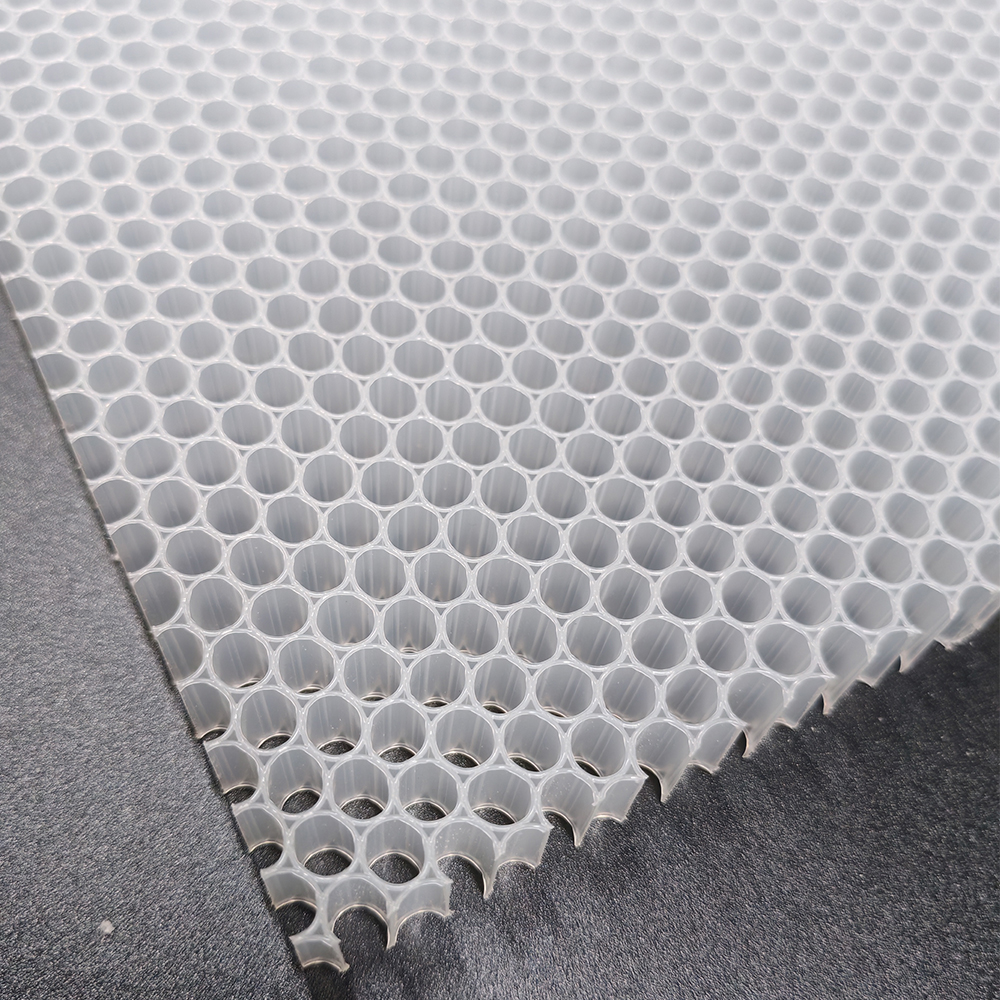
PP honeycomb core is a thermoplastic cellular material made from polypropylene.
Its main structural function is to maintain separation between the two skins while transferring shear loads through the sandwich construction.
Important core selection parameters include:
| Parameter | Why It Matters |
|---|---|
| Density | Influences core mass and mechanical performance |
| Thickness | Affects panel depth and bending stiffness |
| Cell size | Influences local support and bonding behavior |
| Compressive strength | Relevant to through-thickness loading |
| Shear strength | Relevant to sandwich-panel load transfer |
| Surface condition | Influences adhesive bonding |
| Dimensional tolerance | Affects panel thickness and manufacturing consistency |
The actual properties must be confirmed using the supplier’s technical data and suitable test methods.
2.3 Bottom FRP Skin
The bottom skin completes the sandwich structure.
Depending on the product, the two skins may have identical thicknesses or different constructions.
For example, a truck body wall panel may use a decorative or weather-resistant outer surface and a functional inner surface selected for cleaning, appearance and service conditions.
2.4 Adhesive Layer
The adhesive transfers loads between the FRP skins and the PP honeycomb core.
This is a critical manufacturing stage because polypropylene generally has low surface energy. Adhesive selection must therefore consider surface preparation, adhesive chemistry, curing conditions and production speed.
Potential bonding approaches include:
- Surface activation by corona treatment
- Plasma treatment
- Controlled flame treatment
- Compatible primer systems
- Specialized structural adhesives
- Qualified adhesive films
The selected process should be validated on the actual FRP and PP materials being used.
2.5 Edge Reinforcement
The edges of a honeycomb sandwich panel may require solid inserts or reinforced sections.
This is especially important for:
- Panel-to-panel joints
- Hinges and locks
- Screws and bolts
- Mounting brackets
- Door frames
- Structural connection points
A well-designed edge structure improves fastening reliability and helps protect the cellular core from local damage.
3. Why FRP and PP Honeycomb Are Used Together
FRP and PP honeycomb perform different functions in a sandwich panel.
| Component | Main Function | Manufacturing Consideration |
|---|---|---|
| FRP skin | Surface protection and structural contribution | Resin system, fiber content and thickness |
| PP honeycomb core | Lightweight structural spacing and shear transfer | Density, thickness and cell geometry |
| Adhesive | Transfers load between skins and core | Surface treatment and curing |
| Edge inserts | Supports fastening and connections | Insert material and placement |
| Sealant or coating | Protects joints and exposed edges | Environmental compatibility |
The combination allows panel manufacturers to design products for specific weight, stiffness, durability and cost targets.
However, the complete panel’s performance cannot be calculated by simply adding the individual component properties. Sandwich construction must be evaluated as a combined system.
4. Manufacturing Process of FRP PP Honeycomb Sandwich Panels
Step 1: Raw Material Inspection
Before production, inspect the FRP sheets and PP honeycomb core.
Check:
- Sheet thickness
- Surface quality
- Core density
- Core thickness
- Cell uniformity
- Dimensional consistency
- Material storage conditions
Poor raw material consistency can cause variations in panel weight, thickness and bonding quality.
Step 2: Core Cutting and Preparation
Cut the PP honeycomb core according to the required panel dimensions.
The cutting process should avoid unnecessary deformation of the cellular structure. Core edges should be inspected for crushed cells, uneven cuts and dimensional deviations.
Step 3: Surface Treatment
Because PP has low surface energy, bonding preparation is especially important.
The manufacturer should identify a treatment process compatible with the selected adhesive. Treatment effectiveness should be verified rather than assumed.
Step 4: Adhesive Application
Apply the adhesive according to the manufacturer’s recommended coverage, working time and curing conditions.
Insufficient adhesive may cause incomplete bonding. Excessive adhesive may increase weight and cost without necessarily improving panel performance.
Step 5: Panel Assembly
Position the top FRP skin, PP honeycomb core and bottom FRP skin.
Ensure that the core is aligned correctly and that the adhesive is distributed consistently.
Step 6: Pressing and Curing
Use an appropriate press, vacuum system or other qualified manufacturing process.
Pressure, temperature and curing time should be controlled according to the adhesive system and material compatibility. Excessive pressure can damage the core, while inadequate pressure may result in poor contact and bonding defects.
Step 7: Trimming and Edge Finishing
After curing, trim the panel to the required dimensions.
Complete edge reinforcement, sealing and any additional machining operations.
Step 8: Final Inspection
Inspect the finished panel for:
- Thickness consistency
- Surface defects
- Flatness
- Edge quality
- Bonding integrity
- Weight consistency
- Dimensional accuracy
5. Key Parameters for FRP Honeycomb Sandwich Panel Design
The following table provides a product-development framework. It is not a certified specification or a guaranteed production range.
| Design Parameter | Possible Design Options | Selection Consideration |
|---|---|---|
| FRP skin thickness | Customized | Surface durability and bending performance |
| PP honeycomb core density | Customized by grade | Weight and mechanical requirements |
| Core thickness | Customized | Panel depth and stiffness |
| Cell size | Customized | Bonding and local support |
| Panel width | According to production line | Equipment and transport limitations |
| Panel length | According to application | Truck body or trailer dimensions |
| Surface finish | Smooth, textured or coated | Appearance and service environment |
| Edge construction | Open, sealed or reinforced | Fastening and joint design |
| Adhesive system | Selected by compatibility | Bonding strength and curing process |
Manufacturers should develop a specification around the complete panel rather than selecting each component independently.
6. How to Improve Panel Weight and Structural Performance
Optimize Skin Thickness
FRP skins contribute significantly to panel mass. Increasing skin thickness may improve some mechanical properties, but it also increases weight and material cost.
Manufacturers should determine the minimum practical skin construction that satisfies the design requirements.
Select the Appropriate Core Density
Higher core density does not automatically mean better overall panel performance.
The core should be selected based on compression, shear, local loading, panel span and the required safety margin.
Optimize Panel Thickness
Increasing the distance between the two skins can improve bending stiffness in many sandwich constructions.
However, panel thickness must also be compatible with vehicle design, edge connections and available production equipment.
Improve Adhesive Efficiency
A consistent adhesive layer helps maintain bonding quality while controlling unnecessary weight.
The objective is not to use the maximum amount of adhesive, but to achieve reliable bonding under validated manufacturing conditions.
Reinforce Only Where Necessary
Hinges, locks, bolts and mounting points may require localized reinforcement.
Strategically positioned inserts can provide connection strength without adding unnecessary reinforcement throughout the entire panel.
7. Quality Control and Testing
FRP sandwich panel manufacturers should establish quality control procedures for raw materials, production processes and finished products.
| Test or Inspection | Purpose |
|---|---|
| Core density inspection | Confirms material consistency |
| Core compression test | Evaluates compressive behavior |
| Core shear test | Evaluates shear properties |
| Flatwise tensile test | Assesses through-thickness bonding and strength |
| Skin-to-core peel test | Checks bonding quality |
| Panel flexural test | Evaluates bending behavior |
| Impact test | Evaluates resistance to localized impact |
| Water absorption test | Assesses moisture-related performance |
| Environmental aging | Evaluates durability under selected conditions |
ASTM C365/C365M, C273/C273M and C393/C393M may be relevant to core and sandwich construction testing. The correct method depends on the specimen design and the property being measured.
For production qualification, manufacturers should also conduct tests on representative finished panels, not only on isolated core samples.
8. Common Manufacturing Problems and Solutions
| Manufacturing Problem | Possible Cause | Recommended Action |
|---|---|---|
| Skin-core delamination | Inadequate surface treatment or incompatible adhesive | Review surface preparation and bonding system |
| Uneven panel thickness | Inconsistent core thickness or pressing | Improve material inspection and press control |
| Crushed honeycomb cells | Excessive pressure or poor handling | Adjust pressure and handling procedures |
| Panel warping | Uneven curing or material stress | Review curing conditions and material compatibility |
| Excessive panel weight | Overuse of adhesive or excessive skin thickness | Optimize component specifications |
| Weak edge fastening | Insufficient edge reinforcement | Redesign inserts and connection details |
A stable manufacturing process depends on controlling material quality, bonding parameters and production equipment together.
9. How FRP Panel Manufacturers Should Select a PP Honeycomb Core Supplier
For commercial production, the supplier should be evaluated on more than price.
A practical supplier assessment should include:
- Product range: Availability of different densities, thicknesses and cell dimensions.
- Technical documentation: Clear specifications and test data.
- Customization: Ability to supply required sheet dimensions and processing options.
- Batch consistency: Stable material properties across repeat orders.
- Bonding support: Technical guidance on PP surface preparation.
- Production capacity: Ability to support regular bulk purchasing.
- Sample evaluation: Willingness to provide samples for panel trials.
- Communication: Reliable technical and commercial support.
For FRP sandwich panel factories, a long-term core supplier should help maintain material consistency and support continuous product improvement.
10. Frequently Asked Questions
Q1: What is an FRP PP honeycomb sandwich panel?
It is a composite panel made by bonding FRP skins to a PP honeycomb core, creating a lightweight sandwich structure for transportation and industrial applications.
Q2: Why is surface treatment necessary when bonding PP honeycomb core?
Polypropylene has low surface energy, which can make adhesive bonding difficult. Suitable surface activation or a compatible bonding system is generally required.
Q3: Can PP honeycomb core be used in continuous FRP panel production?
It may be suitable for selected production systems, but equipment compatibility, adhesive curing, material handling and process speed should be evaluated through production trials.
Q4: What affects the weight of an FRP honeycomb sandwich panel?
The main factors include FRP skin thickness, resin and fiber content, core density and thickness, adhesive quantity, edge reinforcement and additional fittings.
Q5: How can manufacturers improve FRP sandwich panel quality?
They should control raw material consistency, surface preparation, adhesive application, pressing conditions, curing and finished-panel inspection.
11. Conclusion
FRP PP honeycomb sandwich panel manufacturing requires coordinated material selection and process control.
The FRP skins provide surface and structural contributions, the PP honeycomb core creates a lightweight cellular structure, and the adhesive system connects the components into one integrated panel.
For FRP sandwich panel manufacturers, the most important factors are reliable skin-to-core bonding, consistent core quality, suitable edge reinforcement and complete panel testing.
Selecting an experienced PP honeycomb core manufacturer can help composite panel factories develop customized products and maintain stable production quality.
