
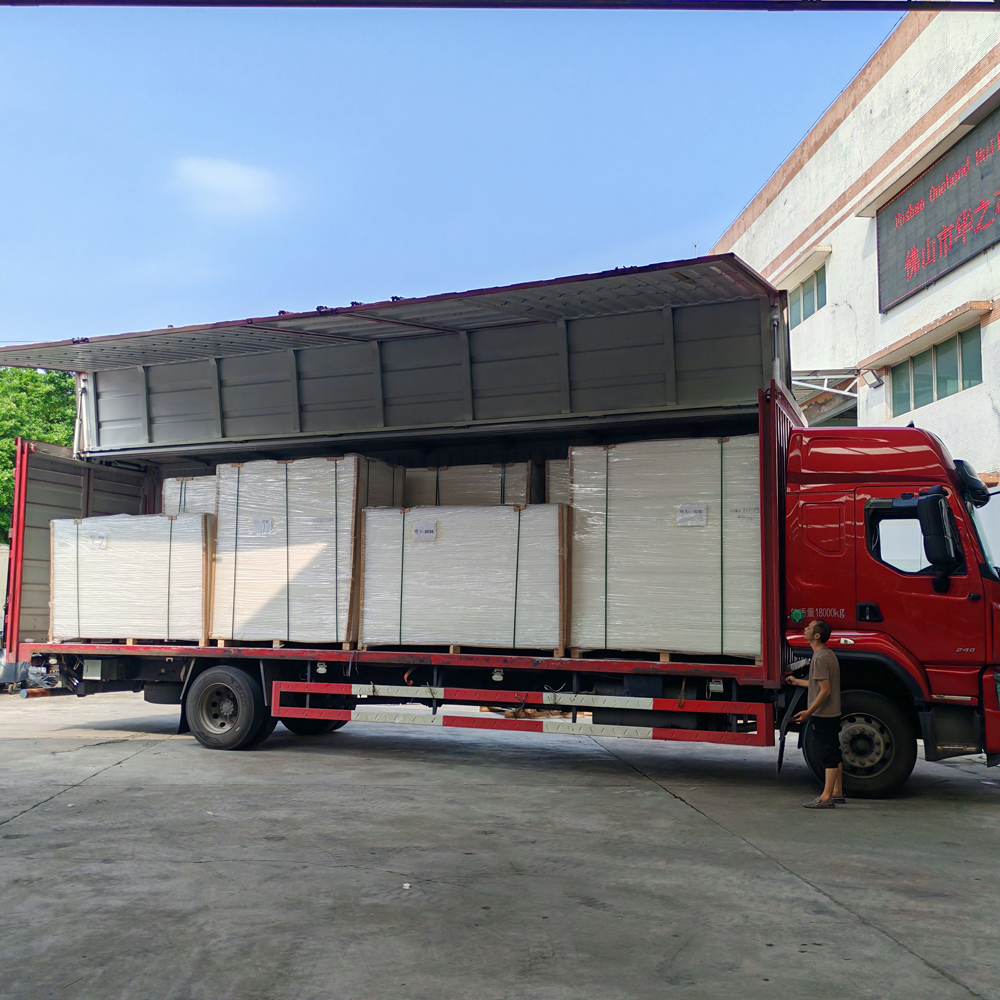
1. Introduction: Why Lightweight Materials Matter in Truck Body Manufacturing
Weight reduction is an important consideration in modern truck body manufacturing. Truck body manufacturers and commercial vehicle producers are constantly looking for materials that can reduce vehicle body weight without compromising structural performance, durability or operational reliability.
Traditional materials such as plywood, solid aluminum sheets and steel structures are widely used in truck body construction. However, these materials can increase overall vehicle weight, require additional structural support or create maintenance challenges.
Lightweight composite sandwich panels provide an alternative. By combining high-strength surface materials with a lightweight core, manufacturers can produce panels with a favorable strength-to-weight ratio.
A typical PP honeycomb sandwich panel consists of:
- FRP or fiberglass surface sheets
- PP honeycomb core
- Structural adhesive layer
- Optional reinforcement materials and edge inserts
This structure is suitable for truck body walls, doors, roofs, partitions and other composite components, depending on the required mechanical properties and panel design.
For truck body composite panel factories, selecting the right core material and surface combination is essential for achieving consistent production quality.
2. Complete Structure of a PP Honeycomb Truck Body Panel
A sandwich panel is not simply a core material covered with two sheets. Its performance depends on the interaction between the skins, core, adhesive and connection details.
2.1 FRP Surface Sheets
FRP (Fiber Reinforced Plastic), also known as fiberglass reinforced plastic, is commonly used as a surface material in lightweight composite panels.
The FRP skins provide:
- Surface hardness and protection
- Resistance to moisture and corrosion
- Abrasion resistance, depending on resin and surface finish
- A smooth or textured decorative surface
- A load-bearing contribution through the sandwich structure
FRP surface sheets are available in different thicknesses, colors, textures and resin systems.
For truck body manufacturers, the selection of FRP skins should consider impact resistance, UV exposure, cleaning requirements, surface appearance and bonding compatibility.
2.2 PP Honeycomb Core
PP honeycomb core is a lightweight thermoplastic core material featuring a cellular structure.
Its honeycomb geometry provides separation between the two surface skins while supporting shear transfer through the core. This structural arrangement helps the finished panel achieve bending stiffness with relatively low material mass.
Typical characteristics include:
- Low density compared with many solid construction materials
- Cellular structure with a high void fraction
- Moisture resistance
- Corrosion resistance
- Good processability
- Potential for customized thickness and cell dimensions
The actual mechanical performance depends on core density, cell geometry, thickness, orientation, manufacturing quality and the finished panel design.
2.3 Adhesive Bonding Layer
The adhesive layer connects the FRP skins to the PP honeycomb core.
Bonding is particularly important because PP has relatively low surface energy. Standard adhesives may not achieve reliable bonding without appropriate surface preparation or a compatible bonding system.
Possible solutions include:
- Corona or plasma surface treatment
- Flame treatment where appropriate and controlled
- Compatible primers
- Specialized structural adhesives
- Film adhesives or other qualified bonding systems
Manufacturers should validate the selected adhesive system through peel, flatwise tensile and other relevant tests.
2.4 Edge Reinforcement and Embedded Inserts
Honeycomb cores are lightweight, but their cellular structure does not automatically provide sufficient fastening strength at every connection point.
For truck body doors, hinges, locks, mounting points and panel joints, manufacturers may need:
- Solid polymer inserts
- Plywood or composite inserts
- Metal reinforcement profiles
- High-density foam inserts
- Locally reinforced core sections
These details are especially important for panels exposed to repeated opening, closing, vibration and impact loads.
3. How PP Honeycomb Sandwich Panels Reduce Truck Body Weight
The main weight-saving principle is structural efficiency.
In a sandwich panel, the two surface skins are separated by a lightweight core. This increases the distance between the skins and can improve bending stiffness without requiring a solid material throughout the panel thickness.
For a truck body manufacturer, the weight of a finished panel is determined by the mass of all its components:
[
M_{\text{panel}}=M_{\text{skin 1}}+M_{\text{core}}+M_{\text{skin 2}}+M_{\text{adhesive}}+M_{\text{reinforcement}}
]
A lightweight core can reduce the material mass in the middle of the panel while maintaining the required structural configuration.
However, weight reduction should be evaluated at the complete panel level, not by comparing core densities alone.
Example of Panel Weight Calculation
The following example is illustrative only. It is not a certified product specification.
| Component | Example Configuration | Weight Calculation |
|---|---|---|
| FRP top skin | 1.5 mm, 1,800 kg/m³ | 2.70 kg/m² |
| PP honeycomb core | 15 mm, 80 kg/m³ | 1.20 kg/m² |
| FRP bottom skin | 1.5 mm, 1,800 kg/m³ | 2.70 kg/m² |
| Adhesive | Estimated 0.50 kg/m² | 0.50 kg/m² |
| Total | 18 mm sandwich panel | 7.10 kg/m² |
Actual finished panel weight will vary with FRP resin content, fiber reinforcement, core density, adhesive application, edge inserts and manufacturing tolerances.
Manufacturers should compare complete panels with the same dimensions, thickness, loading conditions and performance requirements.
4. Applications in Truck Body Manufacturing
Truck Body Side Walls
Lightweight FRP and PP honeycomb sandwich panels can be used for side walls where low weight, moisture resistance and surface durability are important.
Panel thickness and skin specifications should be selected according to the vehicle dimensions, support spacing and expected service loads.
Truck Body Roof Panels
Roof panels may require low weight, weather resistance and sufficient stiffness across the supporting structure.
The complete roof design should consider water drainage, joint sealing, UV exposure, wind loading and mounting details.
Truck Body Rear Doors
Rear doors experience repeated operating loads and localized stresses around hinges, locking systems and handles.
Reinforced inserts and edge details are therefore essential. A lightweight core should be combined with suitable local reinforcement rather than relying on the honeycomb structure alone.
Internal Partitions
PP honeycomb sandwich panels can also be considered for internal partitions and compartment dividers where low weight and easy cleaning are required.
5. PP Honeycomb Core vs Other Core Materials
Truck body panel manufacturers may compare PP honeycomb with PVC foam, PET foam, plywood and aluminum honeycomb.
| Core Material | Main Characteristics | Considerations for Manufacturers |
|---|---|---|
| PP Honeycomb | Lightweight cellular thermoplastic structure | Bonding preparation and insert design are important |
| PVC Foam | Closed-cell rigid foam with established composite applications | Density, resin compatibility and fire requirements need evaluation |
| PET Foam | Thermoplastic foam core with recyclable material options | Grade, density and processing compatibility vary |
| Plywood | Solid wood-based panel material | Higher moisture sensitivity and weight may be concerns |
| Aluminum Honeycomb | High stiffness-to-weight potential | Requires suitable bonding, corrosion control and edge treatment |
No single core material is suitable for every truck body application. Selection should be based on panel-level mechanical performance, processing conditions, cost and service environment.
6. Manufacturing Process for FRP PP Honeycomb Sandwich Panels
A typical manufacturing workflow includes:
- Material preparation: Prepare FRP skins, PP honeycomb core, adhesive and reinforcement inserts.
- Core cutting: Cut the PP honeycomb core to the required panel dimensions and thickness.
- Surface preparation: Apply the required treatment to the bonding surfaces.
- Adhesive application: Apply a compatible adhesive at the specified coverage and thickness.
- Panel assembly: Position the top skin, core and bottom skin accurately.
- Pressing and curing: Use an appropriate pressing system and curing conditions.
- Edge finishing: Install edge reinforcement and complete trimming and sealing.
- Quality inspection: Check dimensions, flatness, bonding quality and relevant mechanical properties.
The exact process depends on the adhesive chemistry, FRP skin construction, production equipment and panel specifications.
7. Important Quality Tests for Truck Body Composite Panels
A professional truck body panel manufacturer should evaluate the complete sandwich panel rather than relying only on core material data.
Relevant testing may include:
| Test | What It Evaluates |
|---|---|
| Flatwise tensile test | Bonding and through-thickness strength |
| Core shear test | Shear performance of the core |
| Flexural test | Bending behavior of the complete panel |
| Peel or bond test | Skin-to-core bonding quality |
| Impact test | Resistance to localized impact |
| Water absorption test | Moisture-related behavior |
| Dimensional inspection | Thickness, length, width and flatness |
| Environmental aging | Performance after temperature and moisture exposure |
ASTM C365/C365M, ASTM C273/C273M and ASTM C393/C393M are examples of relevant sandwich-core and sandwich-construction test methods. The applicable method should be selected according to the material system and test objective.
8. How to Select a PP Honeycomb Core Supplier
For truck body composite panel factories, choosing a core supplier is not simply a matter of comparing price per square meter.
Important purchasing considerations include:
- Density options: Confirm available densities and acceptable tolerances.
- Thickness range: Check whether the supplier can meet the required panel design.
- Cell dimensions: Evaluate the relationship between cell size and the intended panel structure.
- Mechanical properties: Request technical data for compression and shear performance.
- Surface compatibility: Confirm the treatment and bonding method required for PP.
- Dimensional stability: Evaluate thickness consistency and flatness.
- Cutting and customization: Confirm available sheet sizes and custom processing.
- Production capacity: Ensure stable supply for repeated bulk orders.
- Technical support: Ask for assistance with material selection and panel development.
A reliable PP honeycomb core manufacturer should be able to provide product specifications, samples and technical support for composite panel development.
9. Frequently Asked Questions
Q1: What is PP honeycomb sandwich panel used for in truck body manufacturing?
It can be used for truck body side walls, roof panels, rear doors, internal partitions and other lightweight composite components, subject to the required structural design.
Q2: Can PP honeycomb core be bonded with FRP sheets?
Yes. However, polypropylene has low surface energy, so suitable surface treatment and a compatible adhesive system are generally required to achieve reliable bonding.
Q3: How does PP honeycomb core reduce truck body weight?
Its cellular structure reduces the amount of material used in the panel core while allowing the two surface skins to remain separated, which can improve bending stiffness relative to a solid construction.
Q4: Can manufacturers customize PP honeycomb core thickness and density?
Customization depends on the supplier’s production capabilities. Buyers should confirm available thicknesses, densities, cell dimensions and sheet sizes before ordering.
Q5: Is a PP honeycomb panel suitable for heavy-duty truck floors?
It may be suitable for selected floor designs, but concentrated loads, wheel loads, support spacing, impact and local reinforcement must be evaluated through engineering calculations and testing.
10. Conclusion
Lightweight PP honeycomb sandwich panels offer truck body manufacturers an opportunity to develop composite structures with reduced material mass and customized performance.
The key is to optimize the complete panel structure: FRP skins, PP honeycomb core, adhesive bonding, edge reinforcement and connection details.
For truck body composite panel factories, selecting a consistent PP honeycomb core supplier and validating the finished panel through appropriate testing are essential steps toward stable, repeatable production.
