
1. Introduction: The Growing Demand for Lightweight Truck Body and Trailer Panels
Lightweight construction has become an important consideration in truck body and trailer manufacturing.
Commercial vehicle manufacturers are continuously evaluating ways to reduce vehicle body weight while maintaining structural performance, durability, and operational efficiency.
Traditional truck body construction may use plywood, solid boards, metal sheets, or other conventional panel materials. These materials can be suitable for many applications, but their weight, moisture behavior, maintenance requirements, and manufacturing characteristics may limit their suitability for certain lightweight vehicle body designs.
As composite manufacturing technology develops, sandwich panels are increasingly considered for selected truck body and trailer applications.
Among the available core materials, PP honeycomb core, also known as polypropylene honeycomb core, offers a lightweight cellular structure that can be incorporated into different composite panel configurations.
When combined with suitable facing materials such as fiberglass reinforced plastic (FRP), aluminum sheet, or other engineered skins, PP honeycomb core can be used to manufacture lightweight sandwich panels for selected vehicle body components.
Potential applications include:
- Truck body side panels
- Trailer wall panels
- Lightweight cargo body panels
- Truck body doors
- Trailer roof panels
- Interior partition panels
- Selected flooring systems
- Customized composite panels for commercial vehicles
However, the suitability of PP honeycomb core depends on the requirements of the complete panel.
Panel stiffness, core shear strength, compression resistance, skin-to-core bonding, impact resistance, fastening details, and environmental exposure must all be considered during material selection.
This guide explains the properties, benefits, applications, manufacturing considerations, and purchasing requirements associated with PP honeycomb core for truck body and trailer sandwich panel manufacturing.
2. What Is PP Honeycomb Core?
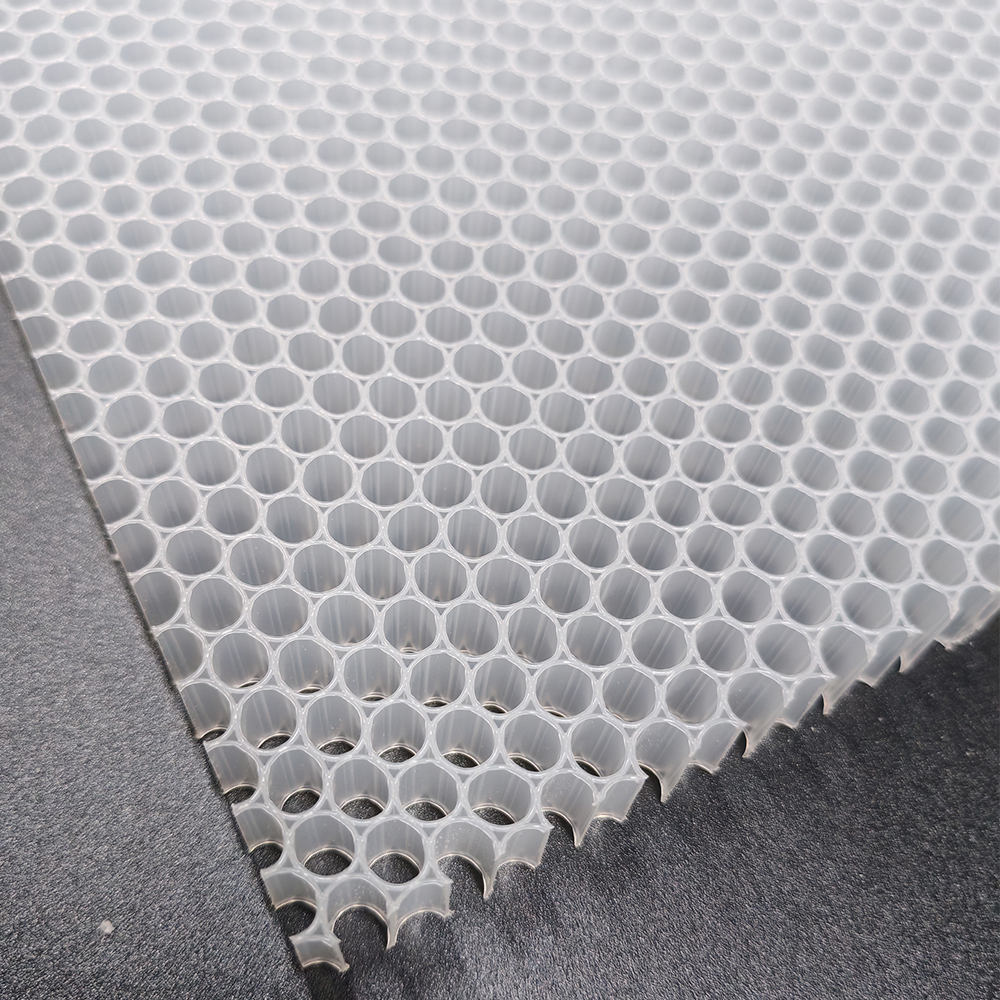
PP honeycomb core is a lightweight core material made from polypropylene, a thermoplastic polymer.
Its internal structure consists of interconnected cellular walls arranged in a honeycomb configuration.
This geometry creates a lightweight cellular structure that can support the facing materials of a sandwich panel.
Unlike a solid plastic sheet, PP honeycomb core uses a cellular structure to reduce material consumption while providing internal support.
The core’s actual mechanical performance depends on its density, cell geometry, wall thickness, polymer formulation, manufacturing quality, and loading direction.
2.1 How Does PP Honeycomb Core Work in a Sandwich Panel?
A typical truck body sandwich panel contains three principal layers:
- Upper facing material.
- PP honeycomb core.
- Lower facing material.
The facing materials provide much of the panel’s tensile and compressive resistance under bending.
The core maintains the separation between the skins and transfers shear loads through the sandwich structure.
When appropriately designed, this configuration can provide favorable bending stiffness relative to panel weight.
For example, an FRP-faced PP honeycomb sandwich panel may consist of:
- An outer FRP skin.
- A polypropylene honeycomb core.
- An inner FRP skin.
The outer surface can be selected according to appearance, weather exposure, cleaning requirements, and mechanical performance.
The inner surface can be designed for cargo protection, interior durability, or other application requirements.
2.2 Typical PP Honeycomb Sandwich Panel Configurations
| Panel Structure | Facing Materials | Potential Applications |
|---|---|---|
| FRP + PP Honeycomb + FRP | Fiberglass reinforced plastic | Lightweight truck body walls |
| Aluminum + PP Honeycomb + Aluminum | Aluminum sheet | Selected lightweight vehicle panels |
| FRP + PP Honeycomb + Aluminum | FRP and aluminum | Customized composite panels |
| Decorative Skin + PP Honeycomb + FRP | Decorative facing and FRP | Interior truck body panels |
| Wear-Resistant Skin + PP Honeycomb + FRP | Specialized surface and FRP | Selected cargo panel applications |
These configurations are examples rather than universal product specifications. Each design requires evaluation of skin properties, adhesive compatibility, core performance, and the intended loading conditions.
3. Why Lightweight Materials Matter in Truck Body Manufacturing
Vehicle body weight influences payload capacity, energy consumption, vehicle handling, and operating economics.
For commercial transport operators, reducing unnecessary body weight may create opportunities to increase payload within applicable legal limits or reduce the energy required to transport a given load.
The actual benefit depends on the vehicle type, operating route, cargo, powertrain, and vehicle design.
3.1 Payload Efficiency
The gross vehicle weight rating and other applicable legal limits restrict the total operating weight of a commercial vehicle.
A lighter body may leave more of the permitted weight available for cargo, provided that axle limits, load distribution, and other regulatory requirements are satisfied.
For example, reducing the weight of a truck body or trailer panel system may allow a manufacturer to optimize the balance between body weight and cargo capacity.
However, the benefit must be evaluated at the vehicle-system level. Panel weight reduction alone does not establish a specific payload increase.
3.2 Fuel and Energy Efficiency
A lighter vehicle may require less energy to accelerate and operate under certain conditions.
The effect on fuel consumption depends on factors such as:
- Vehicle mass.
- Driving cycle.
- Road gradient.
- Average speed.
- Aerodynamic drag.
- Tire resistance.
- Powertrain efficiency.
- Cargo weight.
Consequently, PP honeycomb panels should be evaluated as one component of a broader vehicle lightweighting strategy.
3.3 Easier Handling and Installation
Lightweight panels can also offer manufacturing and maintenance benefits.
Depending on panel dimensions and construction, they may reduce the effort required for handling, installation, and replacement.
Potential benefits include:
- Easier movement of large panels.
- Reduced manual handling effort.
- More flexible panel design.
- Opportunities for prefabricated components.
- Potentially lower installation labor.
Actual handling benefits depend on panel size, rigidity, edge design, and the equipment used during assembly.
4. Main Benefits of PP Honeycomb Core for Truck Body and Trailer Panels
PP honeycomb core offers several characteristics that may be useful in lightweight composite panel manufacturing.
The benefits should be evaluated against the mechanical and environmental requirements of the intended application.
4.1 Lightweight Cellular Structure
The honeycomb structure provides internal support without requiring a solid core throughout the panel thickness.
This can help reduce the material mass of the panel compared with certain solid-board constructions.
For truck body manufacturers, lower panel mass may support vehicle lightweighting objectives.
However, the complete panel weight depends on the core, skins, adhesive, reinforcement, surface finish, and hardware.
4.2 Low Water Absorption of Polypropylene
Polypropylene has low water absorption.
This characteristic may be beneficial in vehicle body panels exposed to rain, humidity, washing water, or occasional moisture.
Nevertheless, the moisture resistance of a finished PP honeycomb sandwich panel also depends on the skins, adhesive, joints, edges, and fastener penetrations.
A panel with exposed or poorly sealed edges may still allow moisture to enter the assembly.
4.3 Design Flexibility
PP honeycomb core can be incorporated into different sandwich panel designs.
Depending on the manufacturer’s capabilities, the core may be available in different densities, thicknesses, cell sizes, and sheet dimensions.
This flexibility can support customized panel manufacturing for different truck body and trailer configurations.
4.4 Compatibility with Composite Facing Materials
PP honeycomb core can be used in sandwich structures with suitable facing materials, including FRP.
FRP skins can provide corrosion resistance and different surface finishes, depending on the resin system and laminate design.
However, polypropylene has relatively low surface energy. A suitable bonding system and, where necessary, surface treatment should be validated before production.
4.5 Potential for Prefabricated Panel Production
Sandwich panels can be manufactured as prefabricated components before installation into the vehicle body.
This can help manufacturers standardize panel dimensions, surface finishes, and assembly processes.
Production consistency depends on core quality, skin preparation, adhesive application, pressing conditions, and inspection procedures.
5. PP Honeycomb Core for Truck Body Wall Panels
Truck body walls protect cargo and form part of the vehicle’s enclosure.
Depending on the vehicle design, side walls and front walls may need to resist wind pressure, vibration, handling impacts, cargo contact, and environmental exposure.
PP honeycomb sandwich panels may be considered for selected wall panel applications where the complete structure meets the required performance.
5.1 FRP PP Honeycomb Panels for Truck Body Walls
An FRP-faced PP honeycomb panel combines a lightweight cellular core with composite outer skins.
Potential advantages include:
- Reduced panel weight compared with some solid-board constructions.
- Corrosion-resistant FRP facing options.
- Flexible panel dimensions.
- Different exterior surface finishes.
- Potential for customized panel structures.
For exterior truck body walls, manufacturers should evaluate UV exposure, weather resistance, surface durability, and edge sealing.
5.2 Important Design Considerations
Truck body wall panels should not be selected according to core density alone.
Important design factors include:
- Panel dimensions.
- Unsupported span.
- Wind pressure.
- Vibration.
- Impact exposure.
- Skin thickness.
- Core shear strength.
- Fastener and joint design.
- Required service life.
The wall panel must also be compatible with the vehicle body’s frame and connection system.
For applications involving high impact loads or structural vehicle-body requirements, the complete assembly should be verified by engineering analysis and appropriate testing.
6. PP Honeycomb Sandwich Panels for Trailer Manufacturing
Trailer manufacturers often seek lightweight panels that can be integrated into standardized or customized vehicle body structures.
Potential applications include:
- Box trailer walls.
- Cargo trailer side panels.
- Trailer front walls.
- Trailer roof panels.
- Interior partitions.
- Selected access panels.
- Customized composite enclosure panels.
The appropriate panel structure depends on the trailer’s dimensions, payload, operating environment, cargo type, and structural requirements.
6.1 Box Trailer Wall Panels
Box trailer wall panels may require a balance of weight, stiffness, durability, and appearance.
PP honeycomb sandwich panels can be considered when their mechanical properties meet the relevant loading requirements.
For large wall panels, designers should consider:
- Panel deflection.
- Frame spacing.
- Skin stiffness.
- Core shear behavior.
- Connection strength.
- Damage caused by cargo movement.
- Water ingress at panel joints.
6.2 Trailer Roof Panels
Trailer roof panels may be exposed to rain, sunlight, temperature changes, and wind loading.
For roof applications, the finished panel should be evaluated for weather resistance, water management, panel deflection, and attachment strength.
The PP honeycomb core’s low water absorption does not eliminate the need for proper roof joints, drainage, and edge sealing.
6.3 Specialized Trailer Applications
Different trailer types have different requirements.
A general cargo trailer may prioritize weight and durability. A refrigerated trailer requires insulation and thermal performance. A chemical transport trailer may require specialized materials and compliance.
PP honeycomb core should not automatically be considered a replacement for every conventional trailer core.
For refrigerated trailers, thermal conductivity and insulation performance are critical. For heavy-duty flooring, compression, impact, and concentrated-load performance are essential.
Material selection must reflect the actual operating requirements.
7. PP Honeycomb Core for Truck Body Doors and Access Panels
Truck body doors and access panels are frequently opened, closed, handled, and exposed to localized loads.
Their design must account for hinges, latches, fasteners, edge reinforcement, and repeated operating cycles.
PP honeycomb sandwich panels may be suitable for selected lightweight door constructions, provided that the connection areas are properly designed.
7.1 Why Door Design Requires Special Attention
The edges of a sandwich panel can be more vulnerable than the central panel area.
Hinges and latches introduce localized loads that may exceed the capacity of the core if appropriate reinforcement is not provided.
Possible design solutions include:
- Reinforced edge sections.
- Embedded inserts.
- Local solid-core regions.
- Reinforcement plates.
- Dedicated hinge and latch mounting structures.
The correct solution depends on the door size, hardware, opening frequency, and expected loads.
7.2 Important Tests for Truck Body Doors
For customized truck body doors, manufacturers should consider:
- Hinge attachment strength.
- Latch attachment strength.
- Local compression.
- Panel bending.
- Repeated opening and closing.
- Impact resistance.
- Water ingress around the perimeter.
These tests should be performed on representative finished panels and connection assemblies.
8. Can PP Honeycomb Core Be Used for Trailer Flooring?
PP honeycomb core can be incorporated into selected lightweight flooring sandwich panels, but flooring applications require careful engineering.
Truck and trailer floors may experience concentrated wheel loads, pallet loads, forklift traffic, cargo movement, and repeated impact.
A panel suitable for an interior wall may not be suitable for a load-bearing floor.
8.1 Flooring Performance Requirements
Important requirements may include:
- Compression strength.
- Core shear strength.
- Flexural stiffness.
- Maximum allowable deflection.
- Impact resistance.
- Surface abrasion resistance.
- Fastener retention.
- Edge durability.
- Resistance to repeated loading.
For example, a flooring panel intended only for light cargo handling may have different requirements from a floor exposed to forklift traffic.
8.2 Why Core Density Is Not Enough
A higher-density PP honeycomb core may offer improved performance in some configurations, but the relationship between density and mechanical properties is grade-dependent.
Flooring performance depends on the entire panel construction, including the skins and support arrangement.
The design should account for concentrated loading, local reinforcement, and the actual contact area of wheels or cargo supports.
For heavy-duty flooring, manufacturers should compare PP honeycomb core with alternative core materials and validate the complete panel through appropriate tests.
9. Technical Parameters of PP Honeycomb Core for Truck Body Panels
When purchasing PP honeycomb core, manufacturers should request a technical data sheet that identifies the actual material grade and its measured properties.
The following table lists common specification categories.
9.1 PP Honeycomb Core Technical Specification
| Parameter | Unit or Description | Importance |
|---|---|---|
| Core Material | Polypropylene | Identifies the base polymer |
| Core Density | kg/m³ | Influences weight and mechanical performance |
| Core Thickness | mm | Affects panel geometry and stiffness |
| Cell Size | mm or defined geometric dimension | Influences structural and processing characteristics |
| Compression Strength | MPa | Relevant to local compression |
| Shear Strength | MPa | Relevant to sandwich-panel load transfer |
| Shear Modulus | MPa | Influences shear deformation |
| Water Absorption | % or agreed test result | Helps assess moisture behavior |
| Surface Treatment | Treatment type or untreated | Relevant to adhesive compatibility |
| Sheet Dimensions | mm | Determines manufacturing format |
| Dimensional Tolerance | mm or percentage | Important for production consistency |
| Color | As supplied or customized | Identification and production requirements |
Mechanical values should be provided by the manufacturer for the specific grade. Generic values should not be treated as certified specifications.
9.2 Finished Truck Body Sandwich Panel Specification
| Parameter | Specification Description |
|---|---|
| Panel Structure | FRP + PP Honeycomb + FRP, or another designed configuration |
| Panel Thickness | Customized according to design |
| Core Thickness | Selected according to application |
| Skin Material | FRP, aluminum, or other compatible facing |
| Skin Thickness | Determined by engineering requirements |
| Panel Length and Width | Customized |
| Finished Panel Weight | kg/m² |
| Flexural Performance | Verified through suitable testing |
| Core Shear Performance | Verified through suitable testing |
| Bonding Performance | Verified for the selected adhesive system |
| Surface Finish | Smooth, textured, or customized |
| Edge Treatment | Sealed or reinforced according to design |
| Environmental Requirements | Based on the vehicle’s operating conditions |
10. Manufacturing Process of PP Honeycomb Truck Body Panels
Manufacturing quality is essential for reliable PP honeycomb sandwich panels.
A typical production workflow may include the following stages.
Step 1: Core Material Inspection
Inspect the PP honeycomb core for:
- Thickness consistency.
- Surface flatness.
- Cell structure uniformity.
- Visible damage.
- Contamination.
- Dimensional accuracy.
Step 2: Surface Preparation
Because polypropylene has relatively low surface energy, the core’s bonding surface may require treatment.
Possible methods include corona treatment, plasma treatment, flame treatment, primer systems, or other validated processes.
The appropriate method depends on the core grade and adhesive system.
Step 3: Skin Preparation
Prepare the selected facing materials.
For FRP skins, inspect the laminate thickness, surface condition, dimensions, and compatibility with the intended adhesive.
Step 4: Adhesive Application
Apply a suitable adhesive according to the validated manufacturing procedure.
Important controls include:
- Adhesive quantity.
- Coverage uniformity.
- Working time.
- Curing conditions.
- Compatibility with both core and skins.
Step 5: Panel Assembly
Position the skins and PP honeycomb core according to the panel design.
Ensure correct alignment and avoid core displacement.
Step 6: Pressing and Curing
Use an appropriate pressing or consolidation method.
Pressure should be controlled to achieve consistent bonding without crushing or damaging the core.
Step 7: Cutting and Edge Finishing
Cut the finished panel to the specified dimensions.
Seal or reinforce the edges according to the application.
For door panels, add the required inserts or reinforced regions for hinges and latches.
Step 8: Quality Inspection
Inspect the finished panels for:
- Thickness.
- Flatness.
- Surface defects.
- Dimensional accuracy.
- Weight per square meter.
- Bonding quality.
- Mechanical performance.
- Edge quality.
For exterior panels, the inspection plan should also address weather exposure and water ingress.
11. Quality Testing for PP Honeycomb Truck Body and Trailer Panels
The required test program depends on the application and applicable engineering requirements.
The following standards may be relevant to evaluating sandwich core materials and composite sandwich constructions.
| Standard | General Test Subject | Potential Relevance |
|---|---|---|
| ASTM C365/C365M | Flatwise compressive properties of sandwich cores | Core compression behavior |
| ASTM C273/C273M | Shear properties of sandwich core materials | Core shear behavior |
| ASTM C393/C393M | Core shear properties of sandwich constructions by beam flexure | Sandwich panel behavior |
| ASTM D7249/D7249M | Facing properties of sandwich constructions by long-beam flexure | Facing behavior under bending |
| ASTM D7766/D7766M | Damage resistance of sandwich constructions | Impact-related damage evaluation |
The applicable standard edition and specimen configuration should be confirmed with the testing laboratory.
Depending on the vehicle application, additional testing may be required for:
- Repeated loading.
- Vibration.
- Impact resistance.
- Water exposure.
- Temperature cycling.
- Fastener retention.
- Door hinge durability.
- Surface abrasion.
A test report for the core alone does not establish the performance of the finished truck body panel.
12. PP Honeycomb Core vs Other Core Materials for Truck Body Manufacturing
PP honeycomb core is one of several materials used in lightweight composite manufacturing.
The appropriate selection depends on the finished panel’s requirements.
12.1 PP Honeycomb Core vs PVC Foam Core
| Comparison Factor | PP Honeycomb Core | PVC Foam Core |
|---|---|---|
| Structure | Geometric honeycomb cells | Cellular foam |
| Weight | Depends on grade and geometry | Depends on grade and density |
| Compression Performance | Grade- and geometry-dependent | Grade-dependent |
| Shear Performance | Depends on cell structure and material | Depends on foam structure and formulation |
| Water Absorption | Generally low for PP | Generally low for suitable closed-cell grades |
| Bonding | May require surface treatment | Depends on foam surface and adhesive |
| Machining | Requires suitable cutting and edge design | Commonly machinable |
| Potential Applications | Lightweight panel structures | Sandwich panels requiring suitable foam-core properties |
12.2 PP Honeycomb Core vs Plywood
Plywood is used in many conventional truck body constructions.
Its advantages can include ease of machining and straightforward fastening.
However, weight, moisture protection, and long-term durability should be considered for the specific plywood grade and construction.
PP honeycomb sandwich panels use a different structural approach, combining a cellular core with outer skins.
They may provide weight-saving opportunities, but they require suitable bonding, edge treatment, and hardware reinforcement.
12.3 PP Honeycomb Core vs Aluminum Honeycomb Core
Aluminum honeycomb core is used in various lightweight sandwich structures.
Its mechanical properties, corrosion considerations, processing requirements, and cost structure differ from those of PP honeycomb core.
PP honeycomb core may be considered when a polymer-based cellular core is appropriate for the application.
Aluminum honeycomb may be considered where its specific stiffness, temperature behavior, or engineering characteristics are required.
The selection should be based on finished-panel testing and the intended service conditions.
13. How to Select the Right PP Honeycomb Core for Truck Body Manufacturing
A practical selection process should begin with the finished panel’s requirements rather than the core material alone.
Step 1: Define the Application
Identify whether the panel will be used for:
- Truck body walls.
- Trailer walls.
- Roof panels.
- Doors.
- Interior partitions.
- Flooring.
- Equipment access panels.
Different applications require different mechanical properties.
Step 2: Define the Design Loads
Identify the expected loads, including bending, local compression, impact, vibration, and repeated loading.
For flooring panels, define the concentrated loads and support spacing.
For doors, define the hinge and latch requirements.
Step 3: Select the Facing Materials
Choose the outer skins according to the required mechanical performance, weather resistance, surface finish, and manufacturing process.
Step 4: Select Core Density and Thickness
Compare available grades using measured mechanical properties.
Do not assume that the highest density or greatest thickness is always the best option.
Step 5: Confirm Bonding Compatibility
Verify that the core, adhesive, and skins form a suitable bonding system.
Conduct representative production trials before mass production.
Step 6: Evaluate Finished-Panel Weight
Calculate and measure the complete panel weight.
Include the core, skins, adhesive, reinforcements, coatings, and other components.
Step 7: Conduct Application-Specific Testing
Test the complete panel under representative conditions.
For example, a wall panel and a floor panel should not automatically use the same test program.
Step 8: Compare Total Manufacturing Cost
Consider material price, production efficiency, scrap rate, installation requirements, and expected service life.
This approach provides a more useful purchasing decision than comparing core price alone.
14. Common Purchasing Mistakes When Buying PP Honeycomb Core
Mistake 1: Choosing Material by Density Alone
Density does not fully describe mechanical performance.
Recommendation: Request grade-specific compression and shear data.
Mistake 2: Ignoring Bonding Requirements
PP honeycomb core may require surface treatment or a compatible adhesive system.
Recommendation: Validate bonding before production.
Mistake 3: Comparing Core Weight Instead of Finished Panel Weight
Skins, adhesives, reinforcement, and surface treatments contribute to the final mass.
Recommendation: Compare complete panel weight in kg/m².
Mistake 4: Using Wall Panel Specifications for Flooring
Flooring panels may experience much higher concentrated loads.
Recommendation: Define the application and test the complete flooring assembly.
Mistake 5: Overlooking Fastener and Edge Design
Door hinges, latches, and panel joints introduce localized loads.
Recommendation: Design suitable edge reinforcement and inserts.
Mistake 6: Assuming All PP Honeycomb Panels Are Waterproof
Water may enter through damaged skins, joints, and exposed edges.
Recommendation: Define edge sealing and environmental requirements.
Mistake 7: Treating All Trailer Applications as Equivalent
General cargo trailers, refrigerated trailers, and specialized transport vehicles have different performance requirements.
Recommendation: Match the panel structure to the actual operating conditions.
15. How to Choose a Reliable PP Honeycomb Core Manufacturer
For truck body and trailer panel manufacturers, supplier selection affects material consistency and production reliability.
A qualified supplier should provide clear technical information and support application-specific evaluation.
15.1 Technical Documentation
Request:
- Technical data sheets.
- Density and thickness specifications.
- Cell size information.
- Compression and shear data.
- Dimensional tolerances.
- Surface treatment information.
- Available test reports.
- Sample material for production trials.
15.2 Production Capability
Evaluate whether the supplier can provide:
- Consistent material quality.
- Customized thicknesses.
- Different density options.
- Required sheet dimensions.
- Bonding surface treatment.
- Stable production capacity.
- Suitable packaging.
- Long-term supply support.
15.3 Sample Validation
Before bulk purchasing, produce representative panels using the intended skins, adhesive, and manufacturing process.
Evaluate the panel’s weight, bonding quality, dimensional accuracy, and mechanical behavior.
This is particularly important when introducing PP honeycomb core into an existing truck body or trailer production line.
16. Frequently Asked Questions About PP Honeycomb Core for Truck Body and Trailer Manufacturing
Q1: What Is PP Honeycomb Core Used for in Truck Body Manufacturing?
PP honeycomb core can be used in selected lightweight composite panels for truck body walls, trailer walls, doors, roofs, interior partitions, and other applications where the finished panel meets the required performance.
Its suitability depends on the panel structure, facing materials, bonding system, loading conditions, and environmental exposure.
Q2: Can PP Honeycomb Panels Reduce Truck Body Weight?
PP honeycomb sandwich panels can reduce weight compared with some solid-board constructions.
The actual weight reduction depends on the complete panel design, including core density, core thickness, skin materials, adhesive, and reinforcement.
A reliable comparison requires finished-panel weight measurements for equivalent performance requirements.
Q3: Can PP Honeycomb Core Be Bonded with FRP?
Yes. PP honeycomb core can be used in FRP-faced sandwich panels.
Because polypropylene has relatively low surface energy, suitable surface treatment or an appropriate adhesive system may be required.
Bonding compatibility should be verified through testing.
Q4: Is PP Honeycomb Core Suitable for Trailer Flooring?
It can be considered for selected flooring applications, but the finished panel must be engineered for the expected loads.
Compression strength, shear strength, flexural stiffness, impact resistance, surface durability, and support spacing should be evaluated.
Q5: Is PP Honeycomb Core Suitable for Refrigerated Trailers?
PP honeycomb core should not automatically be considered a substitute for dedicated insulation cores.
Refrigerated trailer panels must meet thermal performance requirements in addition to structural requirements.
Thermal conductivity, insulation thickness, joint design, and condensation control must be evaluated. The complete panel should be tested or assessed for the intended refrigeration conditions.
Q6: What Is the Difference Between PP Honeycomb Core and PVC Foam Core?
PP honeycomb core uses a geometric cellular structure, while PVC foam core uses a cellular foam structure.
Their mechanical behavior, bonding requirements, processing characteristics, and costs differ.
The best choice depends on the finished panel’s required performance.
Q7: What Technical Data Should I Request from a PP Honeycomb Core Supplier?
Request the core density, thickness, cell geometry, compression strength, shear strength, dimensional tolerances, surface treatment details, and relevant test reports.
The information should identify the specific grade and test method.
Q8: Can PP Honeycomb Core Be Customized?
Depending on the manufacturer’s production capability, PP honeycomb core may be customized by thickness, density, cell size, dimensions, and surface treatment.
The specifications should be agreed before bulk production.
Q9: Is PP Honeycomb Core Fireproof?
No. Standard polypropylene is combustible.
Flame-retardant formulations may improve fire performance, but the complete panel must be evaluated against applicable requirements. A material description alone does not establish fire compliance.
Q10: How Can I Compare PP Honeycomb Core Suppliers?
Compare suppliers based on material consistency, technical documentation, mechanical test data, customization capability, bonding support, sample availability, production capacity, and total delivered cost.
The lowest unit price is not necessarily the lowest-cost solution if the material causes bonding defects, production losses, or performance problems.
17. Conclusion: PP Honeycomb Core for Lightweight Truck Body and Trailer Panel Solutions
PP honeycomb core is a lightweight cellular material that can be incorporated into selected truck body and trailer sandwich panels.
When combined with suitable facing materials, it can support the production of lightweight composite walls, doors, roof panels, partitions, and other vehicle body components.
Its potential advantages include low core weight, low water absorption of the polypropylene material, design flexibility, and compatibility with different composite manufacturing processes.
However, the performance of a finished truck body panel depends on the complete sandwich structure.
Core density, thickness, cell geometry, compression strength, shear performance, bonding compatibility, facing materials, edge reinforcement, and operating conditions must all be considered.
For manufacturers and procurement teams, the most effective approach is to select PP honeycomb core according to the actual application, verify the finished panel through appropriate testing, and evaluate the total cost of manufacturing.
With suitable engineering and process control, PP honeycomb core can be a useful material option for lightweight truck body and trailer composite panel manufacturing.
