
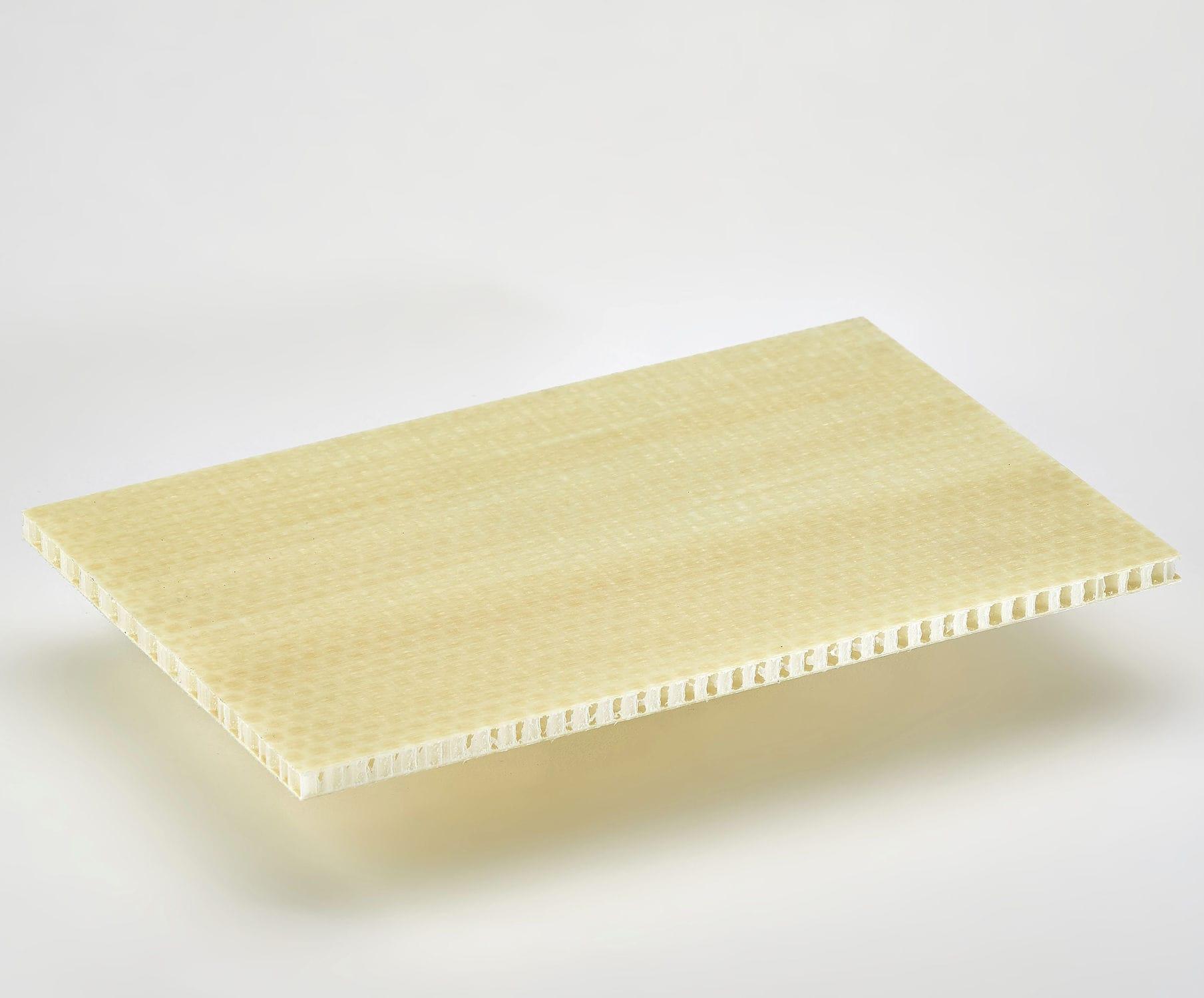
1. Introduction: Why Material Selection Matters in Marine Composite Panel Manufacturing
The marine composite industry increasingly relies on lightweight sandwich structures to improve vessel efficiency, reduce material consumption, and optimize interior construction.
From boat cabin wall panels and yacht furniture to marine partitions and selected flooring systems, composite sandwich panels offer an alternative to traditional solid materials.
Among the available core materials, PP honeycomb core (polypropylene honeycomb core) has attracted attention because of its lightweight cellular structure, low water absorption, customizable geometry, and compatibility with different composite panel configurations.
However, selecting a suitable PP honeycomb core is not simply a matter of choosing a particular density or thickness.
A marine composite panel is a complete engineered structure. Its performance depends on the interaction between the core material, facing materials, adhesive system, panel dimensions, manufacturing process, and service conditions.
An unsuitable core selection may result in:
- Insufficient compression resistance.
- Excessive panel deflection.
- Poor skin-to-core bonding.
- Local core crushing.
- Sandwich panel delamination.
- Unstable manufacturing quality.
- Increased finished-panel weight.
- Unnecessary material costs.
For marine composite panel manufacturers, selecting the right PP honeycomb core requires a systematic evaluation of mechanical properties, processing compatibility, environmental resistance, and finished-panel requirements.
This guide explains the major factors involved in selecting PP honeycomb core for marine composite panel manufacturing, with practical recommendations for boatbuilding, yacht interior construction, FRP panel production, and customized sandwich panel applications.
2. Understand the Structure and Function of PP Honeycomb Core
Before selecting a PP honeycomb core, manufacturers should understand how the material works within a sandwich panel.
PP honeycomb core is manufactured from polypropylene, a thermoplastic polymer. Its internal structure consists of interconnected cellular walls arranged into a honeycomb configuration.
Unlike solid plastic sheets or foam core materials, honeycomb core uses a geometric cellular structure to provide internal support while minimizing material consumption.
2.1 How Does PP Honeycomb Core Work in a Sandwich Panel?
A typical PP honeycomb sandwich panel consists of three main layers:
- Upper facing material.
- PP honeycomb core.
- Lower facing material.
The core separates the two skins and helps transfer shear loads between them.
The outer skins primarily contribute to the panel’s tensile and compressive resistance under bending, while the core contributes to shear resistance and maintains the distance between the skins.
This arrangement can provide high bending stiffness relative to the panel’s weight when properly designed.
For example, a marine FRP PP honeycomb sandwich panel may use:
- Fiberglass reinforced plastic as the upper skin.
- Polypropylene honeycomb as the internal core.
- Fiberglass reinforced plastic as the lower skin.
The complete structure can be used to manufacture selected boat interior wall panels, partitions, furniture panels, and flooring components.
2.2 Main Functions of PP Honeycomb Core
| Function | Description | Importance in Marine Panels |
|---|---|---|
| Lightweight Support | Provides internal panel volume with relatively low material consumption | Helps reduce finished-panel weight |
| Shear Transfer | Transfers shear forces between facing layers | Important for sandwich-panel integrity |
| Skin Separation | Maintains the distance between the two skins | Contributes to bending stiffness |
| Compression Resistance | Resists through-thickness compressive loading | Important for supports and concentrated loads |
| Structural Stability | Supports the facing materials | Helps maintain panel geometry |
| Manufacturing Flexibility | Can be supplied in different thicknesses and geometries | Supports customized panel production |
The core should not be evaluated independently of the facing materials. A high-quality core cannot compensate for insufficient skin strength, poor adhesive selection, or inadequate panel design.
3. Factor One: Select PP Honeycomb Core Density According to Application Requirements
Density is one of the most frequently discussed parameters when purchasing PP honeycomb core.
It is commonly expressed in kilograms per cubic meter (kg/m³).
Density influences material weight and is often related to mechanical performance. However, density alone does not determine the overall quality or suitability of a honeycomb core.
Two PP honeycomb cores with the same nominal density may have different compression and shear properties because of differences in:
- Honeycomb cell geometry.
- Cell wall thickness.
- Polymer formulation.
- Manufacturing process.
- Material distribution.
- Dimensional tolerances.
3.1 Why Is PP Honeycomb Core Density Important?
The core density affects the amount of polypropylene used in a given volume.
For a core with a specified thickness, increasing density generally increases the core’s mass per unit area.
The core mass can be estimated using:
Core Mass per Square Meter = Core Density × Core Thickness
Where:
- Core mass is expressed in kg/m².
- Density is expressed in kg/m³.
- Thickness is expressed in meters.
For example, consider a hypothetical PP honeycomb core with a density of 80 kg/m³ and a thickness of 20 mm.
Core mass:
80 × 0.020 = 1.60 kg/m²
This calculation represents the core material only. It does not include FRP skins, adhesives, edge reinforcement, coatings, or other components.
3.2 How to Compare Different PP Honeycomb Core Densities
The following table provides a comparison framework. The density values are illustrative purchasing categories, not universal industry classifications or guaranteed product grades.
| Illustrative Density Category | Material Weight | Selection Considerations | Potential Applications |
|---|---|---|---|
| Lower-density grades | Lower core mass | Verify compression and shear requirements carefully | Lightweight interior panels |
| Medium-density grades | Moderate core mass | Balance weight and mechanical performance | Partitions and composite wall panels |
| Higher-density grades | Higher core mass | Evaluate whether additional mechanical performance is necessary | Selected flooring and equipment panels |
A buyer should request the actual technical data sheet for each available grade rather than assuming that a particular density automatically provides a specific strength.
3.3 Density Selection Recommendations
For marine interior wall panels, lightweight construction may be a priority, provided that the panel satisfies the required deflection and handling conditions.
For marine partition panels, manufacturers should consider panel span, impact exposure, connection details, and the required stiffness.
For boat flooring panels, compression and shear performance become particularly important because the panels may experience repeated foot traffic and concentrated loads.
Professional recommendation: Select PP honeycomb core density according to tested mechanical properties and the finished panel’s design requirements, not according to density alone.
4. Factor Two: Select the Correct PP Honeycomb Core Thickness
Core thickness is another important factor in sandwich panel design.
Increasing the core thickness can increase the distance between the outer skins. Under suitable design conditions, this can significantly improve the bending stiffness of the complete sandwich panel.
However, increasing thickness also affects panel dimensions, edge treatment, installation space, and material consumption.
4.1 Relationship Between Core Thickness and Panel Stiffness
In a sandwich panel, the facing materials carry much of the tensile and compressive stress generated by bending.
The core keeps the skins separated and transfers shear loads between them.
As the distance between the skins increases, the panel can achieve greater bending stiffness without requiring an equivalent increase in skin material.
This is one of the principal advantages of honeycomb sandwich construction.
However, the actual improvement depends on:
- Skin thickness.
- Skin elastic modulus.
- Core shear modulus.
- Core shear strength.
- Panel span.
- Boundary conditions.
- Adhesive performance.
- Applied load distribution.
A thicker PP honeycomb core does not automatically make every panel suitable for heavier loading.
4.2 Common PP Honeycomb Core Thickness Options
The following thicknesses are illustrative product configuration options. Actual availability depends on the manufacturer’s production capability.
| Core Thickness | Potential Panel Applications | Main Considerations |
|---|---|---|
| 5–10 mm | Thin composite boards and selected decorative panels | Limited structural depth |
| 10–15 mm | Lightweight interior boards | Check panel stiffness and support spacing |
| 15–20 mm | Boat interior walls and partitions | Balance weight and rigidity |
| 20–30 mm | Thicker marine sandwich panels | Evaluate shear and bending behavior |
| 30–50 mm | Selected flooring and equipment panel designs | Requires application-specific engineering |
| Above 50 mm | Specialized sandwich structures | Check manufacturing, handling, and installation constraints |
These ranges are not design approvals. The appropriate thickness must be confirmed through engineering calculations and panel testing.
4.3 Thickness Selection for Different Marine Applications
| Application | Main Design Priorities |
|---|---|
| Boat Interior Wall Panel | Weight, flatness, appearance, handling |
| Yacht Cabin Partition | Stiffness, impact resistance, fastening details |
| Marine Furniture Panel | Machining, edge strength, insert design |
| Boat Flooring Panel | Compression, shear, bending, deflection |
| Equipment Access Panel | Local loading, fastener strength, repeated use |
| Lightweight Interior Deck Panel | Span, support conditions, vibration, surface durability |
For large-format wall panels, manufacturers should also consider dimensional stability and handling during transportation and installation.
5. Factor Three: Choose the Appropriate Honeycomb Cell Size and Geometry
Cell size is an important geometric parameter of PP honeycomb core.
The honeycomb cell structure influences the distribution of material, mechanical behavior, bonding characteristics, and processing performance.
Different cell geometries may be suitable for different panel designs.
5.1 What Is PP Honeycomb Cell Size?
Cell size refers to the characteristic dimension of the individual honeycomb cells.
Depending on the manufacturer’s measurement method, it may be specified as an internal cell dimension, nominal cell diameter, or another agreed geometric measurement.
For accurate purchasing communication, suppliers and buyers should define the measurement method rather than relying on an ambiguous cell-size description.
5.2 How Does Cell Size Influence Panel Performance?
Cell geometry may influence:
- Core compression behavior.
- Core shear properties.
- Bonding contact with the facing material.
- Local support of the skins.
- Cutting and machining behavior.
- Resin or adhesive distribution.
- Manufacturing consistency.
A smaller cell size may provide more frequent cellular support points, while a larger cell size may change the core’s structural behavior and processing characteristics.
However, neither smaller nor larger cells are universally superior.
The result depends on cell wall thickness, material grade, core density, loading direction, and the complete sandwich design.
5.3 Cell Size Selection for Marine Composite Manufacturing
| Selection Factor | Questions to Ask the Supplier |
|---|---|
| Cell Geometry | What honeycomb geometry is used? |
| Cell Size | What nominal cell dimensions are available? |
| Dimensional Tolerance | How is cell size measured and controlled? |
| Mechanical Properties | Are compression and shear results available? |
| Bonding Performance | Has the core been tested with the intended facing material? |
| Manufacturing Compatibility | Is the cell structure suitable for the intended cutting and bonding process? |
Marine composite panel manufacturers should evaluate cell size together with density and mechanical test data.
6. Factor Four: Evaluate Compression Strength and Shear Strength
Mechanical properties are essential when selecting PP honeycomb core for marine composite panels.
Two particularly important properties are compression strength and shear strength.
These properties describe different types of mechanical behavior and should not be used interchangeably.
6.1 Compression Strength
Compression strength describes the core’s resistance to compressive loading through its thickness.
It is particularly relevant to applications involving:
- Concentrated loads.
- Local support points.
- Fastener areas.
- Flooring systems.
- Equipment mounting locations.
- Handling and assembly pressure.
If the core has insufficient compression resistance, localized loading may cause core crushing or permanent deformation.
For boat flooring panels, compression performance should be considered alongside the surface skin’s load distribution capability.
6.2 Shear Strength
Shear strength describes the core’s resistance to shear loading.
In a sandwich panel, the core transfers shear forces between the upper and lower skins.
Insufficient core shear strength may contribute to:
- Core shear failure.
- Excessive panel deflection.
- Skin-to-core separation.
- Local structural damage.
Shear performance is especially important for panels with relatively large unsupported spans.
6.3 Compression Strength vs Shear Strength
| Property | Loading Direction | Main Engineering Concern |
|---|---|---|
| Compression Strength | Through the core thickness | Local crushing and support loading |
| Shear Strength | Within the core structure | Transfer of shear forces |
| Shear Modulus | Shear deformation | Panel deflection |
| Flexural Strength | Complete panel under bending | Overall panel performance |
| Bonding Strength | Skin-to-core interface | Delamination resistance |
A buyer should request test reports that identify the material grade, specimen dimensions, test direction, test method, and results.
6.4 Relevant Mechanical Test Standards
The following ASTM standards may be relevant to sandwich core and composite panel evaluation:
| Standard | Test Subject | Potential Use |
|---|---|---|
| ASTM C365/C365M | Flatwise compressive properties of sandwich cores | Evaluating core compression |
| ASTM C273/C273M | Shear properties of sandwich core materials | Evaluating core shear |
| ASTM C393/C393M | Core shear properties of sandwich constructions by beam flexure | Evaluating sandwich-panel behavior |
| ASTM D7249/D7249M | Facing properties of sandwich constructions by long-beam flexure | Evaluating facing behavior |
| ASTM D7766/D7766M | Damage resistance of sandwich constructions | Evaluating impact-related damage |
The applicable edition, specimen preparation, and suitability for the specific PP honeycomb construction should be confirmed with the testing laboratory.
7. Factor Five: Check Bonding Compatibility Between PP Honeycomb Core and FRP Skins
Bonding compatibility is one of the most important considerations in PP honeycomb sandwich panel manufacturing.
Polypropylene has relatively low surface energy. This can make it difficult to achieve reliable adhesion using some conventional adhesive systems.
Therefore, selecting a suitable PP honeycomb core requires evaluating not only its mechanical properties but also its bonding characteristics.
7.1 Why Is PP Honeycomb Core Difficult to Bond?
Polypropylene is a non-polar thermoplastic material with relatively low surface energy.
Many conventional adhesives are designed for materials with different surface characteristics.
Without suitable preparation and an appropriate adhesive system, bonding between PP honeycomb core and FRP skins may be insufficient.
Possible consequences include:
- Weak skin-to-core adhesion.
- Local delamination.
- Inconsistent bonding.
- Reduced panel bending performance.
- Production defects.
7.2 Common Surface Treatment Methods
Depending on the material grade and manufacturing process, the following approaches may be considered:
| Treatment Method | Main Purpose | Manufacturing Considerations |
|---|---|---|
| Corona Treatment | Modifies surface characteristics | Requires controlled treatment conditions |
| Plasma Treatment | Improves surface activation | Requires suitable equipment and process control |
| Flame Treatment | Modifies surface characteristics through controlled exposure | Requires careful safety and process management |
| Primer System | Improves compatibility with selected adhesives | Must be validated for the material and adhesive |
| Specialized Adhesive System | Provides a suitable bonding solution | Requires compatibility and durability testing |
Not every treatment method is suitable for every PP honeycomb core or production line.
The supplier should clarify whether the core is supplied untreated or with a specified surface treatment.
7.3 How to Evaluate Bonding Performance
For FRP PP honeycomb panels, the manufacturer should evaluate:
- Surface condition of the PP core.
- Compatibility between the core and adhesive.
- Compatibility between the adhesive and FRP skin.
- Adhesive application quantity.
- Pressing pressure.
- Curing temperature and time.
- Finished-panel bonding performance.
- Environmental durability of the bonded assembly.
A successful laboratory coupon test is useful, but production-scale validation is also important because panel dimensions and processing conditions may influence the final result.
Purchasing recommendation: Ask the PP honeycomb core supplier whether bonding-treated material is available and request evidence of compatibility with your intended FRP skin and adhesive system.
8. Factor Six: Consider Water Resistance and Marine Environmental Conditions
Water resistance is an important consideration for marine composite materials.
Boat interiors may experience high humidity, condensation, cleaning water, and occasional water exposure.
Polypropylene has low water absorption compared with many conventional wood-based materials. This is one reason PP honeycomb core is considered for moisture-sensitive composite applications.
However, the moisture resistance of the finished sandwich panel depends on the complete construction.
8.1 Water Resistance of PP Honeycomb Core
The polypropylene polymer itself has low water absorption.
Nevertheless, water may enter the finished panel through:
- Damaged surface skins.
- Unsealed cut edges.
- Poorly bonded interfaces.
- Panel joints.
- Fastener holes.
- Installation penetrations.
Therefore, a PP honeycomb core should not be described as making every finished panel waterproof.
8.2 Moisture Protection for Marine Sandwich Panels
For improved moisture durability, manufacturers should consider:
- Suitable FRP facing materials.
- Continuous skin coverage.
- Sealed panel edges.
- Compatible adhesives.
- Protected fastener locations.
- Properly designed joints.
- Inspection of damaged surfaces.
For areas exposed to repeated water contact, the complete panel assembly should be evaluated under representative environmental conditions.
8.3 Marine Environmental Conditions to Consider
| Environmental Factor | Potential Effect | Recommended Evaluation |
|---|---|---|
| High Humidity | May affect adhesives and facing materials | Humidity conditioning |
| Water Exposure | May affect edges and bonded interfaces | Water exposure testing |
| Temperature Changes | May cause differential expansion | Thermal cycling |
| Saltwater Exposure | May affect exposed metals and selected components | Saltwater exposure where relevant |
| Cleaning Chemicals | May damage some surface finishes | Chemical compatibility testing |
| Vibration | May contribute to fatigue or interface damage | Application-specific vibration testing |
The core material is only one part of the environmental performance of a marine composite panel.
9. Factor Seven: Select the Right Facing Material for Marine PP Honeycomb Panels
The facing material plays a major role in the final performance of a sandwich panel.
It contributes to bending resistance, surface durability, appearance, and environmental protection.
For marine applications, fiberglass reinforced plastic is one of the important facing options.
9.1 FRP Skin for PP Honeycomb Sandwich Panels
FRP stands for fiberglass reinforced plastic.
It combines glass fiber reinforcement with a polymer resin matrix.
FRP skins can be produced in different thicknesses, reinforcement configurations, resin systems, and surface finishes.
Potential advantages include:
- Corrosion resistance.
- Flexible surface design.
- Good strength-to-weight potential.
- Compatibility with customized panel manufacturing.
- Availability of smooth and textured finishes.
The actual performance depends on the laminate design, fiber orientation, resin system, manufacturing quality, and skin thickness.
9.2 Comparison of Common Facing Materials
| Facing Material | Main Characteristics | Potential Marine Applications |
|---|---|---|
| FRP | Composite facing with customizable thickness and finish | Walls, partitions, flooring |
| Gelcoat FRP | Decorative surface with integrated finish | Yacht interior panels |
| Aluminum Sheet | Metallic surface and rigidity | Selected interior panels |
| HPL | Decorative and wear-resistant surface options | Furniture and interior decoration |
| Plywood | Easy to machine and fasten | Customized furniture and interior panels |
| PVC Decorative Sheet | Decorative surface options | Selected interior applications |
The correct facing material depends on the application, bonding system, weight target, fire requirements, and desired appearance.
10. Factor Eight: Calculate the Weight of the Complete Marine Sandwich Panel
For boatbuilding and yacht manufacturing, weight is a critical purchasing and design factor.
However, comparing only the density of PP honeycomb core is not sufficient.
Manufacturers should calculate the weight of the entire sandwich panel.
10.1 Sandwich Panel Weight Calculation
The total panel mass per square meter can be estimated as:
Total Panel Mass = Core Mass + Upper Skin Mass + Lower Skin Mass + Adhesive Mass + Additional Components
For a simplified three-layer panel:
[
M = \rho_c t_c + \rho_{s1}t_{s1} + \rho_{s2}t_{s2} + M_a
]
Where:
- (M) = total panel mass per square meter.
- (\rho_c) = core density.
- (t_c) = core thickness.
- (\rho_{s1}), (\rho_{s2}) = skin densities.
- (t_{s1}), (t_{s2}) = skin thicknesses.
- (M_a) = adhesive mass per square meter.
All thicknesses must be expressed in meters when densities are expressed in kg/m³.
10.2 Illustrative Weight Calculation
Assume the following hypothetical panel configuration:
| Component | Assumed Specification |
|---|---|
| PP Honeycomb Core Density | 80 kg/m³ |
| PP Honeycomb Core Thickness | 20 mm |
| Upper FRP Skin Density | 1,800 kg/m³ |
| Upper FRP Skin Thickness | 1.5 mm |
| Lower FRP Skin Density | 1,800 kg/m³ |
| Lower FRP Skin Thickness | 1.5 mm |
| Adhesive Mass | Excluded |
Core mass:
80 × 0.020 = 1.60 kg/m²
Upper FRP skin mass:
1,800 × 0.0015 = 2.70 kg/m²
Lower FRP skin mass:
1,800 × 0.0015 = 2.70 kg/m²
Estimated panel mass:
1.60 + 2.70 + 2.70 = 7.00 kg/m²
This is an illustrative calculation, not a certified product weight or ONEBOND product specification. Actual mass will depend on the core, laminate, resin content, adhesive, surface finish, and additional reinforcement.
10.3 Why Finished-Panel Weight Matters
A lightweight core does not automatically produce a lightweight finished panel.
For example, increasing FRP skin thickness may significantly increase the panel mass.
Likewise, edge reinforcement, inserts, surface coatings, and adhesive consumption may influence the final result.
For accurate material selection, buyers should request the finished-panel weight and compare it with the required mechanical performance.
11. Factor Nine: Match PP Honeycomb Core to the Marine Composite Manufacturing Process
The core must be compatible with the manufacturer’s production equipment and manufacturing workflow.
A material that performs well in a laboratory may still cause production problems if it is not compatible with the selected bonding and pressing process.
11.1 Common Manufacturing Processes
Marine PP honeycomb sandwich panels may be manufactured using different processes.
| Manufacturing Process | Description | Important Control Factors |
|---|---|---|
| Adhesive Bonding | Separate skins are bonded to the core using an adhesive | Adhesive compatibility and application |
| Vacuum Bagging | Vacuum pressure consolidates the panel assembly | Vacuum level, sealing, and curing |
| Flat-Bed Pressing | The assembled panel is pressed between flat surfaces | Pressure distribution and panel flatness |
| Vacuum Pressing | Vacuum equipment is used for panel consolidation | Vacuum consistency and adhesive curing |
| Customized Composite Molding | Specialized equipment and molds are used | Temperature, pressure, and mold design |
The most suitable method depends on the panel construction, adhesive chemistry, production volume, equipment, and required quality level.
11.2 Manufacturing Problems Related to Core Selection
| Production Problem | Possible Cause | Recommended Action |
|---|---|---|
| Skin Delamination | Insufficient bonding or unsuitable adhesive | Validate surface treatment and adhesive |
| Core Crushing | Excessive pressing pressure | Optimize pressure and process parameters |
| Uneven Panel Thickness | Poor core dimensional consistency | Improve material inspection |
| Surface Deformation | Uneven support or unsuitable processing conditions | Review tooling and pressing method |
| Incomplete Bonding | Poor adhesive distribution | Optimize adhesive application |
| Panel Warpage | Uneven skins, curing, or thermal behavior | Review laminate balance and curing |
Core selection should therefore be completed together with production-process validation.
12. Factor Ten: Evaluate Total Cost Instead of Only PP Honeycomb Core Price
Price is an important factor in material purchasing, but the lowest core price does not necessarily produce the lowest finished-panel cost.
A buyer should evaluate the total cost of manufacturing and using the material.
12.1 Main Cost Components
| Cost Factor | Description |
|---|---|
| Core Material Price | PP honeycomb core purchase cost |
| Core Density | Influences material consumption per unit volume |
| Core Thickness | Influences material quantity and panel dimensions |
| Facing Material Cost | FRP, aluminum, HPL, or other skins |
| Adhesive Cost | Depends on bonding system and consumption |
| Surface Treatment | May involve additional processing |
| Manufacturing Labor | Cutting, assembly, pressing, and finishing |
| Scrap Rate | Material loss caused by defects |
| Quality Inspection | Testing and inspection costs |
| Transportation | Depends on dimensions, packing, and shipment volume |
12.2 Compare Cost per Finished Square Meter
For marine composite panel manufacturers, the more useful comparison is often the cost per square meter of finished panel.
A simplified calculation is:
Finished Panel Cost per m² = Core Cost + Skin Cost + Adhesive Cost + Processing Cost + Quality Cost + Other Direct Costs
This approach provides a more realistic basis for comparing different core materials and panel configurations.
A slightly more expensive core may be economically preferable if it improves production yield, reduces bonding defects, or meets mechanical requirements with a more efficient panel design.
13. PP Honeycomb Core vs PVC Foam Core for Marine Composite Manufacturing
PP honeycomb core and PVC foam core are both used in lightweight composite manufacturing.
However, they have different internal structures and material characteristics.
13.1 Technical Comparison
| Comparison Factor | PP Honeycomb Core | PVC Foam Core |
|---|---|---|
| Material | Polypropylene | Polyvinyl chloride-based foam |
| Structure | Geometric honeycomb cells | Cellular foam |
| Density | Grade-dependent | Grade-dependent |
| Compression Performance | Depends on cell geometry and grade | Depends on foam density and grade |
| Shear Performance | Depends on cell structure and material | Depends on foam structure and formulation |
| Water Absorption | Generally low for PP | Generally low for suitable closed-cell grades |
| Bonding | May require surface treatment | Depends on foam surface and adhesive |
| Machining | Requires suitable cutting and edge design | Commonly machinable |
| Typical Use | Lightweight panels and selected interior structures | Marine sandwich panels and structural composite applications |
13.2 Which Material Is Better for Marine Applications?
There is no universal answer.
PP honeycomb core may be considered where a geometric cellular structure, low core weight, and customized panel configuration are desired.
PVC foam core may be considered where its specific foam properties and established composite processing characteristics meet the project requirements.
The selection should be based on:
- Required compression strength.
- Required shear strength.
- Panel span.
- Finished-panel weight.
- Skin material.
- Adhesive compatibility.
- Environmental exposure.
- Manufacturing process.
- Project budget.
For marine composite panel manufacturers, a comparative trial using equivalent finished-panel configurations can provide more useful information than comparing core density alone.
14. Marine Applications and Recommended PP Honeycomb Core Selection Priorities
Different marine applications require different material properties.
The following table provides a practical selection framework.
| Marine Application | Main Performance Priorities | Recommended Evaluation |
|---|---|---|
| Boat Interior Wall Panel | Lightweight construction, flatness, appearance | Finished-panel weight and flexural behavior |
| Yacht Cabin Partition | Stiffness, impact resistance, connections | Panel bending and local reinforcement |
| Marine Furniture Panel | Machining, edge strength, fastener retention | Insert and edge tests |
| Boat Flooring Panel | Compression, shear, deflection, surface durability | Representative load and panel tests |
| Equipment Access Panel | Local loading and repeated operation | Fastener and local compression tests |
| Interior Ceiling Panel | Low weight, dimensional stability, surface quality | Flatness and bonding consistency |
| Decorative Composite Panel | Surface finish, dimensional accuracy, bonding | Appearance and adhesion inspection |
These recommendations are starting points for material selection. They do not replace engineering design or marine regulatory approval.
15. How to Evaluate a PP Honeycomb Core Manufacturer and Supplier
Selecting a reliable supplier is an important part of marine composite panel manufacturing.
A professional PP honeycomb core manufacturer should provide consistent material quality, clear technical information, customized production options, and reliable communication.
15.1 Technical Documentation
Before purchasing, request:
- Product technical data sheet.
- Density specifications.
- Thickness specifications.
- Cell size and geometry information.
- Compression strength data.
- Shear strength data.
- Water absorption information.
- Surface treatment details.
- Dimensional tolerance information.
- Relevant test reports.
Technical documentation should clearly identify the tested grade and test method.
15.2 Manufacturing Capability
A supplier’s production capability can influence material consistency and delivery reliability.
Buyers should evaluate:
- Production capacity.
- Thickness range.
- Density range.
- Customized dimensions.
- Cell structure consistency.
- Surface treatment options.
- Quality control procedures.
- Sample availability.
- Batch traceability.
15.3 Customization Capability
Marine composite panel manufacturers may require different PP honeycomb core specifications for different projects.
A supplier should be able to discuss customization according to:
- Core thickness.
- Density.
- Cell size.
- Sheet dimensions.
- Surface treatment.
- Cutting requirements.
- Packaging requirements.
Customized specifications should be confirmed in writing before production.
15.4 Sample Testing Before Bulk Purchasing
Before placing a large order, manufacturers should evaluate samples in their own production environment.
A practical sample validation process includes:
- Inspect the core dimensions and surface condition.
- Confirm the material density.
- Test adhesive compatibility.
- Produce a representative sandwich panel.
- Evaluate panel flatness and bonding quality.
- Conduct relevant mechanical tests.
- Review environmental performance where necessary.
- Confirm the results before bulk purchasing.
This process helps reduce the risk of material incompatibility and production defects.
16. Marine PP Honeycomb Core Purchasing Checklist
The following checklist can be used by procurement teams when requesting quotations from a PP honeycomb core manufacturer.
| Item | Information to Confirm |
|---|---|
| Product | PP Honeycomb Core |
| Application | Boat Wall, Partition, Flooring, Furniture, or Other |
| Density | Required density in kg/m³ |
| Thickness | Required core thickness in mm |
| Cell Size | Required or acceptable cell dimensions |
| Cell Geometry | Supplier’s available structure |
| Mechanical Properties | Compression and shear requirements |
| Surface Treatment | Untreated or bonding-treated |
| Facing Material | FRP, aluminum, HPL, or other |
| Adhesive System | Intended adhesive type |
| Sheet Dimensions | Required length and width |
| Dimensional Tolerance | Agreed production tolerance |
| Environmental Requirements | Humidity, water, temperature, and chemical exposure |
| Fire Requirements | Applicable project regulations |
| Testing | Required test methods and reports |
| Quantity | Sample order and bulk quantity |
| Packaging | Protection during transportation |
| Delivery | Lead time and shipment arrangement |
16.1 Example RFQ Specification for PP Honeycomb Core
The following example can be adapted for a supplier inquiry:
Product: Polypropylene Honeycomb Core for Marine Composite Panel Manufacturing
Application: FRP-faced boat interior wall panels, partitions, and selected flooring panels.
Required Information:
- Available PP honeycomb core densities.
- Available core thicknesses.
- Available cell sizes and geometries.
- Compression strength and shear strength data.
- Core dimensional tolerances.
- Surface treatment options for FRP bonding.
- Recommended adhesive compatibility.
- Available sheet dimensions.
- Sample availability.
- Production lead time.
- Bulk order capacity.
- Technical data sheet and test reports.
The buyer should separately specify the design loads and regulatory requirements for any structural or safety-critical application.
17. Frequently Asked Questions About Selecting PP Honeycomb Core
Q1: What Is the Best Density for PP Honeycomb Core in Marine Composite Panels?
There is no single best density for every marine composite panel.
The appropriate density depends on the application, panel thickness, facing materials, support spacing, compression requirements, and shear performance.
For lightweight boat interior wall panels, weight may be a major consideration. For flooring panels, compression and shear performance may become more important.
Buyers should compare actual mechanical test data rather than selecting a core based only on its nominal density.
Q2: How Do I Choose the Right PP Honeycomb Core Thickness?
Core thickness should be selected according to the required panel stiffness, unsupported span, loading conditions, skin properties, and installation dimensions.
A thicker core can increase the distance between the skins and improve sandwich-panel bending stiffness under suitable design conditions.
However, the final thickness should be confirmed through engineering calculations and testing.
Q3: Does PP Honeycomb Core Need Surface Treatment Before FRP Bonding?
Depending on the adhesive system and manufacturing process, surface treatment may be necessary.
Polypropylene has relatively low surface energy, which can make bonding difficult with some conventional adhesives.
Corona treatment, plasma treatment, flame treatment, primer systems, or specialized adhesives may be considered.
The correct solution should be validated through bonding tests using the actual PP core, adhesive, and FRP skin.
Q4: What Is the Difference Between PP Honeycomb Core Density and Compression Strength?
Density describes the mass of material per unit volume, while compression strength describes the material’s resistance to compressive loading.
Density may correlate with mechanical performance, but it does not directly determine compression strength.
Cell geometry, wall thickness, polymer formulation, and manufacturing quality also influence the result.
Q5: Can PP Honeycomb Core Be Used for Marine Flooring?
Yes, PP honeycomb core can be incorporated into selected marine flooring sandwich panels.
However, the finished panel must be designed for the expected loading conditions, including concentrated loads, distributed loads, support spacing, and allowable deflection.
Core compression, core shear, skin strength, bonding, and surface durability should all be evaluated.
Q6: Is PP Honeycomb Core Better Than PVC Foam Core?
Neither material is universally better.
PP honeycomb core uses a geometric cellular structure, while PVC foam core uses a cellular foam structure.
Their mechanical properties, bonding characteristics, processing requirements, and costs differ.
The best material depends on the required finished-panel performance and manufacturing process.
Q7: How Can I Calculate the Weight of a PP Honeycomb Sandwich Panel?
Calculate the mass of each layer separately:
- Core mass = core density × core thickness.
- Skin mass = skin density × skin thickness.
- Add adhesive, coatings, reinforcement, and other components.
The total gives an estimated panel mass per square meter.
For procurement and engineering purposes, actual finished-panel weight should be measured after production.
Q8: What Technical Documents Should a PP Honeycomb Core Supplier Provide?
A professional supplier should provide a technical data sheet, density information, dimensional tolerances, mechanical test results, surface treatment details, and available quality documentation.
Where required, test reports should identify the material grade, test method, specimen configuration, and testing conditions.
Q9: Can PP Honeycomb Core Be Customized for Different Marine Applications?
Yes. Depending on manufacturing capability, PP honeycomb core can be supplied in different densities, thicknesses, cell sizes, dimensions, and surface treatment conditions.
Customized specifications should be based on the buyer’s panel structure and manufacturing requirements.
Q10: Is Standard PP Honeycomb Core Fireproof?
No. Standard polypropylene is combustible.
Some grades may use flame-retardant formulations, but the fire performance of the complete sandwich panel must be verified against the applicable marine regulations and project requirements.
A material description or generic flame-retardant claim does not establish compliance.
18. Conclusion: Selecting the Right PP Honeycomb Core for Reliable Marine Composite Manufacturing
Selecting the right PP honeycomb core is a critical step in manufacturing lightweight marine composite panels.
The correct selection should consider density, thickness, cell geometry, compression strength, shear strength, bonding compatibility, moisture exposure, facing materials, and manufacturing processes.
For boat interior walls, partitions, furniture, and flooring panels, the core should be matched to the specific mechanical and environmental requirements of the finished product.
Marine composite panel manufacturers should also evaluate the total panel weight, adhesive compatibility, edge protection, quality control, and applicable fire and structural requirements.
Most importantly, the selection process should be based on verified material properties and finished-panel testing rather than a single parameter such as density or price.
Working with a technically capable PP honeycomb core manufacturer can help improve material consistency, manufacturing efficiency, and long-term supply reliability.
For marine composite manufacturers looking for lightweight core materials, PP honeycomb core is a material option worth evaluating through application-specific engineering and production trials.
SEO Publishing Strategy
1. Recommended URL Slug
/how-to-select-pp-honeycomb-core-marine-composite-panel/
2. Recommended H1
How to Select PP Honeycomb Core for Marine Composite Panel Manufacturing
3. Recommended Keyword Placement
| Page Element | Recommended Keyword |
|---|---|
| H1 | PP Honeycomb Core for Marine Composite Panel Manufacturing |
| First Paragraph | PP Honeycomb Core, Marine Composite Panel |
| H2 Section | PP Honeycomb Core Density |
| H2 Section | PP Honeycomb Core Thickness |
| H2 Section | PP Honeycomb Core Compression Strength |
| H2 Section | PP Honeycomb Core Bonding Compatibility |
| H2 Section | PP Honeycomb Core vs PVC Foam Core |
| Image Alt Text | PP Honeycomb Core for Marine Sandwich Panel |
| Meta Description | PP Honeycomb Core, Marine Composite Panel Manufacturing |
4. Recommended Image Alt Text
- PP Honeycomb Core for Marine Composite Panel Manufacturing
- Polypropylene Honeycomb Core Material for Boat Building
- FRP PP Honeycomb Sandwich Panel Structure
- PP Honeycomb Core Density and Thickness Comparison
- PP Honeycomb Core Surface Treatment for FRP Bonding
- PP Honeycomb Core for Lightweight Boat Interior Panels
- Marine Composite Panel Manufacturing with PP Honeycomb Core
- PP Honeycomb Core for Yacht Partition and Flooring Panels
5. Recommended Internal Linking Structure
| Anchor Text | Target Page |
|---|---|
| PP Honeycomb Core | PP Honeycomb Core Product Page |
| PVC Foam Core | PVC Foam Core Product Page |
| PET Foam Core | PET Foam Core Product Page |
| Marine Sandwich Panel | Marine Composite Panel Application Page |
| FRP Honeycomb Panel | FRP Honeycomb Panel Product Page |
| Composite Core Materials | Composite Core Materials Category Page |
| PP Honeycomb Panel | PP Honeycomb Panel Product Page |
6. Recommended Related Articles
- PP Honeycomb Core for Marine Applications: Properties, Benefits, and Material Selection
- How PP Honeycomb Panels Improve Lightweight Boat and Yacht Construction
- PP Honeycomb Core vs PVC Foam Core for Marine Sandwich Panels: A Technical Comparison
- PP Honeycomb Panels for Boat Interior Walls, Partitions, and Flooring
- How to Select PP Honeycomb Core for Marine Composite Panel Manufacturing
7. SEO Search Intent Analysis
This article primarily targets three types of search intent:
| Search Intent | Example Search Keywords | Content Objective |
|---|---|---|
| Informational | How to select PP honeycomb core | Explain technical selection criteria |
| Commercial Investigation | PP honeycomb core vs PVC foam core | Help buyers compare materials |
| Transactional / B2B | PP honeycomb core manufacturer, PP honeycomb core supplier | Encourage technical inquiries and quotations |
The article should be linked to the corresponding PP Honeycomb Core product page. The product page should, in turn, link back to this technical guide.
This creates a clear relationship between the informational page and the commercial product page.
8. Final SEO Recommendations
For stronger organic search performance:
- Use the primary keyword naturally in the title, introduction, headings, and meta description.
- Avoid repeating the exact keyword in every paragraph.
- Add original product photographs showing PP honeycomb core sheets, cell structures, surface treatment, and finished FRP sandwich panels.
- Include real technical data sheets where available.
- Add internal links to related core material product pages.
- Use descriptive anchor text rather than generic phrases such as “click here.”
- Add FAQ structured data only when the visible page content meets Google’s current structured-data requirements.
- Ensure the article provides useful technical information that is not simply duplicated across other product pages.
The central SEO objective is to establish topical authority around PP Honeycomb Core for marine composite manufacturing, while directing qualified B2B visitors toward product specifications, samples, and quotation inquiries.
