
Introduction: A Structural Revolution at Sea
The modern shipbuilding industry—across commercial vessels, workboats, leisure yachts, high-speed patrol craft, and offshore support platforms—is undergoing a historic transformation. For more than a century, metals and solid laminates dominated the marine design space. Wood, steel, and monolithic fiberglass laminate formed the backbone of most vessel structures.
But over the past 30 years,—and accelerating dramatically in the last decade—composite sandwich structures have become one of the most important innovations in marine engineering. At the center of this transformation stands a material that is strong, lightweight, fatigue-resistant, and remarkably adaptable:
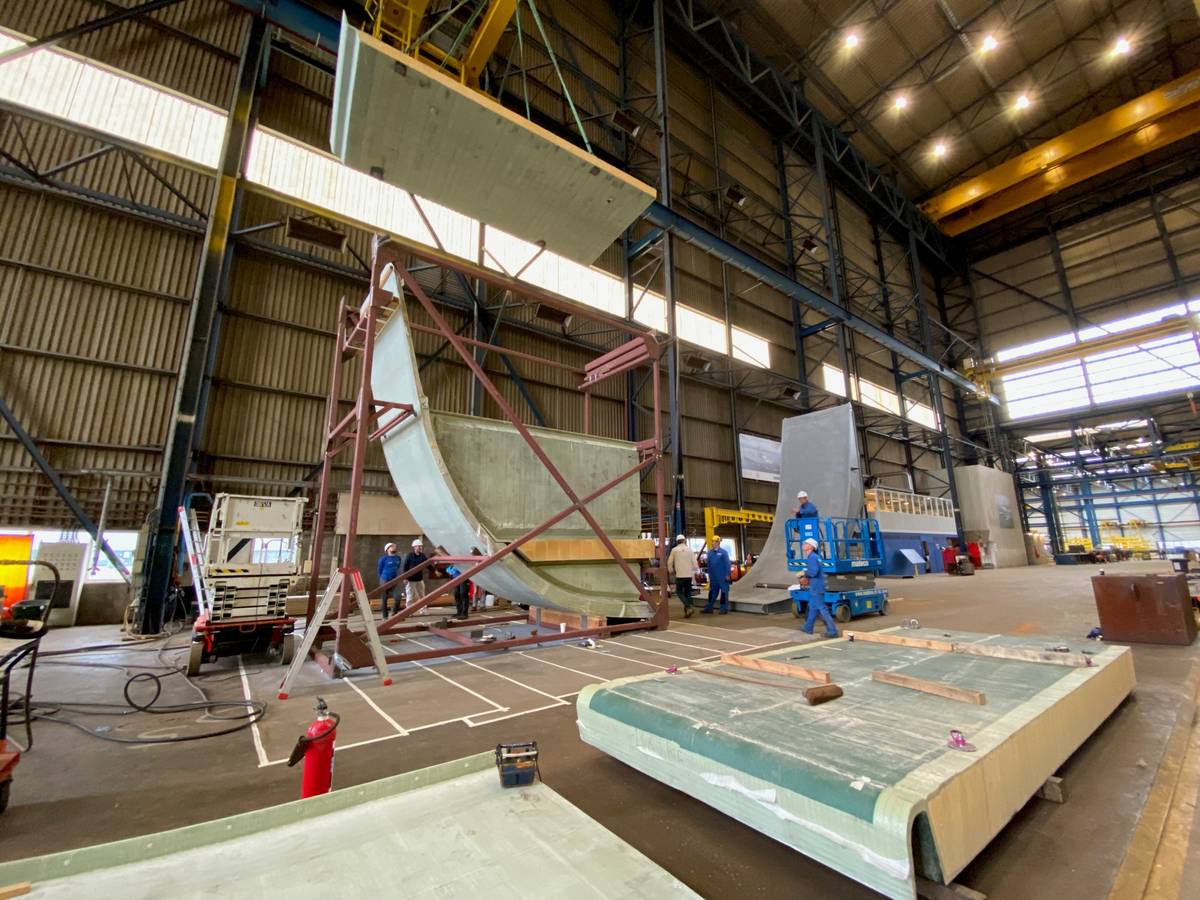
PVC Foam Core.
PVC (polyvinyl chloride) foam core is now one of the most widely used structural core materials for marine sandwich construction, enabling higher performance, lower weight, improved stability, superior corrosion resistance, and longer service life.
This article offers a deep technical and practical dive into how composite sandwich structures work, why PVC foam core is an industry favorite, how naval architects are designing with it, and what this means for the future of marine engineering.
1. Understanding Composite Sandwich Structures in Marine Engineering
1.1 What Is a Sandwich Structure?
A sandwich structure is built from three layers:
- Two strong skins (facesheets)—typically fiberglass, carbon fiber, or hybrid composites.
- One lightweight structural core—PVC foam, PET foam, balsa, or honeycomb.
This configuration mimics an I-beam:
- The skins handle tensile and compressive loads.
- The core handles shear loads and keeps the skins separated, dramatically increasing bending stiffness.
Mechanical Analogy
A sandwich panel achieves:
High stiffness + low weight → superior strength-to-weight ratio.
This is why sandwich structures dominate sectors requiring both power and efficiency:
marine, aerospace, wind energy, automotive, and rail.
1.2 Why Sandwich Construction Is Ideal for Boats
Marine conditions expose vessels to:
- Impact loads (waves, slamming)
- Fatigue stress (cyclic loading)
- Vibration
- Water ingress risks
- Corrosion
- High structural loads relative to weight
A sandwich structure provides:
- Lightweight hulls for better speed and fuel efficiency
- Higher stiffness against slamming
- Superior vibration damping
- Reduced noise and improved passenger comfort
- Improved stability (lower center of gravity)
- Longer fatigue life
For vessels ranging from racing sailboats to commercial workcraft, sandwich composites represent one of the most effective engineering upgrades available.
2. Why PVC Foam Core Dominates Marine Sandwich Construction
PVC foam core is widely regarded as the most balanced and versatile core material for marine vessels.
2.1 Key Advantages of PVC Foam Core
1. Excellent Strength-to-Weight Ratio
PVC foam delivers:
- High compressive strength
- High shear strength
- High stiffness
Without the weight penalty of solid laminates.
2. Closed-Cell Structure
Closed-cell PVC foam is inherently:
- Water-resistant
- Non-absorbent
- Dimensional stable even after exposure
This is critical for avoiding hull blistering, wet core failures, and delamination.
3. Compatibility with Marine Resin Systems
PVC foam bonds well with:
- Epoxy
- Polyester
- Vinyl ester
This makes it suitable for various fabrication routes.
4. Thermal and Acoustic Insulation
The foam’s cellular structure:
- Dampens vibration
- Reduces engine and wave noise
- Improves thermal efficiency
Ideal for crew comfort and superstructure design.
5. Excellent Fatigue Resistance
PVC withstands repeated cyclic stress—critical for vessels operating in rough seas.
6. Damage Tolerance
PVC foam is not as brittle as honeycomb, and unlike balsa:
- It does not wick water
- It maintains impact resistance even when cracked
7. Manufacturing Flexibility
Available in:
- Rigid sheets
- Contoured (kerf-cut) formats
- Double-cut sheets
- Scrim-backed sheets for infusion
PVC foam adapts to complex hull curvature.
3. Types of PVC Foam Core Used in the Marine Industry
PVC core foams fall into two major categories:
3.1 Linear PVC Foam
Properties:
- Tough, ductile
- High impact resistance
- Lower stiffness
Ideal for:
- Impact zones
- Slamming areas
- Stringers
- Hull bottoms
3.2 Cross-Linked PVC Foam
Properties:
- Higher stiffness
- Higher temperature resistance
- Higher mechanical strength
Ideal for:
- Decks
- Superstructures
- Bulkheads
- High-load areas
4. Where PVC Foam Core Is Used in Marine Vessels
Below is a detailed application matrix for PVC core in boats:
| Vessel Area | PVC Core Function |
|---|---|
| Hull sides | Increase stiffness with minimal weight |
| Hull bottom | Resist slamming loads and fatigue |
| Decks | Provide rigidity and prevent deflection |
| Transom | Reinforce engine mounting zones |
| Bulkheads | Reduce weight; maintain partition stiffness |
| Superstructures | Increase buoyancy, reduce top weight |
| Cabins / interiors | Lightweight panels and insulation |
| Stringers / stiffeners | Structural support with low weight |
| Engine room covers | Noise damping and high stiffness |
| Hatches | Stiff but lightweight structures |
PVC foam core enables designers to improve performance without compromising durability.
5. The Engineering Science Behind Sandwich Structures
5.1 Bending Stiffness and Core Thickness
One of the most powerful advantages of sandwich construction is that stiffness increases dramatically by increasing core thickness—not by increasing laminate thickness.
Formula:
Stiffness ∝ Thickness³
Thus:
- A slightly thicker PVC core panel can replace a much heavier monolithic laminate.
- This yields exponential stiffness gains.
5.2 Shear Strength and Core Selection
In hulls and slamming zones:
- High shear loads demand moderate-to-high density PVC foam.
Decks often require:
- High compressive strength to support human loads.
Superstructures require:
- Low-density foam to minimize weight above the center of gravity.
5.3 Fatigue Behavior
Marine composite structures experience millions of load cycles.
PVC foam’s fatigue resistance ensures:
- Fewer structural failures
- Longer service life
- High reliability under repeated loading
6. Manufacturing Processes Using PVC Foam Core
PVC foam adapts to all major marine composite processes.
6.1 Hand Lay-Up
Traditional but effective:
- Easy to incorporate
- Good for small to medium vessels
6.2 Vacuum Bagging
Improves:
- Fiber-to-resin ratio
- Structural consistency
- Weight control
6.3 Vacuum Infusion (VARTM / Resin Infusion)
Most common for high-end marine construction.
Advantages:
- High quality laminate
- Low void content
- Excellent bonding
- Consistent mechanical properties
PVC foam with scrim bonding or perforations enhances resin flow.
6.4 RTM (Resin Transfer Molding)
Ideal for:
- High volume production
- Precise shapes
- Consistent part thickness
6.5 Prepregs
For advanced racing yachts:
- High performance carbon fiber skins
- High-temperature-resistant PVC cores
7. Comparing PVC Foam with Other Marine Core Materials
A technical comparison across key metrics:
| Property | PVC Foam | PET Foam | SAN Foam | Balsa | Honeycomb |
|---|---|---|---|---|---|
| Water Absorption | Excellent | Good | Good | Poor | Excellent |
| Strength-to-Weight | Very good | Good | High | High | Excellent |
| Fatigue Resistance | Excellent | Good | High | Medium | Variable |
| Cost | Moderate | Economical | Higher | Moderate | High |
| Impact Resistance | High | Medium | High | Medium | Low |
| Ease of Shaping | Easy | Easy | Moderate | Easy | Difficult |
PVC foam achieves the best balance across marine-specific criteria.
8. Real-World Use Cases in Shipbuilding
1. High-Speed Patrol Boats
Weight is critical. PVC foam reduces displacement and improves acceleration.
2. Luxury Yachts
Demand for quiet cabins makes PVC foam ideal for acoustic insulation.
3. Fishing Vessels
Durability and impact resistance are essential—PVC foam excels.
4. Passenger Ferries
Improved fuel economy and stability benefit operators directly.
5. Naval and Military Craft
Shock loads, blast resistance, and fatigue strength make PVC foam preferred for certain rapid-response craft.
6. Recreational Boats
Cost-performance balance aligns perfectly with PVC foam capabilities.
9. Future Trends: PVC Foam Core in Next-Generation Vessels
9.1 Sustainability and Recycling
New PVC foam grades use:
- Bio-based materials
- Recyclable thermoplastic matrices
9.2 Hybrid Composite Structures
Integration of:
- Carbon fiber skins
- Multimaterial sandwich cores
9.3 Automated Manufacturing
Robotic cutting and automation allow:
- Faster panel production
- Perfect fitment
- Reduced labor costs
9.4 Lightweighting for Electric Boats
Electric propulsion needs:
- Lower hull mass
- Higher stiffness
- Better thermal insulation
PVC foam is an enabling material.
10. Conclusion: Composite Sandwich Structures Are the Future of Shipbuilding
The marine industry is shifting rapidly toward advanced composite structures to meet increasing demands for:
- Fuel efficiency
- Structural longevity
- Environmental compliance
- Performance and speed
- Passenger comfort
- Lower maintenance costs
PVC foam core stands at the center of this evolution, offering a near-ideal combination of strength, toughness, weight reduction, manufacturability, and marine durability.
Whether for a high-speed patrol craft, a luxury yacht, or a commercial ferry, PVC foam sandwich construction delivers measurable advantages that are redefining what marine vessels can achieve.
