
How to Choose the Right Core Thickness for FRP Truck Body Panels: 10mm, 15mm, 20mm, 25mm and 30mm Compared
SEO Title: FRP Truck Body Panel Core Thickness: 10mm to 30mm Compared
Meta Description: Compare 10mm, 15mm, 20mm, 25mm and 30mm core thickness for FRP truck body panels. Learn how thickness affects weight, stiffness and structural performance.
URL: /frp-truck-body-panel-core-thickness/
Primary Keyword: FRP Truck Body Panel Core Thickness
Secondary Keywords:
- FRP Sandwich Panel Thickness
- Truck Body Panel Core Thickness
- 10mm PP Honeycomb Core
- 15mm PET Foam Core
- 20mm PVC Foam Core
- 25mm Composite Panel Core
- 30mm Sandwich Panel Core
- Lightweight Truck Body Panels
- FRP Truck Body Sandwich Panel
- Customized Composite Core Material
1. Introduction: Why Core Thickness Matters in Truck Body Panels
When manufacturing FRP truck body panels, selecting the correct core thickness is just as important as choosing the core material.
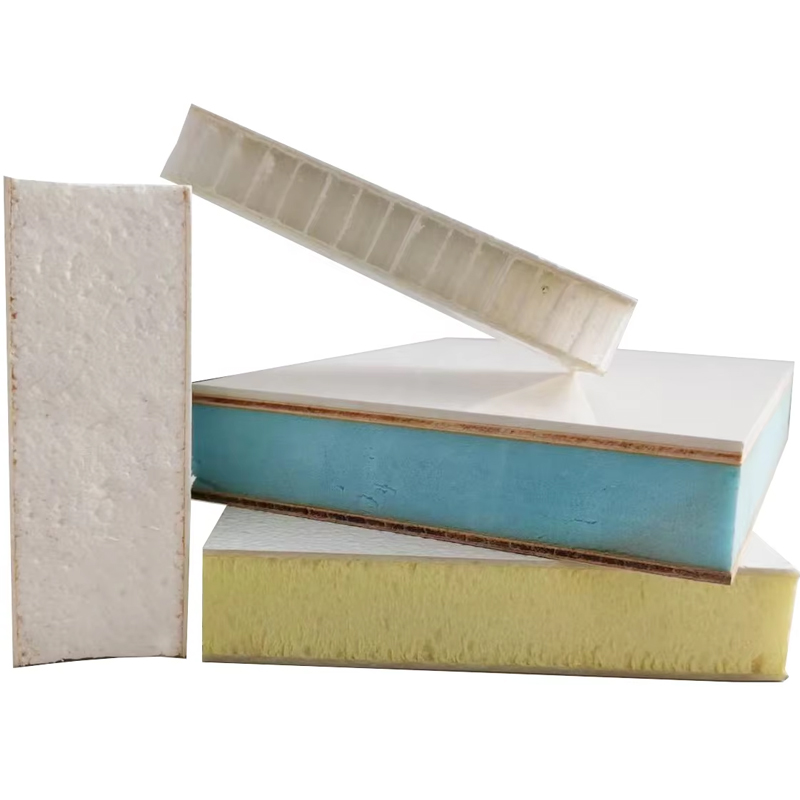
A sandwich panel typically consists of two FRP face sheets bonded to a lightweight core. The core maintains the separation between the face sheets, contributes to shear resistance and influences the overall panel thickness and bending behavior.
For truck body manufacturers, core thickness affects several important factors:
- Overall panel thickness
- Panel weight
- Bending stiffness
- Core shear behavior
- Compression performance
- Insulation performance where required
- Production cost
- Installation and connection details
Commonly considered core thicknesses include 10mm, 15mm, 20mm, 25mm and 30mm.
However, a thicker core is not automatically better. The right thickness depends on the panel application, face sheet construction, support spacing, loading conditions and material properties.
This article explains how to compare different core thicknesses and select a suitable configuration for FRP truck body panels.
2. Understanding Core Thickness in FRP Sandwich Panels
An FRP sandwich panel is generally made up of three main structural components:
- Outer FRP skin
- Lightweight core material
- Inner FRP skin
Adhesive or resin layers connect the core to the face sheets.
The total panel thickness can be estimated as:
Total Panel Thickness = Outer Skin Thickness + Core Thickness + Inner Skin Thickness + Bonding Layer Thickness
For example, consider a panel with:
- Outer FRP skin: 1.5mm
- Core: 20mm
- Inner FRP skin: 1.5mm
The nominal total thickness is approximately 23mm, excluding any additional thickness introduced by adhesive layers or surface finishes.
This distinction is important when buyers request a 20mm sandwich panel.
A 20mm core is not the same as a 20mm finished panel.
Manufacturers should confirm whether the requested thickness refers to the core alone or the complete sandwich panel.
3. Comparing 10mm, 15mm, 20mm, 25mm and 30mm Core Thickness
Different thicknesses offer different design possibilities.
The following table provides a general comparison for initial material selection.
| Core Thickness | General Design Consideration | Potential Applications |
|---|---|---|
| 10mm | Thin core configuration where limited panel depth is required | Interior partitions, selected door panels, compact structures |
| 15mm | Moderate thickness for lightweight panel construction | Interior panels, selected side wall structures |
| 20mm | Common starting point for evaluating general sandwich panel designs | Truck side walls, partitions, selected roof panels |
| 25mm | Greater skin separation and potential bending stiffness | Larger panels, selected roof and wall structures |
| 30mm | Thicker sandwich configuration for applications requiring greater panel depth | Selected truck body structures, insulated panel designs |
These are preliminary design categories, not universal engineering recommendations.
The suitability of each thickness must be verified through structural calculations and panel testing.
10mm Core Thickness
A 10mm core may be considered when the overall panel thickness must remain relatively small.
Potential applications include interior partitions, compact structures and selected door components.
However, a thin core provides less separation between the face sheets than a thicker core.
For panels with long spans or higher bending requirements, the face sheet thickness, support arrangement and core shear properties require careful evaluation.
15mm Core Thickness
A 15mm core provides more separation between the face sheets than a 10mm core.
It may be considered for lightweight interior structures and selected vehicle panels where the required panel depth is limited.
The final configuration should be evaluated against panel span, support spacing and expected loading.
20mm Core Thickness
A 20mm core is a useful starting point for evaluating many general sandwich panel designs.
It can be considered for truck side walls, interior partitions and selected roof structures.
However, whether 20mm is sufficient depends on the selected core material, FRP skin construction, panel dimensions and structural requirements.
25mm Core Thickness
A 25mm core provides greater separation between the face sheets compared with 20mm.
This may improve bending stiffness when other design conditions remain comparable.
It can be evaluated for larger panel areas and applications where increased panel depth is acceptable.
Manufacturers should also consider additional material weight, edge details and connection dimensions.
30mm Core Thickness
A 30mm core may be considered for sandwich panels requiring greater thickness or specific structural and thermal design characteristics.
For refrigerated truck panels, core thickness can also influence thermal resistance.
However, insulation performance depends on the thermal conductivity of the selected core, joints, connections and thermal bridges.
A thicker core should not be selected without evaluating the complete panel design.
4. How Does Core Thickness Affect Panel Weight?
Core thickness directly affects core weight when the material density remains constant.
For solid foam cores, the theoretical weight per square meter can be calculated using:
Core Weight (kg/m²) = Density (kg/m³) × Thickness (m)
The following table uses a hypothetical foam density of 60 kg/m³ to illustrate the relationship.
| Core Thickness | Thickness in Meters | Core Weight at 60 kg/m³ |
|---|---|---|
| 10mm | 0.010m | 0.60 kg/m² |
| 15mm | 0.015m | 0.90 kg/m² |
| 20mm | 0.020m | 1.20 kg/m² |
| 25mm | 0.025m | 1.50 kg/m² |
| 30mm | 0.030m | 1.80 kg/m² |
These figures are calculation examples, not actual product specifications.
For PP honeycomb, the calculation should use the measured bulk density of the complete honeycomb core configuration rather than the solid density of polypropylene.
Why Panel Weight Is More Than Core Weight
The final FRP sandwich panel also includes:
- Outer FRP skin
- Inner FRP skin
- Adhesive or resin
- Reinforcement inserts
- Edge closures
- Hardware and connection components
Therefore, increasing core thickness does not represent the entire change in finished panel weight.
For an accurate comparison, manufacturers should calculate the weight of the complete panel structure.
5. How Does Core Thickness Affect Bending Stiffness?
One of the main reasons to use a sandwich structure is to separate the two face sheets.
When the distance between the face sheets increases, the panel can achieve greater bending stiffness without using a solid material throughout its thickness.
For a simplified symmetric sandwich panel with thin, identical face sheets, bending stiffness is strongly influenced by the distance between the face sheets.
However, this does not mean that increasing core thickness always produces the same proportional improvement in panel performance.
The final result also depends on:
- Face sheet modulus
- Face sheet thickness
- Core shear modulus
- Core shear strength
- Panel span
- Support conditions
- Bonding quality
- Loading direction
The Importance of Core Shear Performance
As the core becomes thicker, the distance between face sheets increases, but the core must still transfer shear forces.
If the core has insufficient shear strength or shear stiffness, the panel may experience excessive deformation or failure.
Therefore, thickness selection should consider both bending stiffness and core shear performance.
A thicker core with unsuitable mechanical properties may not provide the expected structural benefits.
6. Core Thickness Selection for Different Truck Body Applications
The correct thickness depends on the function of each truck body component.
6.1 Truck Side Wall Panels
Truck side walls usually require a balance between low weight, bending stiffness and impact resistance.
Potential core thicknesses for initial design evaluation include 15mm, 20mm, 25mm and 30mm.
The final selection should consider:
- Panel height and width
- Support spacing
- FRP skin thickness
- Core shear properties
- Cargo contact and impact
- Mounting and connection details
PP honeycomb, PET foam and PVC foam may all be considered depending on the required structure and bonding process.
6.2 Truck Roof Panels
Roof panels may require adequate stiffness and resistance to environmental exposure.
Potential thicknesses should be evaluated according to:
- Roof span
- Supporting frame arrangement
- Equipment mounting loads
- Water drainage
- Weather exposure
- Thermal requirements
For refrigerated truck roofs, thermal conductivity and complete panel U-value should also be considered.
6.3 Truck Floor Panels
Truck floors are exposed to concentrated loads, repeated impact and cargo movement.
A 20mm or 30mm core should not automatically be considered sufficient simply because it is thicker.
Floor panel design should include:
- Flatwise compression strength
- Core shear strength
- Face sheet thickness
- Point-load resistance
- Impact resistance
- Support spacing
- Local reinforcement
- Fatigue and repeated loading
In many applications, the complete structural design and reinforcement details are more important than core thickness alone.
6.4 Truck Rear Door Panels
Rear doors require adequate stiffness and reliable support for hinges, locking systems and other hardware.
Thickness selection should consider:
- Door dimensions
- Hardware weight
- Hinge positions
- Locking system loads
- Edge reinforcement
- Repeated opening and closing
Local reinforcement and load transfer details should be designed together with the core structure.
7. How Core Material Changes the Thickness Selection
The same nominal thickness does not provide identical performance across different core materials.
PP honeycomb, PET foam and PVC foam have different structural characteristics.
| Core Material | Structure | Thickness Selection Considerations |
|---|---|---|
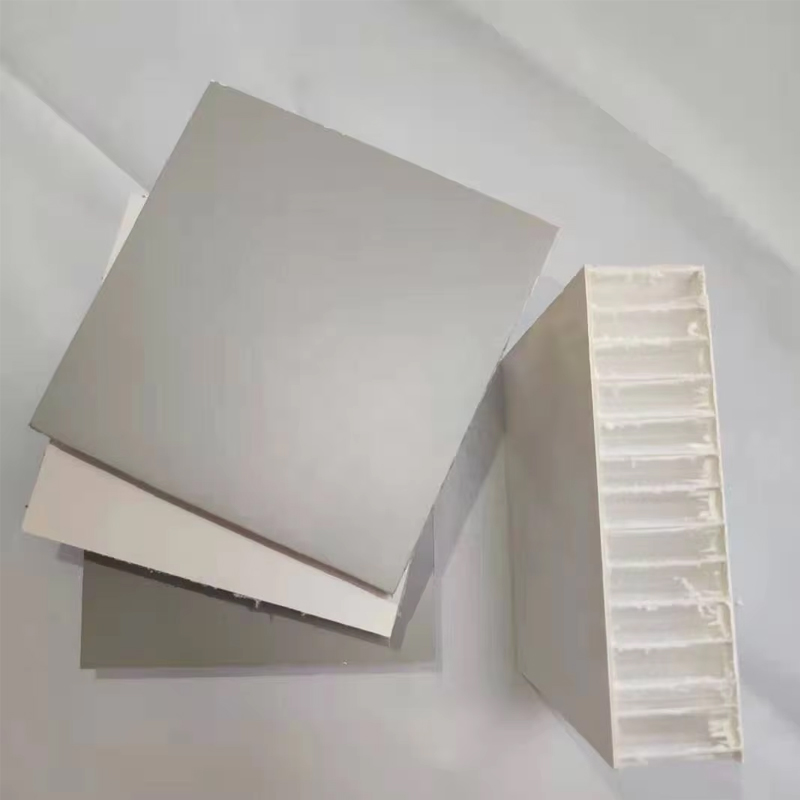
| PP Honeycomb | Cellular honeycomb | Cell size, direction, facing, compression and shear properties |
| PET Foam | Cellular foam | Density, compression, shear and bonding compatibility |
| PVC Foam | Rigid cellular foam | Grade, density, mechanical properties and processing conditions |
PP Honeycomb Thickness Selection
For PP honeycomb, manufacturers should consider both core thickness and cell geometry.
A thicker PP honeycomb core may increase face sheet separation, but its performance also depends on:
- Cell size
- Cell wall geometry
- Bulk density
- Core orientation
- Facing configuration
- Adhesive bonding
For large FRP truck body panels, bonding reliability must be established before selecting a final production specification.
PET Foam Thickness Selection
PET foam thickness should be selected together with density and mechanical performance.
A lower-density PET foam may reduce weight, but its compression and shear performance may differ from a higher-density grade.
The complete sandwich panel should be tested under representative loading conditions.
PVC Foam Thickness Selection
PVC foam is available in different structural grades.
Manufacturers should consider the combination of density, thickness, compressive properties, shear properties and FRP skin design.
A higher-density PVC foam may be suitable for some demanding structures, but its weight and cost should also be evaluated.
8. How to Select Core Thickness: A Practical Engineering Workflow
A reliable selection process should begin with the actual panel requirements.
Step 1: Define the Application
Identify whether the core is being used for a truck side wall, roof, floor, rear door or interior partition.
Step 2: Confirm the Overall Panel Thickness
Determine the maximum permitted panel thickness, including both FRP skins and bonding layers.
Step 3: Define the Loading Conditions
Consider panel span, support spacing, distributed loads, concentrated loads, impact and repeated loading.
Step 4: Select the Core Material
Compare PP honeycomb, PET foam and PVC foam based on mechanical properties, weight, bonding and production requirements.
Step 5: Compare Candidate Thicknesses
Evaluate 10mm, 15mm, 20mm, 25mm and 30mm configurations using the same face sheet construction and comparable test conditions.
Step 6: Calculate Complete Panel Weight
Include the core, both FRP skins, adhesive, reinforcement and edge components.
Step 7: Manufacture Prototype Panels
Produce trial panels using the intended production process.
Step 8: Test and Confirm
Evaluate the prototype for bending, shear, compression, bonding and other application-specific requirements.
This process helps avoid selecting a core thickness based only on nominal dimensions or supplier recommendations.
9. Important Technical Tests for Different Core Thicknesses
When comparing different core thicknesses, manufacturers should use consistent testing methods and clearly defined sample configurations.
Relevant test methods may include:
| Test Standard | Test Purpose |
|---|---|
| ASTM C271/C271M | Sandwich core density |
| ASTM C365/C365M | Flatwise compressive properties of sandwich cores |
| ASTM C273/C273M | Core shear properties |
| ASTM C297/C297M | Flatwise tensile properties |
| ASTM C393/C393M | Core shear properties of sandwich constructions by beam flexure |
| ASTM D7249/D7249M | Facing properties of sandwich constructions by long beam flexure |
The applicable standard and current revision should be confirmed before testing.
When comparing thicknesses, manufacturers should maintain consistent skin materials, adhesive systems, specimen dimensions and loading conditions wherever the test method permits.
Otherwise, differences in results may come from changes in the entire panel design rather than core thickness alone.
10. Common Mistakes When Choosing Sandwich Panel Core Thickness
Mistake 1: Assuming a Thicker Core Is Always Stronger
A thicker core may increase face sheet separation, but it does not automatically improve compression strength or core shear performance.
Mistake 2: Comparing Different Materials Only by Thickness
A 20mm PP honeycomb core and a 20mm PVC foam core have different structures and mechanical characteristics.
Nominal thickness alone is not a sufficient comparison.
Mistake 3: Ignoring FRP Skin Thickness
The face sheets are major structural components of a sandwich panel.
Reducing skin thickness to save weight may affect bending, impact and durability performance.
Mistake 4: Ignoring Bonding Quality
A panel with a suitable core thickness can still fail if the skin-to-core bonding is inadequate.
Mistake 5: Selecting Floor Panel Thickness Based on Side Wall Experience
Floor panels experience different loading conditions and often require more demanding structural evaluation.
Mistake 6: Confusing Core Thickness with Finished Panel Thickness
Always clarify whether a quotation refers to the core thickness or the complete panel thickness.
11. What Should Buyers Specify When Ordering Customized Core Materials?
For truck body panel manufacturers, providing complete specifications helps suppliers recommend suitable core products.
| Specification | Example or Required Information |
|---|---|
| Core material | PP Honeycomb / PET Foam / PVC Foam |
| Core thickness | 10 / 15 / 20 / 25 / 30mm |
| Density | Required kg/m³ |
| Dimensions | Length × Width |
| PP honeycomb cell size | Required cell dimension |
| Facing | Bare / Nonwoven / Customized |
| Application | Side wall / Roof / Floor / Door |
| Panel structure | FRP skin on one side or both sides |
| Processing method | Adhesive bonding / Vacuum process / Other |
| Quantity | Trial order and estimated regular demand |
| Mechanical requirements | Compression / Shear / Bending / Other |
The actual specification should be confirmed according to the final panel design and production requirements.
12. ONEBOND Customized Composite Core Materials
ONEBOND provides composite core material options for industrial sandwich panel manufacturers.
Our product range includes:
- PP Honeycomb Core
- PET Foam Core
- PVC Foam Core
- XPS Foam Core
- PU Foam Core
- Aluminum Honeycomb Core
For truck body and trailer panel manufacturers, we can discuss customized material requirements based on:
- Core thickness
- Density
- Sheet dimensions
- PP honeycomb cell size
- Facing configuration
- Cutting requirements
- Intended panel application
The selection of 10mm, 15mm, 20mm, 25mm or 30mm core material should be based on the required panel structure and technical performance.
ONEBOND focuses on supporting customers with suitable composite core material options for lightweight truck body panels, FRP sandwich panels and other industrial applications.
Contact ONEBOND for customized core material specifications and technical discussions.
13. Frequently Asked Questions
Q1. What core thickness is commonly considered for FRP truck body panels?
Manufacturers may evaluate 10mm, 15mm, 20mm, 25mm and 30mm cores, depending on panel design, loading conditions and overall thickness requirements.
Q2. Is a 20mm core suitable for truck side wall panels?
A 20mm core can be evaluated for truck side walls, but its suitability depends on core material, FRP skin thickness, panel dimensions, support spacing and structural requirements.
Q3. What is the difference between 20mm core thickness and 20mm panel thickness?
A 20mm core refers only to the central material. A 20mm finished panel includes the core, both face sheets and bonding layers, so its core must be thinner.
Q4. Does increasing core thickness reduce panel weight?
Not necessarily. Increasing thickness generally increases core weight at a fixed density, although it may improve structural efficiency by increasing the separation between the face sheets.
Q5. Is 30mm PP honeycomb suitable for truck body panels?
It may be considered for selected panel designs. Cell size, facing, bonding, mechanical properties and overall panel requirements must be evaluated.
Q6. Which is better for truck body panels, 20mm PET foam or 20mm PVC foam?
Neither is universally better. The comparison should consider density, compression, shear, bonding compatibility, panel weight and application-specific performance.
Q7. Does a thicker core improve thermal insulation?
For a given foam material and thermal conductivity, increasing thickness generally increases thermal resistance. However, complete panel performance also depends on joints, connections and thermal bridges.
Q8. What core thickness is suitable for truck flooring?
There is no universal thickness. Flooring requires evaluation of concentrated loads, compression, shear, impact, face sheet strength and support spacing.
Q9. Can ONEBOND supply customized 25mm or 30mm core materials?
ONEBOND can discuss customized core thickness requirements according to product type, production feasibility and project specifications.
Q10. What information is needed to recommend the right core thickness?
The application, panel dimensions, overall panel thickness, face sheet materials, core type, loading conditions and production method are important starting points.
Suggested Internal Links
- PP Honeycomb Core –
/pp-honeycomb-core/ - PET Foam Core –
/pet-foam-core/ - PVC Foam Core –
/pvc-foam-core/ - FRP Sandwich Panel –
/frp-sandwich-panel/ - FRP Truck Body Panel Manufacturing –
/how-to-manufacture-frp-truck-body-panels/ - PP Honeycomb vs PET Foam vs PVC Foam –
/pp-honeycomb-vs-pet-foam-vs-pvc-foam-truck-body-panels/ - Lightweight Truck Body Panels –
/lightweight-truck-body-panels/
Suggested Image Alt Text
- 10mm PP honeycomb core for FRP sandwich panels
- 15mm PET foam core for truck body panels
- 20mm PVC foam core for composite panel manufacturing
- 25mm PP honeycomb core sheet
- 30mm structural foam core for truck body sandwich panels
- FRP truck body panel cross section showing core thickness
- Customized composite core thickness for trailer panel manufacturers
