
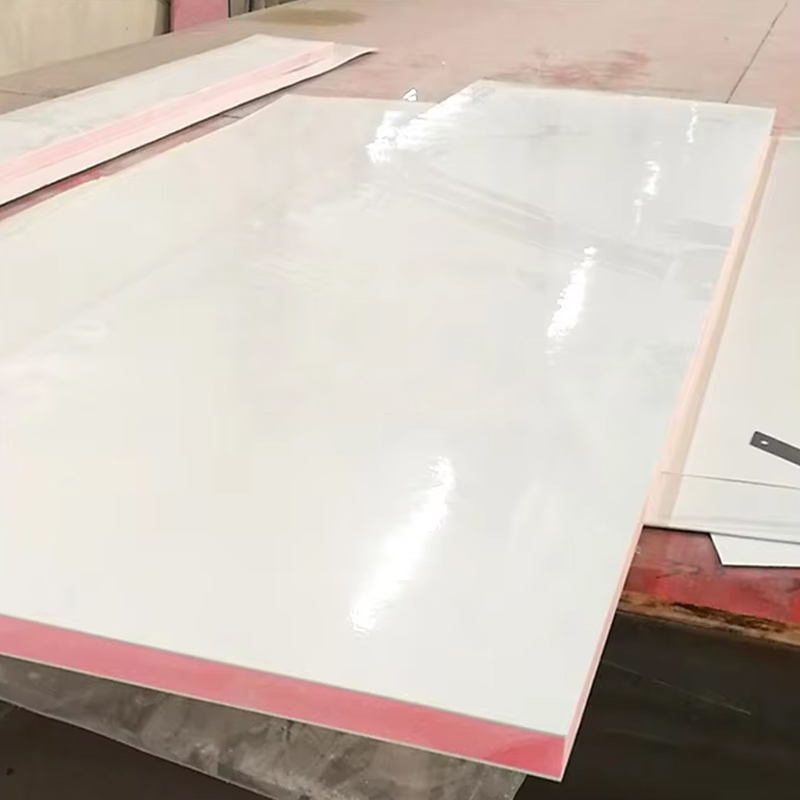
PP Honeycomb Core Bonding with FRP Skins: Adhesives, Surface Treatment and Delamination Prevention
1. Introduction: Why Is PP Honeycomb Bonding Important?
PP honeycomb core is widely considered in lightweight composite sandwich panel manufacturing because of its cellular structure and low weight. When combined with FRP (Fiber Reinforced Plastic) skins, it can be used to manufacture composite panels for truck bodies, trailers, transportation equipment and industrial applications.
However, one technical challenge deserves particular attention: bonding polypropylene honeycomb core to FRP skins.
Unlike some foam core materials, polypropylene has relatively low surface energy. This characteristic can make it difficult for conventional adhesives and resin systems to achieve reliable adhesion directly to the PP surface.
In practical manufacturing, an unsuitable bonding system may lead to weak adhesion, interfacial failure or delamination during panel production or service.
For FRP sandwich panel manufacturers, the bonding process is therefore just as important as selecting the correct core density, cell size and thickness.
This article explains the key factors involved in PP honeycomb bonding, including surface treatment, adhesive selection, nonwoven facing, production process control and quality testing.
2. Why Is Polypropylene Difficult to Bond?
Polypropylene is a non-polar thermoplastic material with relatively low surface energy.
In simple terms, many conventional adhesives do not spread or interact with untreated polypropylene surfaces as effectively as they do with higher-surface-energy materials.
This can create several bonding challenges:
- Poor adhesive wetting
- Limited interfacial adhesion
- Inconsistent bonding strength
- Localized adhesive separation
- Delamination under mechanical or environmental stress
The problem is not necessarily related to the adhesive strength alone.
Even when an adhesive has good mechanical properties, the bond may fail if the interface between the adhesive and PP surface is inadequate.
This is why polypropylene bonding should be evaluated as a complete material system rather than simply selecting an adhesive based on its product description.
Key Factors Affecting PP Bonding
| Factor | Potential Influence |
|---|---|
| PP Surface Energy | Affects adhesive wetting and interfacial adhesion |
| Surface Cleanliness | Contamination can reduce bonding reliability |
| Surface Treatment | May improve surface wettability and adhesion |
| Adhesive Chemistry | Determines compatibility with PP and FRP |
| Adhesive Application | Influences coverage and bond-line consistency |
| Curing Conditions | Affects the development of final bond properties |
| Service Environment | Temperature, moisture and vibration can affect durability |
For manufacturers, the first step should be identifying the exact PP honeycomb configuration and the bonding system required for the finished panel.
3. Main Bonding Methods for PP Honeycomb Core and FRP Skins
There is no single bonding method that is suitable for every PP honeycomb core, FRP skin and production process.
The appropriate method depends on the PP formulation, surface condition, facing material, adhesive chemistry, manufacturing equipment and final application.
Several approaches can be evaluated.
3.1 Direct Adhesive Bonding with Surface Preparation
Direct adhesive bonding involves applying a compatible adhesive system between the PP honeycomb core and FRP skin.
Because untreated PP has low surface energy, surface preparation may be necessary.
Potential preparation methods include:
- Cleaning to remove dust, oil and processing contamination
- Controlled surface activation
- Plasma treatment
- Corona treatment
- Flame treatment, where suitable and safely controlled
Surface activation methods are not interchangeable. Their suitability depends on the material geometry, treatment equipment, production speed and required bonding performance.
For example, treating the exposed surface of a honeycomb structure can be more complicated than treating a flat polypropylene sheet.
The treatment must reach the relevant bonding surfaces without damaging or deforming the cellular structure.
Direct bonding should be validated through actual production-representative samples.
3.2 Nonwoven Faced PP Honeycomb Core
Nonwoven faced PP honeycomb is an alternative configuration that can be evaluated for composite panel production.
In this structure, a nonwoven fabric layer is attached to one or both sides of the PP honeycomb core.
The nonwoven facing provides an additional surface for the adhesive system and may improve compatibility with selected FRP panel manufacturing processes.
Potential advantages include:
- A different bonding interface compared with exposed PP
- More convenient adhesive application in suitable production systems
- Greater flexibility in developing composite panel structures
- Potential integration into established sandwich panel production processes
However, nonwoven facing does not automatically solve every bonding problem.
There are two separate interfaces:
Interface 1: PP Honeycomb Core to Nonwoven Facing
The connection between the polypropylene cellular structure and the nonwoven material must be reliable.
Interface 2: Nonwoven Facing to FRP Skin
The adhesive or resin system must also provide suitable bonding between the facing material and the FRP skin.
Both interfaces require validation.
If the first interface is weak, the nonwoven layer may separate from the PP core. If the second interface is weak, the FRP skin may detach from the facing.
Therefore, the complete faced core should be evaluated as a finished material configuration.
3.3 Using a Compatible Adhesive System
Adhesive selection should be based on compatibility with both bonding surfaces.
Potential adhesive categories for composite sandwich panel development include:
- Polyurethane adhesives
- Epoxy adhesive systems
- Acrylic adhesive systems
- Specialized structural adhesives designed for low-surface-energy plastics
- Adhesive systems recommended for specific nonwoven and FRP combinations
These are candidate categories for evaluation, not interchangeable or universally suitable solutions.
The selection process should consider:
- Compatibility with polypropylene or the facing material
- Compatibility with the FRP surface
- Required bond-line thickness
- Open time and working time
- Curing conditions
- Production cycle requirements
- Resistance to moisture and temperature changes
- Long-term mechanical performance
An adhesive suitable for bonding a PP sheet may not necessarily be suitable for bonding a cellular PP honeycomb core.
The geometry, contact area and load transfer mechanism are different.
4. How to Select the Right Adhesive for PP Honeycomb and FRP Panels
Choosing an adhesive based only on its initial bonding strength is not sufficient.
A reliable bonding system must work with the complete panel structure and the intended manufacturing process.
Adhesive Selection Comparison
| Adhesive Category | Potential Evaluation Area | Important Consideration |
|---|---|---|
| Polyurethane Adhesive | Flexible composite bonding | Confirm PP compatibility and curing requirements |
| Epoxy Adhesive | Structural bonding applications | Untreated PP adhesion should not be assumed |
| Acrylic Adhesive | Selected plastic and composite bonding | Confirm compatibility with the exact PP grade |
| Low-Surface-Energy Structural Adhesive | Bonding difficult-to-bond plastics | Verify performance on actual honeycomb geometry |
| Resin-Based Bonding System | FRP composite panel production | Confirm compatibility with PP surface or facing |
The final adhesive choice should be determined through supplier technical data, material compatibility assessment and bonding trials.
Questions to Ask an Adhesive Supplier
Before purchasing an adhesive for PP honeycomb core bonding, manufacturers should ask:
- Is the adhesive suitable for polypropylene?
- Does it require surface activation or a primer?
- Can it bond the selected FRP skin?
- Is it compatible with the nonwoven facing material?
- What is the recommended bond-line thickness?
- What are the recommended curing conditions?
- What are its temperature and moisture resistance characteristics?
- Can it be used with the existing production equipment?
The answers should be documented and confirmed through testing.
5. Surface Treatment for PP Honeycomb Core
Surface treatment is an important part of developing reliable PP bonding.
The objective is to improve the surface condition and bonding compatibility without damaging the material.
5.1 Cleaning and Surface Preparation
Before bonding, the PP honeycomb surface should be inspected for:
- Dust
- Oil or grease
- Loose particles
- Manufacturing residues
- Surface damage
- Moisture or other contamination
Cleaning methods must be compatible with the PP material and the selected adhesive.
Solvents should not be introduced without confirming their compatibility and safety.
5.2 Plasma Treatment
Plasma treatment can modify the surface chemistry of polypropylene and increase surface wettability.
It is used in selected industrial processes to improve adhesion to difficult-to-bond polymer surfaces.
Important process considerations include:
- Treatment intensity
- Treatment uniformity
- Distance from the treatment source
- Production speed
- Time between treatment and bonding
Surface activation effects can change over time. Therefore, the interval between treatment and adhesive application should be controlled and validated.
5.3 Corona Treatment
Corona treatment is commonly used to improve the surface wettability of polymer films and sheets.
It may be considered for suitable PP surfaces, but the effectiveness of corona treatment on a finished three-dimensional honeycomb core depends on the equipment and the accessible bonding surfaces.
Manufacturers should confirm that the treatment reaches the actual bonding areas.
5.4 Flame Treatment
Flame treatment can increase surface energy on certain polypropylene surfaces.
However, the process requires careful control.
Excessive heat can damage, deform or weaken the honeycomb structure.
For thin-walled cellular materials, flame treatment should only be considered after equipment and process trials establish a safe operating window.
Surface Treatment Comparison
| Method | Main Purpose | Important Limitation |
|---|---|---|
| Cleaning | Remove surface contamination | Does not necessarily increase surface energy |
| Plasma Treatment | Modify surface chemistry | Requires controlled equipment and process |
| Corona Treatment | Improve surface wettability | Access to honeycomb bonding surfaces must be verified |
| Flame Treatment | Activate suitable polymer surfaces | Excessive heat may damage the core |
The best treatment method is the one that produces repeatable bonding performance without damaging the core.
6. Bonding Process for PP Honeycomb FRP Sandwich Panels
A controlled manufacturing process helps reduce bonding defects and improve panel consistency.
The exact process depends on the selected PP core, FRP skin, adhesive system and production equipment.
A typical development workflow includes the following stages.
Step 1: Incoming Material Inspection
Inspect the PP honeycomb core and FRP skins before production.
Check:
- Core thickness
- Core dimensions
- Bulk density or product weight
- Cell structure
- Facing condition, if applicable
- FRP skin thickness
- Surface cleanliness
- Material identification and batch records
Damaged or contaminated materials should be evaluated before use.
Step 2: Core Cutting and Preparation
Cut the PP honeycomb core to the required panel dimensions.
Check cutting accuracy and ensure that the core remains dimensionally stable.
If surface treatment is required, perform it according to the validated procedure.
Step 3: FRP Skin Preparation
Prepare the FRP skins according to the adhesive manufacturer’s recommendations.
The bonding surface should be clean and compatible with the selected adhesive system.
Where necessary, surface preparation should be confirmed through trial bonding.
Step 4: Adhesive Application
Apply the adhesive using the validated application method.
Important control factors include:
- Adhesive quantity
- Application uniformity
- Open time
- Bond-line thickness
- Coverage of the intended bonding areas
Insufficient adhesive may result in incomplete bonding.
Excessive adhesive may increase panel weight and cost without necessarily improving performance.
Step 5: Panel Assembly
Position the PP honeycomb core between the FRP skins.
Ensure correct alignment and prevent unwanted movement during assembly.
For nonwoven faced PP honeycomb, confirm that the intended facing surfaces are positioned against the correct adhesive and FRP interfaces.
Step 6: Pressing and Curing
Apply the pressure and curing conditions specified for the validated material system.
Pressure must be sufficient to establish contact between the bonding surfaces without crushing or deforming the honeycomb structure.
Temperature, pressure and curing time should not be selected from a generic recipe.
They must be established according to the adhesive system, core structure, FRP skin and production equipment.
Step 7: Trimming and Finished Panel Inspection
After curing, trim the panel to the required dimensions.
Inspect:
- Panel thickness
- Flatness
- Edge condition
- Surface appearance
- Local deformation
- Delamination
- Bonding consistency
Representative samples should be tested according to the project’s quality requirements.
7. Common Bonding Problems and How to Prevent Delamination
Delamination is one of the important failure modes in composite sandwich panels.
It can occur between the FRP skin and adhesive, adhesive and facing, or facing and PP honeycomb core.
Identifying the failure interface is essential before selecting corrective measures.
Common Bonding Defects
| Problem | Possible Cause | Recommended Investigation |
|---|---|---|
| FRP Skin Separation | Poor adhesive compatibility or inadequate surface preparation | Examine FRP-to-adhesive interface |
| Facing Separation | Weak PP-to-facing connection | Test the core-to-facing interface |
| Localized Unbonded Areas | Uneven adhesive application or insufficient contact | Inspect adhesive coverage |
| Core Crushing | Excessive pressing pressure or unsuitable support | Review pressure distribution and core compression properties |
| Panel Warpage | Uneven curing, temperature or material stresses | Review process uniformity |
| Edge Delamination | Poor edge design, sealing or local bonding | Inspect edge construction |
| Inconsistent Bonding | Variation in surface condition or process parameters | Review incoming materials and process records |
How to Reduce Delamination Risk
1. Confirm Material Compatibility
Do not assume that a conventional adhesive will bond directly to untreated polypropylene.
2. Validate Both Bonding Interfaces
For nonwoven faced PP honeycomb, evaluate both the core-to-facing and facing-to-FRP connections.
3. Control Adhesive Application
Use a consistent application method and monitor adhesive quantity and coverage.
4. Establish a Validated Pressing Process
Excessive pressure can damage the honeycomb core, while insufficient pressure may prevent proper contact.
5. Test the Finished Sandwich Panel
A good-looking panel does not necessarily have reliable internal bonding.
Mechanical testing should be included in the product development and quality control process.
8. Testing Methods for PP Honeycomb and FRP Bonding Performance
Bonding performance should be evaluated through representative test specimens and, where appropriate, finished panel testing.
Important evaluation areas include:
8.1 Flatwise Tensile Testing
Flatwise tensile testing helps assess the resistance of the sandwich construction to tensile loading perpendicular to the panel surface.
It can help identify weak core or bonding interfaces.
8.2 Core Shear Testing
Core shear testing evaluates the ability of the core structure to resist shear loads.
This is important because the core transfers shear between the two FRP skins.
8.3 Sandwich Panel Flexural Testing
Flexural testing helps assess the structural behavior of the complete sandwich construction.
It can provide information about panel stiffness, strength and failure behavior under bending loads.
8.4 Peel or Interface-Specific Testing
Where appropriate, project-specific peel or interface tests can help identify the quality of the bond between individual layers.
The test method should reflect the actual material configuration and failure mode being investigated.
Relevant ASTM Standards
| Standard | General Evaluation Area |
|---|---|
| ASTM C297/C297M | Flatwise tensile strength of sandwich constructions |
| ASTM C273/C273M | Core shear properties |
| ASTM C393/C393M | Flexural properties of sandwich constructions |
| ASTM C365/C365M | Flatwise compressive properties of sandwich cores |
| ASTM C271/C271M | Sandwich core density |
The current standard edition, specimen configuration and scope should be confirmed before specifying a test.
For PP honeycomb FRP panels, the test report should identify the complete material configuration, including core type, facing, adhesive, FRP skin and manufacturing conditions.
9. Bonding Considerations for Different Truck Body Applications
The bonding system should also reflect the service conditions of the finished truck body panel.
Truck Side Wall Panels
Side walls require a balance of low weight, bending performance and durable bonding.
The bonding system should be evaluated under the expected panel dimensions, support spacing and service loads.
Truck Roof Panels
Roof panels may experience temperature changes, moisture exposure and environmental loading.
The complete panel should be evaluated for bonding durability, water ingress and edge sealing.
Truck Floor Panels
Floor panels experience concentrated loads, repeated loading and impact.
The core and bonding system must be assessed as part of a complete structural design.
Additional reinforcement may be required in areas exposed to high local loads.
Rear Door Panels
Rear doors require reliable bonding around hinges, locks and other hardware.
Local inserts, reinforced core sections and suitable edge construction may be necessary.
Application-Based Bonding Requirements
| Application | Main Bonding Consideration |
|---|---|
| Side Wall | Uniform skin-to-core bonding |
| Roof | Bonding durability and environmental protection |
| Floor | Shear, compression and impact performance |
| Rear Door | Local reinforcement and hardware attachment |
| Front Wall | Structural stability and connection details |
A bonding system that works for a side wall should not automatically be approved for a truck floor or rear door.
10. How to Work with a PP Honeycomb Core Supplier
For FRP sandwich panel manufacturers, the core supplier should understand the complete application rather than simply provide a material price.
Before placing an order, buyers should communicate the following information:
| Item | Required Information |
|---|---|
| Core Material | Polypropylene Honeycomb |
| Application | Truck Body / Trailer / FRP Sandwich Panel |
| Core Thickness | Required thickness |
| Cell Size | Required cell dimension |
| Bulk Density | Target density |
| Facing | Bare / Nonwoven Faced |
| Facing Configuration | One Side / Both Sides |
| FRP Skin | Material type and thickness |
| Adhesive | Type and technical requirements, if known |
| Manufacturing Process | Pressing, lamination or other process |
| Mechanical Requirements | Compression, shear and bonding targets |
| Panel Dimensions | Length and width |
| Estimated Demand | Sample quantity and annual requirement |
If the buyer is still developing the panel structure, it is useful to share drawings, material samples and the intended production process.
This allows the core supplier, adhesive supplier and panel manufacturer to evaluate the material system together.
11. Why Choose ONEBOND for Composite Core Materials?
ONEBOND focuses on composite core materials and lightweight sandwich panel solutions for industrial applications.
Our product portfolio includes PP honeycomb core, PET foam core, PVC foam core, XPS foam core and other materials used in composite panel manufacturing.
For FRP sandwich panel producers, choosing the correct core material is only one part of the development process. Core configuration, facing selection, bonding compatibility and finished panel performance must also be considered.
ONEBOND can discuss project-specific requirements for:
- Bare PP Honeycomb Core
- Nonwoven Faced PP Honeycomb Core
- Customized PP Honeycomb Core Configurations
- PP Honeycomb Core for FRP Composite Panels
- Foam Core Materials for Sandwich Panel Manufacturing
Our goal is to support manufacturers in evaluating suitable core materials for their production processes and final applications.
Contact ONEBOND to discuss your PP honeycomb core requirements for FRP sandwich panel manufacturing.
12. Frequently Asked Questions About PP Honeycomb Core Bonding
Q1: Why is PP honeycomb core difficult to bond with FRP skins?
Polypropylene has relatively low surface energy, which can make it difficult for conventional adhesives to achieve reliable adhesion to untreated PP surfaces.
Q2: Can PP honeycomb core be bonded directly to FRP?
Direct bonding may be possible with a suitable adhesive and validated surface preparation, but compatibility must be confirmed through testing.
Q3: What adhesive is best for PP honeycomb core?
There is no universally best adhesive. The selection depends on the PP surface, FRP skin, facing material, manufacturing process and service conditions.
Q4: Does plasma treatment improve PP honeycomb bonding?
Plasma treatment can increase surface wettability and modify polypropylene surface chemistry, but its effectiveness must be validated on the actual honeycomb structure.
Q5: What is nonwoven faced PP honeycomb core?
It is polypropylene honeycomb core with a nonwoven fabric layer attached to one or both sides to provide an alternative surface for composite panel bonding.
Q6: Does nonwoven facing eliminate PP bonding problems?
No. The PP-to-facing interface and the facing-to-FRP interface must both be evaluated.
Q7: What causes delamination in FRP sandwich panels?
Possible causes include poor material compatibility, insufficient surface preparation, uneven adhesive application, unsuitable curing conditions and inadequate process control.
Q8: How can manufacturers test PP honeycomb bonding strength?
They can use suitable flatwise tensile, core shear, flexural and interface-specific tests based on the complete panel construction.
Q9: Can PP honeycomb core be used in truck body panels?
It can be evaluated for selected truck body applications, including side walls, roofs and other composite structures, provided the complete panel meets the required performance criteria.
Q10: What should buyers provide when requesting PP honeycomb core samples?
Buyers should provide the required thickness, cell size, density, facing configuration, FRP skin type, adhesive system and intended application.
Conclusion
Bonding is one of the most important considerations when using PP honeycomb core in FRP sandwich panel manufacturing.
Because polypropylene has relatively low surface energy, manufacturers must pay close attention to adhesive compatibility, surface preparation and interface quality.
Bare PP honeycomb and nonwoven faced PP honeycomb offer different material configurations, but neither should be considered automatically suitable without testing.
A reliable solution requires a complete evaluation of the core, facing, adhesive, FRP skin, manufacturing process and final service conditions.
For truck body and trailer manufacturers, this approach helps reduce bonding defects, improve production consistency and develop lightweight composite panels with more predictable performance.
ONEBOND provides PP honeycomb core and composite core material solutions for manufacturers developing FRP sandwich panels and lightweight industrial structures.
