
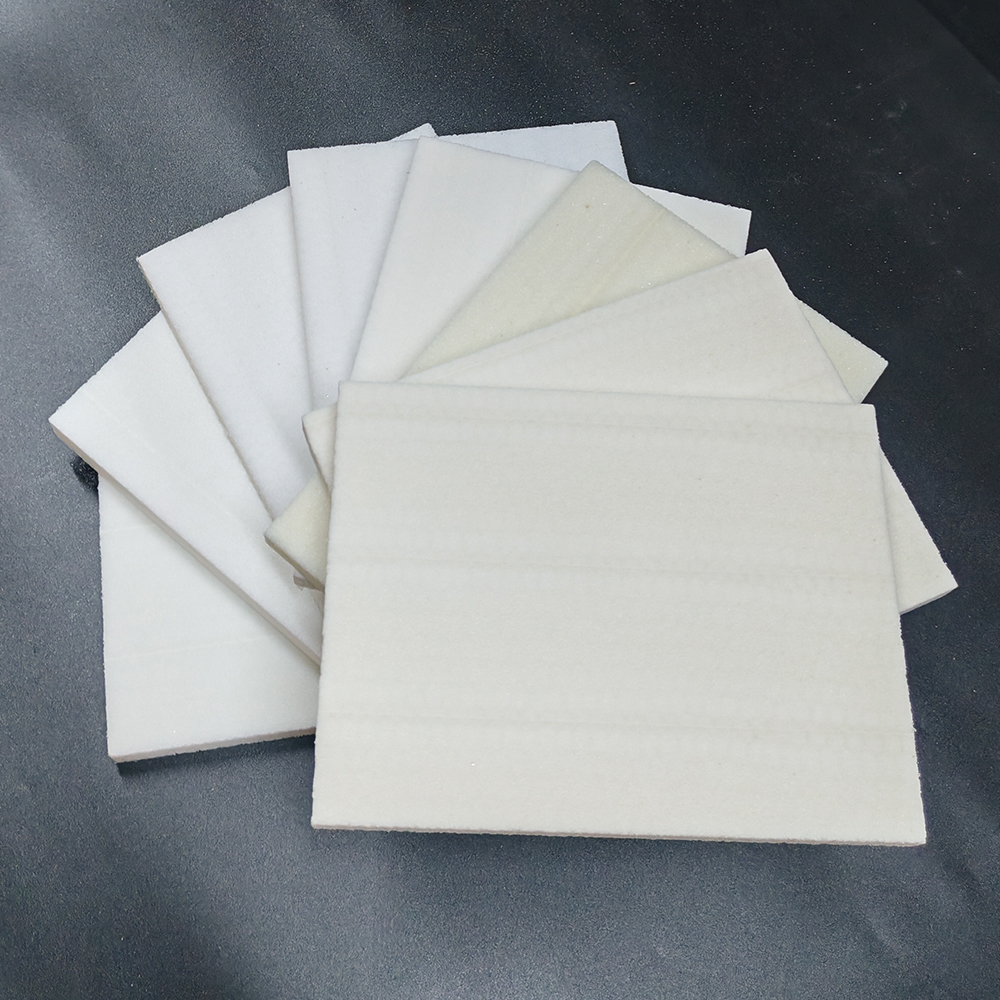
1. What Is PMI Foam Core?
PMI Foam Core, also known as Polymethacrylimide Foam Core or Polymethacrylimide Structural Foam, is a high-performance rigid polymer foam developed for lightweight structural engineering applications.
Unlike conventional insulation foams, PMI foam is primarily designed to function as a structural core in advanced composite sandwich constructions. It is manufactured through a specialized polymerization and foaming process, forming a rigid, cross-linked, predominantly closed-cell structure.
In a typical composite sandwich structure, PMI foam is positioned between two high-strength skins, such as carbon fiber reinforced polymer (CFRP), glass fiber reinforced polymer (GFRP), or other advanced composite laminates.
This construction offers several important advantages:
- High structural stiffness at relatively low weight
- Good compressive and shear performance
- High heat resistance compared with many conventional polymer foams
- Good dimensional stability under suitable processing conditions
- Compatibility with advanced composite manufacturing processes
- Potential for integrated sandwich manufacturing and co-curing
PMI Foam Core is particularly important in industries where weight reduction directly affects product performance, energy efficiency, payload capacity, or operating cost.
Typical markets include aerospace, aviation, satellites, high-performance automotive components, motorsports, advanced rail transportation, medical equipment, and specialized industrial composites.
Its value is not simply that it is lightweight. Its main advantage is the ability to maintain useful mechanical properties under demanding composite manufacturing and service conditions.
2. Why PMI Foam Core Is Different from Conventional Foam Materials
To understand the importance of PMI foam, it is necessary to examine the relationship between core material properties and sandwich structure performance.
In a conventional solid laminate, most of the material is concentrated within a relatively thin structural section. In a sandwich structure, two strong outer skins are separated by a lightweight core.
The outer skins primarily resist tensile and compressive stresses caused by bending, while the core maintains the distance between the skins, transfers shear loads, and supports the face sheets against local deformation.
This structural arrangement can significantly improve bending stiffness without requiring a solid component of equivalent thickness.
PMI foam is particularly suitable for this design because it combines relatively low density with useful compressive strength, shear strength, and thermal stability.
2.1 High Specific Strength and Specific Stiffness
Specific strength refers to strength relative to material density. Specific stiffness refers to elastic modulus relative to density.
These are important selection criteria in aerospace and high-performance composite engineering because reducing weight while maintaining structural performance is often more valuable than maximizing strength alone.
For example, an aircraft component may need to meet strict weight, stiffness, vibration, and fatigue requirements simultaneously.
PMI foam can support these objectives by providing a lightweight core with mechanical properties suitable for structural sandwich applications.
However, the final performance is determined by the complete sandwich structure, including face-sheet material, laminate thickness, adhesive or resin system, core density, and component geometry.
2.2 High Compressive and Shear Performance
Two important mechanical properties of PMI Foam Core are compressive strength and shear strength.
Compressive strength measures the ability of the foam to resist forces acting perpendicular to its surface. It is important for preventing core crushing under localized loads and supporting the outer skins.
Shear strength measures the ability of the core to resist forces acting parallel to the sandwich panel surface. It is particularly important in bending-loaded panels, aircraft structures, and composite components with complex load paths.
Increasing PMI foam density generally improves these mechanical properties, but it also increases material weight and cost.
Therefore, selecting the highest-density grade is not necessarily the best engineering decision. The correct density should be determined by structural calculations and application requirements.
2.3 Heat Resistance and Dimensional Stability
PMI foam is widely used in advanced composite manufacturing because selected grades can withstand elevated curing temperatures.
This is important when manufacturing carbon fiber or fiberglass composite components using prepreg and autoclave processes.
Some commercial PMI foam grades are designed for curing temperatures around 130°C, while specialized heat-resistant grades can support higher processing temperatures, including selected systems designed for approximately 180–190°C.
The actual temperature capability depends on the specific grade, heat treatment, pressure, exposure duration, and processing cycle.
It is essential to distinguish between maximum recommended curing temperature, heat distortion temperature, and long-term service temperature. These are different technical properties and should not be used interchangeably.
2.4 Fine Closed-Cell Structure and Resin Uptake
The cellular structure of PMI foam is another important factor in advanced composite manufacturing.
A fine closed-cell structure helps limit resin penetration into the bulk foam. When the foam is cut or machined, some cells become exposed at the surface, allowing controlled resin interaction and bonding.
This can help reduce unnecessary resin consumption while maintaining bonding between the core and composite skins.
Resin uptake is influenced by cell size, surface preparation, machining conditions, resin viscosity, and the manufacturing process.
For high-value composite components, controlling resin consumption is important because excess resin increases finished-part weight and may affect the intended fiber-to-resin ratio.
3. PMI Foam Core Technical Specifications
PMI Foam Core is available in different density grades. Higher-density grades generally offer greater compressive and shear performance, while lower-density grades are used where weight reduction is the main priority.
The following table presents representative technical data from a commercial PMI foam product series.
Typical Mechanical Properties of PMI Foam Core
| Property | Test Standard | PMI 31 HF | PMI 51 HF | PMI 71 HF |
|---|---|---|---|---|
| Nominal Density (kg/m³) | ISO 845 | 32 | 52 | 75 |
| Compressive Strength (MPa) | ISO 844 | 0.4 | 0.9 | 1.5 |
| Tensile Strength (MPa) | ISO 527-2 | 1.0 | 1.9 | 2.8 |
| Tensile Modulus (MPa) | ISO 527-2 | 36 | 70 | 92 |
| Shear Strength (MPa) | DIN 53294 | 0.4 | 0.8 | 1.3 |
| Shear Modulus (MPa) | DIN 53294 | 13 | 19 | 29 |
| Elongation at Break (%) | ISO 527-2 | 3.5 | 4.0 | 4.5 |
Source: Evonik ROHACELL HF product information. These are representative values for the HF product series, not universal values for all PMI foam products. Density tolerances and mechanical properties depend on product grade and test conditions.
Additional PMI Foam Core Specifications
| Item | Typical Product Information |
|---|---|
| Material | Polymethacrylimide (PMI) |
| Material Structure | Cross-linked rigid closed-cell foam |
| Common Density Grades | Approximately 30–200 kg/m³, depending on series |
| Available Thickness | Grade- and manufacturer-dependent |
| Surface | Plain, machined, grooved, perforated, or customized |
| Processing | CNC machining, milling, drilling, thermoforming, and contour cutting |
| Composite Processes | Prepreg, autoclave, vacuum infusion, RTM, and VARTM, subject to grade |
| Typical Applications | Aerospace, aviation, automotive, medical, marine, and industrial composites |
The specifications above should be used as a technical reference rather than a universal product guarantee. Different PMI manufacturers and product series may have different density grades, cell structures, mechanical properties, and processing limits.
4. PMI Foam Core Manufacturing and Composite Processing
PMI foam is manufactured through a specialized chemical process involving polymer formation, foaming, expansion, and stabilization.
The exact production formulation and process parameters vary by manufacturer. Compared with conventional commodity foam production, PMI manufacturing requires more precise control of polymer chemistry, cellular structure, density, and dimensional stability.
After foam production, the material is processed into sheets, blocks, or customized structural shapes.
4.1 CNC Machining and Precision Cutting
PMI foam can be processed using several conventional machining methods:
- CNC milling
- Drilling
- Turning
- Saw cutting
- Sanding
- Contour cutting
- Thermoforming
These methods allow manufacturers to produce complex core geometries for aerospace structures, curved panels, structural reinforcements, and customized composite components.
Machining accuracy is important because uneven core surfaces or incorrect dimensions may lead to non-uniform bonding pressure and local defects during composite manufacturing.
4.2 Prepreg and Autoclave Processing
PMI foam is used in selected prepreg and autoclave manufacturing processes.
In these processes, pre-impregnated composite fabrics are placed over the foam core and consolidated under controlled temperature and pressure.
The core must maintain sufficient mechanical strength and dimensional stability throughout the curing cycle.
A major engineering consideration is the possibility of core compression or deformation under elevated temperature and pressure.
Therefore, the selected PMI grade must be matched to the actual curing temperature, pressure, heating rate, and holding time.
4.3 Vacuum Infusion and VARTM
PMI foam can also be used in suitable vacuum infusion processes.
Vacuum-assisted resin transfer molding (VARTM) uses vacuum pressure to draw resin through dry reinforcement materials and into the composite structure.
PMI core grades developed for infusion applications can provide a combination of structural performance and controlled resin interaction.
However, the resin flow strategy must be designed carefully. Core perforations, grooves, surface preparation, resin viscosity, and infusion pressure all influence the manufacturing result.
4.4 RTM and Co-Curing
Resin Transfer Molding (RTM) and co-curing processes can be used to manufacture integrated composite sandwich structures.
PMI foam is suitable for selected processes where the core and composite skins are consolidated within a controlled manufacturing cycle.
One potential benefit is the reduction of secondary bonding operations. Instead of manufacturing separate components and bonding them together afterward, certain sandwich structures can be produced in a more integrated process.
This may reduce assembly time and improve production consistency when the process is properly engineered.
5. The Engineering Challenge: PMI Foam Under Heat and Pressure
One of the most important issues in PMI foam applications is its mechanical response during elevated-temperature composite molding.
PMI foam may retain useful mechanical properties at high temperatures, but its compressive strength and modulus are not constant throughout the curing cycle.
A 2024 study published in Polymers investigated the thermo-mechanical behavior of PMI foam between 20°C and 120°C.
The researchers reported that, compared with room-temperature measurements, the foam’s yield stress decreased by approximately 22% at 80°C and 35.2% at 120°C. Its elastic modulus also decreased as temperature increased.
The study further observed a change in failure behavior from predominantly brittle fracture toward plastic yielding at elevated temperatures.
This finding has important implications for sandwich panel manufacturing. A core that performs well under room-temperature compression testing may behave differently under the combined effects of temperature and molding pressure.
Key Manufacturing Risks
Core Compression: Excessive pressure during molding may cause the core to deform or collapse.
Skin-to-Core Debonding: Core deformation can generate defects at the interface between the foam and composite skins.
Dimensional Variation: Temperature and moisture changes may affect the dimensions of the foam before and during processing.
Local Defects: Uneven pressure distribution or inconsistent core thickness may produce non-uniform structural performance.
For this reason, selecting PMI foam based only on its room-temperature compressive strength is insufficient. Engineers should evaluate the complete temperature-pressure-time cycle of the manufacturing process.
6. Main Applications of PMI Foam Core
6.1 Aerospace and Aircraft Manufacturing
Aerospace is one of the most important high-performance markets for PMI structural foam.
In aircraft manufacturing, reducing structural weight can improve fuel efficiency, payload capacity, and overall operating performance.
PMI foam is used in selected composite sandwich structures, including:
- Aircraft interior panels
- Cabin structural components
- Control surfaces
- Radome structures
- Lightweight composite panels
- Selected secondary aircraft structures
Aerospace applications require strict control of material traceability, dimensional tolerances, process qualification, and fire-related performance.
A commercial PMI grade should not automatically be considered aircraft-approved. Buyers must confirm the exact grade, qualification status, and applicable project requirements.
6.2 UAV and Advanced Aircraft Structures
Unmanned aerial vehicles (UAVs), high-performance drones, and advanced aircraft structures often require a combination of low weight, structural rigidity, and aerodynamic precision.
PMI foam can be used as a core in:
- UAV wings
- Fuselage sandwich panels
- Composite fairings
- Lightweight structural covers
- High-performance drone components
Its machining and thermoforming capabilities also support the production of complex geometries.
For these applications, core selection should consider impact resistance, vibration, fatigue, local load introduction, and environmental exposure.
6.3 Satellite and Space Structures
Satellite structures and space-related components often require materials with high stiffness-to-weight ratios and precise dimensional control.
PMI foam is used in selected sandwich structures, antenna components, and other lightweight composite designs.
Specialized PMI grades can also be selected for applications requiring particular dielectric or electromagnetic properties.
For example, certain fine-cell PMI foam grades are developed for radomes and antenna structures where signal transmission and dielectric characteristics are important.
These applications require careful selection of dielectric constant, dielectric loss, moisture management, and the properties of the complete laminate system.
6.4 Automotive and Motorsports
In high-performance automotive manufacturing, lightweight structures can improve vehicle acceleration, handling, and energy efficiency.
PMI foam may be incorporated into selected carbon fiber or fiberglass sandwich structures.
Potential applications include:
- Racing vehicle body panels
- Lightweight aerodynamic components
- Composite structural covers
- High-performance interior panels
- Lightweight vehicle components
In motorsports, the relationship between component weight, stiffness, and structural safety is particularly important.
PMI is generally a premium core option rather than a universal replacement for lower-cost automotive foam materials.
6.5 Medical Equipment and Specialized Industrial Products
PMI foam also has applications in medical technology and specialized industrial equipment.
Its lightweight structure and potential for precise machining make it suitable for selected imaging-related components, positioning structures, and customized composite panels.
Certain grades are also used in radomes, communication equipment, and electronic structures where low dielectric properties are important.
The final application must be matched to the relevant mechanical, electrical, chemical, and regulatory requirements.
7. PMI Foam Core vs. PVC, PET, and SAN Foam Core
PMI, PVC, PET, and SAN are all used as foam core materials in composite manufacturing. However, they serve different market segments and performance requirements.
| Comparison | PMI Foam Core | PVC Foam Core | PET Foam Core | SAN Foam Core |
|---|---|---|---|---|
| Material | Polymethacrylimide | Cross-linked PVC | Polyethylene Terephthalate | Styrene Acrylonitrile |
| Main Market | High-performance composites | Marine and industrial composites | Wind energy, marine, transportation | Wind energy and structural composites |
| Strength-to-Weight Potential | Very high in suitable grades | Good | Good to high, depending on grade | Good to high, depending on grade |
| Temperature Capability | High for selected grades | Grade-dependent | Grade-dependent | Grade-dependent |
| Processing | Prepreg, autoclave, infusion, RTM | Infusion, lamination, bonding | Infusion, lamination, bonding | Infusion and composite lamination |
| Typical Density | Approximately 30–200 kg/m³ | Approximately 45–250 kg/m³ | Approximately 60–320 kg/m³ | Grade-dependent |
| Cost Position | Premium | Medium to high | Medium | Medium to high |
When Should Manufacturers Choose PMI Foam?
PMI is worth considering when:
- The finished component has demanding weight and stiffness requirements.
- The composite manufacturing process involves elevated curing temperatures.
- High compressive and shear performance are required at relatively low density.
- The component has complex geometry and requires precision machining.
- The application requires specialized electrical or dielectric properties.
When Are PVC, PET, or SAN More Practical?
PVC foam may be more practical for established marine and general structural composite applications.
PET foam may be attractive when manufacturers require thermoplastic-based core materials and a potential recycled-material supply chain.
SAN foam can be considered for selected structural composite applications, including wind energy, depending on the required fatigue and mechanical properties.
The correct material should be selected through a comparison of finished-component performance, processing compatibility, material cost, and lifecycle requirements.
8. How to Select the Right PMI Foam Core
Selecting a PMI foam core requires a more detailed engineering evaluation than selecting a conventional insulation foam.
The following factors should be considered.
1. Density and Mechanical Requirements
Choose the density according to the required compressive strength, shear strength, modulus, and weight target.
2. Curing Temperature
Confirm the maximum curing temperature supported by the selected PMI grade. Do not rely on a general PMI temperature rating.
3. Molding Pressure
Evaluate the compressive behavior of the foam under the actual pressure applied during autoclave, RTM, or other molding processes.
4. Core Thickness and Geometry
Determine the required thickness, curvature, local reinforcement, and machining tolerance according to the component design.
5. Resin Compatibility
Confirm compatibility with epoxy, polyester, vinyl ester, or other selected resin systems.
6. Moisture Management
PMI foam can absorb moisture through diffusion despite its closed-cell structure. Proper storage and drying before processing may be necessary.
7. Surface Preparation and Bonding
Evaluate surface quality, machining condition, adhesive compatibility, and the required skin-to-core bonding performance.
8. Qualification and Traceability
For aerospace and other regulated markets, confirm material certificates, batch traceability, testing requirements, and project-specific qualification.
9. ONEBOND PMI Foam Core Solutions
ONEBOND focuses on composite core materials and lightweight sandwich panel solutions for international industrial customers.
Our broader product portfolio covers foam core materials and honeycomb core materials for different composite manufacturing requirements.
For PMI Foam Core projects, material selection should be based on the intended application and the technical requirements of the finished component.
Important specification items include:
- PMI foam density
- Compressive and shear properties
- Sheet thickness and dimensions
- Surface quality and machining tolerances
- CNC cutting and customized contours
- Prepreg and resin processing compatibility
- Processing temperature and pressure requirements
PMI foam is a specialized material category. Buyers should provide the application, required density, thickness, manufacturing process, and performance targets when requesting a quotation.
This information helps establish whether PMI is the appropriate core material or whether PVC, PET, SAN, or another structural foam would provide a more cost-effective solution.
Contact ONEBOND to discuss your PMI Foam Core requirements and customized composite core material solutions.
10. Frequently Asked Questions About PMI Foam Core
Q1: What is PMI Foam Core used for?
PMI Foam Core is primarily used in high-performance composite sandwich structures for aerospace, aircraft, UAVs, satellites, motorsports, medical equipment, radomes, and specialized industrial applications.
Q2: Why is PMI Foam Core suitable for aerospace composites?
PMI offers a combination of low density, useful compressive and shear properties, thermal stability, and compatibility with selected prepreg, autoclave, and resin infusion processes. These characteristics make it suitable for lightweight structural sandwich components.
Q3: What densities are available for PMI Foam Core?
Commercial PMI structural foam products commonly include nominal density grades around 30, 50, 75, 110, and 200 kg/m³. Actual grades and available thicknesses depend on the manufacturer and product series.
Q4: Can PMI Foam Core withstand high-temperature autoclave processing?
Selected PMI grades are designed for elevated-temperature composite processing. Some commercial grades support curing temperatures around 130°C, while specialized grades can support higher temperatures. The exact temperature and pressure limits must be confirmed from the relevant technical data sheet.
Q5: What is the difference between PMI Foam Core and PVC Foam Core?
PMI foam is generally positioned in premium, high-performance composite applications where elevated-temperature processing and high specific mechanical performance are important. PVC foam is widely used in marine, wind energy, and general structural composite applications. The best choice depends on the component design, manufacturing process, performance targets, and total material cost.
Conclusion
PMI Foam Core represents an important category of high-performance structural foam materials for advanced composite manufacturing.
Its combination of low density, mechanical performance, thermal stability, and processing flexibility makes it suitable for demanding applications in aerospace, aviation, satellite structures, high-performance automotive components, and specialized industrial products.
However, PMI foam is not simply a stronger alternative to conventional foam materials. Its real value comes from matching its material properties with the structural design and manufacturing process of a high-performance composite component.
For composite manufacturers, successful PMI foam selection requires a complete evaluation of density, compression, shear behavior, curing temperature, molding pressure, moisture management, and bonding performance.
As lightweight structural engineering continues to advance, PMI Foam Core remains an important material option for manufacturers developing high-performance composite sandwich structures.
