
1. What Is PP Honeycomb Core?
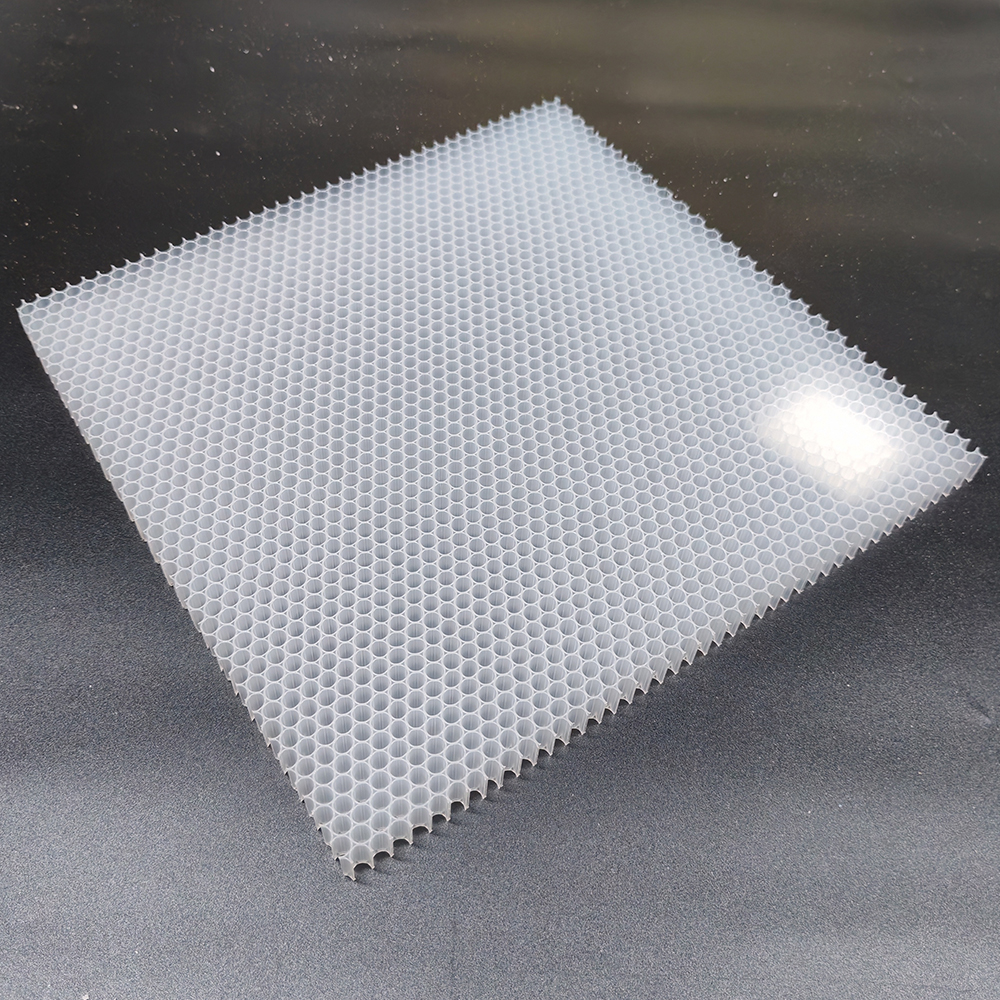
PP Honeycomb Core, also known as Polypropylene Honeycomb Core or Plastic Honeycomb Core, is a lightweight thermoplastic structural material manufactured from polypropylene (PP) resin.
It features a cellular structure consisting of interconnected hollow cells. Depending on the manufacturing process and product design, the cells may have tubular, expanded, or hexagonal configurations.
Unlike conventional foam core materials such as PVC, PET, and XPS, PP honeycomb achieves much of its structural efficiency through geometry rather than a solid cellular polymer matrix.
The hollow-cell structure reduces material consumption while providing useful compressive strength, shear resistance, and energy absorption characteristics.
In composite sandwich panel manufacturing, PP honeycomb core is typically positioned between two facing materials, including:
- Fiberglass reinforced plastic (FRP) sheets
- Aluminum sheets
- Aluminum composite panels
- Plywood and wood-based boards
- Thermoplastic composite skins
- Reinforced polypropylene sheets
The resulting sandwich structure combines the lightweight properties of the honeycomb core with the stiffness and surface durability of the facing materials.
PP Honeycomb Core is widely used in truck body panels, trailer manufacturing, marine composite panels, automotive components, furniture boards, packaging structures, and industrial applications.
Its main value lies in providing a lightweight structural solution for manufacturers seeking to reduce panel weight, improve material efficiency, and develop recyclable thermoplastic-based products.
2. Structural Principle: Why Does PP Honeycomb Provide High Stiffness with Low Weight?
The performance of PP honeycomb core is closely related to its cellular geometry.
A honeycomb structure contains a large number of hollow cells separated by relatively thin polymer walls. This arrangement distributes loads across multiple cell walls instead of relying on a solid block of material.
2.1 Lightweight Cellular Geometry
The most important structural advantage of honeycomb is its ability to create a relatively thick core using a limited amount of raw material.
A thicker sandwich structure can achieve greater bending stiffness because the outer skins are separated by the core.
When a sandwich panel is subjected to bending:
- The upper skin generally carries compressive stress.
- The lower skin generally carries tensile stress.
- The core transfers shear loads between the skins.
- The core also supports the skins against local deformation.
This arrangement allows manufacturers to produce large panels with relatively low weight.
However, honeycomb core alone does not provide the same bending stiffness as a complete sandwich panel. The facing materials and bonding interface are essential to the overall structural performance.
2.2 Cell Size and Mechanical Performance
Cell size is one of the most important parameters in PP honeycomb design.
Common commercial cell sizes include 4 mm, 6 mm, 8 mm, 10 mm, and 12 mm, with other configurations available depending on the manufacturer.
Cell size influences several aspects of performance:
Smaller Cell Size: Provides more cell walls per unit area and can support more uniform surface contact with facing materials. It may be useful for thinner panels and applications requiring finer surface support.
Larger Cell Size: Can reduce material consumption and support lightweight designs, but may require careful consideration of skin thickness, bonding, and local loading.
Cell size alone does not determine mechanical strength. Cell-wall thickness, resin or polymer distribution, core density, manufacturing quality, and loading direction are also important.
2.3 Anisotropic and Directional Properties
PP honeycomb is not necessarily mechanically identical in every direction.
Its compressive behavior through the thickness and shear performance in different in-plane directions can vary according to cell geometry and manufacturing orientation.
For example, a honeycomb core may have different shear strengths in its machine direction and cross direction.
This matters when designing large truck body panels, trailer floors, marine structures, and industrial sandwich panels.
Engineers should therefore review directional mechanical properties rather than relying on a single compression or shear value.
3. Key Properties and Advantages of PP Honeycomb Core
3.1 High Strength-to-Weight Potential
PP honeycomb core provides useful structural performance at relatively low density.
Commercial products commonly include core densities around 60–120 kg/m³, although specialized configurations can fall outside this range.
Its lightweight structure makes it suitable for applications where panel weight directly affects transportation efficiency, payload capacity, installation, or handling.
For example, reducing the weight of truck body panels can help increase available payload and improve vehicle operating efficiency.
The actual weight reduction depends on the complete panel design, including skins, adhesives, inserts, edge reinforcements, and hardware.
3.2 Moisture and Corrosion Resistance
Polypropylene has good resistance to water and many common chemicals.
Unlike metallic honeycomb cores, PP honeycomb does not rust. Its polymer structure also offers resistance to rot and many biological degradation processes.
This makes it suitable for applications exposed to humidity, water, and certain industrial chemicals.
Potential applications include:
- Marine composite panels
- Vehicle body panels
- Industrial partitions
- Wet-process equipment components
- Chemical-resistant filtration structures
Nevertheless, the moisture resistance of a finished sandwich panel depends on the entire construction. Water can enter through damaged skins, exposed edges, joints, or poorly sealed inserts.
3.3 Energy Absorption and Impact Management
The cellular structure of PP honeycomb can deform under compressive loading and absorb mechanical energy.
This behavior makes it useful in applications requiring impact management, protective packaging, and lightweight structural components.
The energy absorption response depends on cell geometry, wall thickness, density, loading speed, temperature, and the type of facing material.
For transportation applications, the complete panel should be evaluated under the expected impact and fatigue conditions.
3.4 Thermoplastic Processing and Recycling Potential
PP is a thermoplastic polymer. It can be softened by heating and processed into different shapes.
This characteristic creates opportunities for thermoforming and thermoplastic composite manufacturing.
PP honeycomb can also be incorporated into thermoplastic sandwich structures using compatible polypropylene-based skins.
Where the core and skins use compatible thermoplastic materials, the finished structure may offer a more straightforward recycling route than some mixed-material thermoset composites.
However, a PP core bonded to aluminum, fiberglass, or other dissimilar materials is not automatically easy to recycle. Separation, contamination, coatings, and adhesive systems must all be considered.
3.5 Sound and Vibration Damping
The cellular structure can contribute to sound and vibration management in selected panel designs.
Its performance depends on panel thickness, skin materials, cell geometry, mounting conditions, and the frequency range being evaluated.
PP honeycomb should not automatically be treated as a high-performance acoustic insulation material. Where sound reduction is a primary requirement, finished-panel acoustic testing is necessary.
4. PP Honeycomb Core Technical Specifications
PP Honeycomb Core is available in different densities, cell sizes, thicknesses, and surface configurations.
The following table presents representative mechanical properties from published commercial technical data.
Typical Mechanical Properties of PP Honeycomb Core
| Property | Test Standard | PP 8-80 | PP 10-64 |
|---|---|---|---|
| Cell Size (mm) | Product specification | 8 | 10 |
| Density (kg/m³) | ISO 845 | 80 | 64 |
| Compressive Strength (MPa) | ISO 844 | 2.0 | 1.0 |
| Compressive Modulus (MPa) | ISO 844 | 97 | 50 |
| Shear Strength (MPa) | ISO 1922 | 0.55 | 0.30 |
| Shear Modulus (MPa) | ISO 1922 | 12.8 | 9.0 |
| Effective Temperature Range (°C) | Product specification | -30 to +80 | -30 to +80 |
| Water Absorption | Product-specific test | Low | Low |
Note: These figures are representative values from a commercial PP honeycomb technical data sheet. Actual values vary with cell geometry, density, specimen thickness, test direction, and manufacturer. The two grades should not be treated as a controlled comparison of cell size alone.
General PP Honeycomb Core Product Specifications
| Item | Typical Product Range |
|---|---|
| Material | Polypropylene (PP) |
| Structure | Tubular, expanded, or other cellular configurations |
| Density | Approximately 60–120 kg/m³ |
| Cell Size | 4, 6, 8, 10, 12, and customized sizes |
| Core Thickness | Approximately 5–100 mm |
| Sheet Dimensions | Common examples include 1220 × 2440 mm and customized sizes |
| Color | White, black, and customized colors |
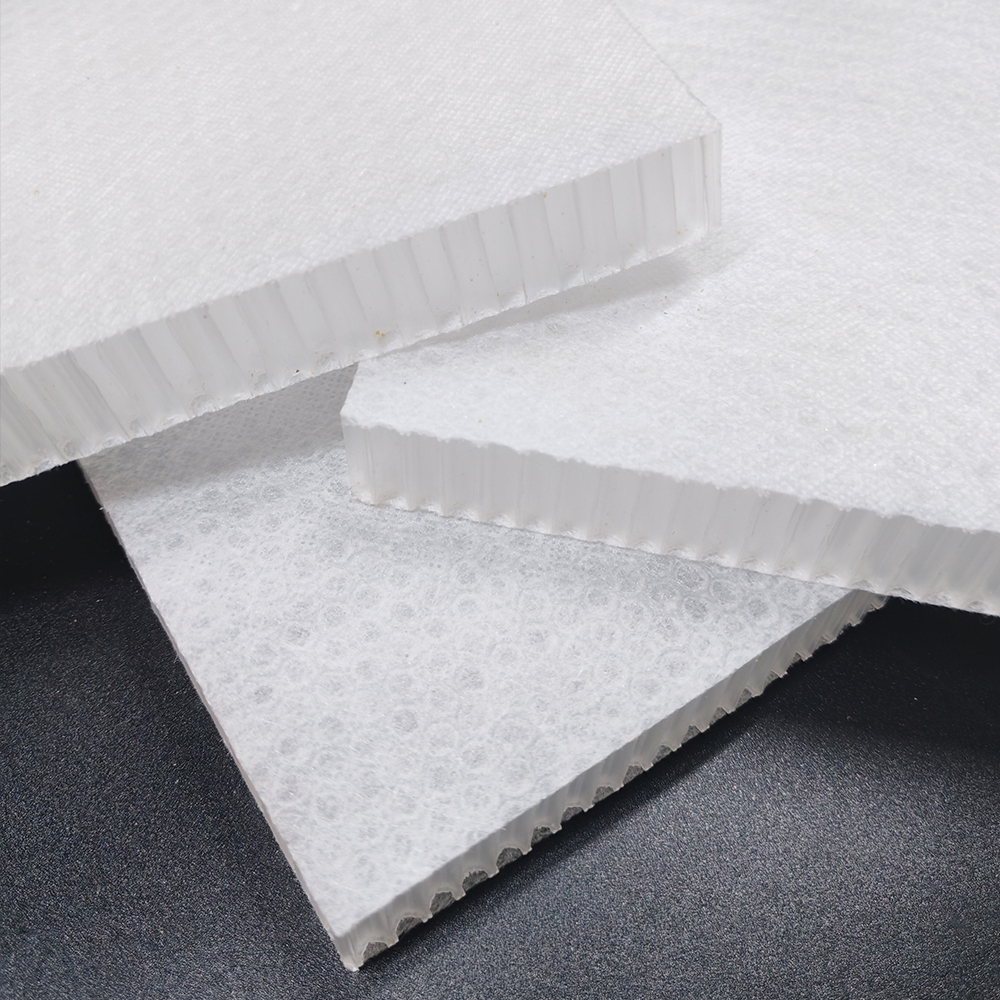
| Surface | Bare core, non-woven fabric, PP film, or reinforced facing |
| Processing | Cutting, thermoforming, lamination, and CNC machining |
| Applications | Truck bodies, trailers, marine, automotive, furniture, and industrial panels |
These are indicative commercial specifications, not ONEBOND guaranteed product values. Available density, cell size, thickness, sheet dimensions, and tolerances must be confirmed for each product series.
5. The Most Important Engineering Challenge: Bonding PP Honeycomb to Facing Materials
One of the biggest technical challenges in PP honeycomb panel manufacturing is achieving reliable bonding between the polypropylene core and its facing materials.
Polypropylene has relatively low surface energy. This makes it difficult for many conventional adhesives and resins to spread and bond effectively to untreated PP surfaces.
For this reason, the interface between the core and the skins requires special attention.
5.1 Non-Woven Polyester Surface Layer
One common solution is to apply a non-woven polyester veil to the surface of the PP honeycomb.
The veil provides an additional bonding surface for compatible adhesives and resin systems.
It can be particularly useful when manufacturing composite sandwich panels through wet lamination or other thermoset bonding processes.
However, the performance of the finished panel depends on the veil material, bonding method, adhesive selection, and manufacturing conditions.
5.2 PP Film Barrier
A PP film layer can be incorporated into selected honeycomb configurations.
This may help control resin penetration and reduce unnecessary resin consumption during composite processing.
The film and surface treatment must be compatible with the selected facing material and bonding process.
5.3 Surface Treatment and Reinforced Facings
Other possible solutions include corona treatment, plasma treatment, flame treatment, specialized primers, and reinforced thermoplastic facings.
These methods aim to improve surface compatibility or create a more suitable bonding interface.
For thermoplastic composite panels, compatible PP-based skins may also be thermally bonded to the core under controlled temperature and pressure.
5.4 Why Bonding Quality Matters
A sandwich panel may have a strong core but still fail if the core-to-skin interface is weak.
Possible failure modes include:
- Adhesive failure at the PP surface
- Cohesive failure within the adhesive layer
- Core-wall damage
- Skin-to-core delamination
- Localized separation under impact or fatigue loading
For this reason, manufacturers should evaluate finished-panel peel strength, flatwise tensile strength, shear performance, and environmental durability.
A reliable PP honeycomb solution is not simply a good core sheet. It is a properly designed and validated core-skin bonding system.
6. PP Honeycomb Manufacturing Process
Commercial PP honeycomb products can be manufactured through different industrial processes, depending on the cell structure and product configuration.
Common methods include extrusion-based production, tubular forming, corrugation, bonding, and expansion.
A typical production sequence may include:
1. Raw Material Preparation
Polypropylene resin and any required additives are prepared according to the product formulation.
2. Extrusion and Cell Formation
The polymer is heated and processed into thin-walled profiles, tubes, or other cellular elements.
3. Cell Assembly and Expansion
The cellular structure is formed or expanded into the required honeycomb configuration.
4. Stabilization and Cooling
The core is cooled and stabilized to maintain its dimensions and structural geometry.
5. Cutting and Calibration
The material is cut into specified thicknesses and sheet dimensions.
6. Surface Treatment
Depending on the intended application, the core may receive non-woven fabric, PP film, reinforced facings, or other bonding treatments.
7. Inspection and Packaging
Finished products are inspected for dimensions, density, surface quality, and relevant mechanical properties before packaging.
Manufacturing control is important because uneven cell geometry, wall thickness variation, and poor surface preparation can affect finished-panel quality.
7. Main Applications of PP Honeycomb Core
7.1 Truck Body and Trailer Manufacturing
Truck bodies and trailers are important markets for PP honeycomb sandwich panels.
Lightweight panels can help reduce vehicle body weight while providing sufficient rigidity for walls, roofs, doors, and selected floor structures.
Typical applications include:
- Truck body wall panels
- Trailer side panels
- Refrigerated vehicle panels
- Truck roof panels
- Vehicle doors
- Interior partitions
- Lightweight floor panels
PP honeycomb can be combined with FRP, aluminum, and other facings to create customized vehicle panels.
For refrigerated truck bodies, the complete panel’s thermal insulation performance must be evaluated separately. PP honeycomb is not automatically an equivalent substitute for a dedicated thermal insulation foam such as PU.
7.2 Marine and Boat Building
PP honeycomb core can be used in selected marine sandwich panel applications.
Its resistance to moisture and corrosion makes it attractive for lightweight components where metallic core corrosion is a concern.
Potential applications include:
- Marine interior panels
- Boat furniture panels
- Cabin partitions
- Lightweight bulkheads
- Composite doors
- Interior structural panels
For primary load-bearing marine structures, the selected PP honeycomb system must be validated for shear, fatigue, impact, bonding, and long-term water exposure.
7.3 Automotive and Transportation
Automotive manufacturers increasingly use lightweight materials to improve energy efficiency and reduce vehicle mass.
PP honeycomb can be incorporated into selected thermoplastic and composite components.
Typical applications include:
- Automotive interior panels
- Trunk floor panels
- Lightweight partitions
- Vehicle luggage compartments
- Bus interior panels
- Railway interior structures
- Lightweight protective covers
Thermoplastic compatibility can be particularly useful in automotive manufacturing, where process efficiency and material recycling are important considerations.
7.4 Furniture and Building Panels
PP honeycomb is also used in furniture and lightweight building products.
Common applications include:
- Lightweight cabinet panels
- Furniture doors
- Office partitions
- Decorative sandwich boards
- Lightweight interior panels
- Modular furniture structures
When combined with aluminum, wood-based boards, or decorative skins, PP honeycomb can produce panels with lower weight than some solid-board alternatives.
For furniture manufacturers, the selection of edge reinforcement, screw inserts, hinges, and fastening points is important because the hollow-cell core cannot always support concentrated fastener loads directly.
7.5 Packaging and Protective Structures
PP honeycomb panels are suitable for reusable packaging systems and protective transport structures.
Their lightweight construction and resistance to moisture can support applications such as:
- Reusable transport boxes
- Protective packaging panels
- Industrial separators
- Logistics partitions
- Returnable packaging systems
The material may help reduce packaging weight and support repeated handling, depending on the panel construction.
7.6 Industrial Filtration and Processing Equipment
PP honeycomb structures can also be used in industrial applications beyond sandwich panels.
Potential uses include:
- Filter support structures
- Gas flow straighteners
- Air distribution components
- Chemical-resistant support structures
- Industrial separation equipment
Polypropylene’s chemical resistance makes it useful in selected corrosive environments, but chemical compatibility must be checked against the actual substances, temperatures, and exposure conditions.
8. PP Honeycomb Core vs. Aluminum Honeycomb Core vs. Foam Core
Different core materials provide different combinations of weight, mechanical performance, corrosion resistance, processing flexibility, and cost.
| Comparison | PP Honeycomb Core | Aluminum Honeycomb Core | PVC Foam Core |
|---|---|---|---|
| Material | Polypropylene | Aluminum alloy | Cross-linked PVC foam |
| Structure | Hollow polymer cells | Metallic honeycomb cells | Closed-cell foam |
| Density | Commonly 60–120 kg/m³ | Grade- and foil-dependent | Commonly 45–250 kg/m³ |
| Moisture Resistance | Good | Requires corrosion and edge considerations | Generally good |
| Corrosion Resistance | Good | Requires suitable alloy and protection | Good |
| Bonding | Requires suitable surface treatment | Requires suitable adhesive and surface preparation | Generally compatible with many composite bonding systems |
| Impact Behavior | Can deform and absorb energy | Depends on foil and cell design | Depends on density and formulation |
| Thermoplastic Processing | Possible | Not applicable | Not generally thermoplastic |
| Typical Applications | Transportation, furniture, marine panels | Aerospace, rail, architectural and industrial panels | Marine, wind energy and structural composites |
When Should Manufacturers Choose PP Honeycomb?
PP honeycomb is worth considering when:
- Low panel weight is important.
- Moisture and corrosion resistance are required.
- Thermoplastic manufacturing is preferred.
- Reusable or recyclable product designs are being developed.
- Large lightweight panels are needed.
- The production system can provide reliable core-to-skin bonding.
When Are Other Core Materials More Suitable?
Aluminum honeycomb may be more suitable when high stiffness-to-weight performance and temperature resistance are important.
PVC foam may be preferred when conventional composite infusion, structural foam machining, or established marine manufacturing processes are central to the application.
PET foam may be attractive when a thermoplastic structural foam core and recycled feedstock options are important.
The correct selection should be based on finished-panel performance, manufacturing compatibility, and total product cost.
9. How to Choose the Right PP Honeycomb Core
Selecting PP Honeycomb Core requires more than specifying a density or cell size.
The following parameters should be considered:
1. Density: Higher-density cores generally contain more material per unit volume and may provide greater mechanical performance, depending on the structure.
2. Cell Size: Select cell dimensions according to the panel thickness, facing material, surface support, and structural requirements.
3. Core Thickness: Determine thickness according to panel stiffness, geometry, and intended loading conditions.
4. Compression Strength: Check the core’s resistance to through-thickness compressive loads.
5. Shear Strength: Review directional shear properties, especially for large sandwich panels.
6. Surface Treatment: Select bare core, polyester veil, PP film, or reinforced facing according to the bonding process.
7. Facing Material: Confirm compatibility with FRP, aluminum, plywood, PP skins, and other facing materials.
8. Temperature Range: Verify both continuous operating temperature and short-term processing temperature.
9. Fastening and Inserts: Design reinforced areas for hinges, screws, handles, and concentrated loads.
10. Finished-Panel Testing: Evaluate bonding strength, bending stiffness, impact resistance, and durability under actual operating conditions.
For B2B buyers, providing the intended application and panel construction is often more useful than requesting only a standard density and thickness.
10. ONEBOND PP Honeycomb Core Solutions
ONEBOND focuses on composite core materials, foam core products, and lightweight sandwich panel solutions for international industrial customers.
PP Honeycomb Core is an important product category for manufacturers developing lightweight panels for transportation, furniture, construction, marine, and industrial applications.
Project specifications can include:
- Customized cell size and density
- Customized core thickness and sheet dimensions
- Plain or surface-treated honeycomb core
- Non-woven polyester fabric and PP film options
- Reinforced PP facing configurations
- Cutting and customized panel processing
- Application-specific core selection
For manufacturers of truck bodies, FRP sandwich panels, trailer structures, and lightweight furniture boards, selecting the correct honeycomb configuration is essential to achieving consistent panel performance.
Contact ONEBOND to discuss your PP Honeycomb Core requirements and customized composite panel solutions.
11. Frequently Asked Questions About PP Honeycomb Core
Q1: What is PP Honeycomb Core used for?
PP Honeycomb Core is used in truck body panels, trailers, marine composite panels, automotive interiors, railway panels, furniture boards, reusable packaging, and industrial filtration structures.
Q2: What cell sizes are available for Polypropylene Honeycomb Core?
Common commercial cell sizes include 4 mm, 6 mm, 8 mm, 10 mm, and 12 mm. Customized configurations may be available depending on the manufacturing process.
Q3: What densities are available for PP Honeycomb Core?
Common commercial densities include approximately 60, 64, 75, 80, and 120 kg/m³. Other density grades may be available depending on cell geometry and product construction.
Q4: Why does PP Honeycomb Core need surface treatment before bonding?
Polypropylene has relatively low surface energy, which makes direct bonding difficult with many conventional adhesives and resins. Non-woven polyester veils, PP film systems, surface treatment, and compatible bonding processes can improve interface performance.
Q5: Is PP Honeycomb Core waterproof and recyclable?
Polypropylene has good moisture resistance and is a thermoplastic material with recycling potential. However, a finished sandwich panel’s waterproof performance depends on its skins, joints, edges, and installation. Recycling also depends on the complete panel construction and separation process.
Conclusion
PP Honeycomb Core is an important lightweight structural material for modern composite sandwich panel manufacturing.
Its cellular geometry, low density, moisture resistance, thermoplastic processing potential, and energy absorption characteristics make it suitable for transportation, marine, furniture, packaging, and industrial applications.
However, successful PP honeycomb panel manufacturing depends on more than selecting the right density and cell size. Surface treatment, bonding technology, directional mechanical performance, edge design, and finished-panel testing are equally important.
For manufacturers developing lightweight FRP panels, truck body structures, trailer panels, and thermoplastic sandwich products, PP Honeycomb Core provides a flexible material option for improving structural efficiency and reducing product weight.
The key is to match the honeycomb geometry, surface configuration, and facing materials to the actual manufacturing process and application requirements.
