
Lightweight Truck Body Panels: How Composite Materials Reduce Vehicle Weight
Vehicle weight has a direct influence on the efficiency and operating economics of commercial transportation. For truck body manufacturers, reducing unnecessary body weight while maintaining structural performance is an important part of modern vehicle design.
Traditional truck body structures often rely on steel sheets, aluminum panels, timber boards, or combinations of these materials. Although these materials remain useful in many applications, lightweight composite sandwich panels offer manufacturers another way to optimize vehicle body construction.
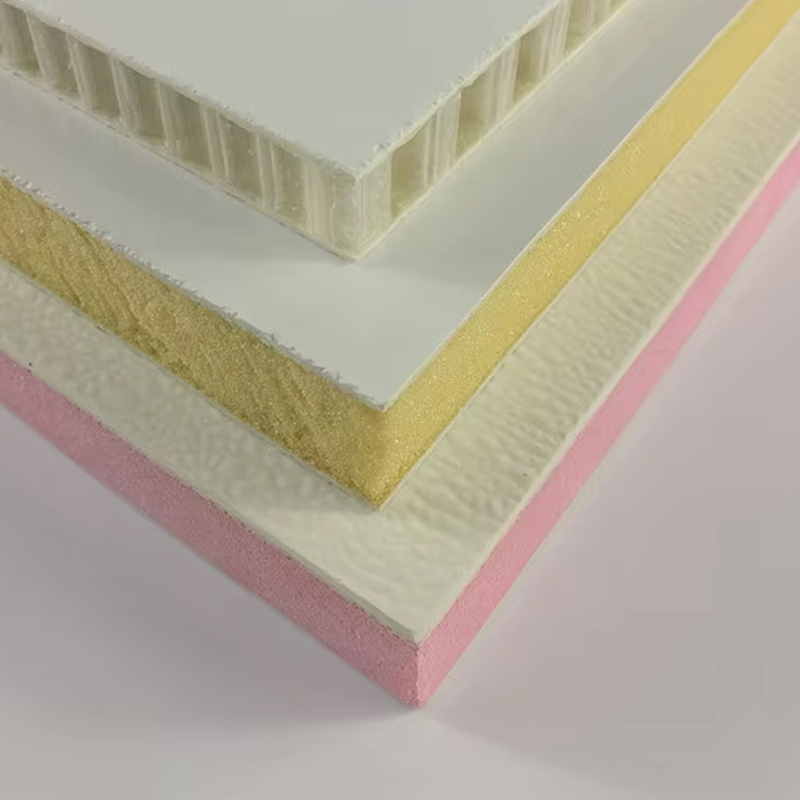
FRP sandwich panels, PP honeycomb core, PET foam core, and PVC foam core are increasingly considered in lightweight truck body and trailer panel designs.
The objective is not simply to replace a heavy material with a lighter one. A successful lightweight structure must maintain sufficient stiffness, strength, durability, bonding reliability, and resistance to the actual service conditions.
This article explains how composite materials help reduce truck body weight, how to calculate panel weight, how different core materials compare, and what manufacturers should consider when developing lightweight truck body panels.
1. Why Is Lightweight Construction Important in Truck Body Manufacturing?
Truck body weight affects the overall vehicle configuration and the amount of weight available for cargo, subject to the vehicle’s rated gross weight, axle limits, and applicable regulations.
A lighter body structure may provide several potential benefits.
1.1 More Available Payload Capacity
The maximum gross vehicle weight is limited by the vehicle design and relevant regulations.
Reducing the weight of the body structure may increase the weight available for cargo, provided that axle, tire, suspension, and legal weight limits are respected.
For commercial transportation operators, this can improve the efficiency of each trip.
1.2 Improved Energy Efficiency
Reducing vehicle mass can lower the energy required for acceleration and operation, although the actual benefit depends on the vehicle type, route, driving conditions, speed, and powertrain.
For electric commercial vehicles, reducing body weight can also help manage energy consumption and available driving range.
1.3 Better Vehicle Design Flexibility
Lightweight panel structures may help manufacturers optimize:
- Body dimensions
- Panel thickness
- Internal space
- Support structure
- Mounting arrangements
- Vehicle payload configuration
1.4 Reduced Structural Material Consumption
A properly designed sandwich panel can provide useful bending stiffness with less material than some solid-panel constructions of similar overall thickness.
However, the final weight and performance must be evaluated at the complete panel level.
2. How Do Composite Sandwich Panels Reduce Truck Body Weight?
The main principle behind sandwich panel construction is to place two relatively strong face sheets around a lightweight core.
A typical FRP truck body sandwich panel consists of:
- Outer FRP skin
- Adhesive bonding layer
- Lightweight core material
- Adhesive bonding layer
- Inner FRP skin
The two face sheets are separated by the core, increasing the distance between them.
This arrangement can improve bending stiffness without requiring a solid panel made entirely from dense material.
The core also contributes to shear resistance and helps maintain the separation between the face sheets.
Why Is This Structure Efficient?
In a sandwich panel, the outer skins carry much of the tensile and compressive stress during bending, while the core transfers shear forces and supports the skins.
When the skins, core, and bonding interfaces are properly designed, the resulting structure can achieve a favorable stiffness-to-weight ratio.
This is the main reason sandwich panels are considered for lightweight truck body manufacturing.
However, a lightweight core alone does not guarantee a lightweight or structurally efficient finished panel. Skin thickness, adhesive consumption, reinforcement, inserts, and edge components must all be included in the design.
3. Main Core Materials Used in Lightweight Truck Body Panels
Different core materials provide different combinations of weight, mechanical properties, insulation characteristics, and manufacturing compatibility.
3.1 PP Honeycomb Core
PP Honeycomb Core is made from polypropylene and features a cellular honeycomb structure.
Its main advantage is its lightweight cellular construction.
Potential characteristics include:
- Lightweight structure
- Low water absorption of the polypropylene material
- Customizable cell size and thickness
- Different density configurations
- Bare and nonwoven-faced options
- Suitability for selected FRP sandwich panel structures
PP honeycomb can be considered for truck side walls, trailer panels, roof panels, and interior partitions.
One important consideration is bonding. Polypropylene has relatively low surface energy, so untreated PP surfaces may be difficult to bond using conventional adhesives.
Surface treatment, compatible adhesives, or suitable facing materials may be required.
For nonwoven-faced PP honeycomb, both the core-to-facing and facing-to-FRP interfaces should be tested.
3.2 PET Foam Core
PET Foam Core is a closed-cell structural foam used in composite sandwich panel manufacturing.
It can be considered for truck body panels where the selected grade provides suitable mechanical properties and processing compatibility.
Important selection factors include:
- Density
- Compressive strength
- Shear strength
- Shear modulus
- Water absorption
- Bonding compatibility
Different PET foam grades can have significantly different properties, so manufacturers should compare actual technical data rather than relying on the material name alone.
3.3 PVC Foam Core
PVC Foam Core is another structural foam option for lightweight composite panels.
Its properties depend on the formulation, density, and manufacturing process.
Potential applications include:
- FRP truck body panels
- Trailer sandwich panels
- Industrial transportation panels
- Selected structural composite panels
PVC foam grades can be selected according to the mechanical requirements of the finished panel.
A higher-density grade may provide different compression and shear performance, but it can also increase material weight and cost.
3.4 PU and XPS Foam Core
PU and XPS foam are commonly considered in insulation-focused panel designs.
They may be relevant to refrigerated trucks, insulated delivery vehicles, and temperature-controlled trailers.
Their suitability depends on thermal conductivity, mechanical requirements, adhesive compatibility, and the complete panel construction.
For insulated truck bodies, manufacturers should also consider thermal bridges, joints, door seals, and edge details.
3.5 Aluminum Honeycomb Core
Aluminum honeycomb core is a lightweight cellular material used in sandwich structures requiring a high stiffness-to-weight ratio.
It can be evaluated for selected truck body and trailer panels.
However, corrosion protection, edge treatment, bonding compatibility, and thermal bridging need to be considered.
4. Comparison of Lightweight Truck Body Panel Core Materials
The following table provides a preliminary comparison for material screening.
| Core Material | Structure | Main Design Focus | Important Consideration |
|---|---|---|---|
| PP Honeycomb | Polypropylene cellular structure | Lightweight sandwich construction | Bonding and interface validation |
| PET Foam | Closed-cell structural foam | Structural composite applications | Grade-specific mechanical properties |
| PVC Foam | Closed-cell structural foam | Structural sandwich panels | Density, shear and compression |
| PU Foam | Cellular foam | Insulated panel construction | Thermal performance |
| XPS Foam | Extruded closed-cell foam | Insulation-focused designs | Resin and adhesive compatibility |
| Aluminum Honeycomb | Aluminum cellular structure | High stiffness-to-weight potential | Corrosion and edge protection |
There is no single core material that is best for every truck body application.
Side walls, roofs, floors, and refrigerated panels have different requirements. The selected core should match the complete panel design.
5. How to Calculate the Weight of a Lightweight Truck Body Panel
One of the most important steps in lightweight panel development is calculating the weight of the complete panel rather than comparing core materials alone.
The theoretical weight per square meter can be calculated by adding the weight of all panel components.
Panel Weight = Outer Skin Weight + Inner Skin Weight + Core Weight + Adhesive Weight + Reinforcement and Other Components
5.1 Calculating Core Weight
For a uniform core material:
Core Weight per Square Meter = Density × Thickness
The thickness must be converted into meters.
For example:
Assume a hypothetical PP honeycomb core has:
- Density: 60 kg/m³
- Thickness: 20 mm
- Thickness in meters: 0.02 m
Calculation:
60 × 0.02 = 1.2 kg/m²
This means the theoretical core weight is 1.2 kg per square meter.
It does not represent the finished panel weight.
5.2 Calculating FRP Skin Weight
For a solid skin with a known density and thickness:
Skin Weight per Square Meter = Skin Density × Skin Thickness
For a composite skin, the actual areal weight can also be obtained from the manufacturer’s technical specification.
For example, if an FRP skin has a specified areal weight of 2.0 kg/m², two identical skins contribute:
2.0 × 2 = 4.0 kg/m²
This is a calculation example, not a universal FRP skin specification.
5.3 Example of Complete Panel Weight Calculation
Consider a hypothetical FRP sandwich panel with:
| Component | Assumed Weight |
|---|---|
| Outer FRP Skin | 2.0 kg/m² |
| Inner FRP Skin | 2.0 kg/m² |
| PP Honeycomb Core | 1.2 kg/m² |
| Adhesive | 0.5 kg/m² |
| Other Components | 0.3 kg/m² |
| Total | 6.0 kg/m² |
The example demonstrates how all components contribute to the finished panel weight.
Actual values must be determined from the selected materials, manufacturing process, and panel design.
6. How Much Weight Can Composite Panels Save?
Weight savings depend on the reference structure and the final composite panel design.
A meaningful comparison should use panels with equivalent dimensions, service requirements, and performance targets.
For example, a manufacturer may compare:
- Traditional metal-skinned panel construction
- Aluminum-skinned sandwich panels
- FRP sandwich panels with foam cores
- FRP sandwich panels with PP honeycomb cores
The comparison should include:
- Outer skin weight
- Inner skin weight
- Core weight
- Adhesive weight
- Reinforcements and inserts
- Edge profiles
- Additional support structures
A lower core density does not automatically mean the complete panel will be lighter.
If a low-density core requires thicker skins, additional reinforcement, or more adhesive, the expected weight advantage may be reduced.
For this reason, manufacturers should compare complete panel designs rather than individual material specifications.
7. Lightweight Design for Different Truck Body Components
Each part of a truck body has different structural requirements.
The most effective lightweight design may use different panel constructions for different components.
7.1 Lightweight Truck Side Wall Panels
Side walls are suitable candidates for composite sandwich construction because they often involve relatively large panel areas.
The design should consider:
- Panel span
- Support spacing
- FRP skin thickness
- Core shear properties
- Impact resistance
- Edge reinforcement
PP honeycomb, PET foam, and PVC foam can be evaluated depending on the target design.
7.2 Lightweight Truck Roof Panels
Roof panels need to maintain stiffness while withstanding weather exposure and vibration.
Lightweight core materials can help reduce roof structure weight.
However, mounting points, roof accessories, support frames, and drainage details must be considered.
7.3 Lightweight Truck Floor Panels
Floor panels are more demanding because they can experience concentrated loads and repeated impact.
The design may require:
- Higher-density core sections
- Thicker or stronger face sheets
- Local reinforcement
- Wear-resistant surface layers
- Appropriate support spacing
Reducing floor weight should never compromise the required load-bearing performance.
7.4 Lightweight Rear Door Panels
Rear doors must support hinges, locks, handles, and repeated opening and closing cycles.
A sandwich panel may require local reinforcement around hardware installation points.
The panel structure should be designed around the actual load paths rather than simply using the same construction as the side walls.
8. How to Optimize Core Density and Panel Thickness
Core density and thickness are two important parameters in lightweight panel design.
However, they should be optimized together with mechanical performance.
Core Density
Lower density generally means less core material per unit volume.
However, lower density can also result in lower compression or shear properties, depending on the material and grade.
Manufacturers should not reduce density without checking the required mechanical performance.
Core Thickness
Increasing core thickness can improve bending stiffness by separating the two face sheets further.
But it also increases the total panel thickness and may affect:
- Panel weight
- Frame dimensions
- Edge construction
- Installation space
- Material cost
Combined Design Approach
A practical lightweight design process should:
- Define the target panel weight.
- Determine the required panel span and support conditions.
- Select a suitable face-sheet structure.
- Compare core materials and grades.
- Evaluate compression and shear performance.
- Confirm bonding compatibility.
- Manufacture prototype panels.
- Test the complete panel under representative conditions.
The objective is to achieve the required performance with the most efficient complete structure.
9. Lightweight Truck Body Panels vs Traditional Solid Panels
| Evaluation Factor | Traditional Solid Panel | Composite Sandwich Panel |
|---|---|---|
| Construction | Solid or layered board | Two skins with lightweight core |
| Weight Optimization | Depends on solid material | High design flexibility |
| Bending Stiffness | Depends on material and thickness | Can achieve high stiffness-to-weight ratio |
| Core Customization | Limited in solid construction | Multiple core options |
| Thermal Insulation | Depends on material | Can incorporate insulation-focused cores |
| Manufacturing | Established processes | Requires controlled bonding |
| Repair | Depends on panel type | Depends on skin, core and damage |
| Material Selection | Often fewer structural layers | More options for customized structures |
Composite sandwich panels can offer significant design flexibility, but they also require careful bonding, edge protection, and quality control.
10. Manufacturing Considerations for Lightweight Composite Truck Body Panels
The manufacturing process directly affects the final panel weight and performance.
A typical process includes:
Step 1: Core Preparation
Cut the selected PP honeycomb, PET foam, or PVC foam to the required dimensions.
Step 2: FRP Skin Preparation
Check skin thickness, surface condition, and compatibility with the bonding system.
Step 3: Adhesive Application
Apply the adhesive uniformly according to the validated process.
Step 4: Panel Assembly
Position the skins and core accurately.
Step 5: Pressing and Curing
Control pressure, temperature, and curing time according to the adhesive and material specifications.
Step 6: Trimming and Finishing
Complete edge trimming, drilling, and other machining operations.
Step 7: Weight and Quality Inspection
Check panel weight, dimensions, flatness, bonding, and mechanical performance.
For PP honeycomb panels, the bonding system deserves special attention because untreated polypropylene has low surface energy.
Excessive adhesive application should also be avoided because it can add unnecessary weight without necessarily improving bonding performance.
11. Quality Control: Lightweight Does Not Mean Under-Engineered
A successful lightweight truck body panel must meet the required performance criteria.
Quality control should evaluate:
| Inspection Item | Purpose |
|---|---|
| Panel Weight per Square Meter | Controls weight consistency |
| Panel Thickness | Checks dimensional accuracy |
| Core Density | Controls material consistency |
| FRP Skin Thickness | Checks face-sheet specifications |
| Core Compression | Evaluates compressive behavior |
| Core Shear | Evaluates shear performance |
| Skin-to-Core Bonding | Checks interface integrity |
| Panel Bending | Evaluates structural response |
| Impact Resistance | Assesses application-specific impact performance |
| Water Absorption | Evaluates relevant moisture behavior |
Relevant ASTM methods may include C271/C271M for core density, C365/C365M for flatwise compressive properties, C273/C273M for core shear properties, C297/C297M for flatwise tensile properties, and C393/C393M for sandwich beam flexural testing.
The exact test program should be selected according to the complete panel structure and intended application.
12. How Truck Body Manufacturers Can Develop a Lightweight Panel Solution
Manufacturers planning to replace traditional panels or improve an existing composite structure should follow a systematic process.
Step 1: Identify the Existing Panel Structure
Record the current material type, panel dimensions, skin thickness, core construction, and finished weight.
Step 2: Define the Weight Reduction Target
Establish a realistic target based on the vehicle design and required performance.
Step 3: Identify Critical Performance Requirements
Determine bending stiffness, compression resistance, impact resistance, shear strength, and environmental requirements.
Step 4: Compare Alternative Core Materials
Evaluate PP honeycomb, PET foam, PVC foam, and other materials based on actual technical data.
Step 5: Design and Manufacture Prototype Panels
Test the complete structure rather than evaluating the core in isolation.
Step 6: Compare Total Cost and Manufacturing Efficiency
Consider material consumption, production time, adhesive usage, waste, rework, and finished panel quality.
Step 7: Validate Before Mass Production
Confirm the selected structure under representative loading and environmental conditions.
13. What Should Buyers Specify When Sourcing Lightweight Truck Body Panel Materials?
For core material suppliers, a clear RFQ makes technical evaluation and quotation more efficient.
| Required Information | Details |
|---|---|
| Application | Truck side wall, roof, floor, rear door, trailer |
| Core Material | PP honeycomb, PET foam, PVC foam, PU foam, etc. |
| Density | Target density or range |
| Thickness | Required core thickness |
| Cell Size | Required for honeycomb core |
| Facing | Bare or nonwoven-faced |
| Skin Material | FRP, aluminum, or other materials |
| Panel Dimensions | Length and width |
| Target Panel Weight | Finished panel weight per square meter |
| Mechanical Requirements | Compression, shear, bending, impact |
| Bonding System | Adhesive or resin type |
| Order Quantity | Prototype, trial, or mass production |
If the buyer already has an existing panel design, providing a technical drawing and current panel weight can make the material evaluation more accurate.
14. ONEBOND Core Materials for Lightweight Truck Body Panels
ONEBOND supplies composite core materials for manufacturers developing lightweight sandwich panels and transportation composite structures.
Our product range includes:
- PP Honeycomb Core
- Nonwoven Faced PP Honeycomb Core
- PET Foam Core
- PVC Foam Core
- XPS Foam Core
- PU Foam Core
- Aluminum Honeycomb Core
These materials can be evaluated for truck body panels, trailer panels, RV panels, marine composite structures, and other lightweight industrial applications.
For truck body manufacturers, the most suitable core depends on the target panel weight, mechanical requirements, panel thickness, bonding system, and manufacturing process.
ONEBOND supports customized core material discussions according to project specifications.
If you are developing a lightweight truck body panel, share your existing panel structure, target weight, core requirements, and application.
Our team can help discuss a suitable material solution for your project.
Frequently Asked Questions
1. What are lightweight truck body panels made of?
They may consist of FRP or aluminum face sheets bonded to PP honeycomb, PET foam, PVC foam, PU foam, or other suitable core materials.
2. How do composite sandwich panels reduce truck body weight?
They use lightweight core materials to separate two face sheets, creating a structure that can provide high bending stiffness relative to its weight.
3. Is PP honeycomb suitable for lightweight truck body panels?
PP honeycomb can be considered for selected truck side walls, roofs, trailer panels, and partitions, provided that bonding and structural performance are validated.
4. Which is lighter, PP honeycomb or PET foam?
The answer depends on the density and thickness of the specific grades. Compare the actual core weight per square meter and complete panel weight.
5. How do I calculate the weight of a truck body sandwich panel?
Add the weight of both face sheets, the core, adhesive, inserts, reinforcements, and edge components per square meter.
6. Does a lower-density core always reduce panel weight?
Not necessarily. Additional skins, adhesive, and reinforcement may offset the core weight reduction.
7. What is the best core material for lightweight truck side walls?
PP honeycomb, PET foam, and PVC foam can all be evaluated. The final choice depends on panel span, bending stiffness, shear performance, bonding, and cost.
8. Can lightweight sandwich panels be used for truck floors?
Yes, selected sandwich structures can be designed for truck floors, but concentrated loads, impact, abrasion, and support conditions require careful verification.
9. Are FRP sandwich panels suitable for refrigerated trucks?
They can be used in refrigerated truck construction, but the core must meet insulation requirements and the complete panel must be designed to control thermal bridges and moisture ingress.
10. What information is needed for a lightweight truck body panel quotation?
Provide the application, panel dimensions, target weight, skin material, core type, density, thickness, facing, and required mechanical performance.
Conclusion
Lightweight truck body panels are an important part of modern commercial vehicle design.
By combining FRP skins with PP honeycomb, PET foam, PVC foam, or other suitable core materials, manufacturers can develop composite sandwich structures with favorable stiffness-to-weight characteristics.
However, effective weight reduction requires more than choosing a low-density core. Skin thickness, core thickness, adhesive quantity, reinforcement, panel span, and structural performance must all be considered.
For truck body and trailer manufacturers, the most successful lightweight solution is one that reduces unnecessary weight while maintaining the strength, durability, and manufacturing consistency required for real-world transportation applications.
