
Engineering Failure Analysis and Process Control Guide
Vacuum infusion is one of the most widely used manufacturing processes for producing lightweight FRP and sandwich composite structures.
It is particularly attractive for:
- Marine hulls
- Yacht decks
- Wind turbine components
- Transportation panels
- Industrial enclosures
- Large composite structures
- Architectural sandwich panels
However, selecting a suitable PVC Foam Core is only the first step.
The actual quality of a vacuum-infused sandwich panel depends on the interaction between:
PVC Foam Core + Face Sheet + Resin + Vacuum System + Core Surface + Flow Path + Bonding + Cure Cycle
A core with excellent mechanical properties can still produce a poor composite panel if resin flow is uncontrolled, bonding is incomplete, the core surface is improperly prepared, or local vacuum pressure causes deformation.
ASTM C273/C273M specifically recognizes that measured core shear behavior can be influenced by the core geometry, adhesive, fabrication method, conditioning, specimen preparation and other test variables. This is an important reminder that a core datasheet cannot completely represent the performance of the finished sandwich structure.
This article approaches PVC Foam Core from a manufacturing perspective:
How does the core behave during vacuum infusion, and how can engineers control the process so that the finished sandwich panel achieves consistent mechanical performance?
1. The Vacuum Infusion Process in One Engineering Diagram
A typical sandwich composite can be simplified as:
Vacuum Bag
──────────────────────────────

Breather / Distribution Layer
──────────────────────────────

FRP Face Sheet
══════════════════════════════

Adhesive / Resin Interface
──────────────────────────────

PVC Foam Core
██████████████████████████████

Adhesive / Resin Interface
──────────────────────────────

FRP Face Sheet
══════════════════════════════

Mold Surface
──────────────────────────────
During infusion, resin must travel through the reinforcement system and reach the required bonding surfaces.
The core therefore has two very different functions:
Structural Function
After curing, the PVC Foam Core provides:
- Shear resistance
- Compression support
- Face-sheet separation
- Buckling resistance
- Weight reduction
Manufacturing Function
During infusion, the core influences:
- Resin flow
- Bonding
- Local resin distribution
- Surface wet-out
- Core deformation
- Cure uniformity
This creates an important engineering principle:
The best PVC Foam Core for a composite structure is not necessarily the core with the highest mechanical strength. It is the core that provides the required structural performance while remaining compatible with the manufacturing process.
2. The Five Variables That Control Infusion Quality
Before discussing density, engineers should identify five variables.
| Variable | Main Question | Typical Risk |
|---|---|---|
| Core density | Is the material structurally suitable? | Insufficient strength |
| Core thickness | Is the sandwich sufficiently stiff? | Excessive deflection |
| Surface condition | Can resin/adhesive bond effectively? | Delamination |
| Permeability / flow behavior | Can resin reach the required areas? | Dry spots |
| Geometry | Can the core conform to the mold? | Bridging / voids |
These variables interact.
For example:
Higher density
may improve compression performance,
but may not necessarily provide the best manufacturing efficiency.
Similarly:
Thicker core
can increase sandwich stiffness,
but can introduce more demanding edge and curvature requirements.
3. PVC Foam Core Density: The First Manufacturing Decision
PVC Foam Core is commonly supplied in different density grades.
For preliminary engineering selection, a useful conceptual range is:
| Density | Typical Position | Potential Application |
|---|---|---|
| 45–60 kg/m³ | Very lightweight | Non-critical panels |
| 60–80 kg/m³ | Lightweight structural | Marine / transportation |
| 80–100 kg/m³ | Medium structural | Decks / industrial panels |
| 100–130 kg/m³ | Higher structural | Higher-load sandwich |
| 130–200 kg/m³ | High-density structural | Local load / demanding structures |
| 200+ kg/m³ | Specialized | High-performance applications |
These are screening ranges rather than universal specifications. The actual mechanical properties must come from the specific PVC Foam Core grade.
A published experimental study, for example, characterized an 80 kg/m³ PVC foam using ASTM D1622 for density, ASTM D1621 for compression, ASTM C273 for shear and ASTM D1623 for tensile properties. The reported values were 1.60 MPa compression strength, 1.20 MPa shear strength and 30 MPa shear modulus for that particular material and test configuration.
The procurement lesson is straightforward:
Never purchase “80 kg/m³ PVC Foam Core” as if density alone defines the material.
The RFQ should require:
- Density
- Compression strength
- Compression modulus
- Shear strength
- Shear modulus
- Thickness
- Thickness tolerance
- Surface treatment
- Test method
4. Density Does Not Tell You Resin Flow
A common purchasing mistake is assuming:
Higher density = better infusion performance.
That conclusion is too simple.
Resin flow depends on the entire laminate system.
Important factors include:
| Factor | Influence |
|---|---|
| Core surface | Bonding and local flow |
| Core geometry | Flow path |
| Groove structure | Resin distribution |
| Perforation | Through-core flow |
| Face-sheet architecture | Resin resistance |
| Resin viscosity | Flow speed |
| Temperature | Resin viscosity |
| Vacuum level | Pressure differential |
| Infusion mesh | Distribution speed |
| Part geometry | Flow distance |
| Core joints | Flow continuity |
Therefore, two PVC Foam Core products with the same density may behave differently during manufacturing if their surface structures are different.
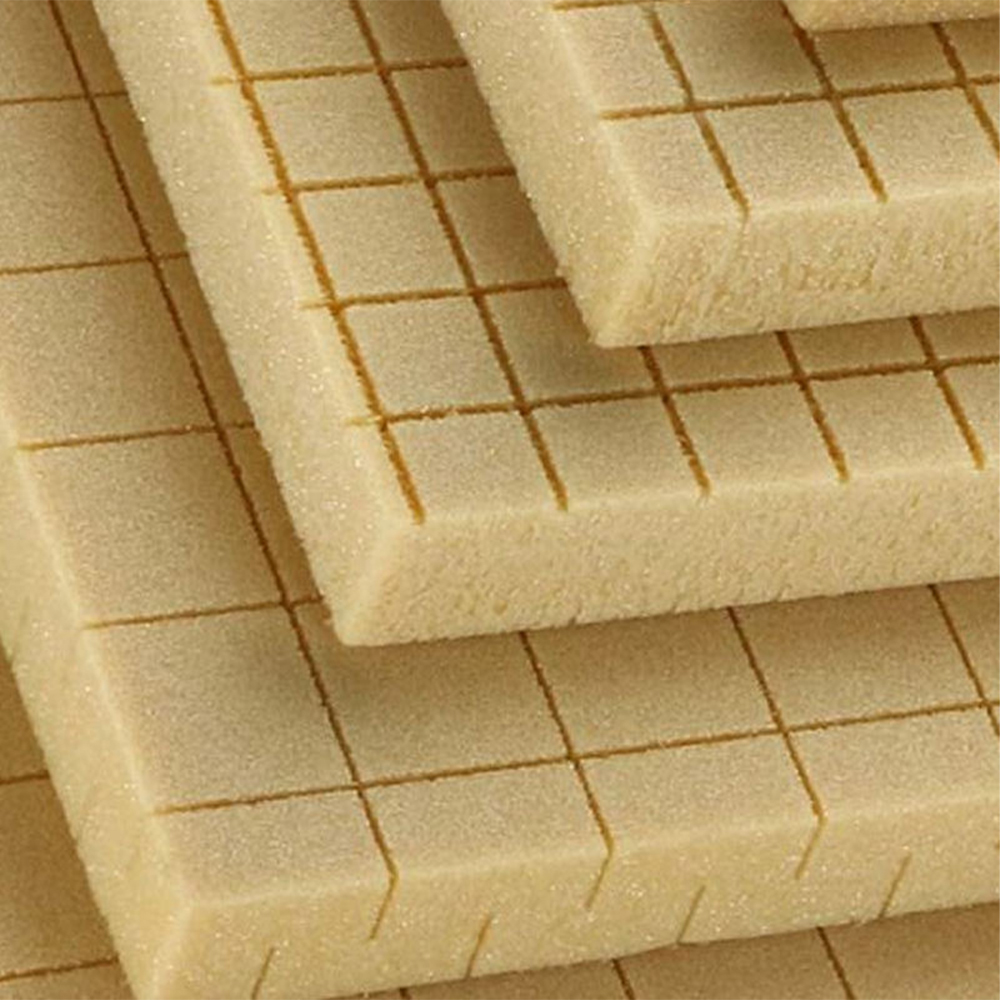
5. Grooved PVC Foam Core vs Standard Surface
For vacuum infusion, manufacturers may use different core surface designs.
Standard Surface
████████████████████████
████████████████████████
████████████████████████
Grooved Surface
████╲____╱████╲____╱████
████╱    ╲████╱    ╲████
████╲____╱████╲____╱████
Perforated Surface
████ ● ████ ● ████ ● ████
████ ● ████ ● ████ ● ████
████ ● ████ ● ████ ● ████
These configurations can be selected according to:
- Resin system
- Laminate architecture
- Part size
- Infusion strategy
- Flow distance
- Core thickness
- Required production cycle
The important point is that surface machining should be designed together with the infusion process, not added as an afterthought.
6. Why Core Thickness Changes the Manufacturing Process
Consider three designs:
| Design | Core Density | Core Thickness | Structural Strategy |
|---|---|---|---|
| A | 80 kg/m³ | 20 mm | Lightweight |
| B | 80 kg/m³ | 30 mm | Higher stiffness |
| C | 80 kg/m³ | 40 mm | Large face-sheet separation |
Increasing core thickness can significantly improve sandwich bending stiffness.
But thicker cores also create new manufacturing considerations:
- Edge treatment
- Core joints
- Curved-surface conformity
- Insert installation
- Local reinforcement
- Vacuum sealing
- Resin distribution
Therefore:
Structural optimization and infusion optimization must be performed together.
7. Vacuum Pressure: What Does the Core Actually Experience?
A simplified vacuum-infused structure can be viewed as:
Atmospheric Pressure
        ↓↓↓↓↓↓↓↓↓
────────────────────
Vacuum Bag
────────────────────
Face Sheet
════════════════════
PVC Foam Core
████████████████████
Face Sheet
════════════════════
Mold
────────────────────
The vacuum system creates the pressure differential that drives resin through the laminate.
However, vacuum pressure should not be considered merely as:
“More vacuum is better.”
The process must control:
- Vacuum level
- Leak rate
- Vacuum stability
- Resin temperature
- Resin viscosity
- Infusion speed
- Cure temperature
- Core integrity
The actual allowable process window depends on the core grade and complete laminate system.
8. Manufacturing Parameter Table
A useful production control sheet can include:
| Parameter | Typical Engineering Control |
|---|---|
| Core density | Grade-specific |
| Core thickness | ± specified tolerance |
| Vacuum level | Process-specific |
| Vacuum leak rate | Controlled |
| Resin viscosity | Controlled |
| Resin temperature | Controlled |
| Ambient temperature | Controlled |
| Resin-to-hardener ratio | Manufacturer specification |
| Infusion time | Process-specific |
| Gel time | Matched to infusion |
| Cure temperature | Resin specification |
| Post-cure | If required |
| Core surface | Standard / grooved / perforated |
| Bondline | Controlled |
| Laminate fiber content | Controlled |
| Vacuum bag integrity | 100% checked |
The exact numerical process window should be established through trials rather than copied from a generic PVC Foam Core datasheet.
9. Failure Mode 1 — Dry Spots
One of the most common vacuum-infusion defects is incomplete resin wet-out.
Typical appearance
████████████████████
████  DRY  ████████
████████████████████
Potential causes:
- Resin viscosity too high
- Flow distance too long
- Poor distribution
- Inadequate vacuum
- Incorrect core surface
- Blocked grooves
- Poor laminate design
- Premature gelation
Corrective Action
| Problem | Possible Action |
|---|---|
| High viscosity | Increase process temperature within resin limits |
| Long flow distance | Redesign flow path |
| Poor core flow | Add grooves/perforations where appropriate |
| Poor vacuum | Repair leaks |
| Early gel | Increase working time |
| Local dry region | Modify infusion strategy |
A dry area is not merely a cosmetic defect.
It can create:
Void → Weak Bond → Local Delamination → Structural Failure
10. Failure Mode 2 — Core Crushing
Core crushing can occur when local loads exceed the allowable compression capability of the core.
Typical locations include:
- Fastener points
- Inserts
- Load introduction zones
- Supports
- Tight-radius areas
- Thin face sheets
Example
Suppose a deck receives a concentrated load.
       LOAD
        ↓
       ███
════════════════ Face Sheet
████████████████ PVC Core
════════════════ Face Sheet
If the load is concentrated over a small area, the nominal average panel load may appear acceptable while local core compression becomes critical.
Engineering Solutions
- Increase core density
- Add local reinforcement
- Add insert material
- Increase face-sheet thickness
- Increase load-distribution area
- Use higher-density PVC Foam Core locally
This is why a single-density core throughout the entire panel is not always optimal.
11. Failure Mode 3 — Core Shear
Core shear is one of the fundamental failure modes of sandwich structures.
ASTM C273/C273M is specifically designed to determine sandwich core shear properties and can provide shear strength and effective shear modulus from force-deflection behavior. ASTM also notes that reported shear properties should account for factors such as core density, adhesive, geometry, conditioning, fabrication and test environment.
Simplified:
Face Sheet
════════════════════
→ → → → → → → → → →
████████████████████
← ← ← ← ← ← ← ← ← ←
════════════════════
Face Sheet
The core transfers shear between the face sheets.
Procurement Parameters
For a structural PVC Foam Core, request:
| Parameter | Unit |
|---|---|
| Shear Strength | MPa |
| Shear Modulus | MPa |
| Density | kg/m³ |
| Thickness | mm |
| Test Direction | Specified |
| Test Standard | ASTM / ISO |
| Conditioning | Specified |
12. Failure Mode 4 — Face-Core Debonding
A sandwich panel can have an apparently strong core but still fail because the interface is weak.
Face Sheet
════════════════════

      ↑ DEBOND

████████████████████
PVC Foam Core

════════════════════
Face Sheet
Potential causes include:
- Poor surface preparation
- Insufficient resin
- Excessive resin
- Contamination
- Poor adhesive compatibility
- Voids
- Inadequate consolidation
- Core surface damage
ASTM C393/C393M recognizes that sandwich beam testing can provide information on core shear, core-to-facing shear strength and sandwich stiffness, and notes that the measured result is affected by facing, adhesive, core geometry, density, conditioning and fabrication variables.
This is why:
Core shear strength ≠ Interface strength
Both must be evaluated.
13. Failure Mode 5 — Resin-Rich Areas
More resin does not automatically mean a stronger laminate.
Excess resin can increase:
- Weight
- Cure shrinkage
- Cost
- Local stress concentration
- Manufacturing variation
A production team should therefore target a controlled laminate architecture rather than simply maximizing resin penetration.
Manufacturing Objective
Too Dry
   ↓
Insufficient Bonding

OPTIMUM
   ↓
Controlled Wet-Out

Too Wet
   ↓
Excess Resin + Weight
The target is a stable process window.
14. ASTM Testing Matrix for PVC Foam Core
A serious qualification program should separate material-level testing from sandwich-level testing.
| Standard | Property / Purpose | Procurement Use |
|---|---|---|
| ASTM D1622 | Density of rigid cellular plastics | Density verification |
| ASTM D1621 | Compression behavior | Core load capability |
| ASTM C271 | Sandwich core density | Core characterization |
| ASTM C272 | Water absorption | Marine/environmental screening |
| ASTM C273/C273M | Core shear properties | Structural design |
| ASTM C297/C297M | Flatwise tensile | Core/skin interface-related evaluation |
| ASTM C364/C364M | Edgewise compression | Panel/core evaluation |
| ASTM C393/C393M | Sandwich beam/core shear behavior | Finished sandwich |
| ASTM D7249/D7249M | Face-sheet properties | Face-sheet qualification |
| ASTM D7250/D7250M | Sandwich stiffness calculations | Structural evaluation |
ASTM C273/C273M specifically states that C393 can also provide approximate core shear properties, while C273 is preferred for core shear and shear modulus when bare core material is available.
Likewise, ASTM D7249/D7249M addresses face-sheet properties and emphasizes that the result is influenced by the complete sandwich construction, including face-sheet architecture, core, adhesive and conditioning.
15. Material Test vs Finished Panel Test
This distinction should be included in every professional RFQ.
Material Level
PVC Foam Core
      ↓
Density
Compression
Shear
Water Absorption
Panel Level
FRP Skin
    +
PVC Foam Core
    +
FRP Skin
    ↓
Flexure
Impact
Bonding
Fatigue
Compression
A material can pass the first group while the finished panel fails the second.
This is particularly important for:
- Marine hulls
- Yacht decks
- Wind blades
- Vehicle floors
- Structural panels
16. Engineering Case Study A — 30 mm PVC Foam Yacht Deck
Project Concept
A yacht manufacturer is considering:
80 kg/m³ PVC Foam Core
with:
30 mm core thickness
and glass-fiber/epoxy face sheets.
Initial Specification
| Parameter | Target |
|---|---|
| Core | PVC Foam |
| Density | 80 kg/m³ |
| Thickness | 30 mm |
| Process | Vacuum Infusion |
| Resin | Epoxy |
| Face Sheet | Glass Fiber Composite |
| Application | Yacht Deck |
| Surface | Grooved / Infusion Compatible |
Qualification Program
First test the core:
- Density
- Compression
- Shear
- Thickness
- Water absorption
Then manufacture sandwich coupons.
Finished Panel Tests
| Test | Objective |
|---|---|
| Three/Four-point flexure | Panel stiffness |
| Core shear | Failure resistance |
| Point loading | Human/fixture loads |
| Impact | Local damage |
| Water conditioning | Marine durability |
| Bond inspection | Interface quality |
Procurement Decision
If the panel meets stiffness and point-load requirements, there may be no engineering reason to automatically increase density.
A better optimization could be:
Maintain 80 kg/m³ + optimize thickness
rather than:
Increase to 130 kg/m³ without structural justification.
17. Engineering Case Study B — Large Marine Hull
Consider a larger hull section requiring a relatively thick PVC Foam Core.
Preliminary Concept
| Parameter | Option A | Option B |
|---|---|---|
| Density | 80 kg/m³ | 100 kg/m³ |
| Thickness | 40 mm | 30 mm |
| Core Weight/m² | 3.2 kg | 3.0 kg |
| Structural Strategy | Thicker | Denser |
The core weight is calculated simply as:
Core Weight = Density × Thickness
For Option A:
80 × 0.04 = 3.2 kg/m²
For Option B:
100 × 0.03 = 3.0 kg/m²
The lighter core does not automatically produce the lighter finished structure because face-sheet requirements, local reinforcement and manufacturing considerations also matter.
Correct Procurement Question
Do not ask:
Which core is cheaper per cubic meter?
Ask:
Which complete sandwich design provides the required stiffness, strength, weight and manufacturing reliability?
18. Engineering Case Study C — Wind Turbine Composite Section
Wind structures introduce cyclic loading.
A conceptual core qualification matrix could be:
| Parameter | Static Test | Fatigue Evaluation |
|---|---|---|
| Density | Required | Batch control |
| Shear Strength | Required | Required |
| Shear Modulus | Required | Required |
| Compression | Required | Required |
| Bonding | Required | Required |
| Moisture | Conditioning | Long-term evaluation |
| Temperature | Screening | Environmental cycling |
| Resin compatibility | Required | Required |
A static shear result should not be interpreted as a complete fatigue qualification.
The engineering team should establish:
- Load spectrum
- Number of cycles
- Temperature range
- Environmental conditioning
- Allowable damage
- Failure criteria
before approving the core.
19. Engineering Case Study D — Transportation Floor Panel
Vehicle and transportation floors experience:
- Distributed loads
- Point loads
- Dynamic vibration
- Impact
- Repeated loading
- Fastener loads
A simple panel may look like:
FRP / GFRP Face Sheet
══════════════════════

PVC Foam Core
██████████████████████

FRP / GFRP Face Sheet
══════════════════════
However, the actual load points may be:
     Seat
      ↓
   ┌─────┐
═══╪═════╪═══
   ███████
═══╪═════╪═══
      ↓
   Support
Local inserts may therefore require:
- Higher-density PVC
- Solid reinforcement
- Aluminum inserts
- Local laminate buildup
This is often more efficient than increasing the density of the entire panel.
20. Why Local Density Zoning Can Reduce Cost
A technically optimized panel does not always need one core density.
Example:
| Panel Area | Core |
|---|---|
| Main field | 80 kg/m³ PVC |
| Seat mounting | 130 kg/m³ PVC |
| Edge | 100 kg/m³ PVC |
| Insert zone | High-density insert |
| Impact zone | Reinforced core |
This approach can reduce:
- Weight
- Material cost
- Resin consumption
while increasing local structural capacity.
For custom PVC Foam Core manufacturing, this creates an important value proposition:
Customization should be based on structural zoning, not simply custom sheet size.
21. CNC Machining and Vacuum Infusion
PVC Foam Core is particularly suitable for CNC processing.
Common operations include:
- Cutting
- Contour shaping
- Grooving
- Drilling
- Perforation
- Tapering
- Edge machining
- Radius machining
- Slotting
Example
A curved marine panel may require:
Flat Sheet
     ↓
CNC Contour Cutting
     ↓
Grooving
     ↓
Dry Fit
     ↓
Vacuum Infusion
     ↓
Final Composite
The machining tolerance becomes part of the final composite quality.
If core pieces do not fit correctly:
Gap → Resin Pool → Weight Increase → Local Weakness
Therefore, CNC tolerance should be included in the purchase specification.
22. Core Joint Design
Large sandwich panels frequently require multiple core pieces.
A poor joint can create:
- Resin-rich regions
- Local stiffness discontinuity
- Core gaps
- Weak bonding
- Dimensional errors
Poor Joint
████████ GAP ████████Controlled Joint
████████│████████For large production programs, the supplier should be able to control:
- Sheet thickness
- Cutting tolerance
- Joint geometry
- Piece numbering
- Packing sequence
- Installation layout
This is especially important for large marine and wind-energy components.
23. Procurement Scorecard for Vacuum-Infusion PVC Foam Core
For an actual purchasing project, the following 100-point model can be used.
| Evaluation Category | Weight |
|---|---|
| Shear Performance | 15 |
| Compression Performance | 10 |
| Density Consistency | 10 |
| Thickness Tolerance | 10 |
| Infusion Compatibility | 10 |
| Surface Treatment | 8 |
| CNC Machining | 7 |
| Bonding Performance | 8 |
| Water Resistance | 6 |
| Batch Traceability | 5 |
| Production Capacity | 4 |
| Technical Support | 4 |
| Price | 3 |
| Total | 100 |
Notice that:
Price = only 3 points
for a structural composite application.
This is intentional.
The cheapest core can become the most expensive material after:
- Rework
- Scrap
- Poor bonding
- Resin waste
- Delamination
- Production delays
- Failed testing
24. Supplier Comparison Example
Assume three suppliers quote an 80 kg/m³ PVC Foam Core.
| Parameter | Supplier A | Supplier B | Supplier C |
|---|---|---|---|
| Density Control | Excellent | Good | Unclear |
| Thickness Control | ± controlled | ± controlled | Unclear |
| Shear Data | ASTM | ASTM | Internal |
| Compression Data | ASTM | ASTM | None |
| Surface Options | Grooved / Perforated | Grooved | Standard |
| CNC | Yes | Yes | No |
| Custom Density | Yes | Limited | No |
| Custom Thickness | Yes | Yes | Limited |
| Batch Traceability | Full | Full | Partial |
| Sample Testing | Yes | Yes | No |
| Technical Support | High | Medium | Low |
| Price | Medium | Low | Lowest |
Decision
For a marine structural project:
Supplier A
may have the highest initial quotation but the lowest manufacturing risk.
For a non-structural panel:
Supplier B
may offer the best commercial balance.
Supplier C should not be selected without resolving the missing technical information.
25. What the RFQ Should Include
A professional RFQ should look like this:
Core Material
PVC Foam Core
Density
80 kg/m³ nominal
Density Tolerance
Supplier to specify
Thickness
30 mm
Thickness Tolerance
Supplier to specify
Sheet Size
Customized
Application
Vacuum-Infused Marine Sandwich Panel
Resin
Epoxy
Face Sheet
Glass Fiber Reinforced Polymer
Surface
Grooved / Perforated
Mechanical Data
- Compression strength
- Compression modulus
- Shear strength
- Shear modulus
Physical Data
- Density
- Water absorption
- Dimensional stability
- Temperature range
Processing
- Vacuum infusion
- CNC contour cutting
- Grooving
- Perforation
Documentation
- Technical datasheet
- Test report
- Batch number
- Certificate of conformity
- Packing specification
Sample Requirement
Representative production sample before mass order
26. Production Quality Control Plan
A professional PVC Foam Core manufacturer should control quality at several stages.
Incoming Raw Material
↓
Foam Production
↓
Density Measurement
↓
Thickness Measurement
↓
Surface Inspection
↓
Mechanical Testing
↓
CNC Processing
↓
Final Dimensional Inspection
↓
Batch Identification
↓
Packaging
↓
Shipment
A simple QC table can be established:
| QC Stage | Parameter | Frequency |
|---|---|---|
| Production | Density | Each batch |
| Production | Thickness | Each batch |
| Surface | Defects | 100% visual |
| Mechanical | Compression | Periodic |
| Mechanical | Shear | Periodic |
| Dimensional | Sheet size | Each production lot |
| CNC | Dimension | First-piece + sampling |
| Packaging | Quantity | Each shipment |
| Traceability | Batch code | 100% |
The exact sampling frequency should be established according to the manufacturer’s quality plan and customer specification.
27. Common Procurement Mistakes
Mistake 1 — Buying by Density Only
“80 kg/m³” is not a complete specification.
Mistake 2 — Comparing Different Test Methods
Two shear-strength values are meaningless if their test conditions are not comparable.
ASTM C273/C273M explicitly identifies factors such as density, geometry, adhesive, conditioning and environment as influences on measured shear properties.
Mistake 3 — Testing Only the Bare Core
The finished sandwich may behave differently.
Mistake 4 — Ignoring Surface Treatment
A good core with poor bonding preparation can produce a poor panel.
Mistake 5 — Ignoring Core Joints
Large structures often contain many core pieces.
Mistake 6 — Selecting the Lowest Price
The cheapest cubic meter may not produce the cheapest finished panel.
Mistake 7 — No Production Trial
Laboratory data cannot replace a representative infusion trial.
28. The Recommended Qualification Sequence
A robust purchasing program should follow this sequence:
Supplier Screening
        ↓
Technical Datasheet Review
        ↓
Sample Core
        ↓
Core Mechanical Testing
        ↓
Infusion Trial
        ↓
Sandwich Coupon Testing
        ↓
Prototype Panel
        ↓
Environmental Testing
        ↓
Production Validation
        ↓
Mass Purchase
This approach reduces the risk of discovering manufacturing problems only after a large production order has been placed.
29. The Three-Level Acceptance Model
For demanding projects, use three acceptance levels.
Level 1 — Material Acceptance
Questions:
- Is density correct?
- Is thickness correct?
- Are mechanical properties acceptable?
↓
Level 2 — Process Acceptance
Questions:
- Does the resin infuse correctly?
- Is bonding consistent?
- Is vacuum stable?
- Are dry spots absent?
- Is resin consumption controlled?
↓
Level 3 — Structural Acceptance
Questions:
- Does the complete sandwich meet design requirements?
- Does it survive impact?
- Does it meet fatigue requirements?
- Does it remain stable after environmental conditioning?
Only when all three levels are passed should the material be approved for production.
30. A More Practical Way to Compare PVC Foam Core Suppliers
Instead of asking:
“What is your PVC Foam Core price?”
ask:
Material
What density grades are available?
Performance
What are the shear and compression properties?
Manufacturing
Can you provide grooved, perforated or CNC-machined core?
Infusion
Can you provide material suitable for vacuum infusion?
Customization
Can density, thickness, sheet size and geometry be customized?
Quality
How is density consistency controlled?
Documentation
Can you provide batch test reports?
Production
What is your monthly capacity?
Validation
Can you provide production samples for our infusion trial?
These questions immediately separate a commodity supplier from a technically capable composite-material manufacturer.
31. Engineering Decision Matrix
| Requirement | Low Priority | Medium Priority | High Priority |
|---|---|---|---|
| Low weight | Standard core | Optimized density | Density + thickness optimization |
| High shear | Standard | Higher density | High-performance grade |
| Point load | Standard | Local reinforcement | High-density zone |
| Vacuum infusion | Standard surface | Grooved | Engineered flow surface |
| Large component | Standard sheets | CNC cutting | CNC + nesting |
| Marine | Standard | Moisture screening | Water conditioning |
| Wind | Static testing | Fatigue screening | Full fatigue qualification |
| Transportation | Static load | Impact | Impact + fatigue |
| Mass production | Basic QC | Batch testing | Statistical process control |
32. Final Engineering Perspective
PVC Foam Core should not be evaluated as an isolated block of polymer foam.
It is part of a manufacturing system.
The final composite structure depends on:
Core Density
Core Thickness
Core Surface
Resin
Face Sheet
Vacuum
Flow Path
Bonding
Cure
Quality Control
The strongest core can fail if the interface is poor.
The lowest-density core can fail if local compression is ignored.
The highest-density core can be unnecessarily expensive if thickness optimization would achieve the same structural target.
And the cheapest core can become the most expensive option when it creates production problems.
33. Final Procurement Framework
For international buyers sourcing PVC Foam Core for vacuum infusion, the recommended decision sequence is:
Step 1
Define the final application.
Step 2
Define load cases.
Step 3
Define environmental conditions.
Step 4
Select a preliminary density range.
Step 5
Optimize core thickness.
Step 6
Specify shear and compression requirements.
Step 7
Specify surface treatment.
Step 8
Confirm resin compatibility.
Step 9
Run an infusion trial.
Step 10
Manufacture sandwich coupons.
Step 11
Test the complete sandwich.
Step 12
Approve the production supplier.
This process turns PVC Foam Core procurement from a commodity purchase into an engineering qualification program.
Conclusion
The performance of a vacuum-infused sandwich panel is determined by much more than the nominal density of the PVC Foam Core.
The core must be evaluated according to:
Mechanical Properties + Resin Flow + Surface Structure + Bonding + Manufacturing Process + Environmental Conditions + Quality Consistency
ASTM C273/C273M provides a structured method for evaluating core shear properties, while ASTM C393/C393M can be used to assess core shear and core-to-facing behavior in sandwich construction. ASTM documentation also makes clear that adhesive, core geometry, density, specimen preparation and conditioning can influence measured performance.
For procurement teams, the most important lesson is:
Do not buy PVC Foam Core only by density, thickness and price. Buy it according to the requirements of the final composite manufacturing process.
For a serious B2B project, the preferred supplier should be able to support not only:
PVC Foam Core Material
but also:
Custom Density → Custom Thickness → Grooving → Perforation → CNC Cutting → Surface Treatment → Batch Testing → Technical Documentation
The ideal supply chain therefore becomes:
PVC Foam Core
↓
Core Machining
↓
Infusion-Compatible Surface
↓
Vacuum Infusion
↓
FRP Sandwich Panel
↓
Mechanical Testing
↓
Environmental Validation
↓
Mass Production
That is the engineering approach that allows PVC Foam Core to deliver not only lightweight construction, but also repeatable composite quality, controlled manufacturing cost and predictable long-term structural performance.
