
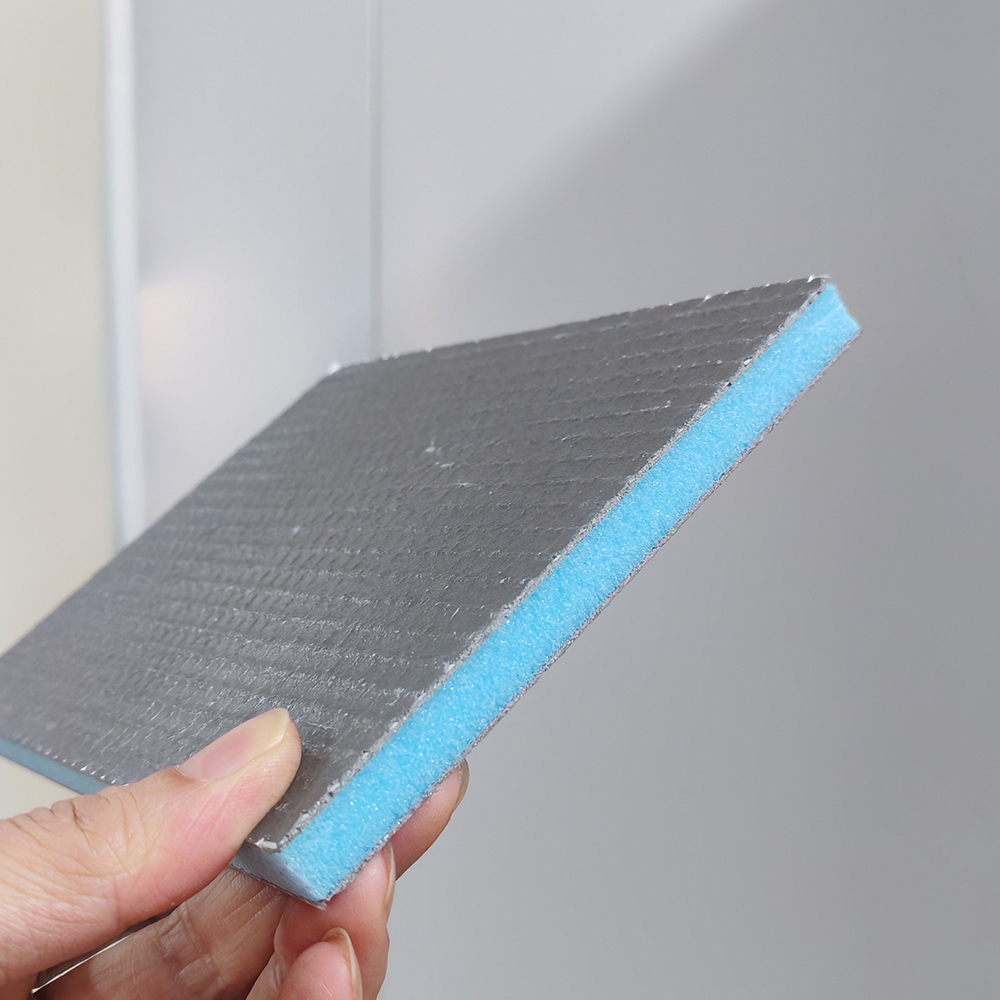
1. What Is XPS Foam Core?
XPS Foam Core, also known as Extruded Polystyrene Foam Core or XPS Rigid Foam Board, is a lightweight closed-cell foam material manufactured through an extrusion process. It is produced by melting polystyrene resin, mixing it with a blowing agent, and extruding the material into a continuous foam board.
During production, the material forms a relatively uniform closed-cell structure. This structure gives XPS foam its characteristic combination of low weight, thermal insulation, moisture resistance, and compressive strength.
XPS Foam Core is widely used in building insulation systems, insulated sandwich panels, tile backer boards, lightweight composite panels, and industrial insulation applications.
In composite panel manufacturing, XPS can serve as a lightweight core between two surface materials, such as fiberglass, FRP, aluminum, or other rigid sheets. The resulting sandwich structure can provide insulation and panel rigidity while reducing overall product weight.
However, XPS should not automatically be considered equivalent to structural PVC or PET foam. Its suitability for load-bearing composite structures must be confirmed through mechanical testing and finished-panel design.
2. Key Properties and Advantages of XPS Foam Core
2.1 Excellent Thermal Insulation Performance
Thermal insulation is one of the most important advantages of XPS foam.
Its closed-cell structure contains trapped gas, which reduces heat transfer through the material. This makes XPS suitable for applications requiring thermal insulation, including building envelopes, insulated roof panels, cold storage structures, and temperature-controlled equipment.
Typical thermal conductivity values for commercial XPS insulation boards are approximately 0.028–0.035 W/(m·K), depending on product grade, thickness, aging, and test conditions.
For manufacturers of insulated sandwich panels, selecting the correct XPS thickness and thermal conductivity is essential to achieving the required insulation performance.
2.2 Closed-Cell Structure and Moisture Resistance
XPS foam is characterized by a high proportion of closed cells. This structure limits water penetration and helps maintain insulation performance in humid environments.
Compared with materials that have more open cellular structures, XPS generally offers low water absorption and good resistance to moisture exposure.
This makes it suitable for:
- Building foundation insulation
- Roof and floor insulation
- Cold storage panels
- Wet-area tile backer boards
- Lightweight insulated composite panels
Actual water absorption varies by product grade and test method. Surface damage, cut edges, joints, and installation details can also affect the moisture performance of a finished panel.
2.3 High Compressive Strength
XPS Foam Core is available in different compressive strength grades.
Typical commercial products include grades with compressive strength ratings of 150 kPa, 200 kPa, 250 kPa, 300 kPa, 350 kPa, 400 kPa, and higher.
Higher-strength grades are often selected for applications exposed to greater compressive loads, such as floor insulation, foundation insulation, and certain panel structures.
For composite sandwich panels, compressive strength is only one selection factor. Shear strength, bonding performance, skin material, panel span, and loading conditions must also be evaluated.
2.4 Lightweight and Easy to Process
XPS foam boards have a relatively low density, making them easy to transport, handle, cut, and install.
Common processing methods include:
- Straight cutting
- CNC contour cutting
- Thickness calibration
- Grooving and slotting
- Edge shaping
- Surface preparation
- Lamination with FRP or other facing materials
These processing options allow manufacturers to produce customized foam components for insulation systems and composite panel production.
2.5 Dimensional Stability
Dimensional stability is important in applications where foam boards are bonded to surface materials or installed in large panel systems.
XPS products are designed to maintain their dimensions under specified temperature and humidity conditions. However, prolonged exposure to excessive temperatures, unsuitable adhesives, or incompatible chemicals can cause deformation or surface damage.
Manufacturers should confirm the maximum service temperature and adhesive compatibility before selecting XPS for a specific application.
3. XPS Foam Core Technical Specifications
XPS Foam Core is available in different density, compressive strength, and thickness configurations. The correct specification depends on whether the material is used for thermal insulation, lightweight panel production, or a specific composite application.
Typical XPS Foam Board Technical Parameters
| Property | Unit | Typical Reference Range |
|---|---|---|
| Material | – | Extruded Polystyrene (XPS) |
| Density | kg/m³ | Approximately 28–50 |
| Thickness | mm | 5–120, depending on product and manufacturing capability |
| Compressive Strength | kPa | 150–700+ |
| Thermal Conductivity | W/(m·K) | Approximately 0.028–0.035 |
| Water Absorption | % | Commonly low; often below 1% in specified immersion tests |
| Cell Structure | – | Closed-cell |
| Surface | – | Smooth or customized |
| Color | – | Blue, pink, green, yellow, white, or customized |
| Processing | – | Cutting, grooving, CNC machining, and lamination |
Note: These are indicative market ranges compiled from different commercial XPS product specifications. They are not guaranteed values for one product series. Density, thickness, compressive strength, thermal conductivity, and water absorption must be confirmed against the manufacturer’s technical data sheet and the applicable test standard.
Representative XPS Grade Comparison
| Grade | Density (kg/m³) | Compressive Strength (kPa) | Typical Application |
|---|---|---|---|
| XPS 150 | 28–30 | ≥150 | General insulation boards |
| XPS 200 | 28–31 | ≥200 | Floor and wall insulation |
| XPS 250 | 30–33 | ≥250 | Roof and foundation insulation |
| XPS 300 | 33–35 | ≥300 | Higher-load insulation applications |
| XPS 350 | 35–38 | ≥350 | High-compression insulation |
| XPS 400 | 38–41 | ≥400 | Heavy-duty insulation applications |
| XPS 500 | 44–47 | ≥500 | High-compressive-load applications |
The grade names and values above are representative examples from commercial XPS product data. They should not be interpreted as a universal grading system.
4. Main Applications of XPS Foam Core
4.1 Building Insulation and Construction
Construction is one of the largest application areas for XPS foam boards.
Its thermal insulation and moisture resistance make it suitable for building envelope systems and insulation applications.
Typical uses include:
- External wall insulation systems
- Roof insulation boards
- Floor insulation
- Foundation and basement insulation
- Cold storage insulation
- Thermal insulation sandwich panels
In these applications, XPS helps reduce heat transfer and improve the energy efficiency of buildings.
4.2 XPS Tile Backer Boards
XPS Tile Backer Board is a specialized product made from XPS foam with reinforced surface layers, often including fiberglass mesh and a cementitious or polymer-modified coating.
It is designed as a lightweight substrate for tile installation in bathrooms, kitchens, shower areas, and other wet environments.
Typical applications include:
- Bathroom wall panels
- Shower wall substrates
- Wet-room construction
- Kitchen wall systems
- Lightweight tile backing boards
The reinforced surface improves the board’s suitability for tile bonding and installation. The finished board’s waterproof performance depends on the complete system, including joints, corners, penetrations, and waterproofing details.
4.3 Insulated Sandwich Panels
XPS Foam Core can be laminated between different facing materials to produce insulated sandwich panels.
Common surface materials include:
- FRP fiberglass sheets
- Aluminum sheets
- Aluminum composite facings
- Cement boards
- Other rigid decorative or protective panels
Typical products include insulated wall panels, roof panels, lightweight partitions, and customized industrial panels.
For manufacturers, XPS provides a practical option when thermal insulation, moisture resistance, and low panel weight are important design requirements.
4.4 Transportation and Vehicle Body Panels
XPS can be considered for selected non-primary structural applications in transportation products where insulation and weight reduction are required.
Potential applications include:
- Refrigerated vehicle insulation panels
- Truck body insulation boards
- Trailer wall panels
- Lightweight partitions
- Interior insulation components
For vehicle body structures exposed to vibration, impact, and repeated mechanical loading, the complete sandwich panel must be tested for bonding strength, shear performance, fatigue, and service durability.
4.5 Industrial and Customized Composite Panels
XPS Foam Core can also be used in customized industrial panels and insulation components.
Examples include:
- Equipment insulation panels
- Lightweight protective boards
- Industrial enclosure panels
- Customized laminated foam boards
- Insulated covers and partitions
Its ease of cutting and machining makes it suitable for manufacturers requiring customized board dimensions and panel configurations.
5. XPS Foam Core Processing and Customization
Different processing methods can be used to prepare XPS foam boards for downstream manufacturing.
Plain XPS Foam Board: Flat foam sheets for insulation and general panel production.
Grooved XPS Foam Board: Machined grooves for selected bonding, shaping, or installation requirements.
CNC Cutting XPS Foam: Customized profiles, dimensions, and shapes for industrial applications.
Laminated XPS Panel: XPS foam bonded to FRP, aluminum, cement board, or other facing materials.
Customized Thickness and Density: Different grades can be selected according to insulation requirements, compressive loads, and final panel design.
For composite panel manufacturers, it is important to select adhesives compatible with polystyrene. Some solvent-based adhesives can damage or dissolve XPS foam. Adhesive compatibility should always be tested before mass production.
6. XPS Foam Core vs. EPS Foam Core vs. PVC Foam Core
XPS, EPS, and PVC foam are three different materials that may be considered for insulation or composite panel manufacturing. Their properties and application priorities are not the same.
| Comparison | XPS Foam Core | EPS Foam Core | PVC Foam Core |
|---|---|---|---|
| Full Name | Extruded Polystyrene | Expanded Polystyrene | Polyvinyl Chloride Foam |
| Manufacturing Process | Extrusion | Expansion and molding | Chemical foaming and molding |
| Cell Structure | Predominantly closed-cell | Bead-based cellular structure | Closed-cell structural foam |
| Thermal Insulation | Very good | Good | Depends on grade |
| Moisture Resistance | Generally very good | Depends on grade and construction | Depends on grade and surface condition |
| Compressive Performance | Available in multiple insulation grades | Depends on density and grade | Available in structural grades |
| Typical Applications | Building insulation, tile backer boards, insulated panels | Building insulation and packaging | Marine, wind energy, and structural composites |
XPS is often selected for insulation and moisture-resistant applications. EPS may be chosen for cost-sensitive insulation and packaging uses. PVC Foam Core is more commonly considered when structural composite performance and compatibility with advanced composite manufacturing are central requirements.
The best material depends on the final product, production process, and technical specifications.
7. How to Choose the Right XPS Foam Core
Before purchasing XPS Foam Core, manufacturers should evaluate the following factors:
- Density: Choose a density suitable for the intended application and required mechanical performance.
- Compressive Strength: Confirm the specified strength and the test method used to measure it.
- Thermal Conductivity: Select a suitable grade and thickness to meet the required insulation performance.
- Water Absorption: Review the test conditions and long-term moisture exposure requirements.
- Thickness and Dimensions: Confirm board thickness, width, length, and dimensional tolerances.
- Surface and Processing: Determine whether plain, grooved, laminated, or CNC-machined boards are required.
- Adhesive Compatibility: Check that the bonding adhesive does not attack polystyrene foam.
- Fire Performance: Confirm the relevant fire classification and local regulatory requirements. Standard XPS should not automatically be described as fireproof or fire-retardant.
For sandwich panel manufacturers, it is also important to test the complete panel rather than relying only on the foam board’s individual properties.
8. ONEBOND XPS Foam Core Solutions
ONEBOND focuses on composite core materials, foam core products, and customized lightweight panel solutions for international industrial customers.
Our XPS Foam Core product range can be developed for different insulation and composite panel requirements.
Potential customization options include:
- Different density and compressive strength grades
- Customized thickness and sheet dimensions
- Plain and machined surfaces
- CNC cutting and contour processing
- Customized foam board configurations
- XPS foam core for insulated sandwich panel production
Whether you are manufacturing XPS tile backer boards, FRP sandwich panels, insulated roof panels, or customized industrial boards, choosing the right foam specification is essential to achieving consistent product quality.
Contact ONEBOND to discuss your XPS Foam Core requirements and request product specifications for your application.
9. Frequently Asked Questions About XPS Foam Core
Q1: What is XPS Foam Core used for?
XPS Foam Core is mainly used for building insulation boards, roof and floor insulation, tile backer boards, insulated sandwich panels, cold storage structures, and selected lightweight industrial panels.
Q2: What is the difference between XPS Foam and EPS Foam?
XPS Foam is manufactured through an extrusion process and has a relatively uniform closed-cell structure. EPS Foam is produced by expanding and molding polystyrene beads. XPS generally offers lower water absorption and higher compressive performance in comparable insulation applications, although actual results depend on product grade.
Q3: What densities and thicknesses are available for XPS Foam Board?
Commercial XPS boards commonly have densities around 28–50 kg/m³, with higher-density options available from some manufacturers. Thickness options vary by product series and may include 5–120 mm or customized dimensions.
Q4: Is XPS Foam Core waterproof?
XPS has a closed-cell structure and generally low water absorption, making it suitable for moisture-resistant insulation applications. However, it should not be treated as a complete waterproofing system. Joints, cut edges, surface coatings, and installation details must also be considered.
Q5: Can XPS Foam Core be used in composite sandwich panels?
Yes. XPS can be laminated between FRP, aluminum, cement board, and other facing materials to produce lightweight insulated sandwich panels. The suitability of XPS for a specific structural application depends on compressive strength, shear performance, adhesive compatibility, and finished-panel testing.
Conclusion
XPS Foam Core is a versatile lightweight foam material with excellent thermal insulation characteristics, a closed-cell structure, moisture resistance, and a range of compressive strength grades.
Its established use in building insulation, tile backer boards, insulated sandwich panels, and industrial applications makes it an important material in the lightweight panel industry.
For manufacturers, the key is to select the appropriate density, compressive strength, thickness, and surface configuration according to the final product requirements.
With the right material specification and panel design, XPS Foam Core can provide an effective solution for insulation-focused and lightweight composite panel production.
