
Rigid polyurethane (PUR) and polyisocyanurate (PIR) foams have become essential materials in modern building construction, offering superior thermal insulation properties that contribute significantly to global energy efficiency goals. However, the imperative to reduce building energy consumption must be balanced against equally critical fire safety requirements. This article examines the technological, regulatory, and market developments shaping the use of polyurethane foam core materials in building applications. It analyzes advances in PIR chemistry, bio-based polyol systems, and flame retardant technologies that enable simultaneous achievement of thermal performance and fire resistance. The article also considers the evolving regulatory landscape following major fire incidents and the industry’s response through innovation in material science and system-level fire safety approaches. The evidence demonstrates that the future of building insulation lies in integrated solutions where energy efficiency and fire safety are not competing priorities but complementary design objectives.
Keywords: polyurethane foam; polyisocyanurate; building insulation; energy efficiency; fire safety; flame retardants; building regulations
1. Introduction
The building sector accounts for approximately 40% of global energy consumption and one-third of greenhouse gas emissions, making building energy efficiency a critical component of climate change mitigation strategies worldwide (International Energy Agency, 2023). Thermal insulation materials play a fundamental role in reducing heating and cooling demands, with polyurethane foams offering exceptional performance due to their low thermal conductivity, typically ranging from 0.020 to 0.025 W/(m·K).
However, the pursuit of energy efficiency through improved insulation must not compromise building fire safety. Major fire incidents involving insulated facade systems, most notably the 2017 Grenfell Tower tragedy in London which claimed 72 lives, have exposed the catastrophic consequences of inadequate fire safety considerations in building design and material selection (Moore-Bick, 2019). This disaster catalyzed fundamental reforms in building regulations across Europe and beyond, fundamentally altering the landscape for insulation materials.
This article examines how the polyurethane industry is responding to the dual imperatives of energy efficiency and fire safety through technological innovation, regulatory compliance, and systems-level approaches to building performance.
2. The Technical Foundation: Polyurethane Foam as Insulation Material
2.1 Structure and Properties
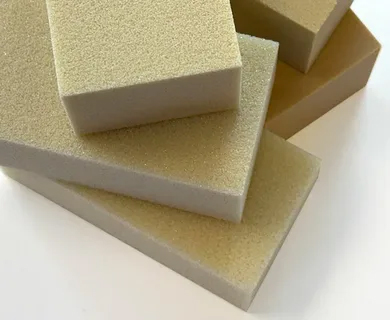
Rigid polyurethane foams are cellular materials formed by the reaction of polyols and isocyanates in the presence of blowing agents, catalysts, and surfactants. The resulting structure consists of a polymer matrix enclosing gas-filled cells, where the low thermal conductivity of the blowing agent (historically CFCs, now replaced by hydrocarbons, HFOs, or water/CO₂ systems) combined with the small cell size creates exceptional insulating properties (Randall & Lee, 2002).
The thermal conductivity of polyurethane foam depends on three components: conduction through the solid polymer, conduction through the cell gas, and radiative heat transfer across cell walls. Optimization of cell morphology—achieving fine, uniform, closed cells—minimizes solid conduction while maintaining structural integrity. Modern foam formulations achieve thermal conductivity values as low as 0.020 W/(m·K), enabling significant energy savings with minimal insulation thickness (ASHRAE, 2021).
2.2 Polyisocyanurate (PIR) Technology
A significant evolution in polyurethane foam technology is the development of polyisocyanurate (PIR) foams, which incorporate higher isocyanate indices (typically 250-350 compared to 100-120 for conventional PUR foams). The excess isocyanate promotes the formation of thermally stable isocyanurate rings through cyclotrimerization reactions (Modesti & Lorenzetti, 2001).
These isocyanurate structures exhibit substantially greater thermal stability than urethane linkages, with decomposition temperatures shifted approximately 55°C higher than conventional polyurethane. During fire exposure, PIR foams form a rigid, insulating char layer that suppresses mass transport and retards further degradation. Quantitative studies demonstrate that optimized PIR formulations achieve char yields exceeding 22% by weight, compared to approximately 3% for conventional PUR foams (Dick et al., 2020).
The fire performance advantages are quantifiable through standard testing methods. Cone calorimeter measurements show that PIR foams achieve approximately 50% reduction in peak heat release rate compared with equivalent PUR formulations, indicating significantly lower fire intensity and slower fire propagation (Lorenzetti et al., 2011).
3. The Regulatory Framework: Driving Performance Standards
3.1 Energy Efficiency Requirements
Building energy codes worldwide have progressively tightened insulation requirements in response to climate commitments. The European Union’s Energy Performance of Buildings Directive (EPBD) requires member states to establish minimum energy performance standards and promotes nearly zero-energy building (NZEB) construction (European Parliament, 2018). Similarly, China’s building energy efficiency standards, including the recent GB/T 21558 update scheduled for July 2026, establish increasingly stringent thermal performance requirements for insulation materials.
The GB/T 21558 standard introduces eight thermal conductivity grades ranging from 020级 (0.020 W/(m·K)) to 040级, incentivizing development of ultra-low thermal conductivity materials that minimize insulation thickness while maximizing energy savings. This grading system enables designers to select materials appropriate for specific applications while providing clear performance benchmarks for manufacturers (SAC, 2025).
3.2 Fire Safety Classification
The European harmonized fire classification system, established under EN 13501-1 and enforced through the Construction Products Regulation (CPR 305/2011), provides a rigorous framework for evaluating material fire performance. Construction products are classified into Euro classes A1 through F based on ignitability, heat release rate, smoke production (s1, s2, s3), and flaming droplet formation (d0, d1, d2) (CEN, 2018).
Polyurethane insulation materials typically achieve classifications between B and E depending on formulation and the presence of flame retardants. The thermosetting nature of polyurethane foam inherently prevents flaming droplets, resulting in favorable d0 classification. However, the smoke production classification (s1, s2, or s3) depends significantly on flame retardant selection and foam chemistry (EFRA, 2021).
The CPR requires manufacturers to provide Declarations of Performance and CE marking, requiring comprehensive testing that accounts for real-world installation conditions through standards like EN 15715. This systems-level approach recognizes that material performance in isolation may not reflect behavior in complete building assemblies (Efectis, 2025).
3.3 Post-Grenfell Regulatory Evolution
The Grenfell Tower inquiry has fundamentally altered the regulatory landscape for insulation materials in building envelopes. The UK’s Building Safety Act 2022 established more rigorous oversight of building work, particularly for higher-risk buildings, and introduced clearer accountability for fire safety throughout the building lifecycle (HM Government, 2022).
Across Europe, heightened scrutiny of facade assemblies has led to more demanding testing requirements, including large-scale tests such as BS 8414 or LEPIR 2 that evaluate complete wall systems under realistic fire exposure conditions. These tests have revealed that material interactions within assemblies can significantly influence fire behavior, emphasizing the importance of system-level rather than component-level fire safety assessment (Bonner & Rein, 2020).
4. Material Innovation: Achieving Dual Objectives
4.1 Bio-Based Polyol Development
The development of bio-based polyurethane foams addresses both sustainability objectives and, in some formulations, fire performance enhancement. A significant study published in the Journal of Cleaner Production (December 2025) demonstrated that maltodextrin/glycerol-based biopolyols can achieve 60% sustainable substitution in rigid polyurethane foam formulations while improving mechanical properties.
At this optimal substitution ratio, the resulting foam achieved compressive strength of 0.96 MPa—241% higher than petroleum-based foam—while maintaining thermal conductivity of 0.0538 W/(m·K) (Feng et al., 2025). This remarkable improvement demonstrates that bio-based substitution can enhance material capabilities while reducing environmental footprint.
Maltodextrin, derived from renewable starch sources, provides abundant hydroxyl sites for cross-linking reactions, while glycerol from biodiesel production offers environmental advantages without competing with food supply chains. The resulting three-dimensional network structure contributes to both mechanical integrity and thermal stability (Feng et al., 2025).
4.2 Advanced Flame Retardant Systems
The transition from traditional halogenated flame retardants toward more environmentally sustainable alternatives represents a major trend in polyurethane foam development. Phosphorus-based flame retardants have emerged as the preferred alternative, operating through dual mechanisms in condensed and gas phases during combustion (EFRA, 2023).
Dimethyl methylphosphonate (DMMP), with approximately 25% phosphorus content by mass, provides effective flame retardancy with minimal toxic gas emissions. Research demonstrates that DMMP concentrations of 2-8 wt% can reduce polyurethane foam burning times by up to 83% and achieve limiting oxygen index (LOI) values exceeding 30% (Wang et al., 2022).
Synergistic combinations of flame retardants have demonstrated performance exceeding that of individual components. A tri-phase system incorporating melamine-derived polyol, expandable graphite, and MoS₂-Cu₂O nanohybrids achieved peak heat release rate reduction of 76.9%, total heat release reduction of 64%, and total smoke production reduction of 82% compared with pristine foam (Zhang et al., 2024). This dramatic improvement is attributed to combined catalytic charring effects and formation of thermally stable protective layers.
The development of reactive flame retardants represents a significant advancement, with compounds that chemically bond into the polymer matrix eliminating migration potential while maintaining compatibility with existing manufacturing processes. ICL’s December 2024 launch of VeriQuel® R100, a patented reactive phosphorus flame retardant for rigid polyurethane and polyisocyanurate insulation applications, exemplifies this approach (ICL, 2024).
4.3 Recycled Material Integration
Integration of recycled materials addresses circular economy objectives while potentially contributing to fire performance. Research demonstrates that recycled poly(ethylene terephthalate) (PET)-based polyester polyols in PIR foam formulations contribute to enhanced thermal stability, with materials exhibiting superior thermo-oxidative resistance compared with conventional polyurethane (MDPI, 2026).
The aromatic structure of PET-derived polyols provides inherent thermal stability that complements the isocyanurate network of PIR foams. This approach addresses multiple sustainability objectives simultaneously: diverting post-consumer plastic from landfills, reducing carbon footprint, and maintaining—in some cases improving—fire performance characteristics essential for building applications (MDPI, 2026).
5. Systems-Level Approaches to Building Performance
5.1 Understanding Facade System Behavior
Research on medium-scale ventilated facade experiments has characterized upward flame spread dynamics in assemblies comprising insulation foam and cladding materials. Studies demonstrate that insulation foams drive early fire growth, with cavity width significantly influencing flame spread behavior (Bonner & Rein, 2020).
A quantified fire growth parameter (γ) has been proposed to characterize flame spread behavior, with γ < 0.005 indicating unsustained spread and values between 0.005 and 0.018 signifying sustained spread over linings. This framework enables reliable interpretation of material interactions within cavity spaces, supporting development of improved fire safety standards (Wang et al., 2025).
These findings emphasize that fire safety cannot be ensured through material selection alone but requires comprehensive consideration of system design, including cavity barriers, fire-stopping details, and overall assembly configuration. The interaction between insulation material, cladding, and cavity geometry fundamentally influences fire behavior in ways that component-level testing cannot predict (Bonner & Rein, 2020).
5.2 Commercial Implementation
Industry leaders are translating advances in material science into commercially available products that meet both energy efficiency and fire safety requirements. BASF’s Elastopir® polyurethane rigid foam system, based on PIR chemistry, achieves 20% better energy efficiency than traditional organic insulation and over 30% better efficiency than inorganic alternatives while meeting stringent global and regional fire standards (BASF, 2021).
In spray foam applications, comprehensive fire testing credentials enable code compliance across diverse building types. BASF’s SPF portfolio provides NFPA 285-compliant assemblies with various cladding options, achieving up to R-40 continuous exterior insulation performance combined with weather barrier resistance (BASF SPF, 2024).
6. Future Directions and Challenges
6.1 Harmonization of Standards
The diversity of national and regional regulatory frameworks presents challenges for manufacturers operating in global markets. Differences in fire testing methods, classification systems, and acceptance criteria complicate product development and market access. Greater harmonization of standards, particularly for large-scale facade testing, would facilitate innovation and ensure consistent safety levels across jurisdictions (EFRA, 2023).
6.2 Next-Generation Insulation Materials
Research continues on insulation materials that could exceed current polyurethane foam performance. Aerogels, vacuum insulation panels, and gas-filled panels offer theoretical thermal conductivities below 0.010 W/(m·K) but face challenges in cost, durability, and practical installation (Koebel et al., 2021). Polyurethane foams incorporating aerogel particles or optimized cell structures may bridge the gap between conventional performance and ultra-insulation.
6.3 Digital Design and Performance Prediction
Machine learning approaches to foam formulation and fire performance prediction offer potential to accelerate development of optimized materials. AI frameworks capable of predicting relationships between formulation parameters, foam morphology, and fire performance could reduce experimental requirements while identifying novel combinations of properties (Chen et al., 2023).
6.4 Circular Economy Integration
As building life-cycle assessment gains prominence, end-of-life considerations for insulation materials become increasingly important. Development of polyurethane foams designed for recyclability, including those based on reversible chemistry or designed for chemical recycling, will be essential for achieving circular economy objectives without compromising in-service performance (Schlummer et al., 2022).
7. Conclusion
The polyurethane foam industry has demonstrated remarkable capacity for innovation in response to the dual imperatives of building energy efficiency and fire safety. Advances in PIR chemistry provide the molecular foundation for enhanced fire resistance while maintaining—and in some cases improving—thermal insulation performance. Bio-based polyol systems demonstrate that sustainability need not compromise material capabilities, with improved mechanical properties achievable alongside reduced environmental footprint. Advanced flame retardant technologies, particularly synergistic multi-phase systems and reactive flame retardants, offer pathways to formulations that reduce fire hazard without the environmental concerns associated with traditional halogenated compounds.
The evolution of regulatory frameworks following major fire incidents has appropriately shifted focus from component-level to system-level fire safety assessment, recognizing that material interactions within complete building assemblies fundamentally influence fire behavior. Industry response through product innovation and systems-level solutions demonstrates commitment to occupant safety while supporting global energy efficiency goals.
The evidence presented in this article supports the conclusion that energy efficiency and fire safety are not competing priorities requiring compromise, but complementary design objectives achievable through integrated material and system development. As building performance requirements continue to tighten and regulatory scrutiny intensifies, the polyurethane industry is well-positioned to provide solutions that excel in both domains, contributing to safer, more sustainable built environments.
References
ASHRAE. (2021). ASHRAE Handbook—Fundamentals. American Society of Heating, Refrigerating and Air-Conditioning Engineers.
BASF. (2021). Journeying toward net zero with PU laminated boards. BASF Corporation.
BASF SPF. (2024). BASF spray foams provide extensive credentials for building code compliance. BASF Spray Polyurethane Foam.
Bonner, M., & Rein, G. (2020). Flammability and multi-objective performance of building facades: Towards optimum selection. Journal of Building Engineering, 32, 101757.
CEN. (2018). EN 13501-1:2018 Fire classification of construction products and building elements – Part 1: Classification using data from reaction to fire tests. European Committee for Standardization.
Chen, Y., et al. (2023). Machine learning for flame-retardant polymer design. Advanced Intelligent Systems, 5(8), 2300124.
Dick, C., et al. (2020). Thermal stability and fire performance of polyisocyanurate foams. Polymer Degradation and Stability, 181, 109327.
Efectis. (2025). Performance, reliability and conformity of thermal insulation products: The technical framework of European standards. Efectis UK.
EFRA. (2021). Fire safety of polyurethane foam in construction applications. European Flame Retardants Association.
EFRA. (2023). Flame retardants for polyurethane foam: Technology and regulation. European Flame Retardants Association.
European Parliament. (2018). Directive (EU) 2018/844 of the European Parliament and of the Council of 30 May 2018 amending Directive 2010/31/EU on the energy performance of buildings. Official Journal of the European Union.
Feng, H., Hu, Y., Wang, J., Chen, H., Jiang, S., & Han, X. (2025). Rigid dextrin-based polyurethane foam for sustainable, high-performance building applications. Journal of Cleaner Production, 537, 147212.
HM Government. (2022). Building Safety Act 2022. UK Public General Acts.
ICL. (2024). ICL launches VeriQuel® R100 reactive flame retardant for polyurethane insulation. ICL Group Press Release.
International Energy Agency. (2023). Tracking Clean Energy Progress 2023. IEA Publications.
Koebel, M., et al. (2021). Aerogel-based thermal insulation. Journal of Physics D: Applied Physics, 54(37), 373001.
Lorenzetti, A., et al. (2011). Fire performance of polyisocyanurate foams. Polymer Degradation and Stability, 96(8), 1455-1461.
MDPI. (2026). Comparative thermal and fire behavior of rigid polyurethane (PUR) and polyisocyanurate (PIR) foams formulated with recycled poly(ethylene terephthalate) (PET) polyols—Part 1. Materials, 19(3), 525.
Modesti, M., & Lorenzetti, A. (2001). Thermal and fire behavior of polyisocyanurate foams. Polymer Degradation and Stability, 74(3), 475-479.
Moore-Bick, M. (2019). Grenfell Tower Inquiry: Phase 1 Report. UK Government.
Randall, D., & Lee, S. (2002). The Polyurethanes Book. John Wiley & Sons.
SAC. (2025). GB/T 21558-2025 Rigid polyurethane foam for building insulation. Standardization Administration of China.
Schlummer, M., et al. (2022). Chemical recycling of polyurethane foams: A review. Waste Management, 144, 127-142.
Wang, J., et al. (2022). Phosphorus-based flame retardants for polyurethane foams. Polymer Reviews, 62(3), 482-513.
Wang, Y., et al. (2025). Upward flame spread behaviour of cladding materials on a medium-scale ventilated façade. Construction and Building Materials, 478, 141047.
Zhang, L., et al. (2024). Tri-phase flame retardant system towards advanced energy-saving building materials with highly efficient fire and smoke toxicity reductions. Construction and Building Materials, 412, 134821.
