
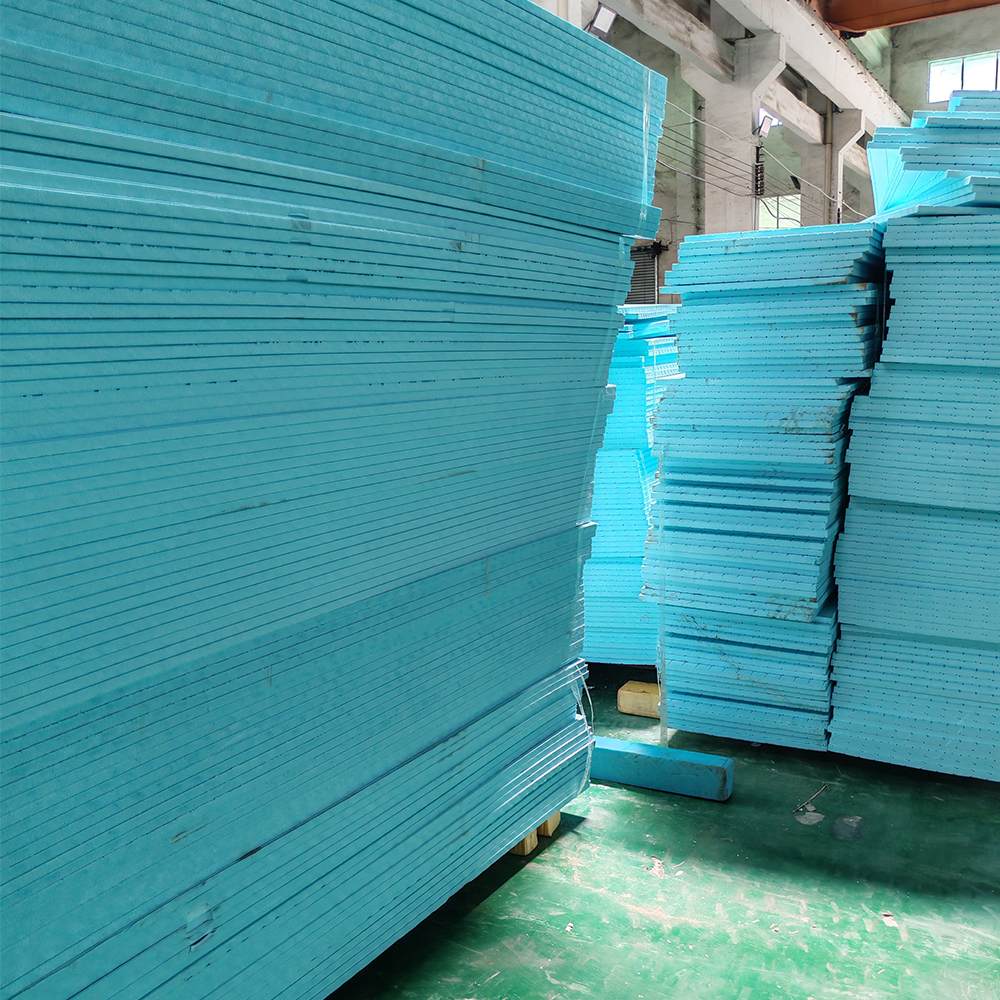
XPS foam board insulation is a rigid thermal insulation system based on extruded polystyrene foam. It is used to reduce heat transfer through walls, roofs, floors, foundations, and other parts of a building envelope. Because XPS combines thermal insulation with relatively high compressive strength and low water absorption, it is frequently considered for applications where a rigid board is more practical than flexible or fibrous insulation.
The fundamental purpose of insulation is to increase the thermal resistance of a building assembly. In hot Middle Eastern climates, the direction of heat flow is often from the hot exterior toward the cooler interior during periods when air conditioning is operating. Without adequate insulation, roofs and external walls can transfer significant amounts of heat into the building. XPS foam board insulation creates a thermal resistance layer that reduces this heat transfer.
This is especially relevant in Saudi Arabia, the United Arab Emirates, Qatar, Kuwait, Oman, and Bahrain, where cooling systems are an important part of building operation. Nevertheless, insulation performance should always be evaluated as part of the complete building envelope. Roof construction, wall composition, windows, doors, air leakage, thermal bridges, solar exposure, HVAC design, and installation quality can all influence actual energy performance.
One major advantage of XPS foam board insulation is its closed-cell structure. This structure helps limit water absorption compared with many insulation materials. This can be important for foundation insulation, floor systems, and certain roof assemblies where moisture exposure is possible. However, proper waterproofing and drainage remain necessary because insulation boards alone are not intended to replace a dedicated waterproofing membrane.
The thickness of XPS foam board insulation should be selected according to the project’s required thermal performance. Common thicknesses include 25 mm, 30 mm, 40 mm, 50 mm, and 100 mm, while other thicknesses can also be produced. A thicker board normally increases thermal resistance, but the final specification should be based on thermal calculations and applicable building requirements.
Compressive strength is particularly important for floor and roof applications. If the insulation is placed beneath a screed, flooring system, or roof layer, it may be exposed to dead loads and imposed loads. Selecting an XPS grade with insufficient compressive performance can result in deformation. For this reason, professional specifications should state a required compressive strength rather than simply requesting “XPS insulation board.”
Installation details also affect performance. Boards should be installed with properly managed joints and should be protected from conditions that could damage the material. Mechanical fasteners, adhesives, membranes, coverings, and other adjacent materials must be chemically compatible with XPS. Exposure to certain solvents or incompatible chemicals can damage polystyrene foam.
For B2B buyers, the most useful supplier documentation includes thermal conductivity, density, compressive strength, water absorption, dimensional stability, thickness tolerance, board dimensions, and fire classification or test information where required. Project buyers should also verify whether the supplier can maintain consistent quality for repeated container-scale orders.
Therefore, XPS foam board insulation is not simply a commodity foam sheet. It is a building-envelope component whose performance depends on material properties, thickness, assembly design, installation, and environmental conditions. For Middle Eastern projects, a technically specified XPS system can provide an effective approach to managing heat transfer when properly designed and installed.
