
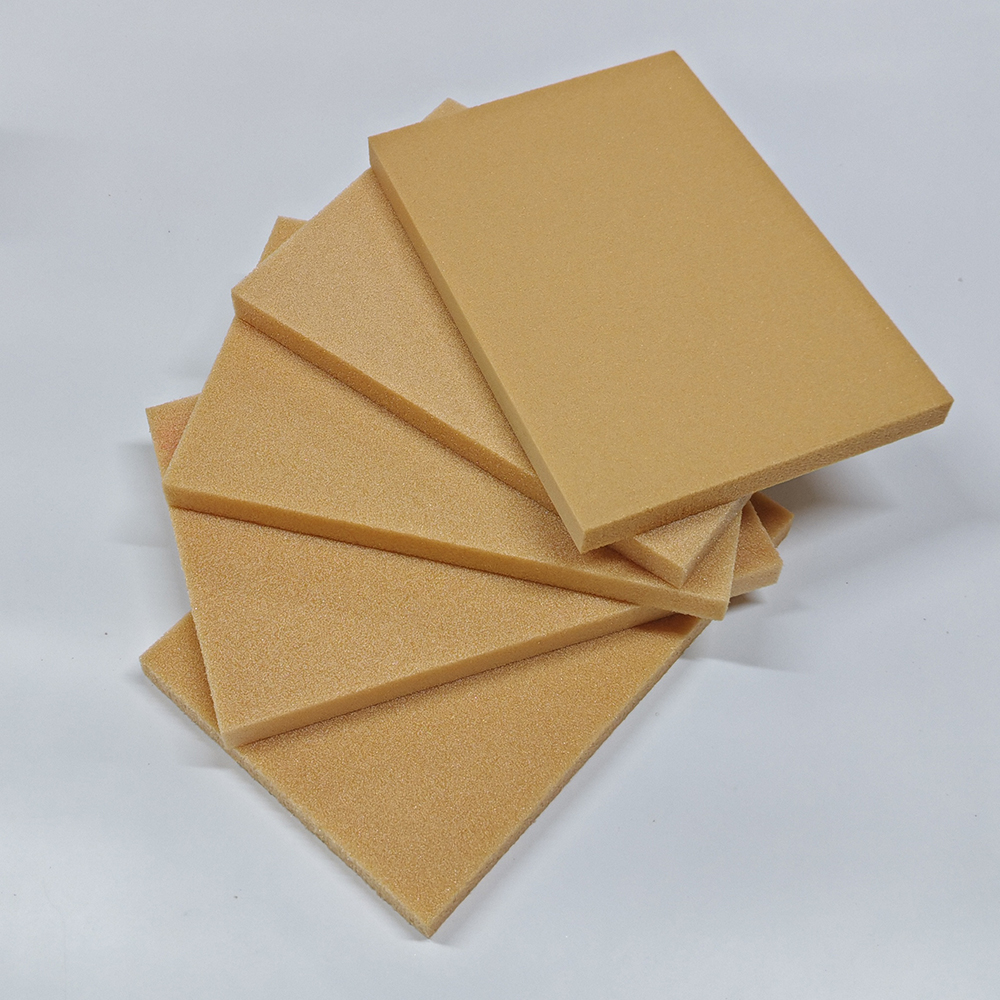
1. What Is PVC Foam Core?
PVC Foam Core, also known as PVC Structural Foam Core or Cross-Linked PVC Foam Core, is a lightweight structural material widely used in composite sandwich panel manufacturing. It is typically placed between two outer skin layers, such as fiberglass, carbon fiber, or aluminum, to create a lightweight structure with high stiffness and good mechanical performance.
PVC structural foam is generally manufactured from polyvinyl chloride-based formulations through a controlled foaming process. Cross-linked PVC foam features a cellular polymer structure designed to provide mechanical stability, compressive strength, and shear resistance.
Unlike conventional insulation foam, structural PVC foam is specifically developed for composite engineering applications where mechanical properties and bonding performance are important.
Its main characteristics include:
- Lightweight closed-cell structure
- Good compressive and shear strength
- Relatively low water absorption
- Good dimensional stability
- Compatibility with different resin systems
- Flexible machining and customization options
PVC foam core is widely used in marine engineering, wind turbine blades, transportation, construction, and industrial composite manufacturing.
2. Key Properties and Advantages of PVC Structural Foam Core
2.1 High Strength-to-Weight Ratio
One of the main advantages of PVC structural foam is its favorable strength-to-weight ratio.
In a sandwich structure, the outer skins carry most of the tensile and compressive stresses during bending, while the core maintains the distance between the skins and transfers shear loads.
This structure increases bending stiffness without requiring a heavy solid material throughout the panel.
It is particularly useful in boat hulls, wind turbine blades, and large FRP sandwich panels where reducing structural weight is important.
2.2 Excellent Compressive and Shear Properties
Compressive strength measures the ability of PVC foam core to withstand loads perpendicular to its surface. Shear strength measures its ability to resist internal sliding deformation.
Both properties are important when designing composite sandwich structures.
PVC foam core is available in different density grades, allowing manufacturers to select suitable mechanical properties for specific applications.
Higher-density materials generally provide higher compressive and shear strength, although actual performance depends on the formulation and manufacturing process.
2.3 Closed-Cell Structure and Moisture Resistance
PVC structural foam features a closed-cell structure that helps limit water absorption.
This characteristic makes it suitable for marine environments, boat building, and outdoor composite applications.
However, the complete sandwich structure must also consider skin integrity, adhesive bonding, edge sealing, and water ingress through joints or damaged surfaces.
2.4 Good Processing Compatibility
PVC foam core can be processed using various composite manufacturing techniques, including:
- Vacuum Infusion
- Vacuum Bagging
- Hand Lay-Up
- Resin Transfer Molding (RTM)
- CNC Cutting
- Contour Machining
Different surface treatments can also be provided to improve resin flow and manufacturing efficiency.
2.5 Customizable Density and Thickness
Different applications require different core densities and thicknesses.
For example, marine manufacturers may select 60 kg/m³ or 80 kg/m³ PVC foam for lightweight structures, while wind energy and industrial applications may require higher-density grades depending on structural loading.
Customized dimensions and machining options help manufacturers optimize their composite panel designs.
3. PVC Foam Core Technical Specifications
PVC Foam Core is available in various density grades, commonly including 45, 60, 80, 100, 130, and 200 kg/m³.
The following table presents representative industry reference values for different structural PVC foam grades.
Typical PVC Foam Core Technical Data
| Parameters | P45 | P60 | P80 | P100 | P130 | P200 |
|---|---|---|---|---|---|---|
| Density (kg/m³) | 48 | 60 | 80 | 100 | 130 | 200 |
| Compressive Strength (MPa) | 0.65 | 0.85 | 1.35 | 2.21 | 3.02 | 4.81 |
| Compressive Modulus (MPa) | 52 | 71 | 92 | 136 | 172 | 242 |
| Tensile Strength (MPa) | 1.42 | 1.61 | 2.21 | 3.52 | 4.78 | 7.15 |
| Shear Strength (MPa) | 0.55 | 0.70 | 1.11 | 1.63 | 2.19 | 3.52 |
| Shear Modulus (MPa) | 16 | 22 | 31 | 36 | 51 | 86 |
| Water Absorption (%) | 1.9 | 1.8 | 1.6 | 1.5 | 1.4 | 1.2 |
Note: These are representative values from an industry PVC foam core technical data sheet, not guaranteed ONEBOND specifications. Test methods, specimen conditions, and product formulations can affect results. Buyers should request the actual technical data sheet for the selected grade.
Available Product Specifications
| Specification | Typical Options |
|---|---|
| Material | Cross-Linked PVC Foam |
| Density | 45–250 kg/m³ |
| Thickness | 3–120 mm, subject to grade and production capability |
| Color | White, yellow, green, gray and customized |
| Structure | Closed Cell |
| Surface | Plain, Grooved, Perforated, Scrim-Faced |
| Processing | CNC Cutting, Grooving, Perforation |
| Shape | Flat Sheet, Customized Contour |
| Application | Marine, Wind Energy, Transportation, Construction |
| Customization | OEM and Custom Manufacturing |
The available thickness, sheet dimensions, colors, and machining options should be confirmed according to the selected density grade and manufacturing requirements.
4. Main Applications of PVC Foam Core
4.1 Marine and Boat Building
Marine engineering is one of the most established applications for PVC foam core.
Boat hulls, yacht decks, bulkheads, and marine interior panels frequently use fiberglass sandwich structures with structural foam cores.
PVC foam provides lightweight construction, moisture resistance, and mechanical support.
Typical applications include:
- Fiberglass Boat Hulls
- Yacht Deck Sandwich Panels
- Marine Bulkhead Panels
- FRP Boat Building
- Composite Ship Interior Panels
- Marine Equipment Structures
For boat builders, selecting the correct PVC foam density, thickness, and surface treatment is important for achieving the required structural performance.
4.2 Wind Turbine Blade Manufacturing
Wind turbine blades require lightweight materials with good shear strength, compressive performance, and fatigue resistance.
PVC foam core can be used in selected blade sections and structural components.
Typical applications include:
- Wind Turbine Blade Core
- Composite Blade Sandwich Structures
- Wind Energy Structural Components
- Fiberglass Reinforced Blade Panels
The selection of foam density and grade depends on the blade design, loading conditions, resin system, and manufacturing process.
4.3 Automotive and Transportation
Lightweight composite materials help reduce vehicle weight and improve transportation efficiency.
PVC foam core can be incorporated into fiberglass sandwich panels and selected industrial vehicle components.
Typical applications include:
- Truck Body Composite Panels
- Recreational Vehicle Panels
- Trailer Sandwich Structures
- Bus Interior Components
- Railway Composite Panels
4.4 Industrial Composite Manufacturing
PVC foam core is also used in industrial equipment enclosures, machinery covers, structural panels, and customized FRP products.
Its combination of lightweight construction, machinability, and mechanical properties makes it suitable for different industrial composite designs.
5. PVC Foam Core Surface Treatments and Processing Options
Different composite manufacturing processes require different foam core surface structures.
Professional PVC foam core manufacturers can provide customized machining services.
Plain PVC Foam Core
Plain foam sheets are suitable for applications where resin distribution is managed through other infusion materials or bonding processes.
Grooved PVC Foam Core
Grooved foam features machined channels on one or both surfaces.
These channels help distribute resin and remove trapped air during vacuum infusion.
Perforated PVC Foam Core
Perforated foam contains regularly distributed holes that allow resin and air to move through the core.
It is commonly used in vacuum infusion and VARTM processes.
Double-Sided Grooved PVC Foam Core
Both surfaces are machined with grooves to support resin distribution and bonding in sandwich constructions.
CNC Contour Cutting
CNC machining allows foam core sheets to be converted into customized shapes for curved hulls, blade sections, and complex composite structures.
These processing options can help improve manufacturing efficiency and reduce manual preparation work.
6. PVC Foam Core vs PET Foam Core
PVC Foam Core and PET Foam Core are two important structural foam materials in composite manufacturing.
Although both are used in sandwich structures, their material chemistry, mechanical properties, processing characteristics, and cost structures differ.
| Comparison | PVC Foam Core | PET Foam Core |
|---|---|---|
| Material | Polyvinyl Chloride | Polyethylene Terephthalate |
| Structure | Closed Cell | Closed Cell |
| Mechanical Performance | Grade-dependent structural properties | Grade-dependent structural properties |
| Moisture Resistance | Generally good | Generally good |
| Recyclability | More challenging | Recyclable thermoplastic material |
| Typical Applications | Marine, wind energy | Wind energy, transportation |
| Processing | Infusion, bonding, machining | Infusion, bonding, machining |
PVC foam core is a mature choice for many marine and structural composite applications. PET foam core is increasingly attractive for manufacturers seeking thermoplastic and recyclable material solutions.
The final selection should be based on actual mechanical data, manufacturing compatibility, and total production cost rather than material name alone.
7. How to Choose the Right PVC Foam Core?
Selecting the correct PVC foam core requires evaluating several technical factors.
Density: Determine the required balance between structural performance and weight.
Thickness: Choose the appropriate thickness according to panel design, bending stiffness, and available installation space.
Compressive Strength: Check whether the foam can withstand the expected compressive loading.
Shear Strength: Evaluate the shear requirements of the sandwich structure.
Water Absorption: Consider the operating environment, especially for marine and outdoor applications.
Processing Method: Confirm compatibility with vacuum infusion, hand lay-up, RTM, or other manufacturing processes.
Surface Treatment: Select plain, grooved, perforated, or customized foam according to resin flow and bonding requirements.
Buyers should request technical data sheets, samples, and processing recommendations before finalizing large-volume orders.
8. Customized PVC Foam Core Manufacturing by ONEBOND
ONEBOND specializes in composite core materials and lightweight structural materials for international industrial customers.
Our product portfolio includes PVC Foam Core, PET Foam Core, XPS Foam Core, PU Foam Core, PMI Foam Core, and PP Honeycomb Core.
We understand that different composite manufacturers require different material specifications and processing solutions.
Our customization options include:
- Density from different structural grades
- Customized thickness and sheet dimensions
- Plain and grooved surfaces
- Single-sided and double-sided grooving
- Perforated foam core
- CNC contour cutting
- Customized machining and packaging
Our products are designed for applications in marine engineering, wind energy, transportation, construction, and industrial composite manufacturing.
Whether you are producing fiberglass boat panels, wind turbine blade structures, truck body sandwich panels, or industrial FRP components, ONEBOND can help you identify suitable PVC foam core specifications.
9. Frequently Asked Questions About PVC Foam Core
Q1: What is PVC Foam Core used for?
PVC Foam Core is mainly used in composite sandwich structures, including boat hulls, yacht decks, wind turbine blades, FRP panels, transportation components, and industrial composite products.
Q2: What is the difference between PVC Foam Core and ordinary PVC Foam Board?
PVC Structural Foam Core is engineered for composite sandwich applications and has specific mechanical requirements, including compressive strength and shear strength. Ordinary PVC foam boards are often designed for decoration, advertising, or general-purpose fabrication.
Q3: What PVC Foam Core density is suitable for boat building?
Common options include 60 kg/m³, 80 kg/m³, 100 kg/m³, and higher-density grades. The correct density depends on hull design, loading conditions, laminate structure, and manufacturing requirements.
Q4: Can PVC Foam Core be used for vacuum infusion?
Yes. Suitable structural PVC foam grades can be used in vacuum infusion and VARTM processes. Grooved and perforated surfaces help distribute resin and remove trapped air during manufacturing.
Q5: Can PVC Foam Core be customized in thickness, density, and surface treatment?
Yes. PVC foam core can be supplied in different densities, thicknesses, sheet sizes, and surface configurations, including plain, grooved, perforated, and CNC-machined options, subject to manufacturing capability.
10. Conclusion
PVC Foam Core is an important structural material in modern composite manufacturing. Its lightweight closed-cell structure, mechanical properties, moisture resistance, and processing flexibility make it suitable for a wide range of sandwich panel applications.
From marine engineering and wind turbine blades to transportation and industrial composite structures, PVC structural foam provides manufacturers with flexible material solutions for lightweight construction.
As an experienced composite core material manufacturer, ONEBOND is committed to providing PVC Foam Core, PET Foam Core, XPS Foam Core, and other structural core materials for global composite manufacturers.
Looking for a reliable PVC Foam Core manufacturer in China? Contact ONEBOND to request technical specifications, product samples, and customized quotations for your composite manufacturing projects.
